CMR Surgical’s Series D deck is a sophisticated example of how a late-stage hardware company transitions its narrative from 'product' to 'platform.' By 2021, the company had already achieved significant milestones, allowing them to focus on the broader digital ecosystem rather than just the mechanics of the Versius robot. The deck emphasizes a 20.4% CAGR for robotic procedures through 2030, positioning CMR as the primary challenger to a market 'dominated by one player.' The inclusion of a dedicated 'Culture' slide and a deep dive into the 'Versius Connect' app signals a shift toward long-term…
Key takeaways
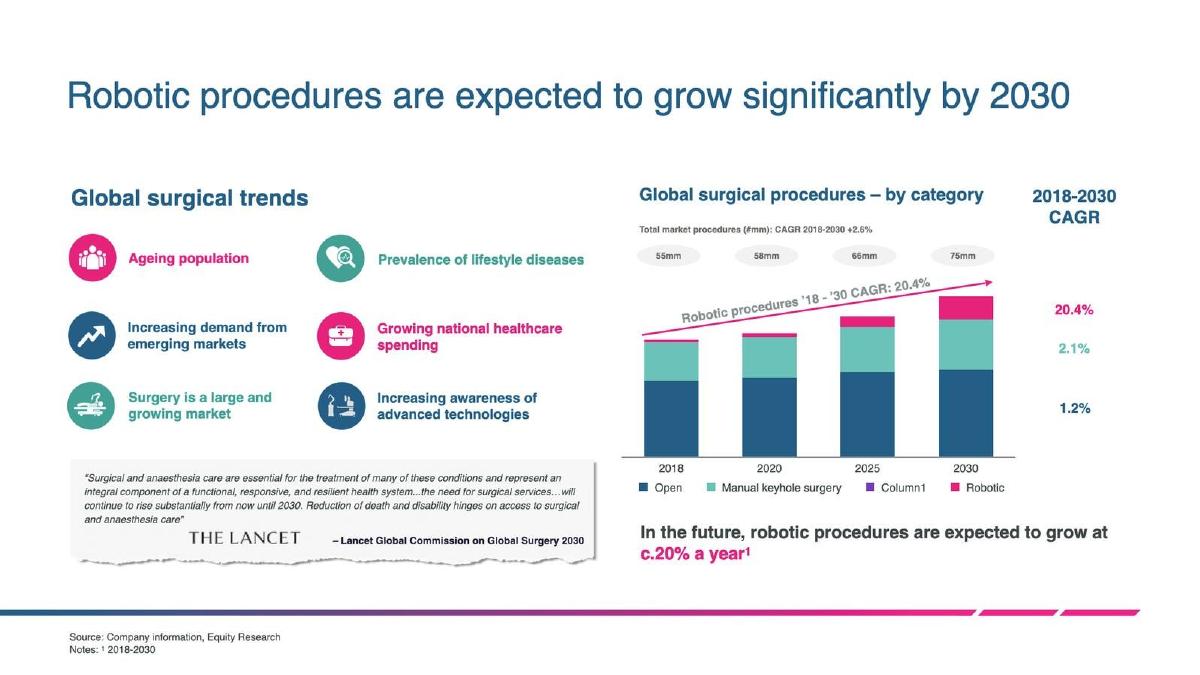
- The deck identifies a massive market opportunity with robotic procedures expected to grow at c.20% a year through 2030 (Slide 3).
- CMR positions the Versius system as 'modular' and 'human scale,' explicitly designed to help surgeons perform more Minimal Access Surgery (MAS) (Slide 4).
- The narrative focuses heavily on the 'digital interface' between surgeon and patient, rather than just the robotic hardware (Slide 4).
- A comprehensive digital ecosystem is mapped out, including hospital dashboards, registries, and the Versius Connect app (Slide 5).
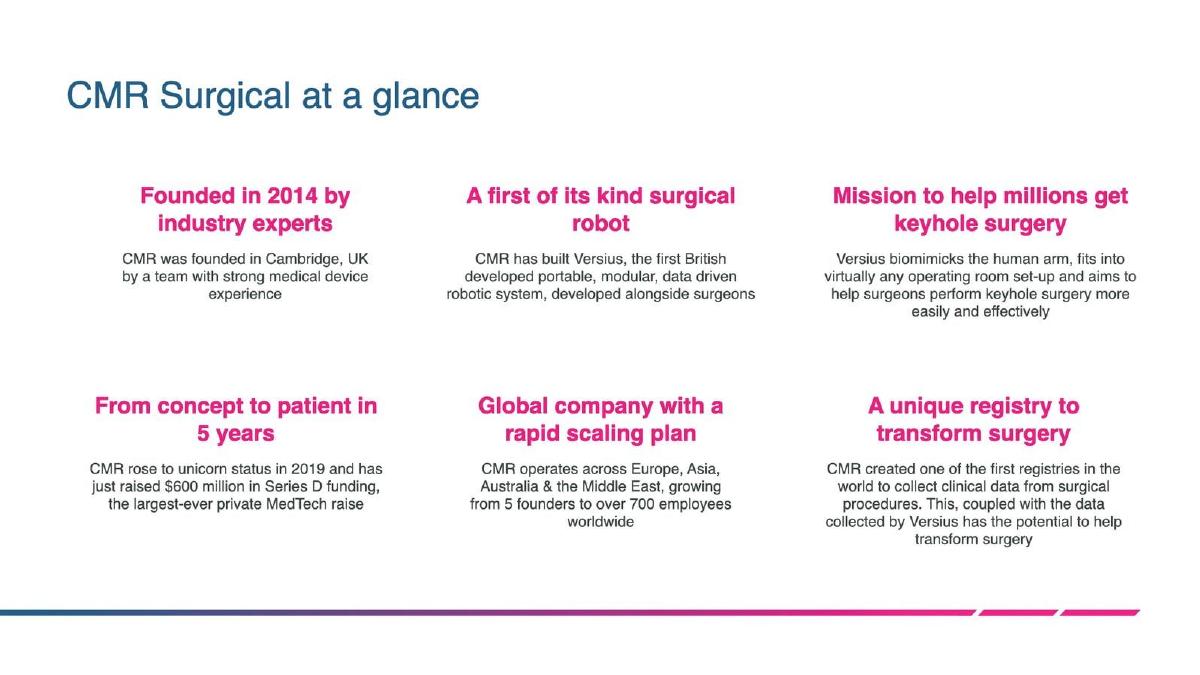
- The company highlights its speed to market, noting they went from 'concept to patient in 5 years' (Slide 8).
- CMR explicitly targets a market 'dominated by one player,' framing themselves as the necessary international disruptor (Slide 8).
- The deck omits a traditional 'Team' slide with executive bios, opting instead for a 'Culture' slide that mentions 40+ nationalities (Slide 8).
- Post-market surveillance is emphasized through the 'CMR Surgical Registry,' addressing regulatory and safety concerns directly (Slide 6).
The Strategic Narrative of a $600M Series D
CMR Surgical’s 2021 pitch deck is a masterclass in late-stage positioning. According to publisher-reported facts from Business Insider, the company raised $600M in a Series D round in 2021. At this stage of the venture lifecycle, the goal is no longer to prove that the technology is possible, but to prove that the business is scalable, defensible, and capable of capturing a significant share of a massive market. The deck focuses heavily on the 'ecosystem' and 'market tailwinds' rather than the granular engineering details that likely dominated their Seed or Series A presentations.
Slide 1-2: Visual Identity and Branding
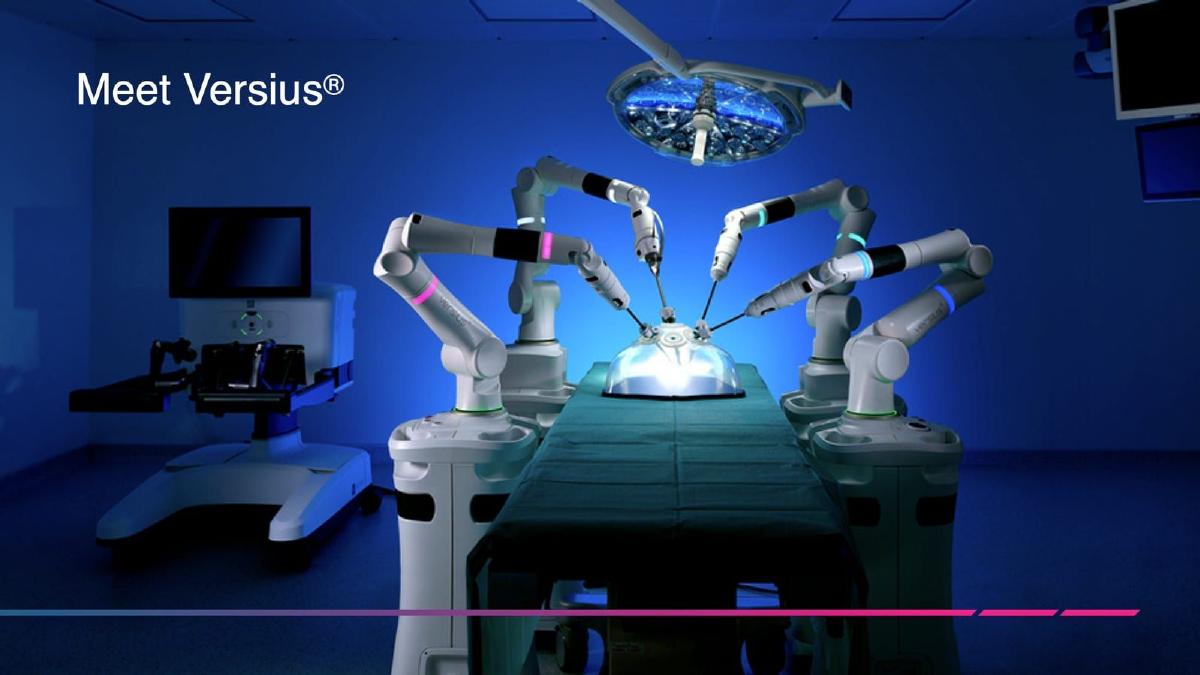
The deck opens with high-quality, atmospheric imagery of the Versius robotic arms. The branding is consistent, using a palette of deep blues and vibrant magentas. Slide 1 introduces the core mission: 'Empowering Surgeons.' This is a subtle but important distinction; the robot is not replacing the surgeon, but enhancing their capabilities. Slide 2 serves as a simple transition to the market analysis.
Slide 3: The Macro Opportunity
Slide 3, titled 'Robotic procedures are expected to grow significantly by 2030,' provides the quantitative 'Why Now?' for the investment. It cites a 20.4% CAGR for robotic procedures between 2018 and 2030, contrasting this with the stagnant growth of open surgery (1.2%) and manual keyhole surgery (2.1%). The slide also lists global surgical trends: an ageing population, prevalence of lifestyle diseases, and increasing demand from emerging markets. By quoting The Lancet, CMR adds third-party clinical credibility to their market projections.
Slide 4: Product Value Proposition
The 'Why Versius?' slide breaks the system down into five core pillars. Modular system: Designed to help surgeons do more MAS (Minimal Access Surgery). Human scale: A key differentiator suggesting the system fits into existing ORs without massive renovations. Patient access: Ensuring the surgical team can reach the patient at all times. Long-term partnership: Moving away from a 'one-off sale' model toward a recurring service and training relationship. Digital interface: Positioning the hardware as a bridge between data and action.
Slide 5: The Digital Ecosystem
This is arguably the most important slide for a Series D investor. It maps out the 'wider digital ecosystem.' It shows a hierarchy starting with the Device (Versius), supported by Education (Versius Trainer, Prof Ed), and powered by Data (Hospital dashboards, Registry, Versius Insight). The text emphasizes that 'Digital starts with Versius,' framing the robot as a data-collection node. This suggests a software-like margin profile and a data-driven moat that competitors would find hard to replicate.
Slide 6: Data in Action
Slide 6 provides a closer look at the user interface. It showcases the 'Versius Connect Surgeon App,' described as a 'data rich hub,' and the 'CMR Surgical Registry' for 'post-market surveillance and safety monitoring.' By highlighting these tools, CMR addresses two investor concerns: how to keep surgeons engaged (the app) and how to satisfy regulators (the registry).
Slide 7-8: People and Culture
Slide 7 is a transition slide titled 'Our people.' Slide 8, 'Our culture sets us apart,' replaces the traditional 'Team' slide found in earlier-stage decks. Instead of individual bios, it focuses on organizational velocity and values. Key claims include: Ambitious: 'Went from concept to patient in 5 years.' Hungry: 'Eyes are set on disrupting a market dominated by one player.' International: 'Employees from 40+ nationalities.' This slide sells the company's execution capability and its ability to attract global talent.
Slide 9: The Closing Vision
The deck concludes with the tagline 'Transforming surgery. For good.' and the company’s social handles. It is a clean, professional exit that leaves the focus on the brand and the mission.
What Works in the CMR Surgical Deck
1. Market Timing: The use of the 20.4% CAGR figure on Slide 3 is a powerful way to show that the market is in a high-growth phase. It justifies a $600M check by showing that the 'pie' is growing rapidly, and there is plenty of room for a new leader.
2. Ecosystem Framing: By Slide 5, the investor is no longer looking at a hardware company; they are looking at a data company. The 'Digital Ecosystem' slide effectively shifts the valuation conversation from hardware multiples to platform multiples.
3. Competitive Positioning: The deck manages to be aggressive without being unprofessional. By mentioning a market 'dominated by one player' on Slide 8, they acknowledge the elephant in the room (Intuitive Surgical) and frame themselves as the necessary, modern alternative.
4. Clinical Credibility: The inclusion of a quote from The Lancet and the mention of a 'Surgical Registry' for safety monitoring shows that CMR understands the regulatory and clinical hurdles of the healthcare industry.
What is Missing from the Deck
1. Financial Specifics: There are no slides showing current revenue, burn rate, or specific unit economics. While these were undoubtedly in the full data room, their absence in the main narrative deck is notable. A Series D investor would need to see the path to profitability.
2. Detailed Competitive Matrix: While they mention the 'one player,' they don't provide a feature-by-feature comparison. They rely on the 'human scale' and 'modular' descriptors to imply superiority without proving it through a side-by-side analysis.
3. The 'Ask': The deck does not state how much they are raising or what the specific use of funds will be. As a $600M round, the use of funds likely included global commercial expansion and R&D for next-gen instruments, but the deck remains silent on these specifics.
4. Executive Leadership: For a company raising over half a billion dollars, the lack of a slide highlighting the CEO, CFO, and CMO is unusual. Investors at this level are betting on the leadership team's ability to manage a massive global organization.
Founder Takeaways: What to Copy
1. Sell the 'Why Now' with Data: Don't just say your market is growing. Use Slide 3 as a template: find a reputable source (like The Lancet), show the CAGR of your specific niche, and contrast it with the slower growth of the status quo.
2. Build a Platform, Not a Product: If you are building hardware, you must show how that hardware generates data and creates a digital ecosystem. Slide 5 is the perfect blueprint for showing how various product lines (training, dashboards, apps) support the core device.
3. Use Culture as a Proxy for Execution: If your team is too large to fit on one slide, use Slide 8’s approach. Highlight your 'speed to market' (e.g., 'concept to patient in 5 years') and your 'international reach' to prove you can execute at scale.
4. Professionalism Over Hype: The design of this deck is understated and clinical. In the healthcare sector, 'flashy' can be perceived as 'risky.' The clean lines and professional photography of the Versius system convey a sense of reliability and safety.
Frequently asked questions
- Why does the deck focus so much on data and apps instead of the robot's specs?
- At the Series D level, investors already understand the hardware works. CMR is selling the 'moat.' By emphasizing the Versius Connect app and the Surgical Registry, CMR demonstrates how they capture data and create a feedback loop that makes their system stickier and more valuable than a standalone piece of hardware.
- What is the significance of the 'human scale' claim on Slide 4?
- Traditional surgical robots are often massive, requiring dedicated operating rooms and significant infrastructure changes. By claiming 'human scale,' CMR is signaling that Versius is easier to integrate into existing hospital workflows, potentially lowering the barrier to adoption and increasing the Total Addressable Market (TAM).
- How does CMR handle the competition in this deck?
- They don't name names, but Slide 8 mentions a market 'dominated by one player' (widely understood in the industry to be Intuitive Surgical). This positioning frames CMR as the primary alternative, which is a powerful narrative for investors looking to back a challenger in a monopolistic or oligopolistic market.
- Why is there no 'Ask' slide or financial projection?
- For a $600M Series D, the 'Ask' is usually handled in private data rooms and one-on-one negotiations with lead investors. This deck serves as the high-level strategic narrative. Additionally, late-stage companies often redact specific financials from decks that might be shared externally to protect competitive intelligence.
- What does the '20.4% CAGR' figure tell us about their strategy?
- Slide 3 uses this figure to prove that the market is not yet saturated. By showing that robotic procedures are growing much faster than 'Open' (1.2%) or 'Manual keyhole' (2.1%) surgery, they argue that the tide is rising, and they are the best-positioned vessel to ride it.