Cloudsmith's 2024 Series A deck is a high-signal document that successfully navigated a $15M raise by positioning artifact management as the 'last line of defense' in the software supply chain. The deck excels at demonstrating product-market fit through a mix of top-tier logos like Shopify and Epic Games, and a sophisticated usage-based pricing model that shows clear expansion paths. While the public version redacts specific revenue figures, the structural transparency regarding customer cohorts, CAC, and LTV for their 'Ultra' tier provides a blueprint for B2B SaaS founders. The narrative mov…
Key takeaways
- The deck identifies a $50 billion Ideal Customer Profile (ICP) market within a broader $500 billion TAM (Slide 15).
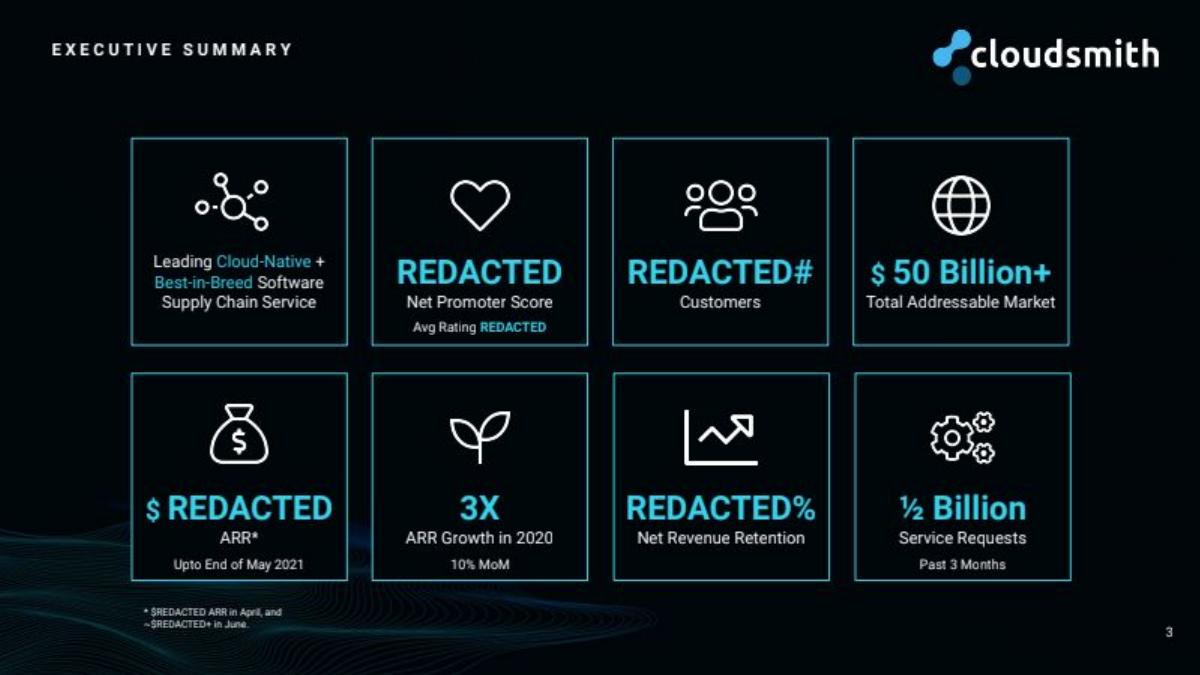
- Cloudsmith reports 3x ARR growth in 2020 with a consistent 10% Month-over-Month growth rate (Slide 3).
- The company processed 1/2 billion service requests in the three months preceding the deck's creation (Slide 3).
- A sophisticated pricing multiplier shows the Enterprise tier generating 39x the revenue of the base 'Team' tier (Slide 19).
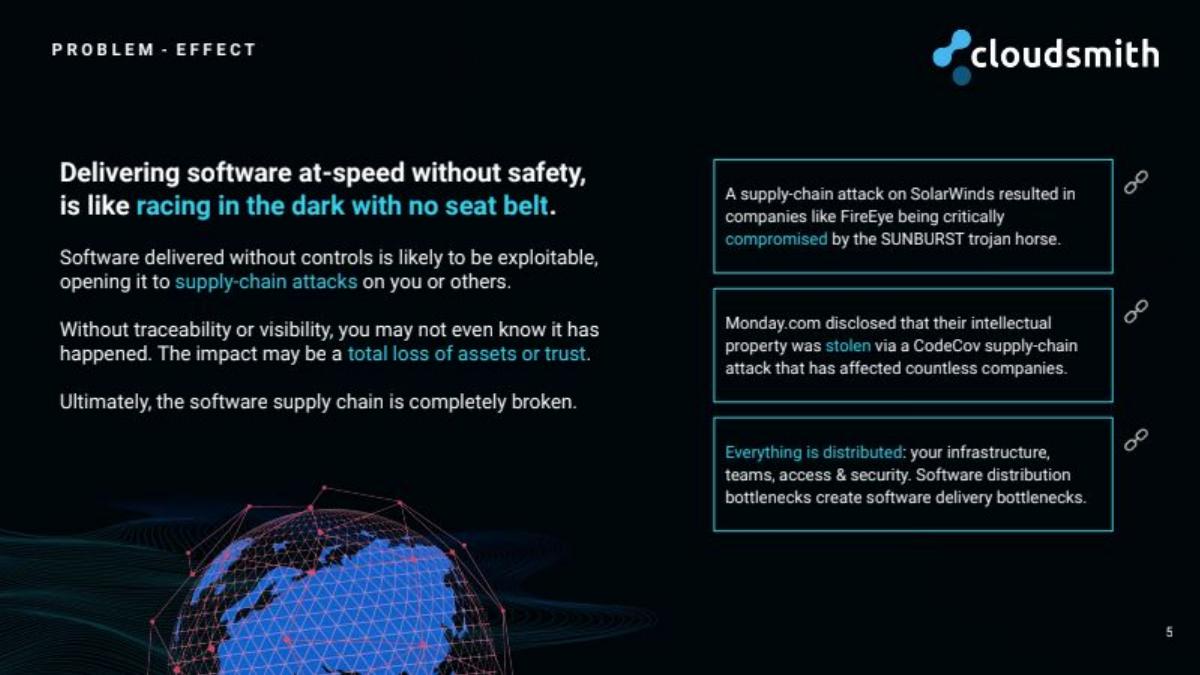
- The deck utilizes high-profile security failures like SolarWinds and CodeCov to establish immediate urgency (Slide 5).
- Customer retention is visualized through a cohort density map showing NRR scaling toward 160% over 12 months (Slide 35).
- The 'Ultra' customer segment is singled out for specific unit economics, including CAC, LTV, and payback time (Slide 17).
- The use of funds is highly specific, allocating 54% to Sales & Marketing and 32% to R&D (Slide 23).
Cloudsmith Series A Teardown: Securing the Software Supply Chain
Cloudsmith's Series A deck is a masterclass in B2B SaaS storytelling, particularly for companies operating in the developer tools and security space. Raising $15M led by Tiger Global, the company leans into the high-stakes world of software supply chain security. The deck is structured to move from a visceral problem (security breaches) to a highly scalable, usage-based financial engine.
Slide 1: The Hook
The title slide is minimalist, featuring the Cloudsmith logo and the tagline: THE FUTURE OF SOFTWARE SUPPLY CHAINS . It sets a high-level strategic tone immediately, moving beyond simple 'package management' to a broader security narrative.
Slide 3: Executive Summary
This slide is a data-dense grid that establishes immediate credibility. Key figures include a $50 Billion+ Total Addressable Market , 3X ARR Growth in 2020 , and 10% MoM growth . Notably, they highlight 1/2 Billion Service Requests in the past three months, which serves as a proxy for product usage and technical scale. While ARR and NPS figures are redacted in this public version, the inclusion of these boxes indicates a transparent approach to investor due diligence.
Slide 5: Problem - Effect
Cloudsmith uses a 'fear, uncertainty, and doubt' (FUD) approach that is grounded in recent history. They cite the SolarWinds attack (SUNBURST trojan) and the Monday.com/CodeCov breach as evidence that the software supply chain is 'completely broken.' By framing the problem as 'racing in the dark with no seat belt,' they elevate their product from a utility to a necessity.
Slide 7: Solution - Cloudsmith
The solution is presented as an evolution of package management. They define their core attributes as Observability , Control , and Performance . This slide introduces 'The Mesh,' described as a worldview of the global Software Bill of Materials (SBOM), signaling that their ambitions extend into data intelligence and graph theory.
Slide 9: Accumulating Trust
A standard but impressive logo wall. High-growth tech companies like Shopify , Epic Games , Carta , and Netlify are featured. The diversity of these logos—spanning e-commerce, gaming, and fintech—validates the 'universal' claim of their platform.
Slide 11: Ecosystem
For developer tools, integrations are everything. This slide visualizes Cloudsmith at the center of a hub, integrating with CI tools (GitHub, CircleCI), Security tools (Snyk, Trivy), Observability tools (Datadog), and Deployment tools (Terraform, Puppet). It positions Cloudsmith as the critical connective tissue in the modern DevOps stack.
Slide 13 & 15: Segmentation and TAM
Slide 13 breaks down revenue by tier: Ultra (59% of ARR), Velocity Self-Serve (23%), and Team Self-Serve (18%). This is a vital slide for Series A investors because it shows that while the company has a 'spear-fishing' developer motion, it is successfully closing large enterprise deals. Slide 15 then maps this to a $500B TAM , a $100B SOM , and a $50B ICP , providing a logical funnel for their market opportunity.
Slide 17: Traction Metrics
This slide provides a granular look at unit economics. It separates 'All Customers' from 'Ultra-Only Customers.' By showing CAC , LTV , and Payback Time specifically for their highest-value segment, they prove that their enterprise motion is efficient. The ARR growth chart shows a clear upward trajectory with a healthy mix of subscription and on-demand usage revenue.
Slide 19: Pricing Model
Cloudsmith utilizes a subscription model scaling with usage-based pricing . The slide shows a 'Multiplier Scale' where the Enterprise tier is 39x the base price. This is a powerful visual for investors, demonstrating that as a customer grows, Cloudsmith’s revenue grows exponentially without requiring a linear increase in sales effort.
Slide 21: Organisation Chart
The team slide is presented as a functional org chart rather than just headshots. It shows Alan Carson (CEO) and Lee Skillen (CTO) leading a team structured around Engineering, Product, and Marketing. This format emphasizes the company's operational readiness to scale.
Slide 23: Use of Funds
The allocation is clear: 54% to Sales & Marketing , 32% to R&D , and 9% to Customer Success . They list specific senior hires (CRO, VP of Engineering, VP of Security) and technical goals like achieving ISO27001 & SOC2 certification . This level of detail gives investors confidence that the $15M will be deployed systematically.
Slide 27: Roadmap
The roadmap is divided into three phases: Current (Year of Compliance) , Tomorrow (Year of Intelligence) , and Future (Year of The Mesh) . This aligns with the earlier solution slide, showing a logical progression from a secure platform to an intelligent data layer.
Slide 29: Target Logos
A 'wish list' of future customers including Apple , Blizzard , Twitch , and Visa . While aspirational, it defines the scale of enterprise Cloudsmith believes it can capture.
Slide 31 & 33: Competition
Slide 31 explains 'Why We Win' against four categories of competitors. Slide 33 is a unique Competitive Pricing matrix. Instead of the standard 'feature checklist,' it plots competitors on a graph, positioning Cloudsmith as a high-value, cloud-native leader compared to legacy tools like JFrog and Sonatype .
Slide 35: Net Revenue Retention (NRR)
The final data slide is a cohort analysis. It shows Density NRR x Tenure , with NRR climbing from 100% at month 3 to approximately 160% at month 12 . This is 'best-in-class' retention data that almost certainly sealed the deal with Tiger Global.
What Cloudsmith Does Well
The deck is exceptionally strong at segmenting data . By isolating the 'Ultra' tier, Cloudsmith avoids the trap of blending low-margin self-serve data with high-margin enterprise data. This allows them to show a very high LTV/CAC ratio that would otherwise be diluted. Additionally, the usage-based pricing visualization (Slide 19) clearly communicates how the company captures value as its customers scale, which is a favorite narrative for modern VCs.
What is Missing
While the deck is comprehensive, it lacks a detailed case study . We see the logos, but we don't see a 'before and after' story of a specific customer like Shopify. Furthermore, there is no gross margin data. For a cloud-native platform handling '1/2 billion service requests,' the cost of goods sold (COGS) is a significant factor in long-term profitability that is not addressed here. Finally, the team slide lacks the 'pedigree' bios (ex-Google, ex-AWS) that many founders use to signal expertise, though the organizational structure partially compensates for this.
Founder Takeaways
Isolate your best customers: If your enterprise metrics are better than your self-serve metrics, show them separately. Don't let a large volume of low-value users hide your true product-market fit. · Use a pricing multiplier: Visualizing how your tiers scale (e.g., 1x to 39x) is more effective than just listing prices. It shows the 'ceiling' of your revenue potential. · Connect to the zeitgeist: Cloudsmith didn't just say they store files; they said they secure the 'software supply chain' during a year when that was a top-three concern for every CISO. · Show NRR cohorts: If you have net revenue retention over 120%, a cohort table (Slide 35) is the most powerful slide you can put in your deck. It proves that your product is 'sticky' and that your customers are happy to pay you more over time.
Frequently asked questions
- What is Cloudsmith's core value proposition?
- Cloudsmith positions itself as a universal, cloud-native software supply chain management platform. According to Slide 7, it focuses on three core attributes: Observability (feedback loops), Control (safety and quality at speed), and Performance (high availability and compliance). It aims to replace fragmented, on-premise, or bespoke artifact management systems with a unified cloud service.
- How does Cloudsmith define its market size?
- The deck uses a three-tier market breakdown on Slide 15. The Total Addressable Market (TAM) is cited at $500 billion, encompassing all software companies. The Service Obtainable Market (SOM) is $100 billion, targeting companies with R&D teams of 50+ developers. The Ideal Customer Profile (ICP) is narrowed to a $50 billion segment focusing on dedicated DevOps and Security functions.
- What does the 'Ultra' customer segment represent in their traction?
- Slide 13 and 17 highlight 'Ultra' customers as a critical growth engine. This segment represents 59% of total ARR as of April 2021. By isolating this group, Cloudsmith demonstrates to investors that while they have a broad self-serve base, their unit economics (LTV/CAC) are optimized for high-value enterprise accounts that drive the majority of revenue.
- What is 'The Mesh' mentioned in the roadmap?
- As described on Slide 7 and Slide 27, 'The Mesh' is Cloudsmith's long-term vision. It involves building a deep understanding of the 'fabric of all software and dependencies' using deep learning, mining, and graph theory. This moves the company from a storage and distribution tool to an intelligence layer for the global Software Bill of Materials (SBOM).
- How does Cloudsmith handle competition in the deck?
- Cloudsmith uses a multi-faceted competitive analysis. Slide 31 categorizes competitors into Self-Build, On-Premises (e.g., Sonatype Nexus), Traditional Package Management (e.g., JFrog Artifactory), and Cloud Platforms (e.g., AWS, GitHub). Slide 33 specifically plots these competitors on a pricing matrix, positioning Cloudsmith as a premium, cloud-native alternative to legacy incumbents like JFrog.