Blue Apron’s 2015 Series D deck, used to raise $135M, is a departure from traditional data-heavy logistics pitches. Across 62 slides (21 analyzed here), the company prioritizes the 'experience' of cooking over the mechanics of delivery. By defining their target audience strictly as Millennials born between 1980-2000, they frame meal kits as a solution to 'dining monotony' and a lack of culinary confidence. The deck relies heavily on visual mockups for a #CookYourJourney campaign, spanning Vine, Snapchat, and Hulu. While it lacks explicit financial tables or CAC/LTV data in this selection, it…
Key takeaways
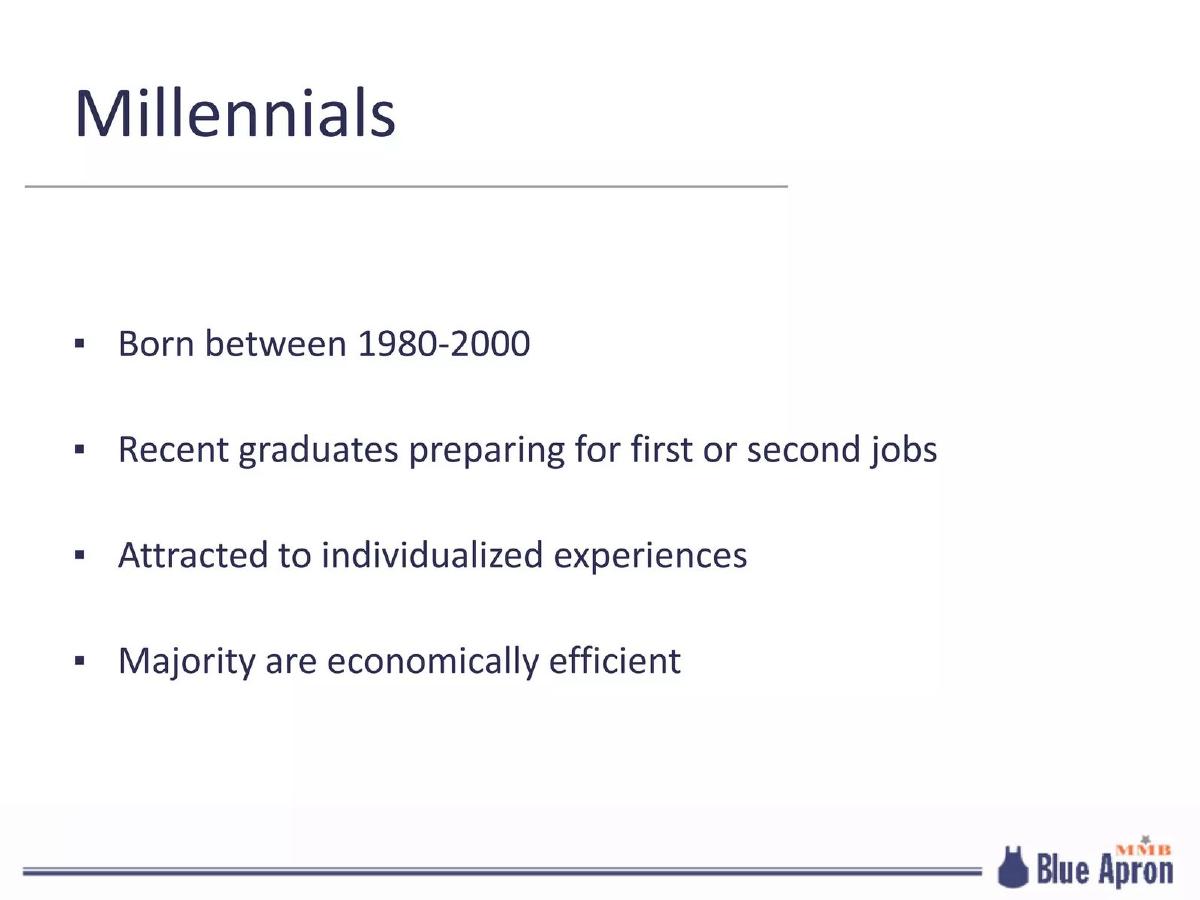
- The deck defines Millennials specifically as those born between 1980 and 2000 on Slide 2.
- Blue Apron identifies 'adventure-seeking' as a core psychological driver for their target customer on Slide 3.
- User personas like 'Jenna' and 'Jake & Monica' are used to illustrate specific pain points like grocery store time-constraints and lack of kitchen guidance on Slides 4 and 5.
- The company frames the decline of home-cooked meals as a market risk driven by new restaurant selections and delivery options on Slide 6.
- Marketing strategy is centered on the hashtag #CookYourJourney, with mockups for now-defunct platforms like Vine on Slide 11.
- The value proposition is explicitly stated as helping customers become a 'better chef' through 'quick and easy culinary success' on Slide 15.
- The deck emphasizes social media sharing as a primary outcome, listed in the final summary on Slide 21.
- Visual storytelling dominates the presentation, using high-fidelity mockups of subway ads and Hulu commercials on Slides 13 and 17.
The Lifestyle Pivot: Selling Experience Over Logistics
Blue Apron’s 2015 Series D deck is a product of its time, reflecting a period when food-tech companies were desperate to be viewed as lifestyle brands rather than low-margin logistics operations. Raising $135M requires a massive vision, and Blue Apron chose to build that vision on the back of Millennial psychographics. The deck is less about the 'how' of moving boxes and more about the 'why' of the modern kitchen.
Slides 1-3: Defining the Millennial Archetype
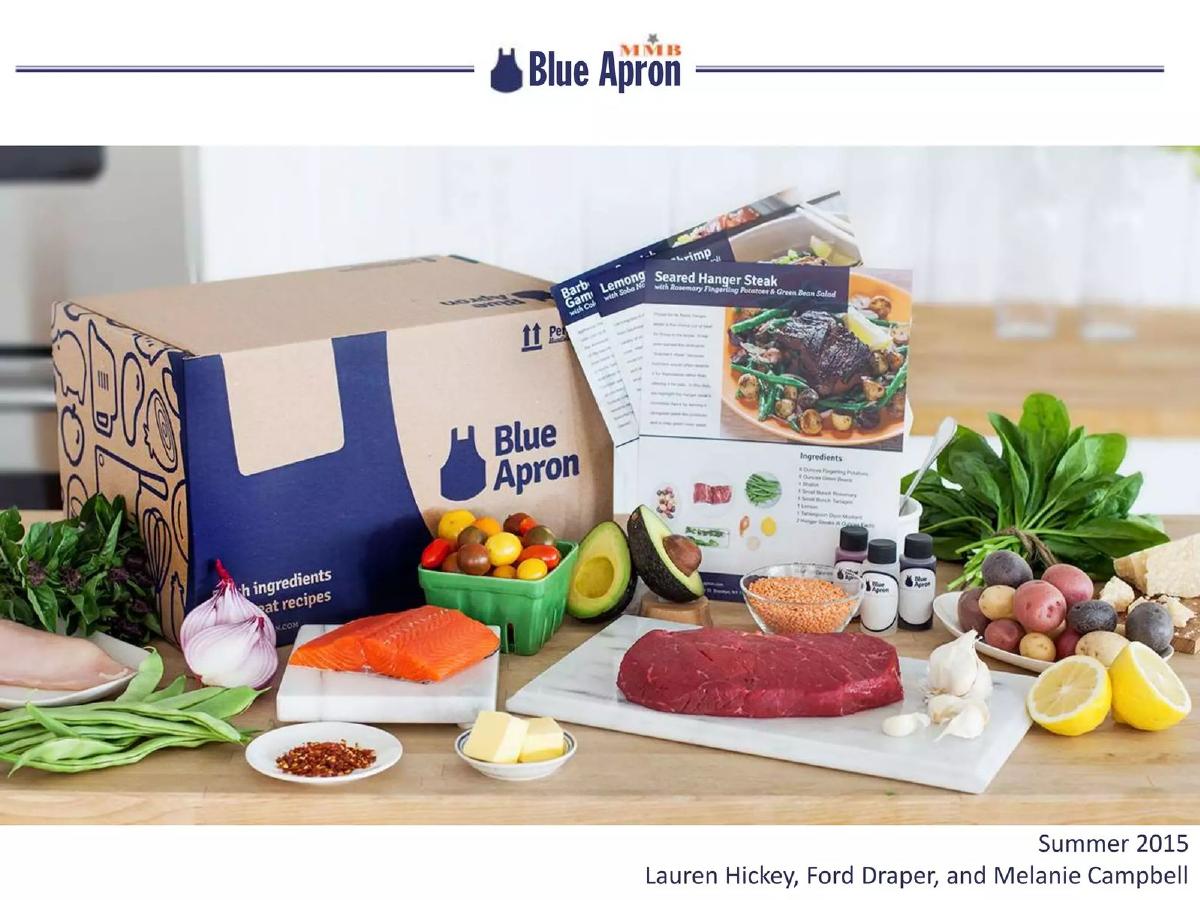
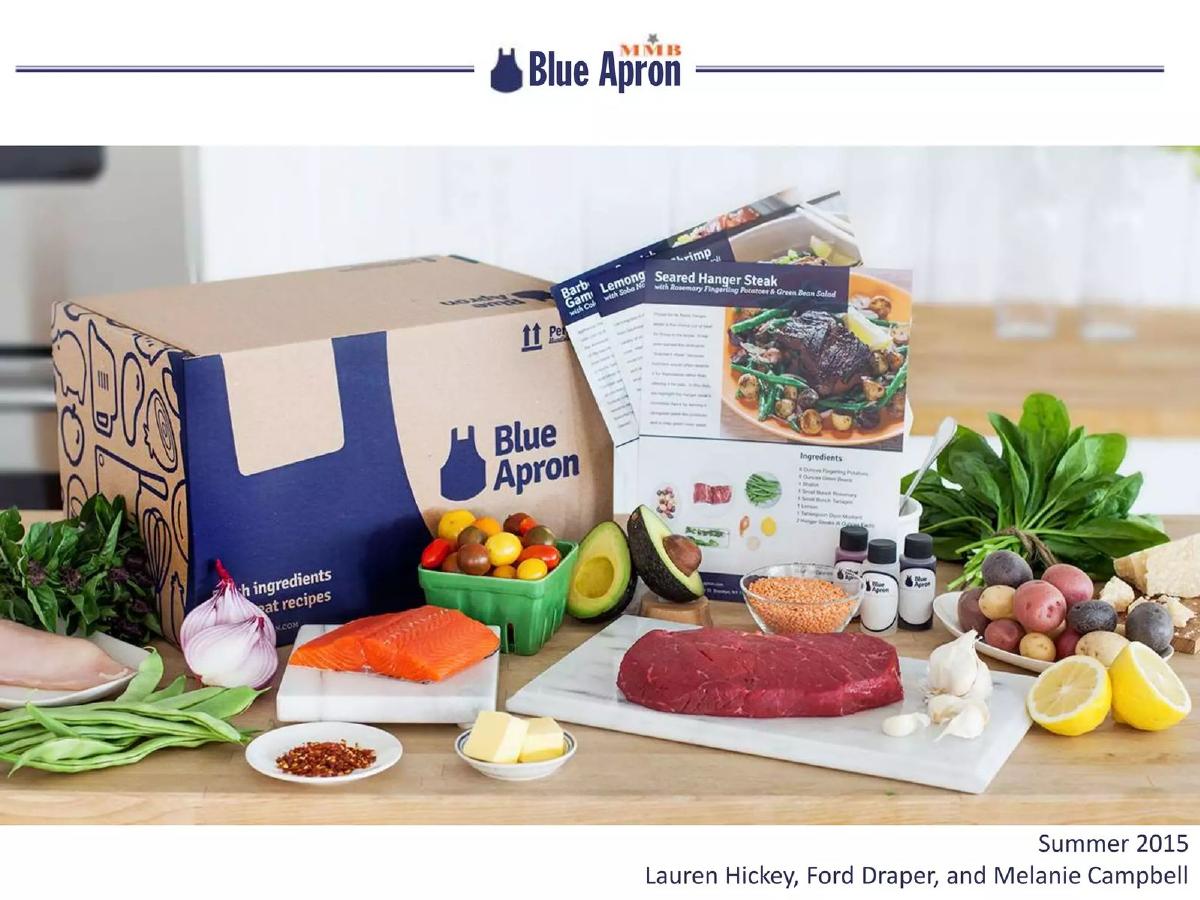
The presentation opens with a high-resolution hero shot of the product: a Blue Apron box surrounded by fresh, raw ingredients like salmon, steak, and kale. It immediately establishes the 'before' state of the product. However, the deck quickly moves from the physical product to the target demographic. Slide 2 defines Millennials with surprising specificity: born between 1980-2000, recent graduates, and 'economically efficient.' By Slide 3 , they add the layer of 'Adventure-Seeking,' using a stock photo of a paddleboarder at sunset to link the brand to a broader sense of exploration.
Slides 4-5: The Persona Deep Dive
Blue Apron utilizes detailed user personas to articulate the problem. Slide 4 introduces 'Jenna,' a 25-year-old teacher and barista in Brooklyn. Her frustration is simple: she 'doesn’t have time to go to the grocery store.' Slide 5 introduces 'Jake & Monica,' an engaged couple who are 'timid about trying new things in the kitchen without guidance.' These slides are critical because they move the problem away from 'hunger' and toward 'aspiration' and 'time-poverty.' They aren't selling food; they are selling the elimination of grocery store friction and culinary anxiety.
Slides 6-7: Market Risks and Opportunities
Slide 6 asks, 'Are Home-Cooked Meals at Risk?' citing new restaurant selections and food delivery options as the primary threats. This is a clever framing; it positions Blue Apron as the defender of the home kitchen against the rise of Seamless and UberEats. Slide 7 then defines the 'Marketing Opportunity' as the ability to 'outshine societal tendencies' by focusing on key consumer insights. This section transitions the deck from identifying the audience to explaining how they will capture them.
Slides 8-12: The Social Media Strategy
The core of this deck segment is the marketing plan. Slide 8 lists a variety of platforms, including the now-defunct Vine. Slide 9 introduces the 'experiential' nature of the brand, claiming that cooking is a 'journey.' This leads into the #CookYourJourney campaign. Slide 10 shows a billboard mockup featuring a deconstructed head of broccoli, while Slide 11 shows a Vine mockup featuring Shawn Mendes with 228,503 loops. The message to investors is clear: Blue Apron is a viral brand that lives on the smartphones of its target demographic.
Slides 13-15: Storytelling and Education
Slide 13 features a subway ad mockup with the tagline 'Every Dish is a New Story.' This reinforces the idea that the meal kit is a narrative experience. Slide 15 brings the value proposition home, stating that the ingredients help the user 'become a better chef.' This is a powerful psychological hook; it suggests that using the service provides a permanent skill upgrade, not just a temporary meal. It shifts the product from a commodity to an educational tool.
Slides 16-21: Multi-Channel Execution and Summary
The final slides of this sequence demonstrate the breadth of the proposed marketing spend. Slide 16 shows a surrealist 'Expand Your Cooking Horizon' ad in a subway tunnel. Slides 17, 18, and 19 show mockups of Hulu ads and YouTube videos, emphasizing that the brand will be omnipresent in the digital spaces where Millennials consume media. Slide 21 concludes the sequence with a summary that emphasizes 'endless adventures' and 'sharing stories on social media.' Notably, the word 'logistics' or 'delivery' is absent from this summary, replaced entirely by lifestyle descriptors.
What Blue Apron Does Well
Blue Apron excels at psychographic targeting . By the end of Slide 5, an investor knows exactly who the customer is, what they fear (the grocery store), and what they want (to feel like a chef). The use of high-fidelity mockups for the #CookYourJourney campaign makes the marketing strategy feel 'real' and ready to execute. They also successfully frame their competition not as other meal kits, but as the general trend of 'not cooking,' which makes their potential market share feel much larger.
What is Missing from the Deck
In this 21-slide selection, there is a glaring lack of hard data . There are no charts showing customer acquisition costs (CAC), churn rates, or the lifetime value (LTV) of a subscriber. For a Series D round—which is typically a 'growth' round based on proven metrics—the absence of unit economics in the first third of the deck is bold. Furthermore, there is no mention of the supply chain, fulfillment centers, or the logistics of shipping perishable goods, which are the most expensive and difficult parts of the business model.
Founder's Tip: Copy the Persona, Show the Math
Founders should emulate Blue Apron’s ability to humanize their data . Instead of saying 'our target market is 25-35 year olds,' they show 'Jenna.' This makes the problem feel urgent and relatable. However, founders must be careful not to lean too heavily on marketing mockups at the expense of financial reality. While Blue Apron raised $135M with this 'lifestyle' approach, the subsequent struggles of the meal-kit industry proved that logistics and retention math matter more than a hashtag in the long run. Use personas to open the heart, but use a spreadsheet to close the deal.
Frequently asked questions
- What is the primary target audience identified in the Blue Apron deck?
- Blue Apron focuses exclusively on Millennials, which they define on Slide 2 as individuals born between 1980 and 2000. They characterize this group as recent graduates, economically efficient, and attracted to individualized, spontaneous experiences. The deck uses this demographic focus to justify its heavy emphasis on social media marketing and digital-first advertising platforms like Hulu and Snapchat.
- How does Blue Apron frame the 'Problem' in this pitch?
- Instead of focusing on food waste or supply chain inefficiency, Blue Apron frames the problem through consumer psychology. On Slides 4 and 5, they highlight 'frustrations' such as not having time to go to the grocery store and being 'timid about trying new things in the kitchen without guidance.' They position the product as a confidence-builder for the 'adventure-seeking' cook.
- What marketing channels does the deck prioritize?
- The deck outlines a multi-channel digital and physical strategy. Slide 8 lists Blog, Facebook, Vine, Snapchat, Yelp, YouTube, and Instagram. Slides 10 through 19 provide visual mockups for these channels, including subway station takeovers, mobile app interfaces for Vine and Snapchat, and pre-roll video ads on Hulu, all unified under the #CookYourJourney campaign.
- Is there any mention of unit economics or financial performance?
- In the 21 slides provided from this 62-slide deck, there are no mentions of unit economics, CAC (Customer Acquisition Cost), LTV (Lifetime Value), or revenue figures. This is unusual for a Series D round, though these details likely resided in the remaining 41 slides. The provided portion is almost entirely dedicated to brand positioning and marketing execution.
- What is the 'Cook Your Journey' concept mentioned throughout the deck?
- It is the central marketing theme used to position Blue Apron as an 'experiential' brand rather than a utility. Slide 9 states that ingredients take the user on a 'journey through different tastes.' This is visualized on Slide 10 with a deconstructed broccoli graphic and on Slide 16 with a surrealist 'Expand Your Cooking Horizon' subway ad featuring a kayak in a river of food.