Blue Room Immersive presents a pitch deck centered on the therapeutic application of virtual reality, specifically utilizing nature-based content to address stress and trauma. The company differentiates itself by moving away from traditional VR gaming and toward 'immersive therapy,' claiming exclusive access to 900 hours of nature footage. The deck relies heavily on the success of mobile meditation apps like Calm and Headspace to validate its market potential, arguing that VR's immersive nature offers a higher success ratio for relaxation. Financially, the company projects significant growth,…
Key takeaways
- The company claims exclusive access and content rights to 900 hours of nature VR content, including scuba diving and mountain landscapes (Slide 3).
- Blue Room Immersive positions itself against 'indirect competition' like gaming and educational VR, arguing that gaming is unsuitable for trauma reduction (Slide 5).
- The financial plan projects a break-even point by the end of 2021 (Slide 6).
- Revenue projections scale from $15,808,320 in 2022 to $39,536,640 in 2024 (Slide 6).
- The business model targets two primary segments: 220 hospital clients and 105,600 home VR unit subscribers (Slide 6).
- The deck cites a $1 billion valuation for the Calm app as a market validator for relaxation-focused technology (Slide 4).
- The company utilizes an advisory board featuring executives from Double A and Quantum Interface to provide industry credibility (Slide 7).
- The core strategy is defined as 'making reality virtual' rather than creating synthetic virtual worlds (Slide 2).
Blue Room Immersive: The Pitch for Reality-Based VR
Blue Room Immersive enters the virtual reality space with a specific thesis: the industry has focused too much on 'making virtual reality' (synthetic environments) and not enough on 'making reality virtual.' The deck positions the company as a content-rich platform designed to bring the calming effects of nature to users through immersive technology. By leveraging a massive library of existing footage, they aim to bypass the high costs of CGI-heavy VR development while addressing a clear market need for mental health and relaxation tools.
Slide 1: Title and Visual Identity
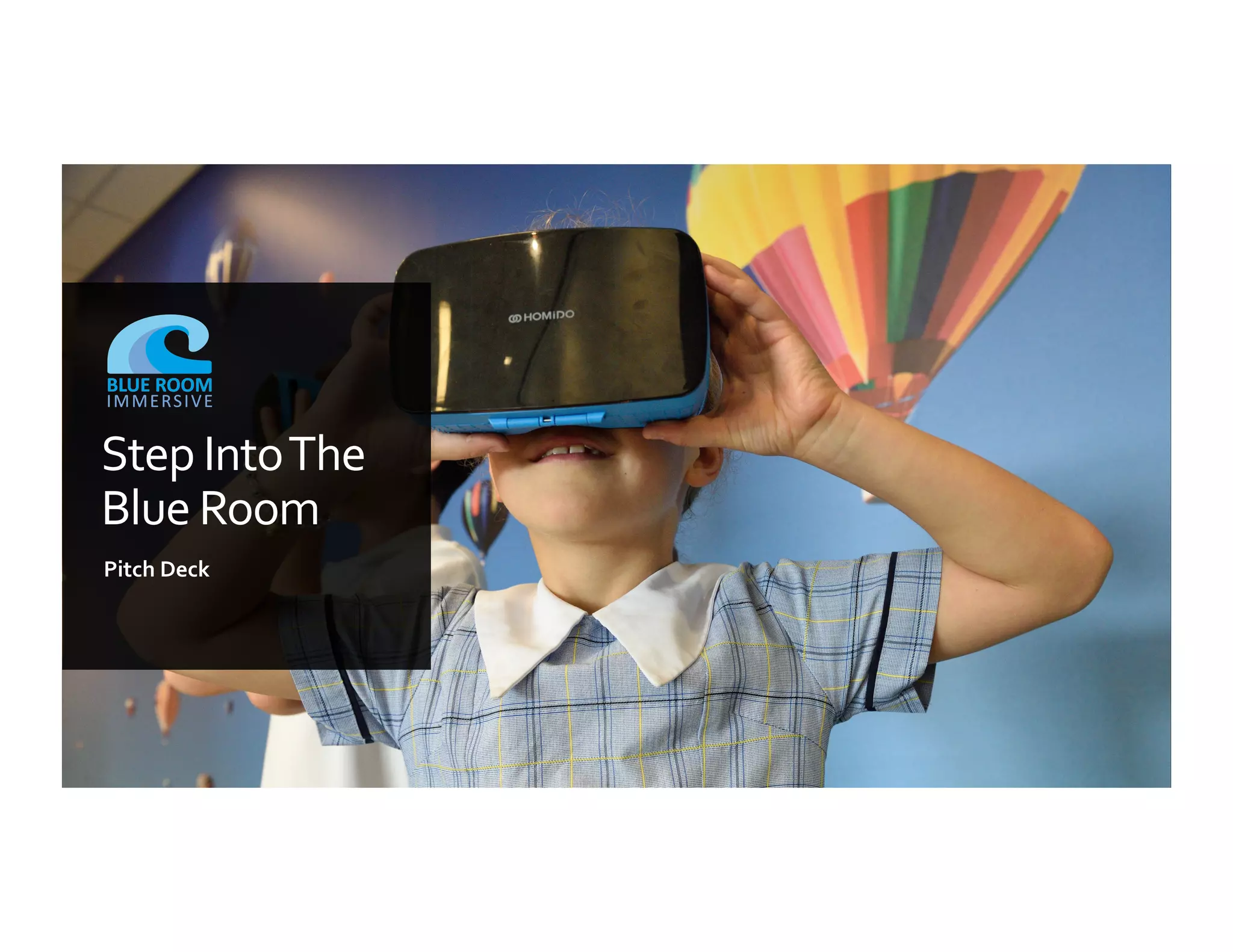
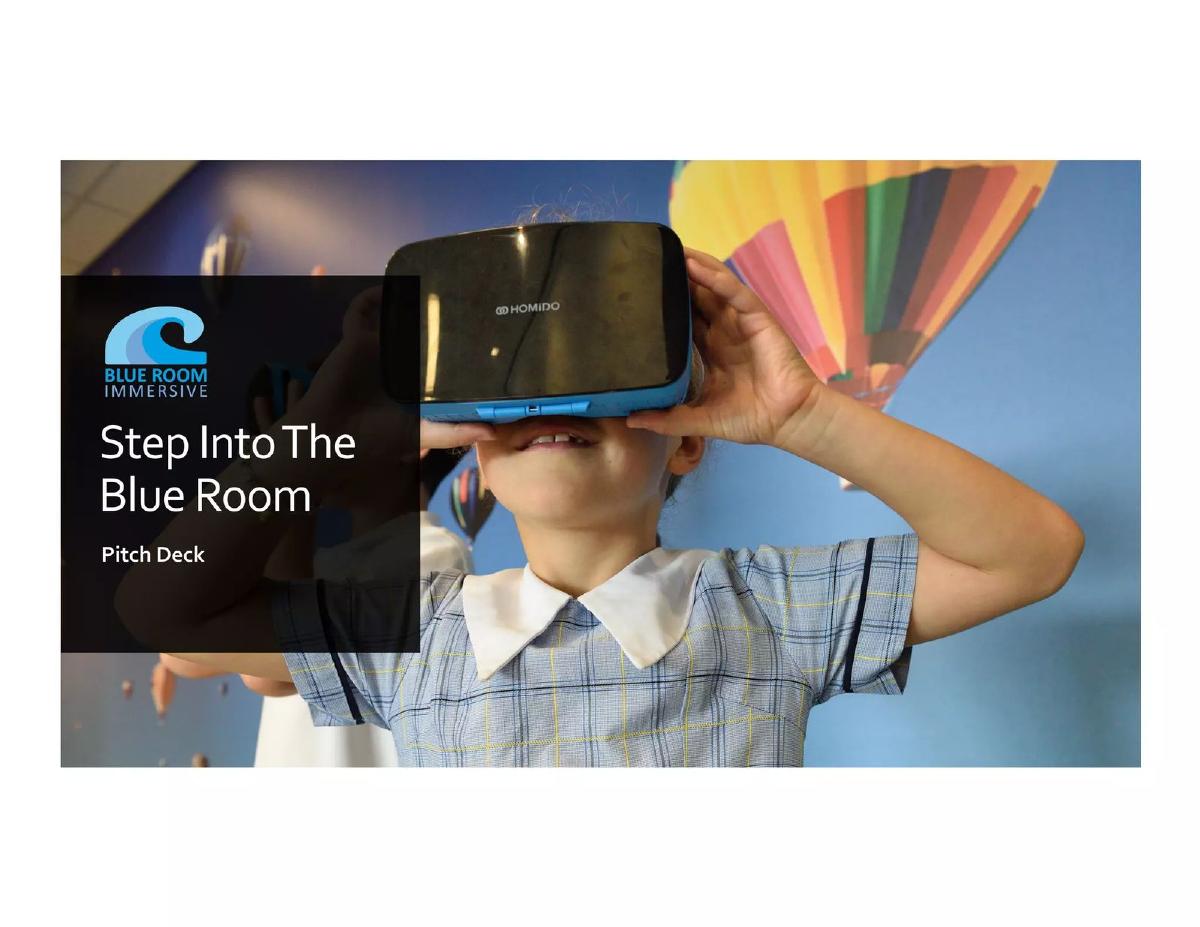
The cover slide features a child using a Homido VR headset against a backdrop of a hot air balloon mural. The branding is clean, using a blue wave logo and the tagline 'Step Into The Blue Room.' It immediately establishes the company as a VR-focused entity, though the use of third-party hardware (Homido) in the imagery suggests the company is primarily a software or content provider rather than a hardware manufacturer.
Slide 2: The Solution and Philosophy
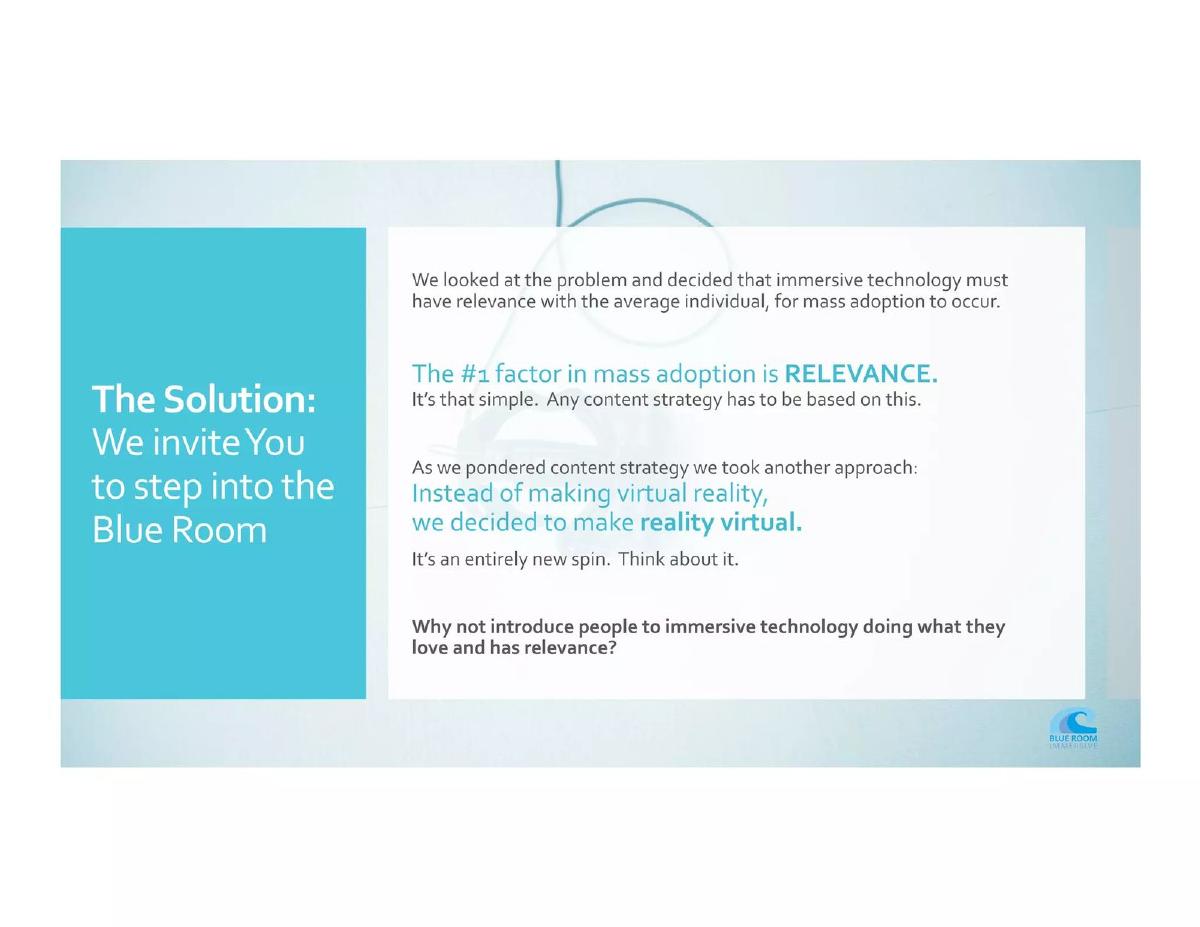
Slide 2 outlines the company's core philosophy. It identifies 'relevance' as the number one factor for mass adoption of immersive technology. The slide introduces the pivot from traditional VR: 'Instead of making virtual reality, we decided to make reality virtual.' This indicates a focus on 360-degree video capture of real-world locations rather than digitally rendered environments. The language is conversational, inviting the investor to 'think about it,' which sets a tone of challenging the status quo of the VR industry.
Slide 3: Content as a Moat
This slide focuses on the 'Nature' vertical. It lists specific examples of content, such as scuba diving in the Caribbean and Gocta Falls in Peru. The most critical data point here is the claim of 'full exclusive access and content rights to 900 hours of nature VR content.' In the content business, this volume represents a significant barrier to entry. The slide also bridges the gap between VR and the existing mobile market by noting that top relaxation apps already use nature content to stimulate serenity, positioning Blue Room as the logical evolution of that trend.
Slide 4: Market Validation and 'Will it Work?'
Slide 4 addresses the viability of the business model by comparing it to the mobile app market. It notes that while 99% of mobile apps fail, relaxation and meditation apps like Calm and Headspace have broken the trend, with Calm reaching a $1 billion valuation. The argument presented is that if mobile apps can succeed in this space, VR—which is more immersive and capable of 'tricking the brain into releasing trauma'—has an even higher chance of success. This slide serves as a proxy for market size and demand, using the success of the 'meditation' category to justify the 'immersive therapy' category.
Slide 5: Competitive Landscape
The competition slide distinguishes Blue Room from the broader VR market. It labels educational and gaming VR as 'indirect competition.' The slide specifically calls out 'mobile apps and PlayStations' as the main current competition. The founders make a qualitative argument against gaming content, stating that 'zombies jumping out and shooting them' is not a solution for reducing trauma. By framing the competition this way, they carve out a niche for 'Immersive Therapy' that is distinct from the entertainment-heavy focus of most VR startups.
Slide 6: The 5-Year Financial Plan
This is the most data-dense slide in the deck. It provides specific revenue targets and growth metrics:
Annual Revenues: $15,808,320 in 2022, growing to $39,536,640 by 2024. · Cumulative Revenues: $85,609,440 by 2024. · Break-Even Point: Projected for the end of 2021. · Client Targets: 220 hospitals and 105,600 home VR unit subscribers.
The slide includes a disclaimer that these numbers are based on reaching only 2% of the available market in 5 countries and only one vertical (hospitals) out of eight potential segments. The claim that the project is 'infinitely scalable' is a bold assertion common in early-stage decks, though the specific numbers provided give investors a concrete baseline for evaluation.
Slide 7: Advisory Board
The final slide shown focuses on 'Advisers' rather than the core team. It features Amber Allen (CEO of Double A, former Warner Brothers executive) and Jonathon Josephson (CEO of Quantum Interface). Allen brings marketing and brand experience, while Josephson provides technical credibility via his patents in motion sensing technology. While these are strong names, the absence of the actual founders or executive team in this sequence leaves a gap regarding who will be responsible for the day-to-day execution of the 5-year plan.
What Blue Room Immersive Does Well
The deck excels at defining a clear, differentiated niche within a crowded and often misunderstood industry. By focusing on 'reality virtual' (360-degree video) rather than 'virtual reality' (CGI), the company presents a much more cost-effective way to generate high volumes of content. The claim of 900 hours of exclusive content is a powerful 'unfair advantage' that investors look for. Furthermore, the comparison to Calm and Headspace is a smart way to validate the market; it takes a proven consumer behavior (paying for digital relaxation) and offers a technologically superior way to deliver that value.
What is Missing from the Deck
The most glaring omission in the provided slides is the core team. While the advisors are impressive, investors fund founders, not just advisors. There is no information on who the CEO, CTO, or Head of Content is, nor their track record in scaling startups. Additionally, the 'Home VR Unit' mentioned in the financials is not explained. It is unclear if Blue Room is developing its own hardware, white-labeling existing headsets, or simply providing a software subscription for devices like the Oculus or Homido. The '8 total available verticals' mentioned on the financial slide are also not listed, leaving the investor to guess where the other 75% of the market potential lies. Finally, there is no 'Ask' slide in this selection, leaving the specific funding requirements and use of proceeds unknown.
Founder's Guide: What to Copy and What to Avoid
Copy the Content Moat: If your startup relies on content, be as specific as Blue Room is on Slide 3. Stating the exact number of hours (900) and specific locations (Swiss Alps, Peru) makes the asset feel tangible and valuable. Copy the Market Proxy: Using a billion-dollar success story like Calm to explain a new category (Immersive Therapy) is an excellent way to reduce perceived risk for an investor.
Avoid the 'Infinitely Scalable' Cliché: While it is tempting to use hyperbole, stating a project is 'infinitely' scalable can come across as naive. Stick to the 2% market penetration logic, which is much more grounded and defensible. Avoid Hiding the Team: Never let a deck go out where the advisors are the only 'people' slide. The founders' experience is the most important factor in early-stage fundraising. If you have a gap in the team, be honest about it and show how the funding will help you hire for that role, rather than just listing high-profile advisors to fill the space.
Frequently asked questions
- What is the primary product offered by Blue Room Immersive?
- The product is a VR content platform focused on 'immersive therapy.' It utilizes a library of 900 hours of raw 360-degree nature footage—such as the Swiss Alps and Caribbean diving—to stimulate relaxation and treat stress. The deck suggests the product is delivered via a 'Home VR Unit' for consumers and as a B2B solution for hospitals.
- How does the company plan to generate revenue?
- According to Slide 6, the company employs a dual-revenue strategy. First, it targets B2B sales to hospitals, aiming for 220 clients. Second, it targets a consumer subscription model, projecting 105,600 subscribers paying for a 'Home VR Unit.' Total cumulative revenue is projected to reach $85,609,440 by 2024.
- Who are the key competitors identified in the deck?
- The deck identifies mobile apps (specifically Calm and Headspace) and gaming consoles like PlayStation as the main competition. The founders argue that while mobile apps are successful, they are 'one dimensional,' and gaming content involving 'zombies' is counterproductive for the stress-reduction market they are targeting.
- What is the stated content advantage of Blue Room Immersive?
- The company claims a significant content moat on Slide 3, stating they have 'full exclusive access and content rights to 900 hours of nature VR content.' They intend to maintain the 'largest library of exotic nature content on earth,' which they believe is the key to mass adoption through 'relevance.'
- Does the deck include information about the founding team?
- No. The provided slides include an 'Advisers' slide featuring Amber Allen and Jonathon Josephson, but there is no slide dedicated to the executive management team, founders, or their specific operational backgrounds. This is a notable omission in the shared materials.