BlueOS presents a deck that functions more as a service agency capabilities brief than a high-growth startup pitch. The slides rely on external validation from figures like Seth Godin and Brian Halligan to establish the 'Inbound' trend, but fail to provide any internal data. There are no slides documenting revenue, customer acquisition costs, or a specific team, and the 'Ask' is entirely missing from the provided sequence. The company defines its 'uniqueness' through qualitative traits like 'passion' and 'storytelling' rather than defensible technology or market share. For investors, the lack…
Key takeaways
- The deck relies on external authority, quoting Seth Godin and HubSpot CEO Brian Halligan on Slide 1 to validate the market.
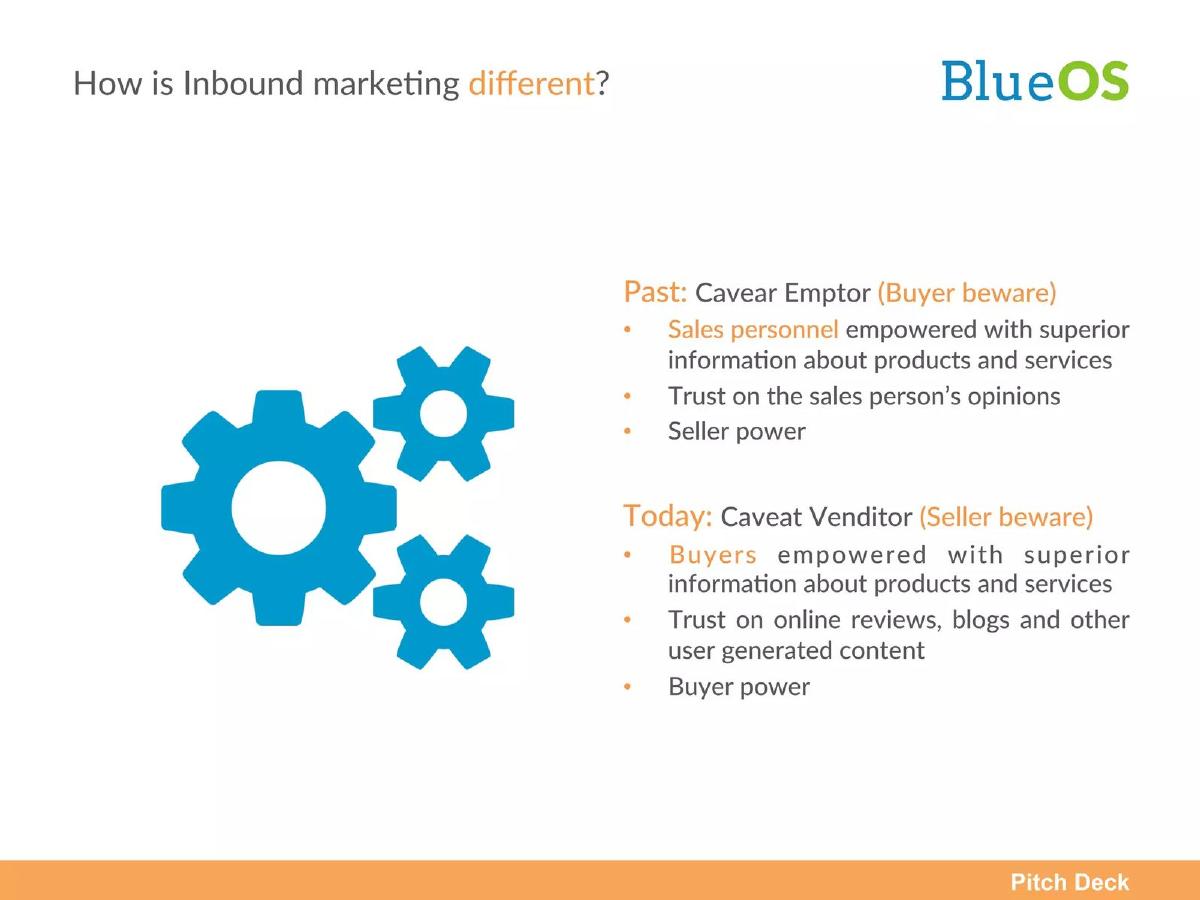
- BlueOS defines the market shift from 'Caveat Emptor' (Buyer beware) to 'Caveat Venditor' (Seller beware) on Slide 2.
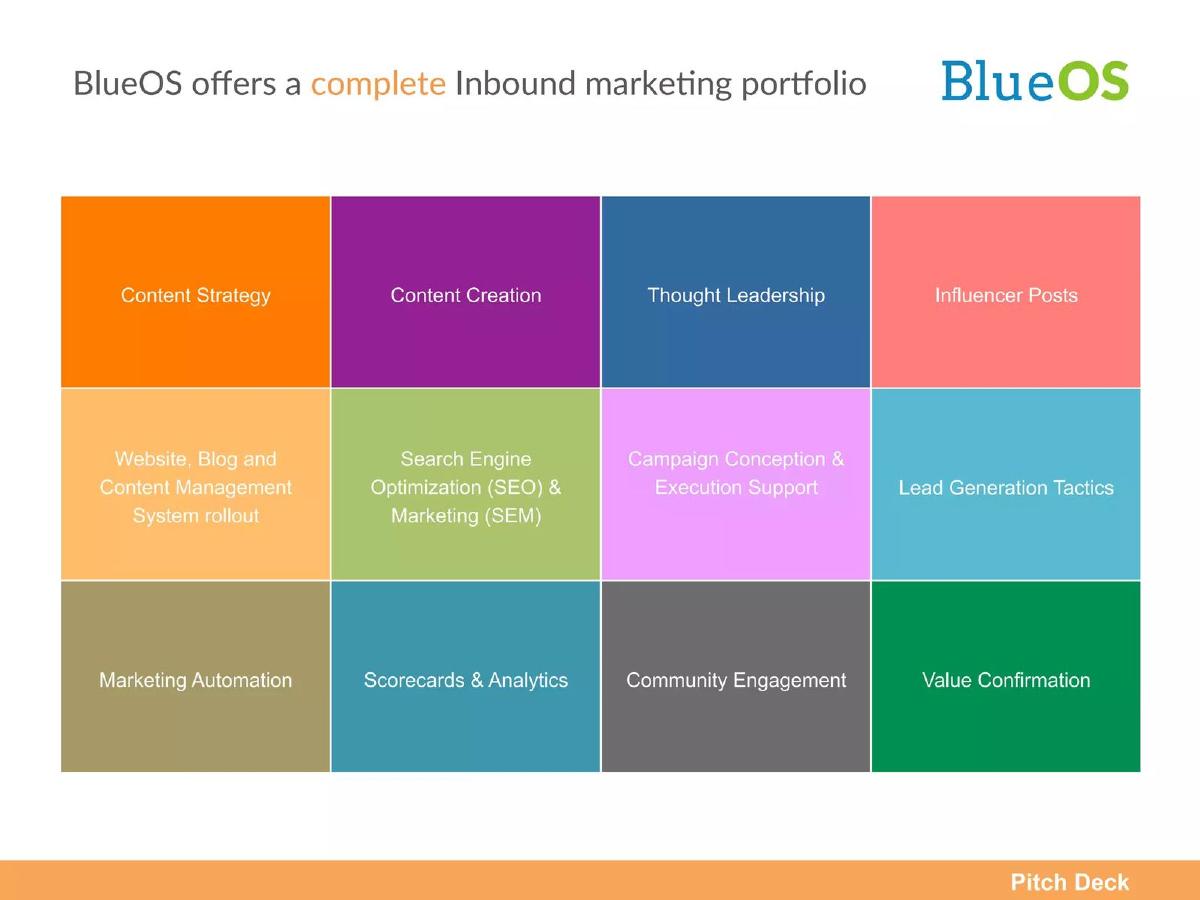
- The service offering is broad, listing 12 distinct areas including Content Strategy, SEO/SEM, and Marketing Automation on Slide 3.
- Geographic focus is split between North America (Wired, CIO Magazine) and Europe/UK (Computer Weekly, Heise Online) as shown on Slide 4.
- The company lists 13 different methodologies on Slide 4, including 'Design Thinking' and 'A/B Testing,' without explaining proprietary implementation.
- Unique value propositions are stated as qualitative skills: understanding mindset, connecting dots, and storytelling on Slide 5.
- The B2B case on Slide 7 emphasizes the complexity of enterprise procurement and the need for a 'broad content portfolio.'
- There is a total absence of financial data, team biographies, or a specific funding request in the analyzed slides.
BlueOS: The Agency Pitch in Startup Clothing
The BlueOS pitch deck is a curious example of a company using the visual language of a startup to sell what is fundamentally a professional services agency. While the name 'BlueOS' implies a software platform or an 'Operating System' for marketing, the content of the slides reveals a traditional agency model focused on content creation and strategy. The deck is heavy on industry philosophy and light on the metrics that professional investors require.
Slide 1: The Appeal to Authority
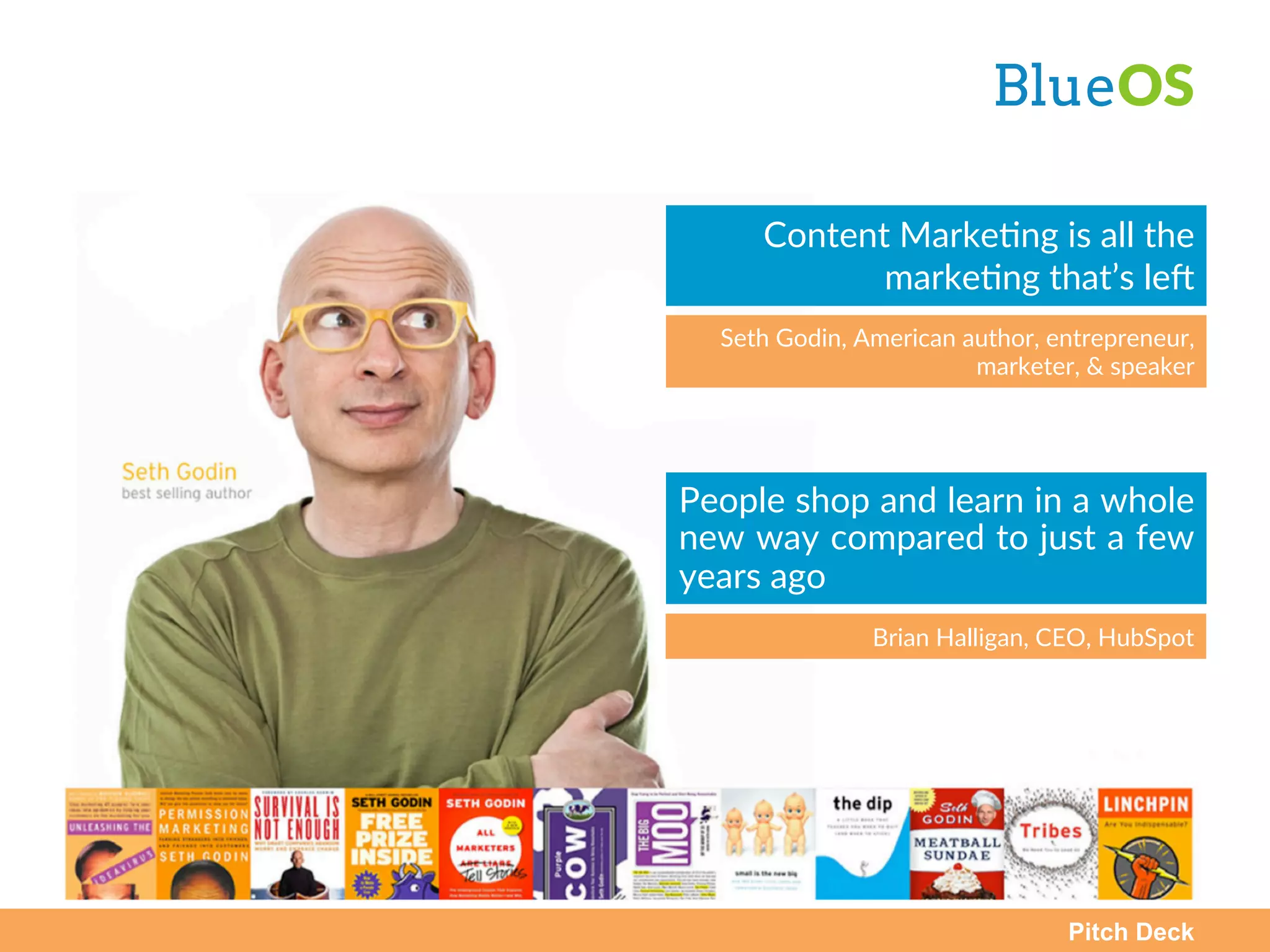
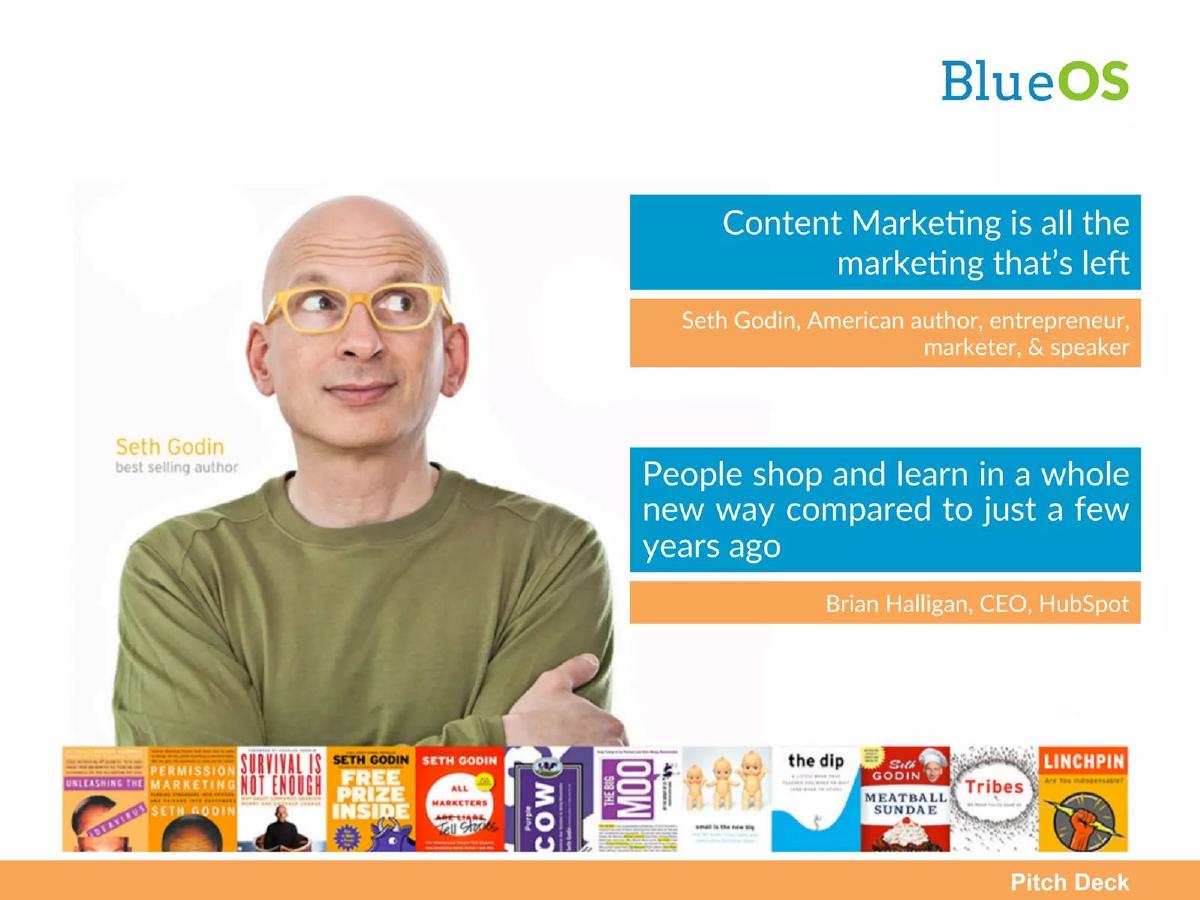
The cover slide sets the tone by not showing a product, but rather a celebrity endorsement of a concept. By featuring Seth Godin and a quote from HubSpot CEO Brian Halligan, BlueOS is attempting to ride the coattails of the 'Inbound Marketing' movement. The slide quotes Godin stating, "Content Marketing is all the marketing that’s left," and Halligan noting that "People shop and learn in a whole new way compared to just a few years ago." While this establishes the market trend, it does nothing to establish BlueOS as a leader within that trend. The inclusion of a row of Seth Godin book covers at the bottom further reinforces that this deck is selling a philosophy rather than a proprietary solution.
Slide 2: Market Dynamics and the 'Why'
Slide 2, titled "How is Inbound marketing different?" , attempts to define the problem/solution gap. It contrasts the 'Past' (Caveat Emptor) with 'Today' (Caveat Venditor). The slide notes that in the past, sales personnel held superior information, whereas today, "Buyers [are] empowered with superior information about products and services." This is a standard marketing theory slide. It identifies a shift in power from seller to buyer but fails to explain how BlueOS specifically captures the value created by this shift. The use of generic gear icons adds little visual value to the argument.
Slide 3: The Service Portfolio
This is the most informative slide regarding what BlueOS actually does. It presents a 12-block grid of services. The company claims to offer a "complete Inbound marketing portfolio," including:
Content Strategy and Content Creation · Thought Leadership and Influencer Posts · Website, Blog and CMS rollout · SEO & SEM · Campaign Conception & Execution Support · Lead Generation Tactics · Marketing Automation · Scorecards & Analytics · Community Engagement · Value Confirmation
From an investment perspective, this slide is a red flag. It describes a highly manual, labor-intensive service business. There is no mention of automation software or a platform that allows these services to scale without a linear increase in headcount.
Slide 4: Channels and Methodologies
Slide 4 lists the publications BlueOS targets and the methodologies they employ. The geographic reach is split between "The USA & Canada" (listing Wired, Information Week, and CIO Magazine) and "Europe & the UK" (listing Computer Weekly and Heise Online). The right side of the slide features a pyramid of 13 methodologies, ranging from "Insight Selling" and "Design Thinking" to "A/B Testing." This list is exhaustive to the point of being generic. By claiming to use every popular business methodology of the last decade, the company risks appearing as though it lacks a specific, focused approach.
Slide 5: The Uniqueness Claim
Slide 5 asks, "What makes us unique?" The answers provided are:
"We understand readers’ mindset" · "We are great in connecting the dots to create compelling content" · "We are great in storytelling" · "Writing is our passion"
For a venture capital pitch, these are weak differentiators. 'Passion' and 'storytelling' are not defensible moats. They are qualitative traits that almost every content agency claims to possess. There is no mention of proprietary data, exclusive contracts, or a unique technology stack that would prevent a competitor from doing the exact same thing.
Slide 6 & 7: Backup and the B2B Case
Slide 6 is a transition slide labeled "Backup." Slide 7 provides a "B2B Case" for why inbound marketing is relevant. It highlights that in large enterprises, "Purchases are strategic in nature and directly affect careers," and that "Multiple stakeholders with diverse expectations [are] involved in buying." The conclusion is that a "broad content portfolio is required" to meet these needs. This slide serves as a sales tool to convince a B2B CMO to hire an agency, but it doesn't serve as a compelling reason for an investor to fund the company.
What is Missing from the BlueOS Deck
The omissions in this deck are significant and would likely prevent it from moving past a first screening with most institutional investors. The following critical elements are missing: 1. The Team Slide: There is no information on who is running BlueOS. Investors back people, especially in service-oriented businesses. Without knowing the founders' backgrounds, it is impossible to judge the company's ability to execute. 2. Traction and Revenue: There are no charts showing growth, no mention of current billings, and no logos of existing clients. A pitch deck without traction is just a collection of ideas. 3. The Business Model: While the services are listed, the pricing model is not. Is it project-based? Retainer-based? Performance-based? The unit economics of how BlueOS makes money are absent. 4. The Competition: The deck ignores the massive landscape of content marketing agencies, SEO firms, and PR shops. Failing to acknowledge competition suggests a lack of market awareness. 5. The Ask: The most critical omission is the funding request. How much money does BlueOS need, and what will they do with it? Without an 'Ask,' this is a presentation, not a pitch.
What Founders Should Copy (and What to Avoid)
Copy: The Clear Service Grid. Slide 3 is a good example of how to clearly categorize a complex range of offerings. If you have multiple product tiers or service lines, a clean, color-coded grid is an effective way to communicate them quickly. Avoid: Over-reliance on Quotes. Using quotes from industry titans like Seth Godin (Slide 1) can help set the stage, but it shouldn't be the primary focus of your opening. Investors want to know what you think and what you have built, not what famous authors have said about your industry. Avoid: Qualitative Differentiators. Never list 'passion' or 'storytelling' as your unique selling points (Slide 5). These are 'table stakes'—the bare minimum required to enter the market. Instead, focus on quantitative advantages like '30% lower CAC than the industry average' or 'Proprietary AI that reduces content production time by 50%.'
Final Verdict
The BlueOS deck is a classic example of a 'lifestyle business' pitch. It describes a company that could be very successful as a boutique agency, providing high-quality services to a handful of large B2B clients. However, as a startup pitch, it fails to demonstrate the scalability, technical innovation, or financial transparency required to attract venture capital. The deck spends too much time selling the category of inbound marketing and not enough time selling the company BlueOS.
Frequently asked questions
- What is the core product of BlueOS?
- Based on Slide 3, BlueOS appears to be a full-service inbound marketing agency rather than a software company. They offer a 'complete Inbound marketing portfolio' covering content creation, SEO, lead generation, and community engagement. There is no mention of a proprietary 'Operating System' or software platform despite the 'OS' suffix in their name.
- Does the deck show any traction or revenue?
- No. The provided slides contain zero mentions of current revenue, number of clients, or growth percentages. The deck is purely conceptual and service-oriented, focusing on the 'why' of inbound marketing rather than the 'how much' of the business's performance.
- Who is the target audience for BlueOS?
- Slide 7 indicates a focus on B2B large enterprises. The company highlights that purchases in this sector are 'strategic in nature' and involve 'multiple stakeholders with diverse expectations.' Their channel list on Slide 4 further suggests a focus on tech-heavy publications like Wired and CIO Magazine.
- What is the company's competitive advantage?
- The deck struggles to define a technical moat. Slide 5 claims they are unique because they 'understand readers' mindset' and 'writing is our passion.' These are subjective service-level claims that do not represent a scalable or defensible competitive advantage in a venture capital context.
- Is there a clear call to action for investors?
- No. The deck ends with a 'Backup' divider (Slide 6) and a B2B case study (Slide 7). There is no slide detailing the amount of capital being raised, the valuation, or the intended use of funds. This suggests the deck may be used more for sales or general partnership introductions than a formal investment round.