BlueOcean’s Series B deck is a masterclass in positioning a software solution against a legacy service-based industry. By framing traditional market research as a slow, survey-based relic of the past, BlueOcean highlights its 26x speed advantage and 90% cost reduction. The deck emphasizes rapid execution, moving from founding in 2019 to $1M ARR in just over a year, and managing $18 trillion in brand value by mid-2021. While the deck is light on specific financial modeling and unit economics, it leans heavily on social proof through a high-caliber team and an impressive roster of enterprise cl…
Key takeaways
- BlueOcean positions itself as a disruptor to the $74 billion market research industry (Slide 2).
- The company claims a significant efficiency advantage: 10% of the cost and 26x faster than traditional methods (Slide 4).
- The 'Cookie Apocalypse' and privacy changes by Google and Apple are cited as primary market drivers (Slide 3).
- The platform achieved $1M ARR by September 1, 2020, approximately 14 months after founding (Slide 11).
- BlueOcean reports informing more than $18 trillion in brand value as of May 2021 (Slide 2).
- The team features leadership with experience at NASA, Microsoft, Disney, and Salesforce (Slide 6).
- The company identifies a $1.4 billion Serviceable Obtainable Market (SOM) specifically in Brand Tracking (Slide 7).
- The deck highlights a viral growth loop where agencies and consultants share dashboards across intercompany networks (Slide 13).
Executive Summary and Traction
Slide 1: Title Slide
The deck opens with the company name, BlueOcean, and the subtitle 'The Leader in Automated Always-On Brand Tracking.' The branding is clean and professional, establishing the core category immediately.
Slide 2: The Vision and High-Level Metrics
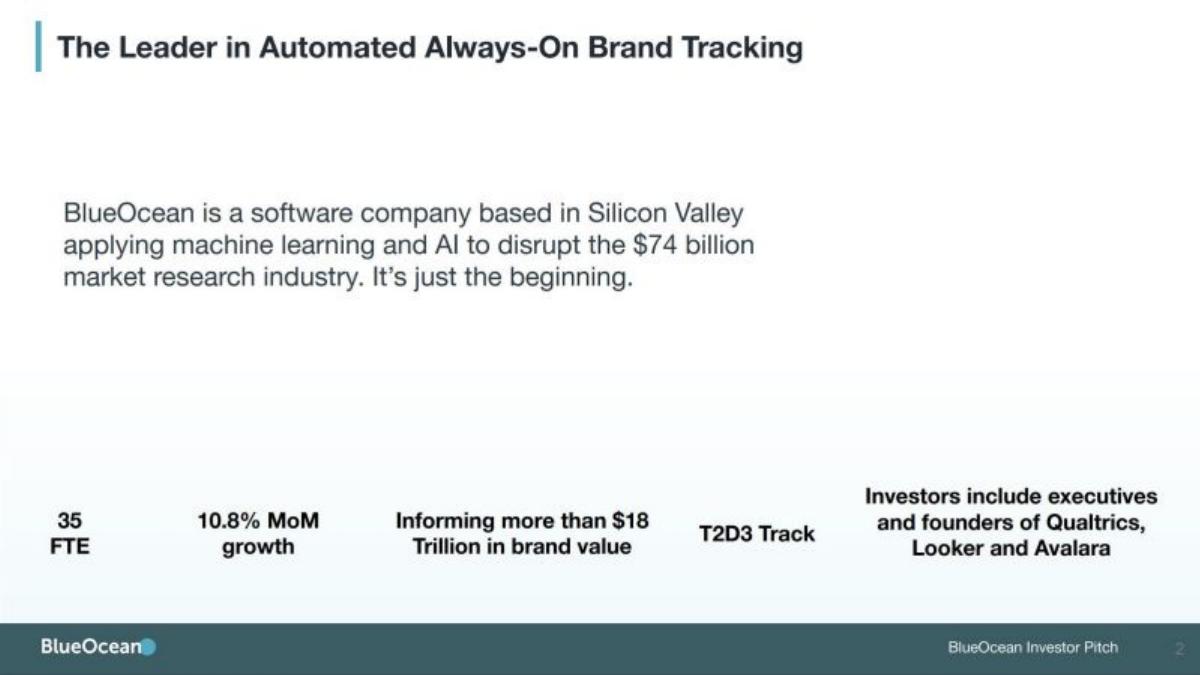
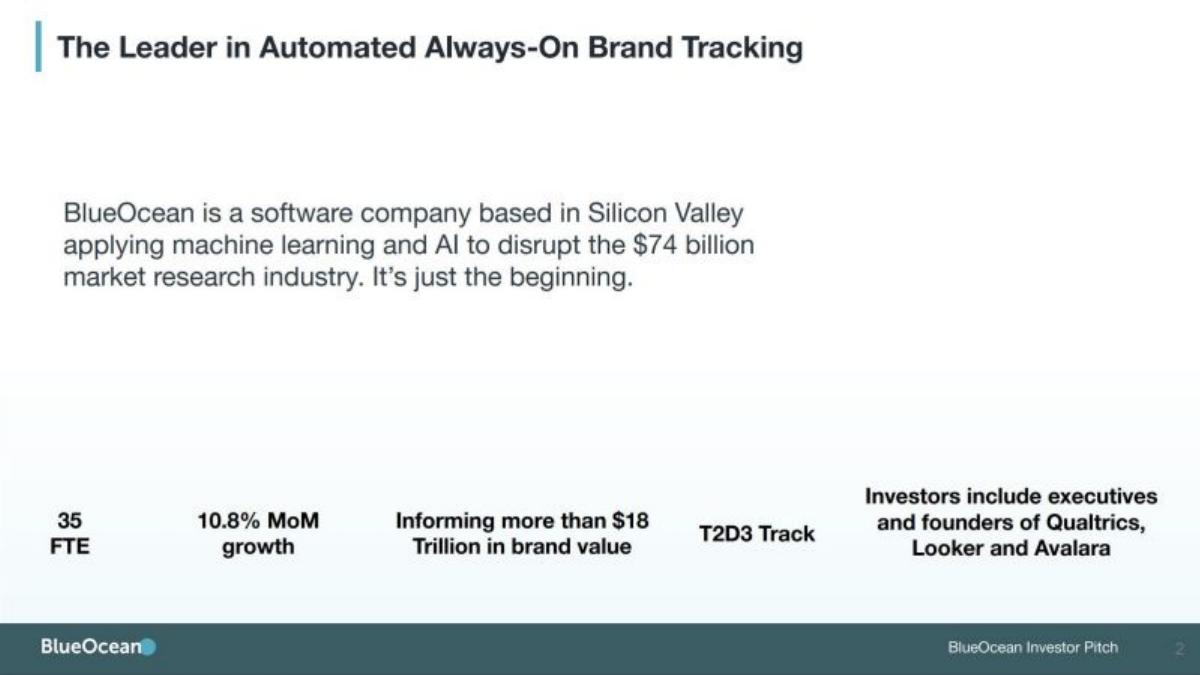
This slide serves as a summary of the company's status. It defines BlueOcean as a Silicon Valley software company using AI to disrupt the $74 billion market research industry . Key metrics listed include: 35 FTE (Full-Time Equivalents), 10.8% MoM growth , and informing more than $18 Trillion in brand value . It also mentions they are on a 'T2D3 Track' and lists high-profile investors from Qualtrics, Looker, and Avalara. This slide is designed to establish immediate credibility through scale and growth velocity.
The Problem and Market Opportunity
Slide 3: Marketing is Broken
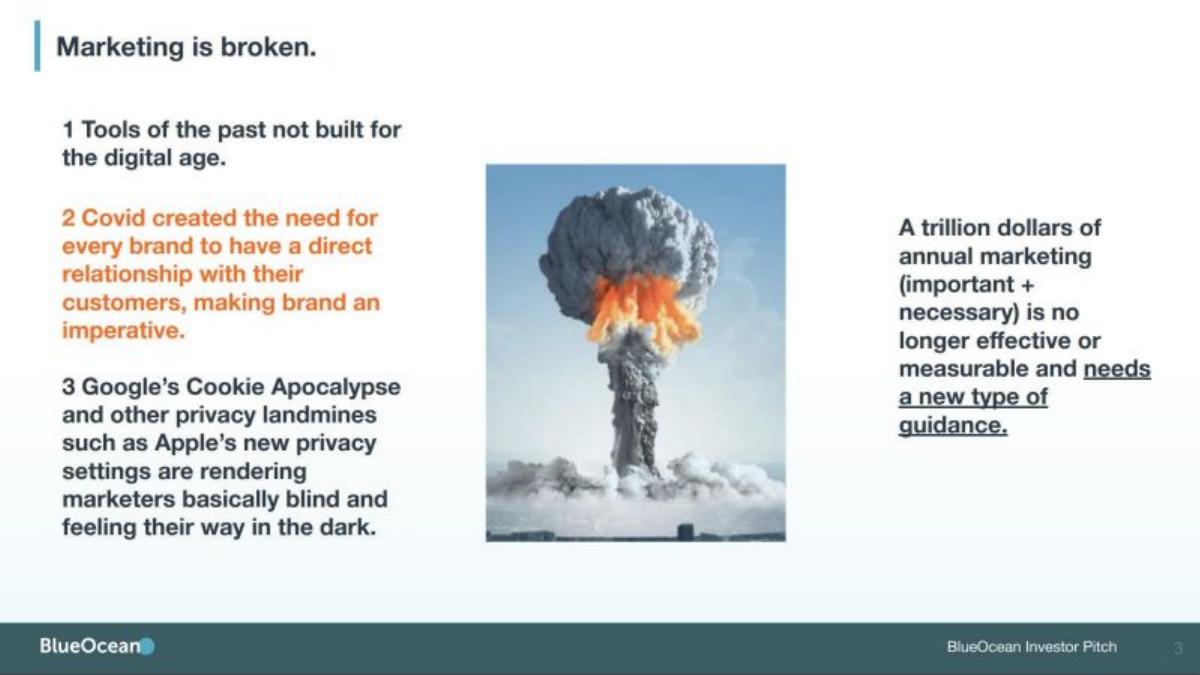
BlueOcean identifies three catalysts for their solution. First, legacy tools are not built for the digital age. Second, Covid-19 forced brands to seek direct customer relationships. Third, 'Google’s Cookie Apocalypse' and Apple’s privacy settings are rendering traditional marketers 'blind.' The slide concludes that a trillion dollars of annual marketing spend needs a new type of guidance because it is no longer effectively measurable.
Slide 4: The Solution - Old Way vs. BlueOcean Way
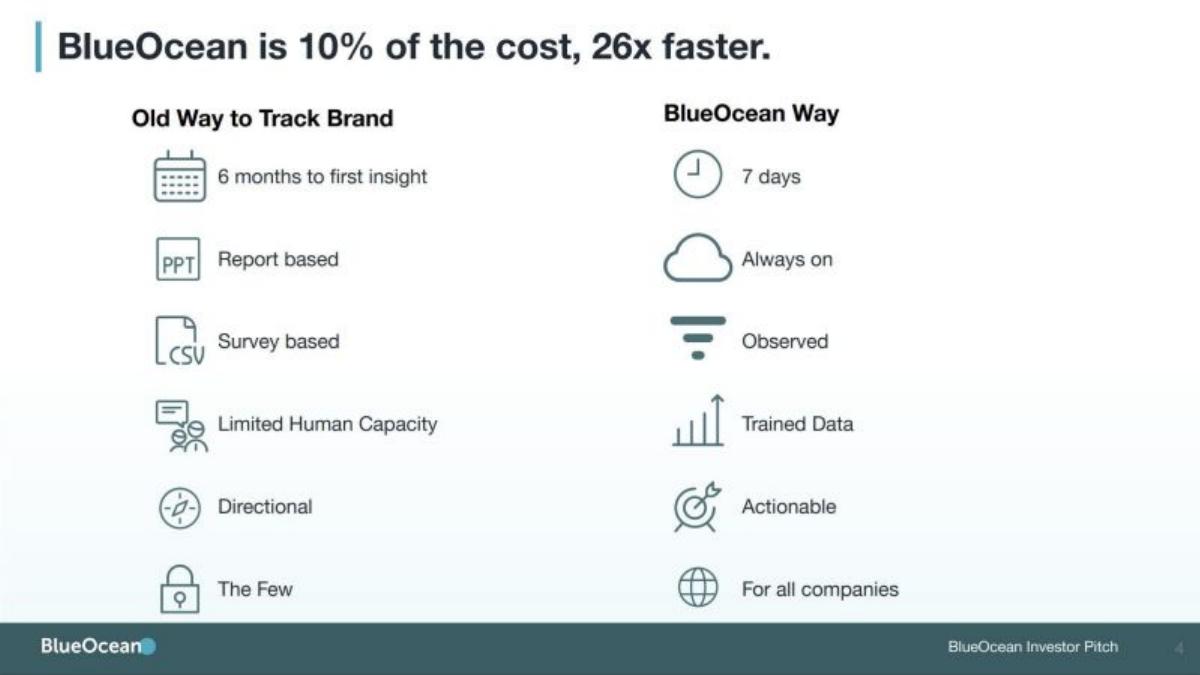
This is a classic comparison slide. The 'Old Way' is characterized by 6 months to first insight, report-based delivery, and limited human capacity. The 'BlueOcean Way' promises insights in 7 days , an 'always on' cloud platform, and trained data that is actionable for all companies. The headline claims BlueOcean is 10% of the cost and 26x faster .
Slide 5: Customer Testimonial
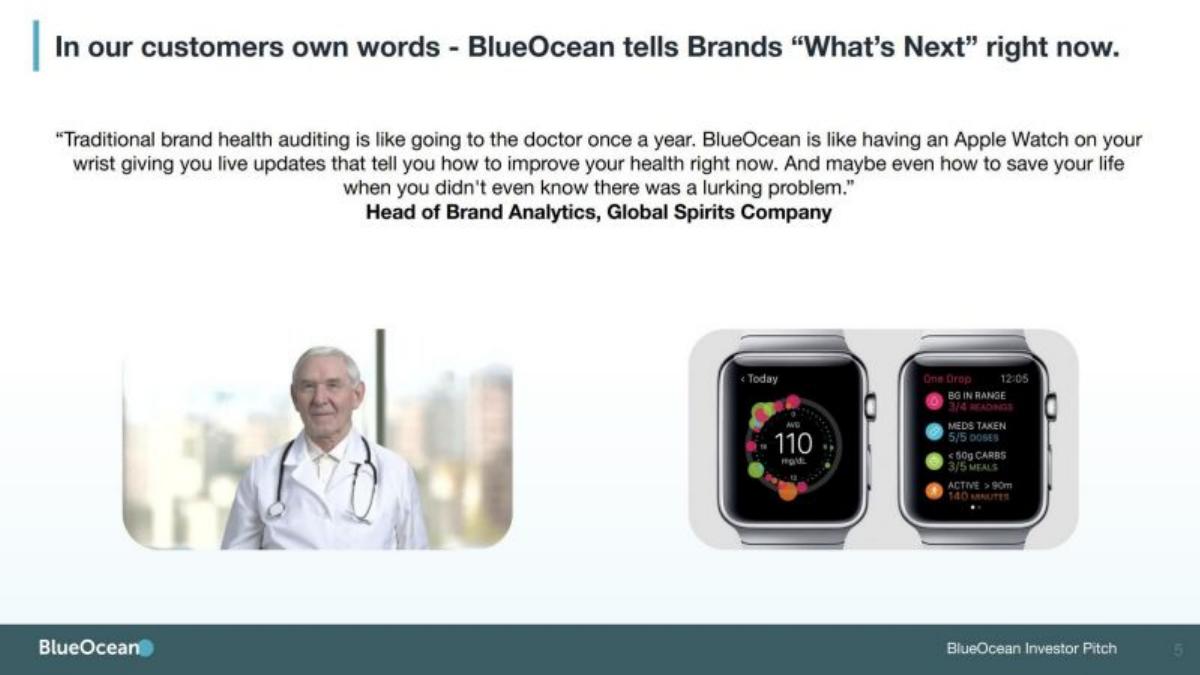
The deck uses a quote from the Head of Brand Analytics at a Global Spirits Company. The customer compares traditional auditing to a yearly doctor's visit, while BlueOcean is likened to an 'Apple Watch on your wrist giving you live updates.' This analogy effectively communicates the shift from reactive to proactive brand management.
The Team and Market Size
Slide 6: Team and Advisors
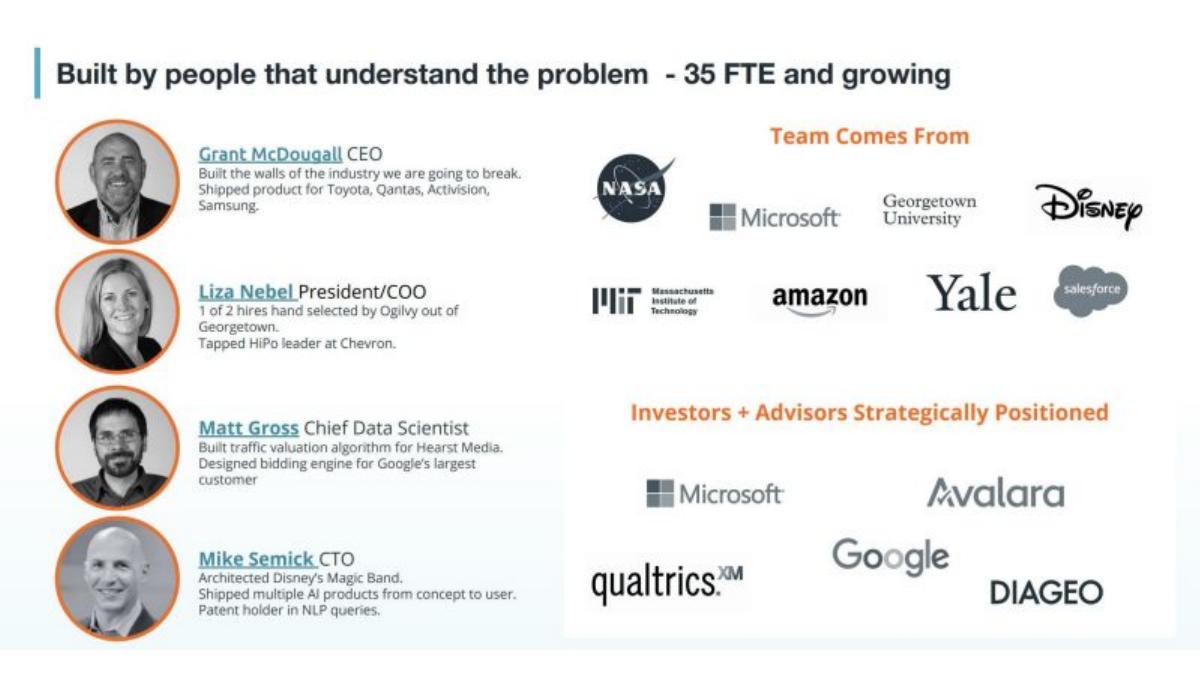
The team slide highlights four key leaders: Grant McDougall (CEO), Liza Nebel (President/COO), Matt Gross (Chief Data Scientist), and Mike Semick (CTO). Their backgrounds include building industry standards and shipping products for Toyota, Disney, and Google. The slide also features a logo wall of former employers and current investors/advisors, including NASA, Microsoft, Amazon, Yale, and Salesforce . This is a high-pedigree team slide intended to de-risk the execution for Series B investors.
Slide 7: Total Addressable Market (TAM)
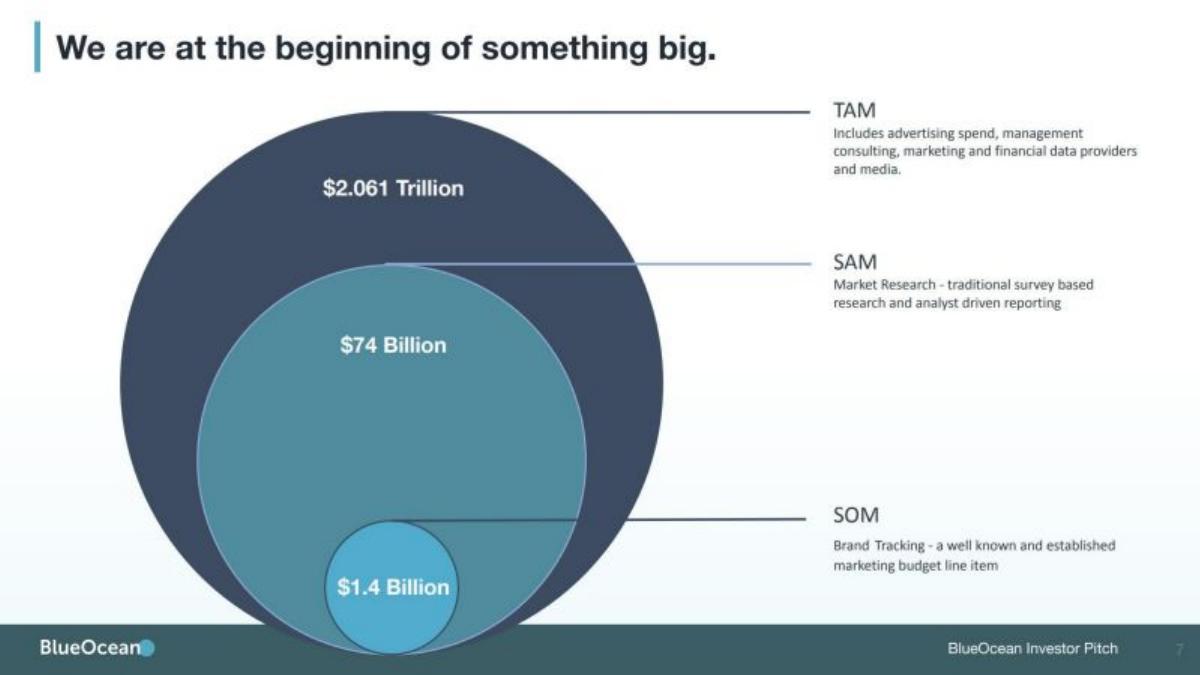
BlueOcean presents a nested circle diagram for market size. The TAM is cited as $2.061 Trillion (including advertising spend and management consulting). The SAM (Serviceable Addressable Market) is the $74 Billion market research industry. The SOM (Serviceable Obtainable Market) is identified as $1.4 Billion for Brand Tracking specifically. By starting with a massive TAM, they suggest significant room for horizontal expansion.
Slide 8: Adjacent Markets
This slide expands on the SOM, showing Brand Tracking as a 'gateway' to larger markets: Management Consulting ($160Bn), Data Providers ($82Bn), and Creative Automation ($520M). This reinforces the narrative that while they are starting with brand tracking, the platform's utility extends into much larger budget line items.
Product and Social Proof
Slide 9: Technical Moat
The deck provides a high-level architectural view of their 'differentiated core/moat,' which they nickname 'DAVY JONES LOCKER.' The process involves ingesting 'Data in the wild,' transforming it, and sharing it to drive action. It lists the types of questions the platform answers, such as 'How much should I spend?' and 'Why is my loyalty falling?' This slide attempts to explain the 'how' without getting bogged down in technical jargon.
Slide 10: Customer Logo Wall
A dense slide featuring 21 logos of major enterprise clients. Notable names include Microsoft, Google, Cisco, Panda Express, Bloomingdale’s, Alteryx, Smirnoff, and Disney . The headline states they work across B2B, B2C, and any vertical, proving the platform's versatility.
Slide 11: Progress Timeline
This timeline shows the company's trajectory from July 3, 2019, to May 2021. Key milestones include: first paying customer (Nov 2019), $1M ARR (Sept 1, 2020) , and reaching $18B in market cap being managed (May 2021). The rapid progression from founding to $1M ARR in 14 months is a strong signal of product-market fit.
Slide 12: Viral Growth Mechanics
This slide explains how BlueOcean spreads. It describes a 'viral' effect where agencies or consultants share dashboards with multiple brands (ABC Co. and DEF Co.). It also mentions that high employee attrition in marketing (17%) actually helps them grow, as marketers take the tool with them to new companies. This addresses the 'Go-To-Market' strategy by showing low-cost acquisition channels.
The Ask
Slide 13: The Objective
The final slide outlines the purpose of the raise. The goals are to drive more sales, launch a new product and API access, and move into adjacent markets. The 'Why Now' is stated as 'Get this done before anybody even sees us coming.' Notably, this slide does not state the specific dollar amount being raised, though catalogue facts indicate the round was $30M.
What Works and What is Missing
What Works
Clear Value Prop: The 10% cost / 26x speed comparison is a compelling hook for any investor. · Velocity: The timeline on Slide 11 clearly demonstrates that this is a 'rocket ship' trajectory, reaching $1M ARR very quickly. · Social Proof: The combination of the high-pedigree team (Slide 6) and the blue-chip logo wall (Slide 10) makes the company look like an established leader rather than a risky startup. · Market Context: Leveraging the 'Cookie Apocalypse' provides a sense of urgency and a 'Why Now' that is grounded in industry-wide shifts.
What is Missing
Financial Specifics: While it mentions $1M ARR and MoM growth, there is no detailed breakdown of current ARR, gross margins, or burn rate. · Unit Economics: There is no mention of Customer Acquisition Cost (CAC) or Lifetime Value (LTV), which are standard for a Series B deck. · Competitive Landscape: The deck compares itself to 'The Old Way' (manual research) but does not name or analyze other AI-driven competitors in the brand intelligence space. · The Ask: The deck lacks a specific funding amount and a detailed 'Use of Funds' breakdown beyond general categories.
What a Founder Should Copy
The Comparison Slide: Slide 4 is an excellent way to visualize a '10x better' solution. It uses simple icons and clear metrics to contrast the old vs. new. · The Gateway Market Strategy: Slide 8 is a great way to show investors that while your initial market (SOM) might seem small, it is a strategic entry point into much larger pools of capital. · The Analogy: Using a customer's 'Apple Watch vs. Doctor's Visit' analogy (Slide 5) is much more effective than a dry technical description of real-time data.
Frequently asked questions
- What is BlueOcean's core value proposition?
- BlueOcean provides an automated, always-on brand tracking platform that replaces traditional, survey-based market research. According to slide 4, they deliver insights in 7 days compared to the traditional 6 months, at 10% of the cost. They use machine learning to analyze 'data in the wild' to provide actionable recommendations for executive leadership.
- How fast has BlueOcean grown since its founding?
- The company has demonstrated rapid scaling. Founded in July 2019, they reached their first $1M in ARR by September 2020. By May 2021, they claimed to be managing $18 trillion in brand value. Slide 2 also notes a 10.8% month-over-month growth rate, positioning them on a 'T2D3' (Triple, Triple, Double, Double, Double) growth track.
- Who are BlueOcean's primary customers?
- BlueOcean targets large enterprise B2B and B2C brands. Slide 10 displays a logo wall including Microsoft, Google, Cisco, Disney, Smirnoff, and Clorox. Their first paying customer was Panda Express, signed in November 2019, just four months after the company was founded.
- What market problem is BlueOcean solving?
- Slide 3 identifies three main issues: tools not built for the digital age, the post-Covid need for direct customer relationships, and the 'Cookie Apocalypse.' They argue that privacy changes from Apple and Google are making traditional marketing measurement 'blind,' necessitating their AI-driven, observational approach.
- What are the key components of BlueOcean's technology?
- The deck refers to their core technology as 'Davy Jones Locker' on slide 9. This engine ingests 'data in the wild' (what businesses say, how they perform, and what people say about them), transforms it through their proprietary moat, and shares actionable insights to answer strategic questions about spend and content strategy.