Blockit’s 20-slide deck from December 2017 presents a multi-phase strategy to modernize the US healthcare referral system. The company identifies a massive inefficiency: 899 million annual appointments, 50% of which are referrals, yet only 55% of patients follow through. Blockit proposes an 'OpenTable for referral scheduling' as a Phase 1 entry point to capture immediate value. The 'secret sauce' lies in a proprietary integration engine that claims to reduce EMR implementation time from months to just 1-2 days. While the deck leans heavily into the 2017 blockchain trend as a long-term vision…
Key takeaways
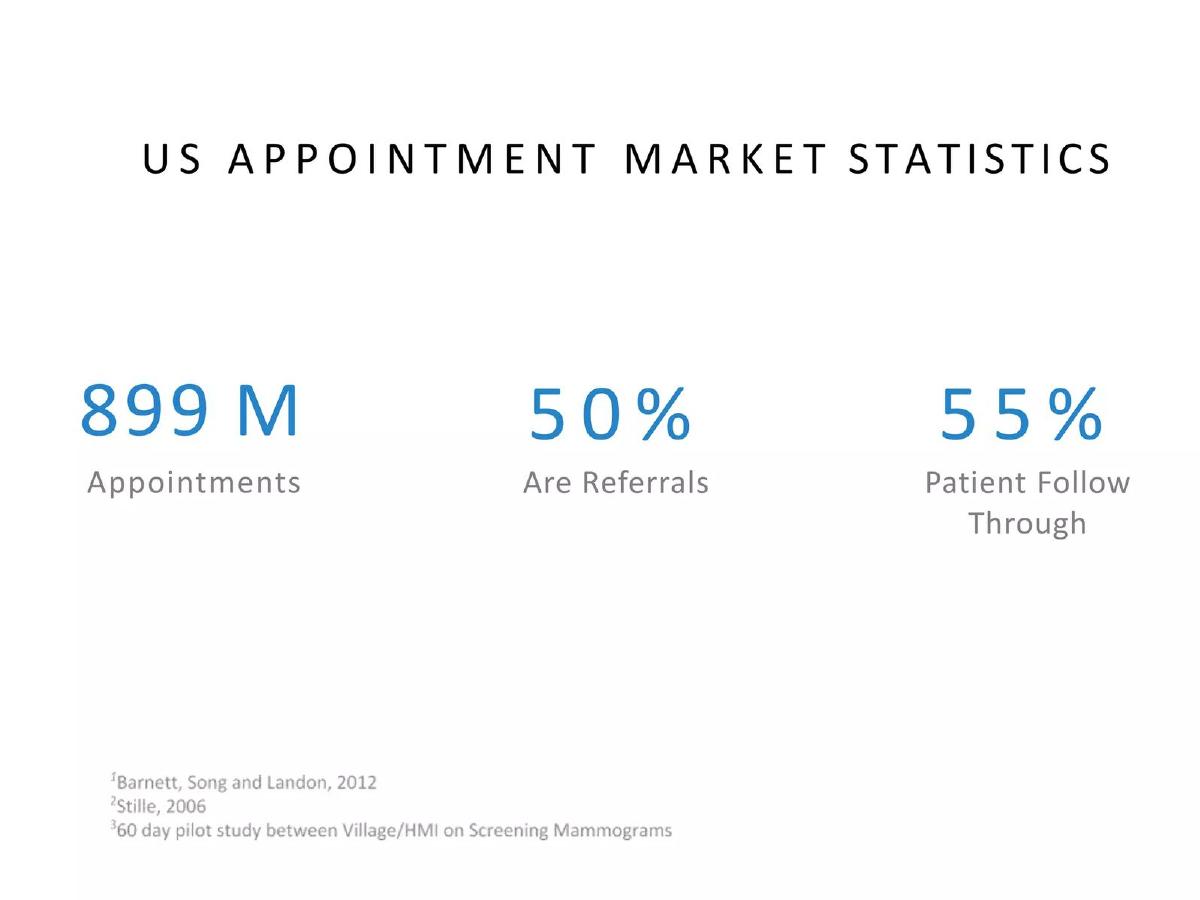
- The US market consists of 899 million appointments annually, with 50% being referrals (Slide 3).
- Baseline patient follow-through on referrals is only 47%, a metric Blockit claims to improve to 90.1% in their MVP (Slides 5, 7).
- Traditional EMR integration costs $3k-$25k and takes 1-6 months; Blockit claims their engine takes 1-2 days with no 3rd party dependencies (Slide 10).
- The revenue model is based on a $1 fee per appointment plus a $25 monthly fixed fee per provider (Slide 11).
- Blockit uses a three-phase roadmap: Entry (Appointment), Expand (Patient Experience), and Open Platform (Democracy/Blockchain) (Slides 13-15).
- The leadership team includes Steve, a former Chief Architect at BigCommerce and co-founder of TwitPic (Slide 18).
- The deck identifies a $1.3B base opportunity at a 40% operating income margin for the initial phases (Slide 17).
- The company lists major healthcare partners including Universal American, TXCIN, Catalyst Health Network, and Baylor Scott & White (Slide 13).
Blockit Pitch Deck Teardown
The Blockit Seed Round deck, dated December 2017, is a classic example of a 'wedge strategy.' It identifies a massive, high-friction problem in a legacy industry—healthcare referrals—and proposes a simple, transactional solution to gain entry before expanding into a more ambitious infrastructure play. In the context of 2017, the inclusion of blockchain was a common way to signal future-proofing and data security, though the core value proposition remains the efficiency of the scheduling engine.
Slide 1-2: The Vision and Thesis
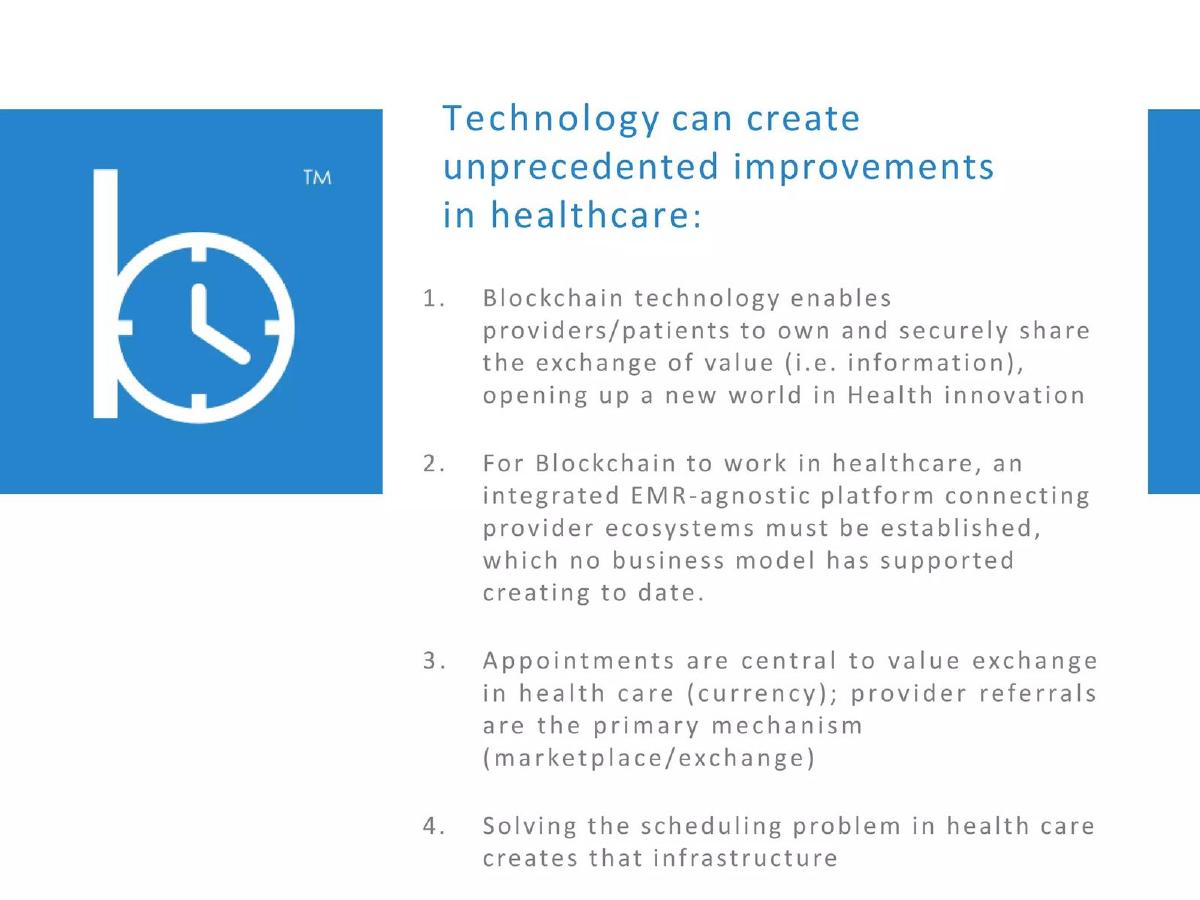
The deck opens with a clean title slide and immediately moves into a four-point thesis. Blockit argues that while blockchain can improve healthcare by allowing secure information exchange, it requires an 'EMR-agnostic platform' to work. They identify appointments as the 'currency' of healthcare and referrals as the primary 'exchange' mechanism. The logic is clear: if you control the scheduling, you control the infrastructure of the value exchange.
Slide 3-5: Market Size and Problem Definition
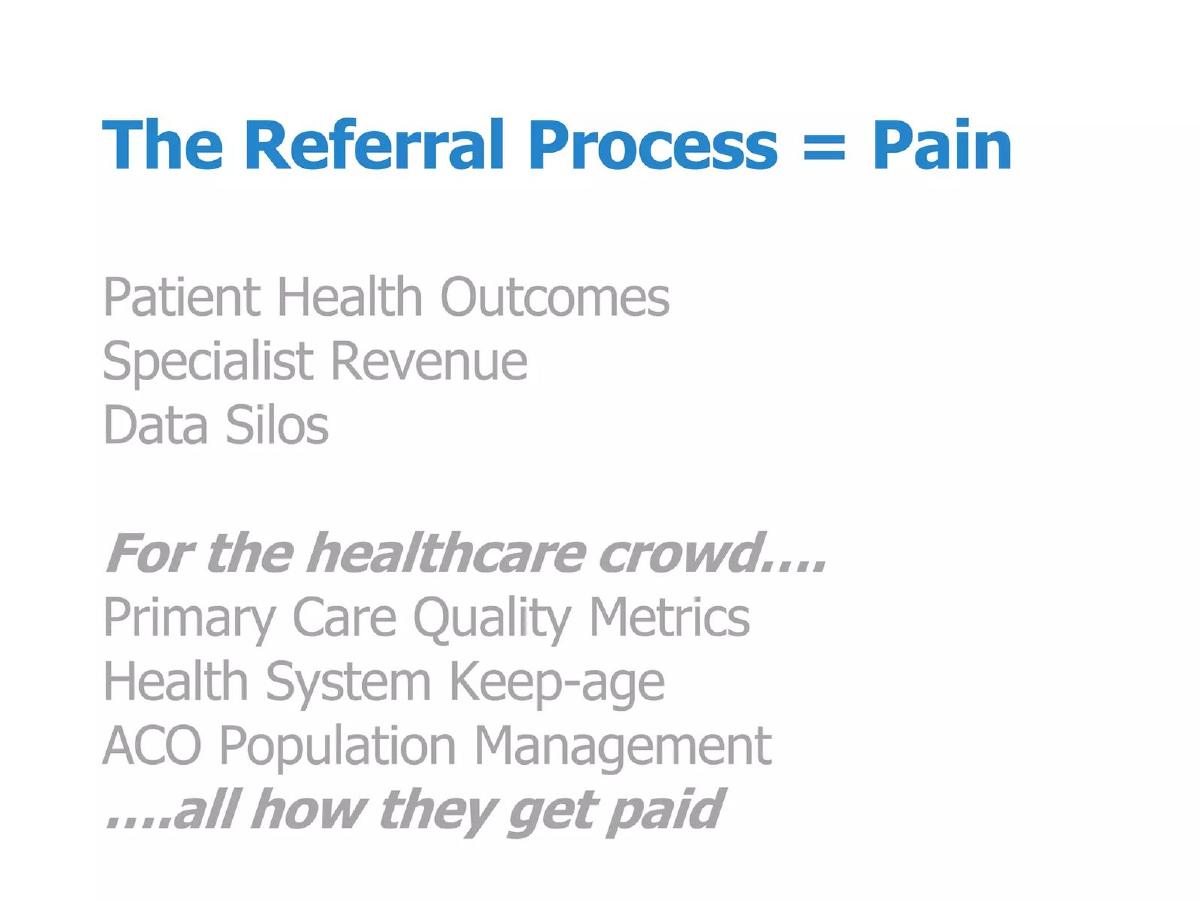
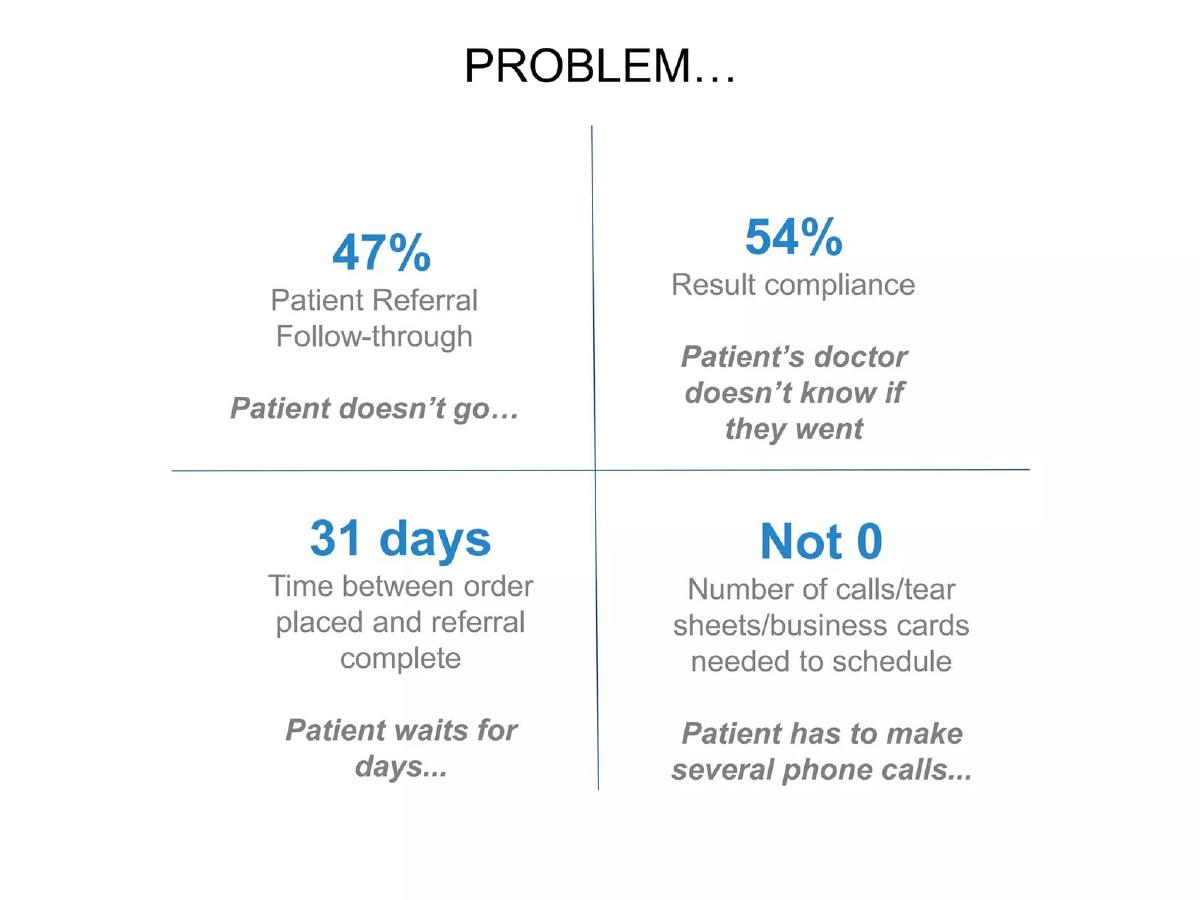
Slide 3 provides the macro context: 899 million appointments in the US, with 50% being referrals and a dismal 55% follow-through rate. The deck cites sources like Barnett, Song, and Landon (2012) to ground these figures. Slide 4 and 5 drill down into the 'Pain.' The referral process is described as a series of data silos that hurt patient outcomes and specialist revenue. Key metrics on Slide 5 highlight the inefficiency: a 31-day wait time for referrals and the fact that patients must make several phone calls to schedule a single visit.
Slide 6-7: The 'OpenTable' Solution and MVP Results
Blockit positions itself as the 'OpenTable for referral scheduling.' This is a strong, recognizable analogy for investors. Slide 7 is the most critical slide for traction, showing MVP results that significantly outperform the baseline. They claim 90.1% patient follow-through (vs. 47% baseline) and 3.8 days to complete a referral (vs. 31 days baseline). Achieving 100% result report compliance is a major selling point for primary care physicians who are often left in the dark after making a referral.
Slide 8-10: Competitive Landscape and Secret Sauce
Slide 8 acknowledges that there are at least 50 other referral platforms but argues they only track the process 'after' the patient arrives, failing to solve the 'no-show' problem. Slide 10 introduces the 'Secret Sauce': the integration engine. It contrasts 'Traditional' integration (1-6 months, $3k-$25k cost, 3rd party dependencies) with Blockit’s approach ( 1-2 days , simple 2-party engagement, no 3rd party permissions). This is a bold claim in the healthcare IT space, where EMR interoperability is notoriously difficult.
Slide 11-12: Revenue Model and Entry Strategy
The business model is straightforward: $1 per appointment and a $25 monthly fee per provider. Slide 12 outlines the 'Entry Point Strategy,' which involves leveraging existing referral platforms' customer bases rather than selling to every doctor's office individually. They set a goal to reach 10,000 providers by the end of 2019.
Slide 13-16: The Three-Phase Roadmap
Phase 1 (Entry): Focus on the 'Appointment' and driving adoption through partners like Universal American and Baylor Scott & White. · Phase 2 (Expand): Focus on 'Patient Experience,' capturing data on the blockchain, and enabling charitable care scheduling. · Phase 3 (Open Platform): Achieving 'Democracy' where patients and providers own their data with no EMR lock-in.
Slide 16 visualizes this 'Long Term Vision' with a map of Texas, suggesting a regional density strategy before national expansion.
Slide 17: Financial Opportunity
Slide 17 quantifies the opportunity. By multiplying 899M appointments by the $1 fee and 1.2M providers by the $25 fee, they arrive at a $1.3B base opportunity . They project a 40% Operating Income (OpInc) margin, which is typical for a high-scale SaaS/transactional platform.
Slide 18-20: Team and Conclusion
The leadership team slide features three founders. The standout is Steve, the Product & Engineering lead, whose background at BigCommerce and TwitPic (acquired by Twitter) provides the necessary technical credibility for the ambitious integration and blockchain claims. The deck concludes with a vision summary and a 'Thank You' slide.
What Blockit Does Well
Strong Analogy: Using 'OpenTable for healthcare' immediately communicates the user experience and the marketplace dynamics of the product without needing deep technical explanation.
Metric-Driven Problem/Solution: The deck does an excellent job of pairing industry pain points (31-day waits) directly with MVP results (3.8-day waits). This makes the value proposition feel tangible and proven.
Clear Wedge Strategy: By starting with a simple scheduling tool to solve a high-pain problem, they create a path toward their much more complex goal of blockchain-based data democratization.
What is Missing from the Blockit Deck
The Ask: The most significant omission is a specific funding request. While the deck is labeled 'Seed Round,' it does not state how much capital is being raised, the valuation, or the specific use of proceeds (e.g., hiring 5 engineers, marketing spend).
Unit Economics: While they provide a macro revenue model ($1/appt), they do not detail the Customer Acquisition Cost (CAC) or the Lifetime Value (LTV) of a provider, which is crucial for a seed-stage investment.
Competitive Detail: Slide 8 mentions '50 referral platforms' but doesn't name them or provide a feature-by-feature comparison. Investors would want to know how Blockit defends against a legacy EMR simply building their own scheduling tool.
Founder Takeaways: What to Copy
The 'Secret Sauce' Comparison: Slide 10 is a masterclass in showing, not just telling, a competitive advantage. By placing the 'Traditional' messy flowchart next to the 'Blockit' streamlined version, they make their technical superiority look obvious.
Phased Ambition: Don't lead with your most 'out there' idea (like blockchain democratization) if it's hard to monetize on day one. Follow Blockit’s lead: solve a boring, expensive problem first (scheduling), and use that to fund the revolution.
Partner-Led Growth: Instead of a 'boots on the ground' sales strategy, Blockit identifies 'Referral Platforms' as their distribution channel. This shows they understand how to scale efficiently in a crowded market.
Frequently asked questions
- What is the primary problem Blockit is trying to solve?
- Blockit targets the 'pain' of the healthcare referral process. According to the deck, the current system suffers from 31-day wait times between orders and completed referrals, low result compliance (54%), and a lack of digital scheduling, forcing patients to make several phone calls. This leads to poor patient outcomes and lost revenue for specialists.
- How does Blockit plan to generate revenue?
- The business model is two-pronged for its initial phases: a $1 transaction fee per appointment (which they note is less than 1% of transaction value) and a low fixed monthly fee of approximately $25 per provider for integration. They also mention a revenue-sharing model with referral platforms to drive adoption.
- What is the significance of blockchain in this deck?
- Blockchain is presented as the long-term infrastructure (Phase 3). Blockit aims to use scheduling as a 'Trojan Horse' to establish a blockchain network that allows patients and providers to own their data without EMR lock-in. They even mention future concepts like 'blockchain masternodes' and a 'proof of stake revenue model' in Slide 14.
- Who are the key members of the leadership team?
- The deck highlights three leaders: Jon (Operations & Sales, serial entrepreneur), Jake (Sales & Product, HIT background), and Steve (Product & Engineering). Steve is the most technically distinguished, cited as the former Chief Architect at BigCommerce and co-founder/CTO of TwitPic, which was acquired by Twitter.
- What traction or validation does the deck provide?
- Blockit provides MVP results comparing their performance to industry baselines. They claim to have reduced the time between order and referral completion from 31 days to 3.8 days and increased patient follow-through from 47% to 90.1%. They also list four significant healthcare networks as partners on Slide 13.