Blitzy’s 10-slide deck is a masterclass in efficiency, focusing heavily on the technical 'how' and the team's credentials to justify a $4.4M Seed round. The company positions itself against existing AI coding assistants by promising a full-lifecycle solution rather than a mere point solution. By highlighting a transition from a services-based 'dogfooding' model to a scalable PLG platform, the founders address the common 'agency trap' head-on. The deck relies on a massive $1.2T TAM and the technical moat of 27 GenAI patents held by the CTO. While it lacks specific financial projections or curr…
Key takeaways
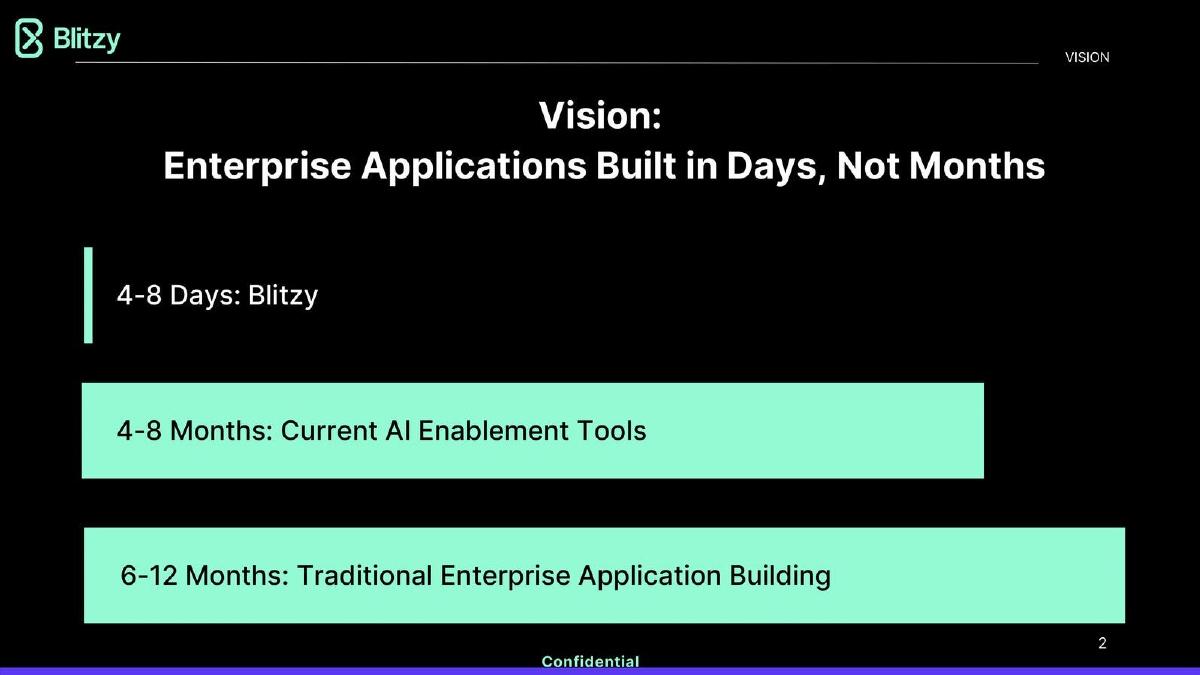
- The deck claims Blitzy can build enterprise applications in 4-8 days, compared to 6-12 months for traditional methods (Slide 2).
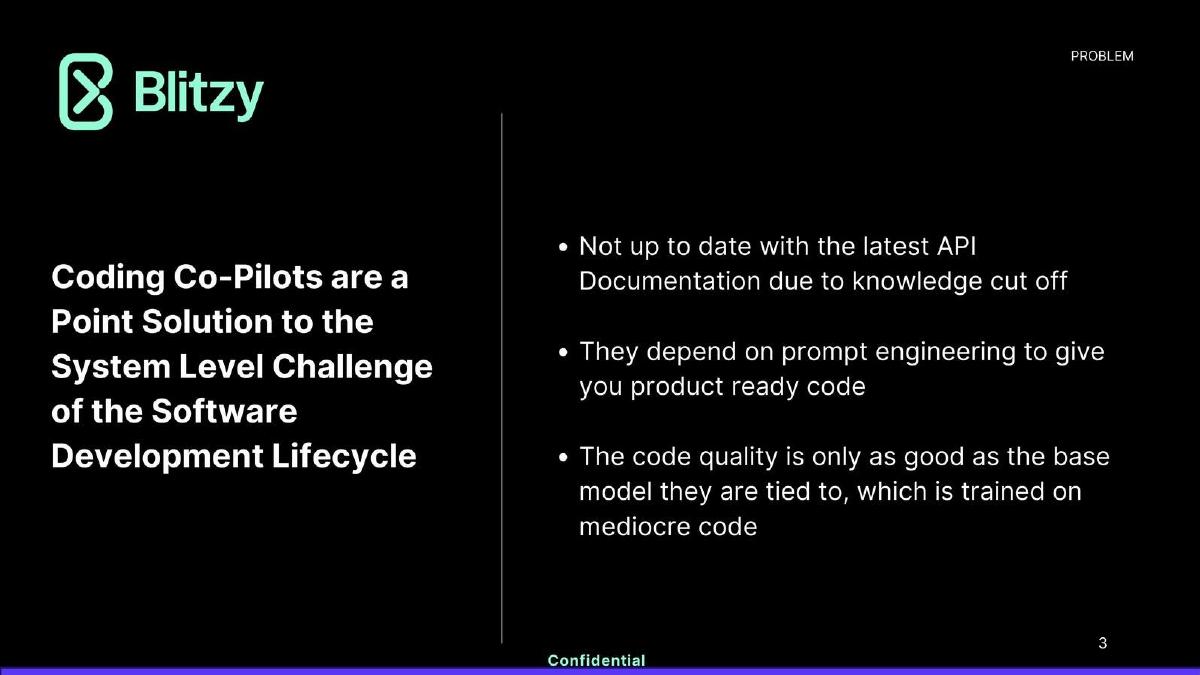
- Blitzy positions itself as a system-level solution, criticizing current coding co-pilots for being 'point solutions' limited by knowledge cut-offs and mediocre training data (Slide 3).
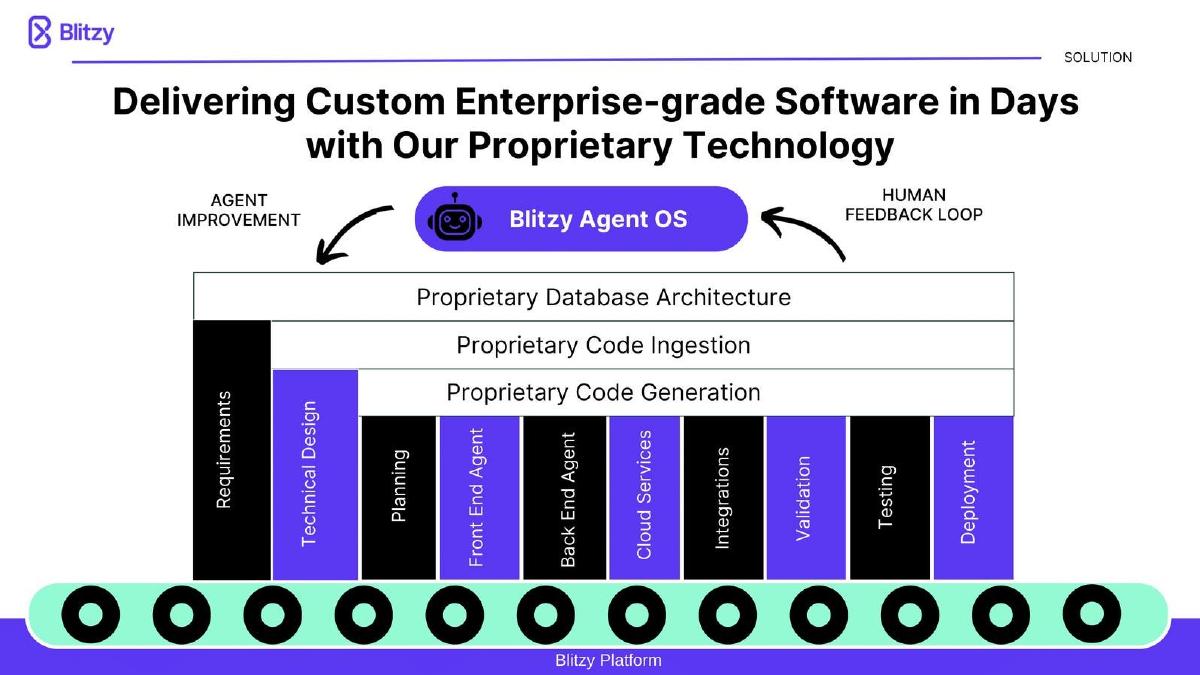
- The technical architecture relies on a 'Blitzy Agent OS' that manages everything from requirements to deployment (Slide 4).
- The Go-To-Market strategy involves a three-stage transition: starting as a Dev Agency, launching a PLG platform, and moving up-market (Slide 6).
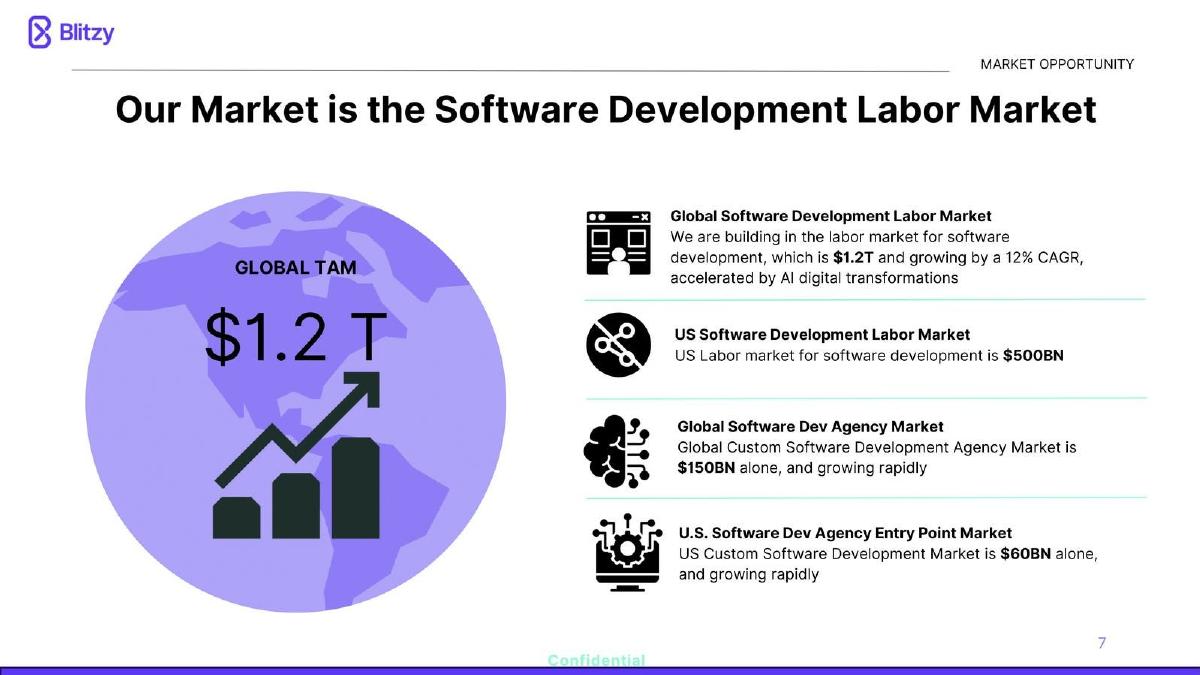
- Market sizing targets the $1.2T Global Software Development Labor Market, with a specific $60BN entry point in the U.S. Custom Software Dev Agency market (Slide 7).
- Defensibility is built on 'Patent-Pending' technology and high switching costs (Slide 8).
- The team slide highlights significant pedigree, including a 3x founder CEO and a CTO with 27 GenAI US patents and experience at NVIDIA (Slide 9).
- The deck omits a specific 'Ask' slide detailing how the $4.4M will be allocated.
The Vision: Compressing Time as a Value Prop
Slide 1: Title Slide
The deck opens with a high-contrast title slide featuring the tagline 'Automating End-to-End Custom Software Development.' The date is marked as Aug 2024. The background image of a dark office space with a large screen displaying a developer sets a professional, enterprise-focused tone. The branding is consistent with a purple and black color palette that carries through the entire presentation.
Slide 2: The Value Proposition
Slide 2 is perhaps the most important slide for an early-stage investor. It defines the 'Vision' as 'Enterprise Applications Built in Days, Not Months.' It uses a simple bar chart to visualize the efficiency gain: Blitzy claims a 4-8 day turnaround, whereas 'Current AI Enablement Tools' take 4-8 months, and 'Traditional Enterprise Application Building' takes 6-12 months. This is a bold claim that sets a high bar for the technical slides to follow.
The Problem and The Technical 'How'
Slide 3: The Problem Statement
Blitzy identifies a specific gap in the current market. They argue that 'Coding Co-Pilots are a Point Solution to the System Level Challenge of the Software Development Lifecycle.' They list three specific pain points: knowledge cut-offs regarding latest API documentation, a dependency on prompt engineering, and code quality issues stemming from base models trained on 'mediocre code.' This slide effectively frames the competition as incomplete rather than just 'worse.'
Slide 4: The Solution Architecture
This slide introduces the 'Blitzy Agent OS.' It features a diagram showing a 'Blitzy Platform' conveyor belt. The process starts with 'Requirements' and 'Technical Design,' then moves through a series of agents: Planning, Front End, Back End, Cloud Services, Integrations, Validation, Testing, and Deployment. Overlaid on this are three layers of proprietary tech: Database Architecture, Code Ingestion, and Code Generation. The slide emphasizes a 'Human Feedback Loop,' suggesting the system isn't fully 'black box' but rather an augmented workflow.
Slide 5: Proprietary Technology Details
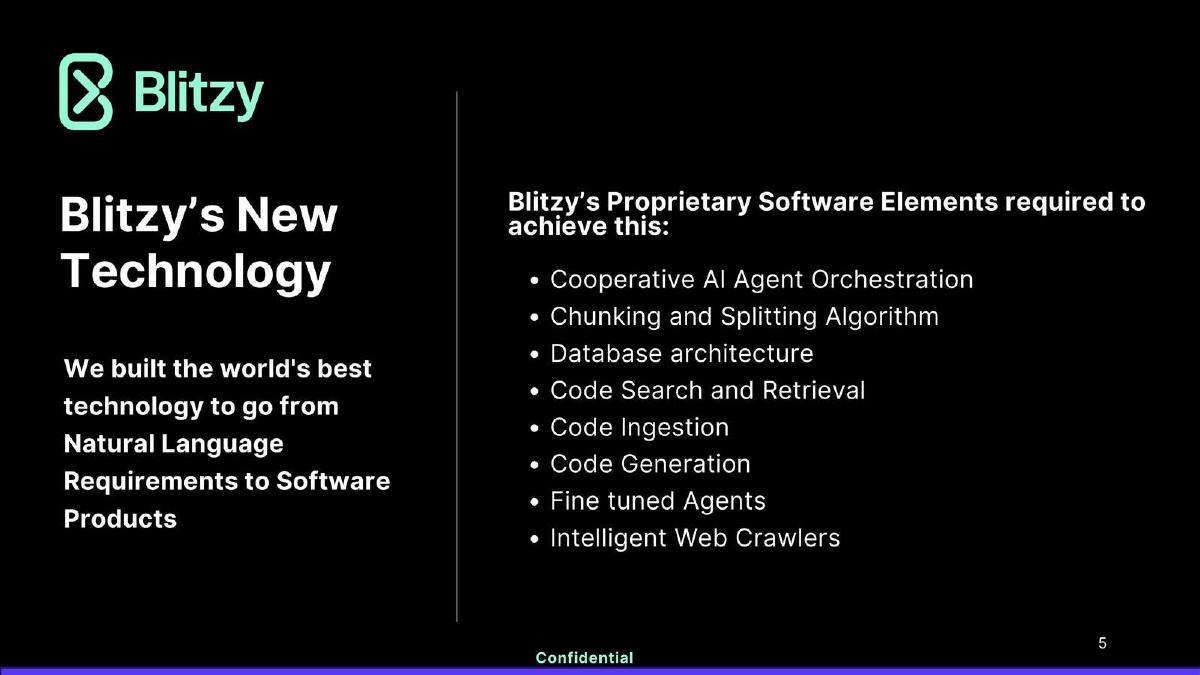
Slide 5 provides a bulleted list of the 'New Technology' developed by the team. It includes 'Cooperative AI Agent Orchestration,' 'Chunking and Splitting Algorithm,' and 'Intelligent Web Crawlers.' By listing these specific components, the founders are signaling to technical due diligence teams that they have built infrastructure beneath the LLM layer, rather than just a thin wrapper.
Market Opportunity and Strategy
Slide 6: Go-To-Market (GTM) Strategy
The GTM slide describes a three-step evolution: 'Dev Agency Dogfooding into PLG Platform Launch.' Step 01 is starting as a Dev Agency to 'Live Our Customer Pain Points.' Step 02 is launching the platform with a PLG motion focusing on other Dev Agencies. Step 03 is moving up-market to drive enterprise adoption. This is a pragmatic approach that solves the 'cold start' problem by generating revenue and data through services before scaling the software.
Slide 7: Market Opportunity
Blitzy targets the 'Software Development Labor Market.' They cite a Global TAM of $1.2T with a 12% CAGR. They break this down further into a $500BN US labor market and a $150BN Global Custom Software Development Agency market. The 'Entry Point Market' is identified as the $60BN US Custom Software Dev market. These figures are massive, which is standard for Seed decks, but the focus on the 'Agency' entry point makes the GTM on the previous slide feel more grounded.
Slide 8: Defensibility
The 'Layered Approach to Defensibility' slide lists three pillars: 'Patent-Pending Code Generation GenAI Technology,' 'Vast 3rd Party Integrations + Data Network Effects,' and 'High Switching Costs.' While 'High Switching Costs' is often a result rather than a strategy, the mention of patent-pending tech and network effects provides the 'moat' narrative investors look for in the crowded AI space.
The Team and The Close
Slide 9: The Founders
This is a high-pedigree team slide. Brian Elliott (CEO) is listed as a 3x Founder, Harvard MBA, and US Army Ranger. Sid Pardeshi (CTO) is described as a 'Serial GenAI Inventor' with 7+ years as a Software Architect at NVIDIA and 27 GenAI US patents. The logos for NVIDIA, Harvard, and Wove reinforce the 'founder-market fit.' In a Seed round, the team is often 70% of the decision, and this slide is designed to minimize perceived execution risk.
Slide 10: Conclusion
The deck ends with a simple contact slide featuring the website and social handle. There is no 'Ask' slide in this version of the deck, which is common in 'leaked' or public versions of decks where the specific terms of the round are kept confidential.
What Works in the Blitzy Deck
Clarity of Comparison: Slide 2 is a textbook example of how to show a 10x (or in this case, a 30x) improvement. By comparing 'days' to 'months,' the value proposition is immediately clear even to a non-technical investor.
Addressing the 'Wrapper' Concern: Many AI startups are dismissed as 'wrappers' on OpenAI. Blitzy fights this on Slide 5 by listing specific architectural components like 'Chunking and Splitting Algorithms' and 'Proprietary Database Architecture.' This suggests they are doing heavy lifting at the infrastructure level.
Founder Pedigree: The team slide is exceptionally strong. Having a CTO with 27 patents in the exact field the company is entering (GenAI) provides a level of technical credibility that few Seed-stage startups can match.
Pragmatic GTM: The 'Agency-first' model is a smart way to build. It allows the company to be cash-flow positive (or at least offset burn) while refining the product. It also ensures the product is built for real-world edge cases that only appear during actual client deliveries.
What Is Missing from the Blitzy Deck
The 'Ask': As noted, there is no slide detailing how much they are raising or what the milestones for the next 18 months look like. While we know from publisher reports that they raised $4.4M, the deck itself doesn't state the capital requirements.
Traction Metrics: Even if they are in the 'Agency' phase, investors usually want to see how many projects have been completed using the 'Agent OS' and what the actual time savings were for those specific cases. The deck relies on theoretical timelines (4-8 days) rather than case studies.
Competitive Landscape: While they mention 'Co-Pilots' generally, they don't address other 'AI Software Engineer' agents like Devin or OpenDevin. In a rapidly moving space, a specific competitive matrix would have helped define their unique positioning more clearly.
Unit Economics: There is no mention of the cost to run these agents. For enterprise-grade software development, the compute costs for 'Cooperative AI Agent Orchestration' can be significant. A slide on the margin profile of the platform vs. the agency model would be beneficial.
What Founders Should Copy
The 'Point Solution vs. System Solution' Argument: If you are entering a crowded market, don't just say you are better. Say the current leaders are solving the wrong part of the problem. Blitzy’s Slide 3 is a great template for this.
Visualizing the Workflow: Slide 4’s 'conveyor belt' visual is an excellent way to explain a complex multi-agent system. It makes a sophisticated technical process look like a reliable industrial one.
Targeting the 'Labor' Market: Instead of just looking at the 'Software Market' (SaaS), Blitzy looks at the 'Labor Market.' This allows them to claim a much larger TAM ($1.2T) because they are positioning their software as a replacement for/augmentation of expensive human hours, not just another tool in the stack.
Pedigree Alignment: Notice how Slide 9 doesn't just list schools and jobs; it titles the founders as 'Serial Entrepreneur' and 'Serial GenAI Inventor.' This tells the investor exactly what 'archetype' each founder represents in the partnership.
Frequently asked questions
- What is Blitzy's core product?
- Blitzy is building an 'Agent OS' designed to automate the entire software development lifecycle. Unlike simple code completion tools, it aims to take natural language requirements and turn them into fully deployed enterprise-grade software, handling planning, front-end, back-end, and testing autonomously.
- How does Blitzy plan to acquire customers?
- The company uses a 'dogfooding' strategy. They initially operate as a development agency to test their own tools on real-world projects. They then plan to transition into a Product-Led Growth (PLG) motion targeting other dev agencies before moving into the broader enterprise market.
- What makes Blitzy's technology different from GitHub Copilot?
- Slide 3 argues that co-pilots are 'point solutions' hampered by prompt engineering and base models trained on 'mediocre code.' Blitzy claims a proprietary architecture including specialized code ingestion, search, and retrieval that overcomes the 'knowledge cut-off' issues of standard LLMs.
- Who are the founders of Blitzy?
- The team is led by CEO Brian Elliott, a 3x founder and Harvard MBA with a background as a US Army Ranger. The technical side is led by CTO Sid Pardeshi, a former NVIDIA software architect who holds 27 GenAI US patents.
- Is there a financial breakdown in the deck?
- No. The 10-slide deck focuses on vision, technology, and market size. It does not include revenue history, burn rate, or a specific breakdown of the $4.4M Seed round usage.