AtoB's 22-slide deck is a textbook example of a vertical fintech play. The company identifies a massive, underserved market—commercial trucking—and systematically dismantles the incumbents (WEX and Fleetcor) by highlighting their high fees, poor user experience, and regulatory troubles. The deck excels at showing, rather than just telling, its value proposition. With clear traction charts showing an 8x increase in transaction volumes and business customers within months of their Series A, AtoB makes a compelling case for product-market fit. The roadmap is equally ambitious, moving from fuel c…
Key takeaways
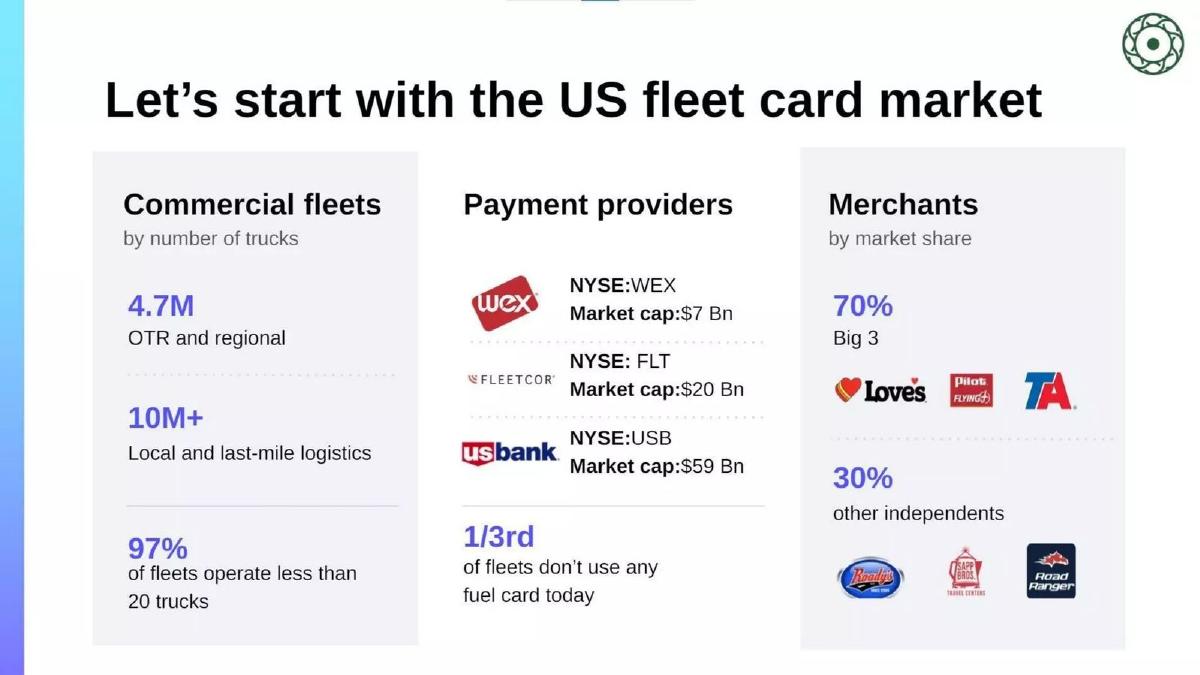
- The deck identifies a massive market with 4.7M OTR trucks and 10M+ local logistics vehicles, noting that 1/3 of fleets currently use no fuel card (Slide 4).
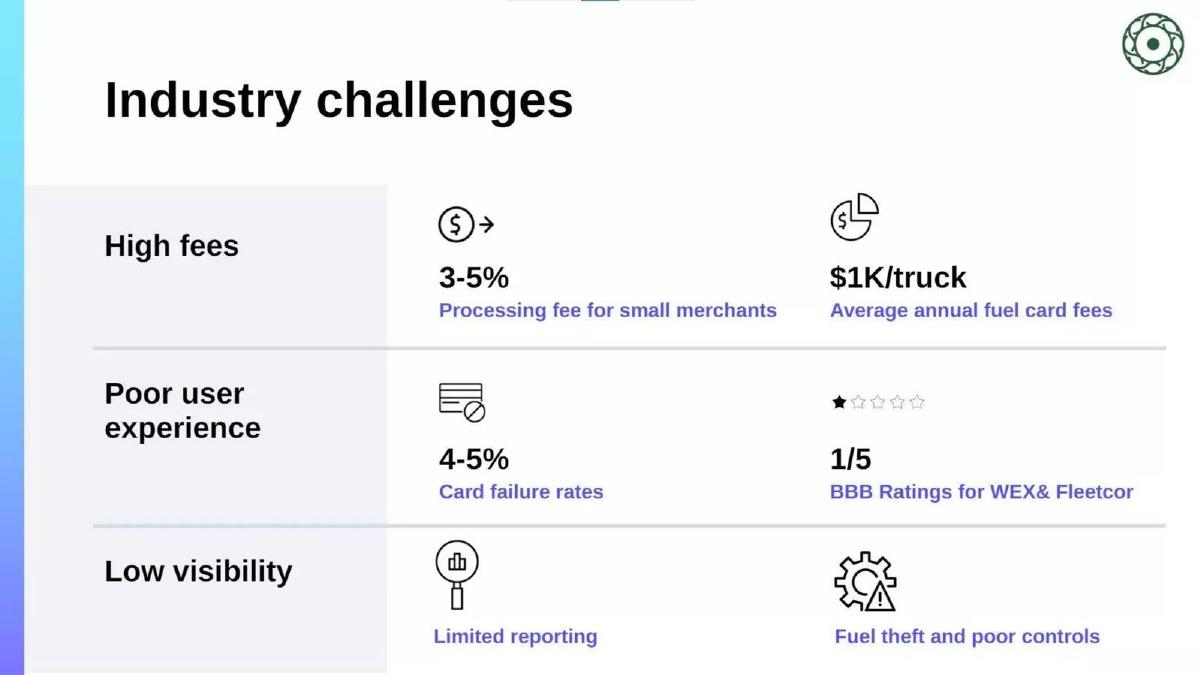
- Incumbents are directly targeted, citing 3-5% processing fees for small merchants and average annual fuel card fees of $1K per truck (Slide 5).
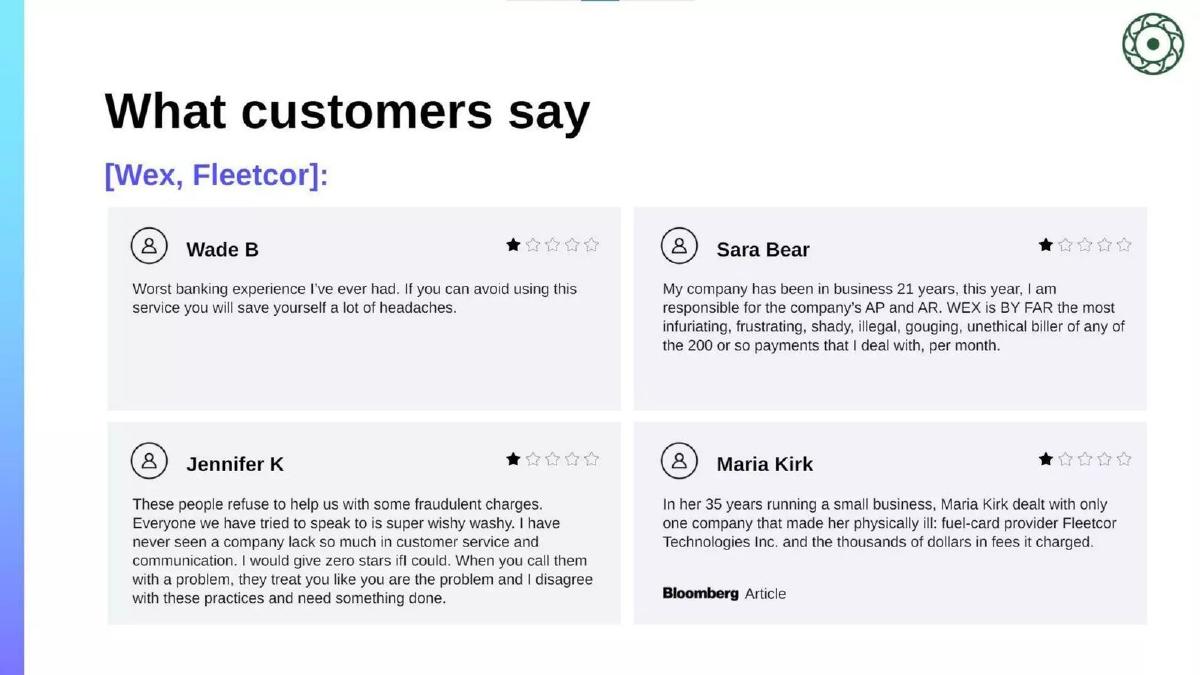
- Customer dissatisfaction is weaponized through specific one-star reviews and mentions of FTC lawsuits against competitors (Slides 6 and 7).
- Traction is demonstrated with an 8x increase in both transaction volumes and business customers between June and October 2021 (Slides 14 and 15).
- The product roadmap shows a clear path to increasing share of wallet, moving from fuel (39% of spend) to payroll (26%) and maintenance (13%) (Slide 21).
- AtoB differentiates its payroll product by integrating with ELD devices to support mileage-based payments, which incumbents lack (Slide 16).
- The TAM is projected to grow from $180B in Q3 2021 to $1.3T+ by Q3 2022 as new products and international markets are added (Slide 20).
- The team slide highlights deep experience from companies like Uber, Cruise, and Square, alongside a massive list of high-profile institutional and angel investors (Slide 2).
Introduction: The Vertical Fintech Playbook
AtoB’s pitch deck is a masterclass in identifying a massive, antiquated industry and proposing a modern, technology-driven solution. The company focuses on the commercial trucking industry, a sector that is vital to the economy but often overlooked by mainstream fintech. By building financial infrastructure specifically for fleets, AtoB positions itself not just as a card provider, but as a central hub for all trucking-related expenses. This teardown will walk through the 22 slides that helped the company raise significant capital, including a $257 million total across its funding rounds.
The Foundation: Team and Market Opportunity
Slide 1: Title Slide The deck opens with a clean, professional title slide. The tagline, "Financial Infrastructure for Commercial Fleets," immediately defines the company's mission. The date, October 2021, places this deck in a period of rapid growth for the company.
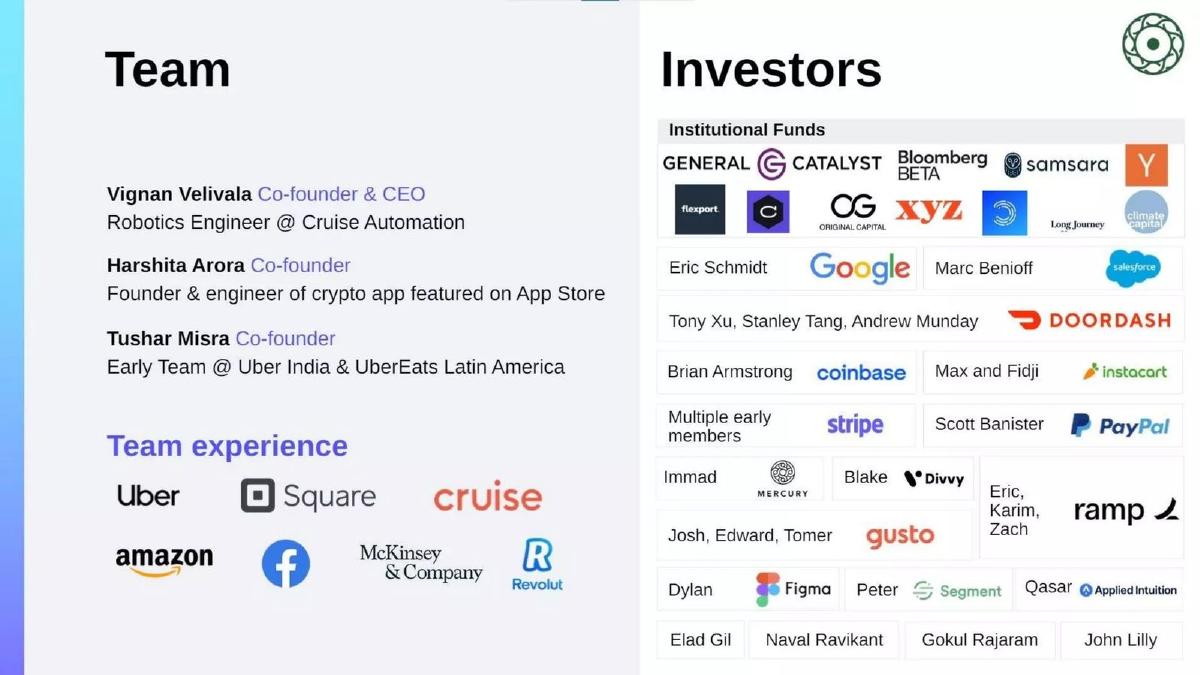
Slide 2: Team and Investors AtoB leads with its strongest assets. The founding team includes Vignan Velivala (CEO, formerly a Robotics Engineer at Cruise), Harshita Arora (Co-founder, developer of a featured crypto app), and Tushar Misra (Co-founder, early team at Uber). The slide also lists experience at Amazon, Facebook, Square, and McKinsey. The right side of the slide is a "who's who" of Silicon Valley investors, featuring General Catalyst, Bloomberg Beta, Y Combinator, and individuals like Eric Schmidt, Marc Benioff, and Naval Ravikant. This slide establishes immediate credibility.
Slide 3: The Problem Statement A simple, high-impact slide states: "In case you don't own a truck... the financial infrastructure for logistics is broken." This sets the stage for the detailed industry analysis that follows.
Slide 4: The US Fleet Card Market This slide provides essential market context. It identifies 4.7 million over-the-road (OTR) and regional trucks, plus over 10 million local and last-mile logistics vehicles. Crucially, it notes that 97% of fleets operate fewer than 20 trucks and that one-third of fleets don't use any fuel card today. It also names the dominant incumbents: WEX ($7B market cap), Fleetcor ($20B market cap), and US Bank ($59B market cap), noting that three merchants (Loves, Pilot Flying J, and TA) control 70% of the market.
Identifying Industry Pain Points
Slide 5: Industry Challenges AtoB breaks down the problems with current providers into three categories: high fees (3-5% processing for small merchants, $1K/truck average annual fees), poor user experience (4-5% card failure rates, 1/5 BBB ratings for incumbents), and low visibility (limited reporting, fuel theft, and poor controls). This slide directly attacks the incumbents' business models.
Slide 6: What Customers Say To humanize the data from the previous slide, AtoB includes four scathing customer reviews of WEX and Fleetcor. Quotes like "Worst banking experience I've ever had" and "made her physically ill" emphasize the deep dissatisfaction in the market.
Slide 7: Regulatory Pressure The company adds another layer of risk for incumbents by highlighting regulatory scrutiny. It shows an FTC press release about suing Fleetcor for "fleecing small businesses" and a Bloomberg article about the CEO's compensation. This suggests that the current market leaders are not just unpopular but potentially legally vulnerable.
The Solution and Product Features
Slide 8: Our Solution: AtoB Fleet Card The solution is introduced with a clean image of the AtoB Visa card. The value proposition is simple: "simplifying fuel payments for everyone: trucking companies, fuel merchants, and drivers."
Slide 9: First Product Features This slide details the specific advantages of the AtoB card: powered by Visa, competitive discounts, credit access, no fees ever, fuel management software, and 24/7 customer service. The "no fees ever" point is highlighted by crossing out the word "FEES," a direct rebuttal to the $1,000/truck fees mentioned earlier.
Market Tailwinds and Traction
Slide 10: Tailwinds Driving Growth A transition slide that prepares the reader for data on market expansion.
Slide 11: E-commerce and Last-Mile Logistics AtoB links its growth to the rise of e-commerce. It cites McKinsey data showing that 60% of people will live in cities by 2030, and urban last-mile deliveries are expected to grow by 78% by 2030. This positions AtoB as a beneficiary of a long-term structural shift in the economy.
Slide 12: Growth in Demand for Fuel Continuing the McKinsey data, this slide shows a projected 36% increase in delivery vehicles and a corresponding rise in emissions by 2030. More vehicles mean more fuel spend, which means a larger market for AtoB.
Slide 13: Product-Market Fit A simple transition slide asserting that the company has achieved strong product-market fit.
Slide 14: Annualized Transaction Volumes This is a key traction slide. It shows a bar chart of monthly transaction volumes from March 2021 to October 2021. The chart shows an 8x increase in volumes, with projections reaching ~$3B by December 2022. The rapid growth post-Series A is clearly visible.
Slide 15: Total Business Customers Mirroring the transaction volume chart, this slide shows an 8x increase in business customers, growing from ~1.2K in June 2021 to ~10K in October 2021, with a projection of ~30K by March 2022. This demonstrates that growth is coming from a broad customer base, not just a few large accounts.
Future Roadmap and Expansion
Slide 16: Next Up: AtoB Payroll Card AtoB outlines its first major product expansion. It identifies a gap in existing payroll software (Gusto, ADP) which doesn't support mileage-based payments. By integrating with ELD (Electronic Logging Device) data, AtoB can automate these payments, which are standard in the trucking industry.
Slide 17: Growth of Payroll Products This slide places AtoB's payroll ambitions in the context of other gig-economy and retail giants like Uber, Lyft, DoorDash, and Walmart. It outlines features for 2022, including early wage access, debit cards with free ATM withdrawals, and FDIC-insured accounts.
Slide 18: International Expansion The roadmap continues with plans for Canada, Mexico, and Europe. It highlights the importance of cross-border shipments in the NAFTA region and the high reporting requirements in the EU as drivers for adoption.
Slide 19: Next Up: Buy Now, Pay Later (BNPL) AtoB identifies other major trucking expenses that are ripe for financing: maintenance (up to $10K/repair), tires ($9K+/year), and insurance ($10K+/year). The proposed BNPL service would offer 4-12 week payment terms at 0% interest for a small fee, helping fleets manage cash flow.
Slide 20: Product Roadmap and TAM This slide synthesizes the expansion plan into a growth chart for the Total Addressable Market (TAM). It shows the TAM growing from $180B in Q3 2021 (fuel card only) to $1.3T+ by Q3 2022 as payroll, BNPL, and international markets are added.
Slide 21: Capturing a Greater Share of Spend The final data slide breaks down the annual spend per OTR truck ($60K-$120K). Fuel accounts for 39%, payroll 26%, and maintenance 13%. By moving into these categories, AtoB shows a clear path to capturing the majority of a truck's annual spend.
Slide 22: Contact Information The deck concludes with a simple contact slide featuring the CEO's email address.
What Works in This Deck
Direct Competitive Comparison: AtoB doesn't shy away from naming its competitors. By highlighting their specific failures—high fees, poor ratings, and regulatory issues—they make a compelling case for why a new player is necessary. Clear Traction Metrics: The use of 8x growth figures for both transaction volumes and customer counts (Slides 14 and 15) provides undeniable evidence of market demand. Strategic Product Roadmap: The deck clearly explains how the company will move from a single product (fuel cards) to a comprehensive financial platform. The integration with ELD devices for payroll (Slide 16) is a particularly strong example of using industry-specific technology to create a competitive advantage. Massive TAM Expansion: Showing how the TAM grows from $180B to $1.3T (Slide 20) demonstrates the long-term scale of the opportunity, which is essential for attracting large-scale venture capital.
What is Missing
Unit Economics: While the deck shows impressive top-line growth, it omits details on unit economics. There is no mention of customer acquisition cost (CAC), lifetime value (LTV), or gross margins. For a fintech company, these metrics are crucial for assessing long-term sustainability. Risk Assessment: The deck is very optimistic. It doesn't address potential risks such as credit defaults (especially for the BNPL product), regulatory hurdles in new markets, or the impact of a shift toward electric trucks on fuel card revenue. Operational Details: There is little information on how the company manages the underlying financial risk or the specifics of its partnership with Visa and other financial institutions.
What a Founder Should Copy
The "Why Now" Slide: Slide 11 and 12 effectively use external data (McKinsey) to show that the company is riding a larger wave of e-commerce and last-mile delivery growth. Founders should always look for macro trends that support their business model. Visualizing the Roadmap: Slide 20 is an excellent way to show how a company's potential grows as it adds new products and enters new markets. It turns a list of features into a vision for a massive business. Using Customer Pain: If your industry has incumbents that are genuinely disliked, use that to your advantage. Slide 6's use of real customer reviews is a powerful way to build empathy for the problem you are solving. Focusing on Industry-Specific Tech: The ELD integration mentioned on Slide 16 shows that the founders deeply understand the unique technical requirements of their target market. Founders should highlight any "unfair advantages" they have that generalist competitors lack.
Conclusion
AtoB's pitch deck is a highly effective fundraising tool because it combines a massive market opportunity with rapid, verifiable traction and a clear vision for the future. By focusing on the specific pain points of the trucking industry and proposing a technology-first solution, the company was able to convince top-tier investors of its potential to become the dominant financial infrastructure for the transportation sector. While it lacks some of the deeper financial metrics that might be required in later-stage rounds, it excels at telling a compelling story of disruption and growth.
Frequently asked questions
- How does AtoB plan to compete with established players like WEX and Fleetcor?
- AtoB's strategy involves eliminating the high fees and poor user experience associated with incumbents. They highlight that competitors charge up to $1,000 per truck annually in fees and have high card failure rates. AtoB offers a 'no fees ever' model powered by Visa, along with modern fuel management software and 24/7 customer service, positioning themselves as a more transparent and reliable alternative.
- What is the significance of the ELD integration mentioned in the deck?
- Electronic Logging Devices (ELDs) are mandatory for US trucks. AtoB uses telematics integration with these devices to enable mileage-based payroll payments. This is a critical differentiator because traditional payroll software like Gusto or ADP typically only supports hourly or fixed pay, whereas most truck drivers are paid by the mile. This integration allows AtoB to capture a significant portion of the 26% of truck spend dedicated to payroll.
- How does the deck demonstrate product-market fit?
- The deck uses two primary metrics to show product-market fit: transaction volumes and the number of business customers. Both metrics show an 8x increase in just four months (June to October 2021). By October 2021, the company had reached approximately 10,000 business customers and was projecting annualized transaction volumes to reach $3B by December 2022, providing clear evidence of rapid adoption.
- What are the key components of AtoB's future product roadmap?
- Beyond the initial fuel card, AtoB's roadmap includes a payroll card with mileage-based pay, a 'Buy Now, Pay Later' (BNPL) service for large maintenance and insurance expenses, and international expansion into Canada and Mexico. This multi-product approach is designed to capture a greater share of the $60K-$120K annual spend per truck, significantly expanding their total addressable market.
- Why does the deck focus so heavily on regulatory issues facing competitors?
- By citing FTC lawsuits and Bloomberg articles about competitors 'fleecing' small businesses, AtoB creates a sense of urgency and a moral imperative for their solution. It suggests that the market is not just underserved but actively mistreated by incumbents, making a new, ethical provider highly attractive to both customers and investors who want to avoid regulatory risk.