Athina represents an early attempt to bring the subscription 'all-you-can-consume' model to the ebook market, a space eventually dominated by Kindle Unlimited and Scribd. The deck, featuring Soylent founder Robert Rhinehart, is a classic pre-seed artifact. It focuses heavily on the value proposition of a $7.99 monthly price point across multiple devices. However, it reveals significant structural hurdles, particularly regarding publisher relations and royalty math. The 'Scenario Analysis' slide is a rare moment of transparency, acknowledging that royalty expenses might exceed revenue—a fatal…
Key takeaways
- The core value proposition is a flat $7.99 monthly subscription for unlimited reading across phone, tablet, and e-reader devices (Slide 5).
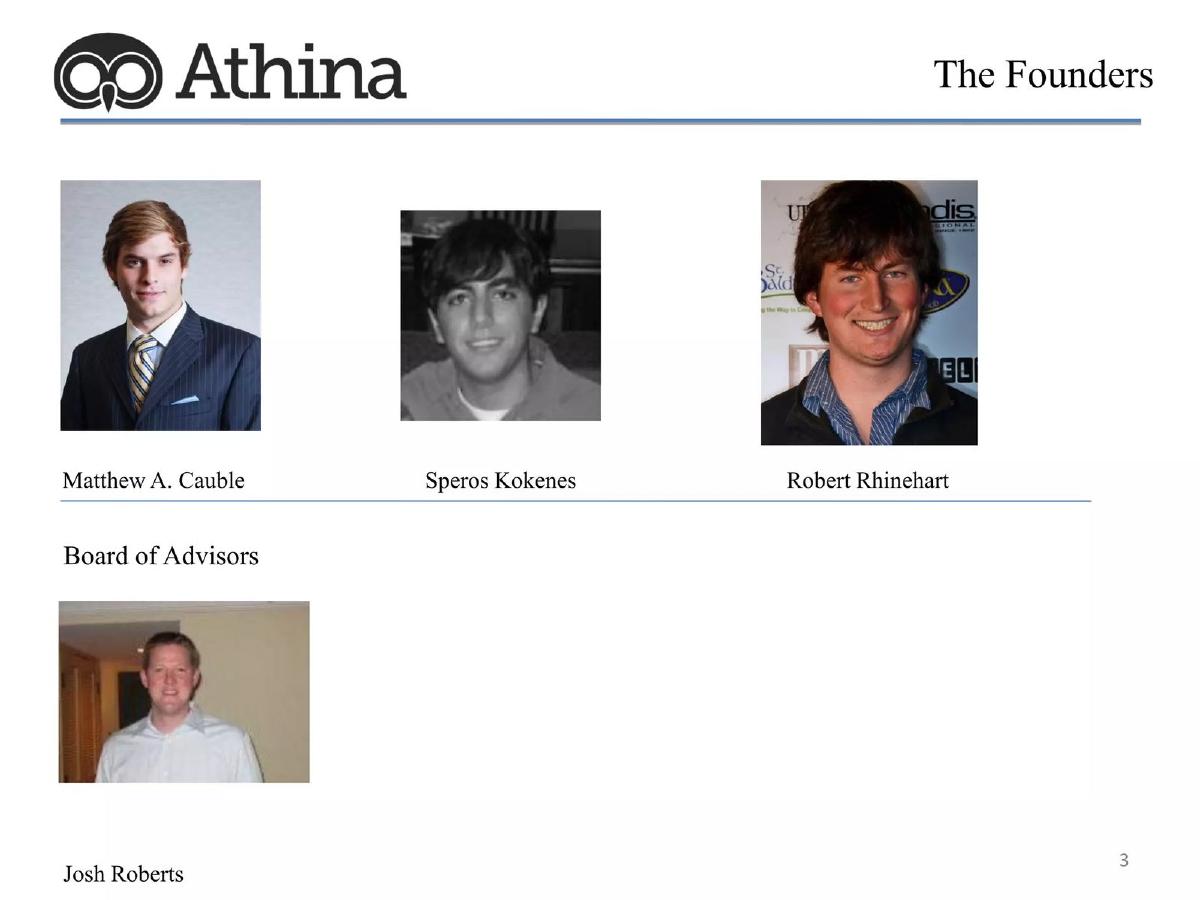
- The founding team includes Matthew A. Cauble, Speros Kokenes, and Robert Rhinehart, with Josh Roberts as an advisor (Slide 3).
- The deck identifies Amazon, Barnes & Noble, OverDrive, 3M, and 24symbols as the primary competitive landscape (Slide 9).
- A 'Scenario Analysis' slide explicitly addresses the risk of major publishers refusing to participate, suggesting a pivot to independent authors and small publishers as a mitigation strategy (Slide 11).
- The startup admits to a potential deficit where royalty expenses exceed revenue, proposing price increases or eBook sales as solutions (Slide 11).
- The company rejects an ad-supported free model, citing that Facebook generates less than $6 per user annually (Slide 11).
- The funding ask is $250,000 to move from a demo to a beta product within 6-8 weeks and cover legal and negotiation costs (Slide 13).
- The long-term roadmap aims for Athina to become a 'house-hold name' and 'increase literacy' beyond its first year of operation (Slide 13).
The Pre-Soylent Pivot: Athina's Subscription Book Ambitions
The Athina pitch deck is a fascinating historical document in the startup world, primarily because it features the early work of Robert Rhinehart and Matthew Cauble before they pivoted to the meal-replacement industry with Soylent. At its core, Athina was a 'Netflix for books' play, attempting to solve the friction of individual book purchases with a flat monthly fee. The deck is brief, totaling 13 slides (with 7 provided here), and follows a standard, if somewhat sparse, narrative arc from team to product to risk management and the final ask.
Slide 1: Title Slide
The deck opens with a minimalist blue gradient background featuring the Athina logo—a stylized owl—and the company name in a white serif font. There is no tagline or mission statement on the cover, relying entirely on the brand name and logo to set the tone. The owl is a traditional symbol of wisdom and Greek mythology (Athena), which aligns with a literary product.
Slide 3: The Founders and Advisors
This slide introduces the leadership team. Matthew A. Cauble , Speros Kokenes , and Robert Rhinehart are listed as the founders. The photos are casual, and notably, there are no biographies or professional histories included on the slide. For a pre-seed deck, the lack of 'why us' context is a significant omission. Josh Roberts is listed as the sole member of the Board of Advisors. In a sector as legally complex as book publishing, investors would typically look for advisors with deep ties to the 'Big Five' publishers, which isn't immediately evident here.
Slide 5: The Value Proposition
Slide 5 delivers the core product message: "Read as much as you want for $7.99 a month." This is the 'Aha!' moment of the deck. Below the text, three devices (a smartphone, a tablet, and an e-reader) are shown displaying book covers like Alice in Wonderland . This illustrates cross-platform compatibility, which was a critical requirement for digital reading services at the time. The $7.99 price point was aggressive, undercutting the standard $9.99 price of a single new ebook on Amazon at the time.
Slide 7: The Demo Placeholder
Slide 7 is a solid blue screen with the text: "This slide intentionally left blank for demo." This indicates that the deck was designed for a live presentation rather than as a standalone 'leave-behind' PDF. In a live setting, the founders would likely have switched to a browser or device to show the functional prototype. For an analyst, this represents a gap in the visual evidence of the product's user interface and experience.
Slide 9: Competitive Landscape
This slide features a collection of logos representing the competition: amazon.com , Barnes & Noble , OverDrive , 3M , and 24symbols . The inclusion of OverDrive and 3M shows an awareness of the library lending market, while 24symbols was a direct competitor in the subscription space. However, the slide lacks a matrix or feature comparison. Simply listing logos tells the investor who the giants are, but it doesn't explain Athina's specific 'wedge' or competitive advantage over them.
Slide 11: Scenario Analysis (Risk Mitigation)
This is arguably the most important slide in the deck. It uses a red-box/blue-box format to address three major existential threats:
Major publishers refuse to offer content: The counter-argument is that small publishers and independent authors are interested, and user demand for price/convenience will eventually force the hand of larger players. · Royalty expenses exceed revenue: The proposed solutions include notifying subscribers of price increases, expanding into direct eBook sales, and renegotiating publisher contracts. This highlights the inherent danger of the 'all-you-can-eat' model in a high-marginal-cost industry. · The pressure for a free/ad-supported model: The team dismisses this by noting that "Facebook generates implying that a $7.99/month ($95.88/year) subscription is a far superior business model.
Slide 13: The Deal and Roadmap
The final slide outlines the 'Today, 1-Year, and Beyond' trajectory. "Today we have a demo product," the slide states. With the requested "$250,000 for acceleration of development, paying legal fees, and negotiating with publishers," the team promises a Beta product in 6-8 weeks. The 1-year goal includes revenue and publisher agreements, while the 'Beyond' stage aims for Athina to be a "house-hold name." The ask is modest by modern standards, reflecting the early-stage nature of the venture.
What Works in This Deck
Clarity of Offer: The $7.99 'read as much as you want' headline is impossible to misunderstand. It identifies the customer benefit immediately without jargon.
Honesty Regarding Unit Economics: Most founders hide the fact that their business model might lose money on every transaction. Slide 11's admission that royalties might exceed revenue shows a level of intellectual honesty that allows for a real conversation with investors about sustainability.
Device Agnostic Approach: Showing the product on a phone, tablet, and e-reader (Slide 5) correctly identifies that readers switch between devices throughout the day, a key requirement for a modern media service.
What is Missing
Founder Pedigree: While we know who these founders became, the deck itself provides zero evidence of their ability to execute. There are no past exits, relevant industry experience, or technical accolades listed on Slide 3.
Market Size (TAM/SAM/SOM): There is no mention of how many people read ebooks, what the total spend in the industry is, or what percentage of that market Athina needs to capture to be viable. This makes the $250,000 ask feel disconnected from the scale of the opportunity.
Unit Economics Detail: While they mention the risk of royalties, they don't provide the math. How much does a publisher get per 'read'? Is it a pool-based model (like Spotify) or a wholesale model (like early Audible)? Without this, the business model is a black box.
User Acquisition Strategy: There is no mention of how they will get users. Competing with Amazon and Barnes & Noble requires a massive marketing budget or a very clever viral loop, neither of which are discussed.
What a Founder Should Copy
The Scenario Analysis Slide: Every founder should have a version of Slide 11. It shows that you have thought through the 'pre-mortem' of your company. By identifying the three biggest ways the company could die and providing a logical (if not yet proven) response, you build credibility with sophisticated investors.
The Staged Roadmap: The 'Today / 1-Year / Beyond' graphic on Slide 13 is a clean way to show how a small amount of seed capital leads to specific milestones. It bridges the gap between a 'demo' and a 'household name' with tangible steps like 'Beta product' and 'Publisher agreements.'
Final Analysis
The Athina deck is a product of its time—a period when the 'Netflix for X' model was being applied to every vertical. It captures the optimism of the early 2010s tech scene but also the brutal reality of digital content licensing. The deck's greatest strength is its simplicity, and its greatest weakness is its lack of defensive 'moats.' In a world where Amazon owns the hardware (Kindle) and the storefront, a pure software play for books faced an uphill battle that $250,000 was unlikely to solve. However, as a historical artifact, it shows the clear, logical thinking that would eventually lead the founders to identify other high-friction industries ripe for disruption.
Frequently asked questions
- Who are the founders of Athina?
- The founders listed on Slide 3 are Matthew A. Cauble, Speros Kokenes, and Robert Rhinehart. Notably, Rhinehart and Cauble later became famous for co-founding Soylent, the meal-replacement company. The deck also lists Josh Roberts as a member of the Board of Advisors.
- What is the business model for Athina?
- Athina proposed a subscription-based model where users pay $7.99 per month for unlimited access to a library of books. Slide 11 indicates they also considered supplemental revenue from selling individual eBooks if royalty costs for the subscription model became unsustainable.
- How did Athina plan to handle content acquisition?
- Slide 11 acknowledges that major publishers might refuse to offer content. Their plan was to leverage 'serious interest' from small publishers and 'thousands of independent authors.' They also planned to use the requested funding to negotiate contracts with larger publishers.
- What was the requested investment and its purpose?
- According to Slide 13, the company was seeking $250,000. These funds were earmarked for accelerating development to reach a beta product in 6-8 weeks, paying legal fees, and negotiating with publishers to build their content library.
- What were the main risks identified in the deck?
- The deck identifies three primary risks on Slide 11: major publishers refusing to join the platform, royalty expenses exceeding subscription revenue, and the potential pressure to offer a free ad-supported model (which they argue against based on low ARPU in social media).