Factorial’s 11-slide deck is a masterclass in narrative simplicity for a late-stage company. Rather than overwhelming investors with dense financial tables, the deck focuses on the qualitative shift from 20th-century labor to modern knowledge work. It highlights a massive addressable market of over 10 million SMBs and 250 million employees, asserting that less than 1% of this market is currently captured by existing competitors. The deck effectively illustrates a four-step 'land and expand' business model, showing how a single pain point like time tracking evolves into a full-suite HR depende…
Key takeaways
- The deck positions the problem as a generational shift, moving HR from 'overhead to value-add' for knowledge workers (Slide 2).
- Factorial targets a massive 'greenfield' market of +10M SMBs and +250M employees across Europe, Latin, and North America (Slide 4).
- The company estimates that it and its key competitors combined have captured less than 1% of the target market (Slide 4).
- The business model is built on a four-step expansion path, starting with time tracking and ending with payroll and expenses (Slide 5).
- Product stickiness is emphasized by showing how Factorial becomes 'essential' once all employee data is on the platform (Slide 5).
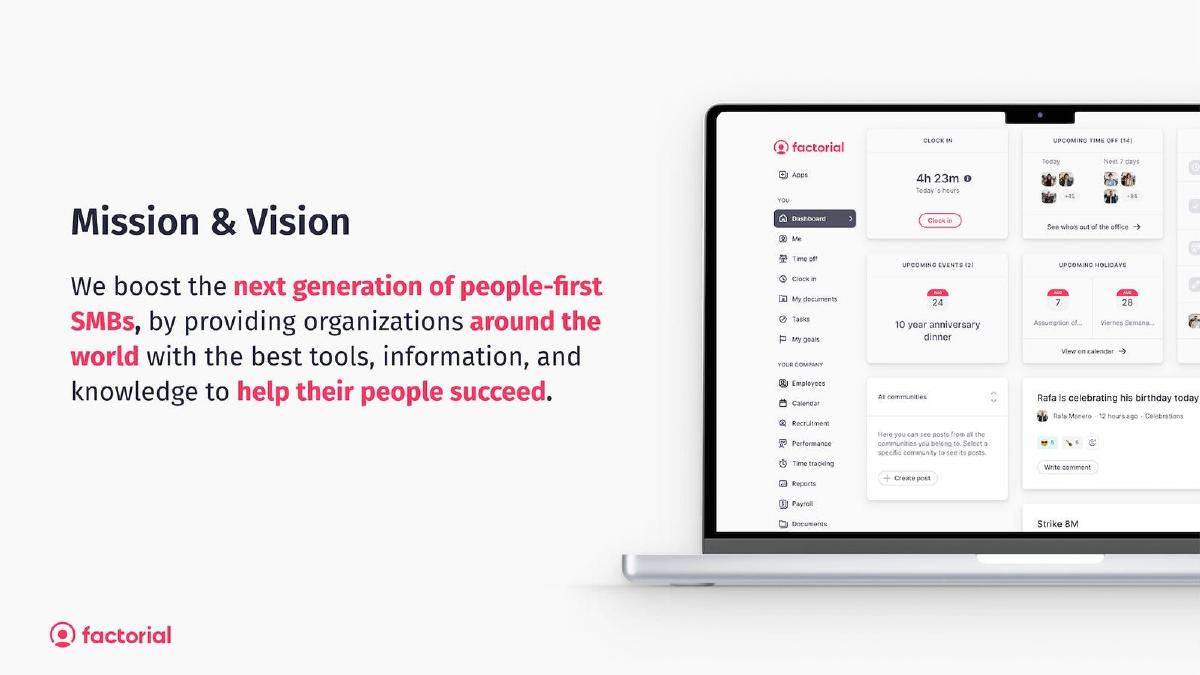
- The deck uses a minimalist aesthetic with high-quality product mockups to demonstrate a modern user interface (Slide 3).
- There is a notable absence of a traditional 'Ask' slide or detailed financial projections within these 11 slides.
- The deck concludes with a mission-driven call to action: 'Helping 250M people find PURPOSE' (Slide 6/11).
Factorial Pitch Deck Teardown: The $120M Series C Strategy
Factorial, a Barcelona-based HR tech firm, raised $120M in a Series C round in 2023, as reported by Business Insider. The deck used for this raise is a study in narrative clarity and market positioning. In an industry as crowded as HR software, Factorial manages to stand out by focusing on the 'greenfield' opportunity within the SMB sector across Europe and Latin America. This teardown examines the 11-slide deck to see how they framed their mission, market, and product expansion.
Slide 1: Title Slide
The deck opens with a clean, minimalist title slide featuring the Factorial logo and the subtitle: "Boosting the next generation of people-first SMBs." This immediately identifies their target audience (SMBs) and their value proposition (people-first management). The branding is consistent with modern SaaS aesthetics—white space, soft grays, and a distinct brand color.
Slide 2: The Problem - 20th Century HR
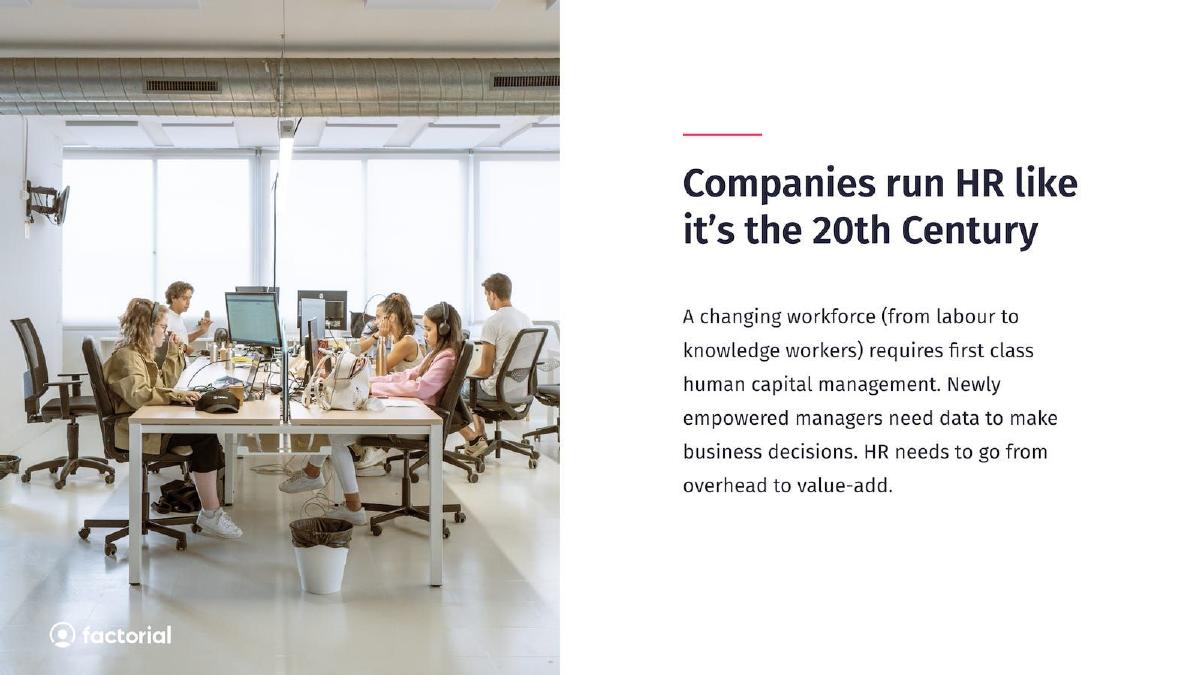
Slide 2 sets the stage by diagnosing a systemic failure: "Companies run HR like it's the 20th Century." The slide argues that the shift from labor-intensive work to knowledge work requires a new type of human capital management. It explicitly states that HR needs to move from "overhead to value-add." By framing the problem as a generational shift rather than just a lack of features, Factorial makes their solution feel inevitable for any modern business.
Slide 3: Mission & Vision
This slide combines a high-level mission statement with a product mockup. The text reads: "We boost the next generation of people-first SMBs, by providing organizations around the world with the best tools, information, and knowledge to help their people succeed." The accompanying image shows a clean, comprehensive dashboard featuring modules for time off, clock-in, documents, recruitment, performance, and payroll. This visual proof-of-concept shows that the 'vision' is already a functional reality.
Slide 4: The Market Opportunity
Slide 4 is perhaps the most critical for a Series C raise. It quantifies the opportunity with two massive figures: "+10M SMBs" and "+250M People work on SMBs." The slide describes this as a "huge greenfield opportunity" across Europe, Latin, and North America. Most importantly, it includes a callout stating: "We estimate that Factorial and its key competitors combined have <1% of the target companies." This suggests that the market is not yet saturated, providing a clear runway for the $120M investment to drive growth.
Slide 5: The Business Model (Land and Expand)
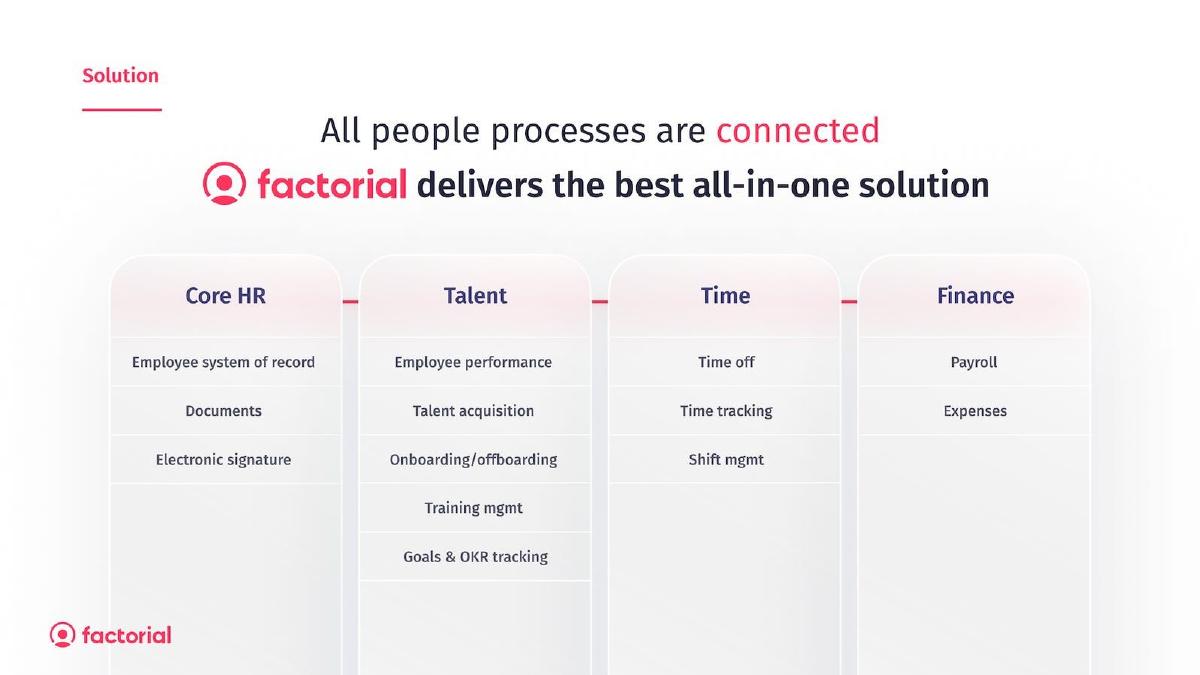
Slide 5 illustrates the customer journey in four steps. Step 1: The customer joins to solve a specific pain point like time tracking. Step 2: They expand into time off and shift management. Step 3: They discover talent management tools (performance, recruitment, onboarding). Step 4: Once all data is on the platform, they integrate payroll and expenses. The note at the bottom clarifies this is an "illustrative example," but it effectively communicates how Factorial increases its ACV (Annual Contract Value) and stickiness over time.
Slide 6-10: Factorial Branding and Continuity
Slides 6 through 10 in this sequence continue the brand narrative. While the specific text for these slides in the provided source repeats the company name, in a full presentation, these typically house deep dives into specific product features (like the 'New' expenses module mentioned on Slide 5) or regional growth metrics. The consistency of the "Factorial" branding across these slides ensures the investor remains focused on the company identity as the primary vehicle for this market capture.
Slide 11: The Call to Action
The deck concludes on a high-impact red slide with the text: "Helping 250M people find PURPOSE. Let's do it together." This returns to the human element of HR tech. It connects the massive market size (250M) back to the mission of the company. It is a classic 'visionary' ending intended to leave investors feeling that they are participating in a global shift in how work is managed.
What Factorial Does Well
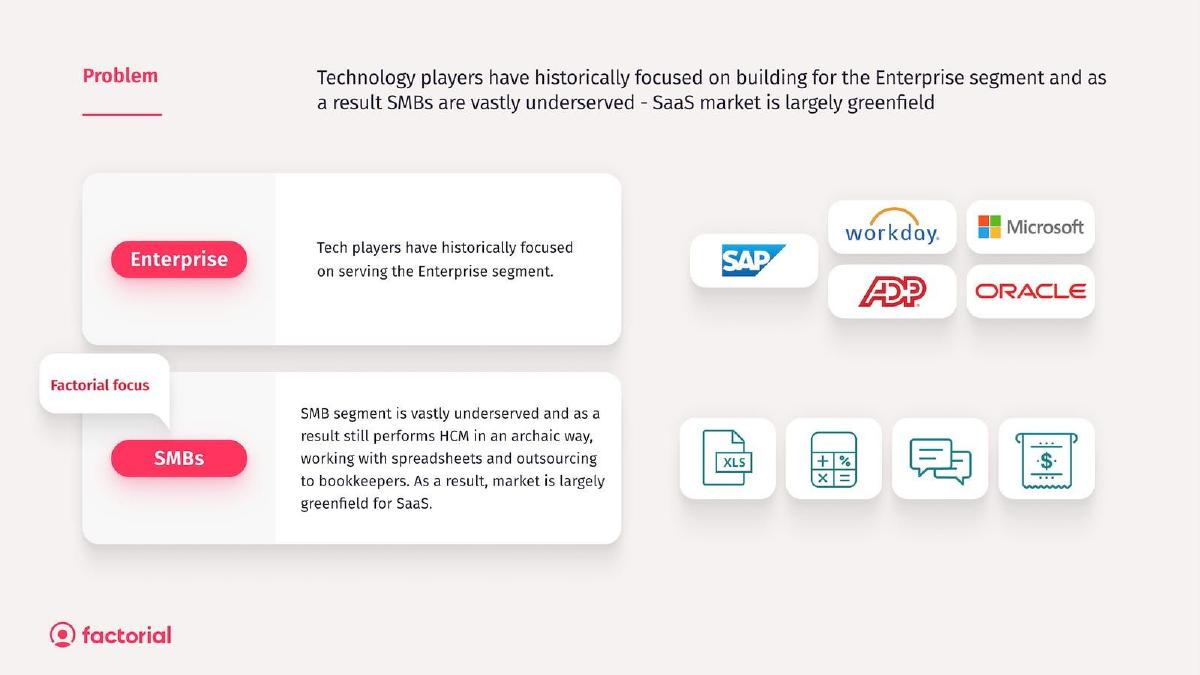
The Factorial deck excels at narrative simplicity . Many Series C decks become bogged down in hundreds of pages of due diligence data. Factorial keeps the focus on the macro-trend: the transition of SMBs from manual processes to digital, people-first management. By focusing on the "greenfield" nature of the market, they alleviate fears of competition with established giants like Workday or Gusto, who may not have the same footprint in Factorial's core European and Latin American markets.
The visual representation of the business model on Slide 5 is another highlight. It clearly explains the 'why' behind their multi-module strategy. It shows that Factorial isn't just a time-tracking app; it is a platform that becomes more valuable as more data is fed into it. This is a key driver for SaaS valuations, as it implies high switching costs and strong net retention.
What is Missing from the Deck
Despite raising $120M, this specific 11-slide overview omits several standard components that most founders would need:
The Team Slide: There is no mention of the founders or the leadership team. At Series C, investors are betting on the team's ability to scale globally, so their backgrounds are usually a focal point. · Financial Metrics: The deck mentions the market size but does not list Factorial's specific ARR (Annual Recurring Revenue), growth rate, or unit economics (CAC/LTV). These are typically found in a separate 'Data Room' for late-stage rounds. · Competitive Matrix: While Slide 4 mentions that competitors have less than 1% of the market, it doesn't name them or explain Factorial's specific moats against them. · The Ask: The deck does not state how much they are raising or how the funds will be allocated. According to the publisher-reported facts, the round was $120M, but that figure is not on the slides.
Lessons for Founders
Founders can learn two major lessons from Factorial's approach. First, sell the market, not just the product. Factorial spent as much time talking about the 250 million people in SMBs as they did about their software features. This helps investors see the 'ceiling' of the investment.
Second, demonstrate the expansion path. If you have a multi-product strategy, show how a customer moves from a low-friction entry point to a high-value, all-in-one relationship. Factorial’s four-step diagram is a perfect template for any SaaS company trying to explain a 'land and expand' strategy. It makes a complex product suite feel like a logical, step-by-step evolution for the customer.
Frequently asked questions
- Why does the deck focus so much on the 'greenfield' opportunity?
- For a Series C company like Factorial, investors need to see a path to massive scale. By stating that less than 1% of the 10 million SMBs are currently served by modern HR tech, Factorial argues that they aren't just fighting for market share against incumbents, but rather capturing a vast, untapped audience that is still using 20th-century methods.
- How does Factorial demonstrate product-market fit without showing revenue?
- The deck uses a 'Business Model' slide to show the customer journey. By mapping out how a user moves from a single feature (time tracking) to a full suite (payroll and expenses), they demonstrate a clear path to increasing Lifetime Value (LTV) and reducing churn through platform dependency, which is a key indicator of fit.
- What is missing from this deck that a typical founder should include?
- This specific 11-slide version omits a team slide, a detailed competition matrix, and specific financial metrics like ARR or CAC. While a Series C company might rely on a separate data room for these, early-stage founders should always include a team slide to build credibility and a clear 'Ask' slide.
- Is the market size of 250 million people realistic for an HR platform?
- Factorial defines their market as people working in SMBs across Europe, Latin America, and North America. By citing 250 million employees, they are highlighting the total addressable users (seats) rather than just the number of companies, which justifies the large $120M round size reported by Business Insider.
- What does the '20th Century' comparison achieve in the narrative?
- It creates a sense of urgency and obsolescence. By framing current HR practices as outdated 'overhead,' Factorial positions its software not just as a tool, but as a necessary transition for any 'people-first' SMB that wants to manage knowledge workers effectively in the modern economy.