FameLinked is a social network designed for celebrities and high-profile individuals, aiming for a 'Billion Dollar Exit Strategy' as stated on slide 4. The deck is notable for its sparse design and heavy reliance on an 'Implied Valuation' model (slide 8) that values the platform at $1,400,000 based on 70,000 users at $20 per user. Despite the high-level ambitions, the deck lacks critical information, including a detailed product walkthrough, a team slide, or specific revenue models beyond a 'private share sale' (slide 14). The presentation focuses almost entirely on the investment structure r…
Key takeaways
- The company positions itself as the 'official Social Network of the Famous' on slide 4.
- Initial target markets include the USA, Canada, Europe, Australia, and India (slide 4).
- The deck claims a current user base of 70,000.00 on slide 8.
- Valuation is calculated using a 'Value Per User' metric of $20, resulting in a $1.4 million platform valuation (slide 8).
- The founders are seeking a $4 million valuation for a 25-45% share sale (slide 10).
- The deck lacks a team slide, competitive analysis, and a technical roadmap.
- Slide 12 claims user growth is 'increasing at an increasing rate' without providing a growth chart or historical data.
- The platform is described as an online platform and iOS application that 'participates with Facebook connect' (slide 4).
FameLinked Pitch Deck Analysis
The FameLinked pitch deck, dated February 21, 2015, is a minimalist presentation that focuses heavily on the financial mechanics of a private offering rather than the product itself. The deck consists of 15 slides, of which 8 are analyzed here. It presents a vision for a niche social network but leaves significant gaps in operational and technical detail.
Slide 1: Title Page
The cover slide introduces FameLinked™ - Social Network of the Famous™ . It features a skyline of a modern financial district, likely Canary Wharf or a similar hub, suggesting a corporate or high-net-worth focus. The logo is a simple blue icon depicting a camera. Michael Herlache is listed as the Managing Director. A family-style crest or coat of arms is included on the right side, though its relevance to the startup is not explained. The date is clearly marked as February 21, 2015 .
Slide 2: Table of Contents
This slide outlines the structure of the presentation. It lists six sections: 1. Overview of FameLinked, 2. FameLinked Valuation, 3. Private Offering, 4. Investment Rationale, 5. Share Purchase Process, and 6. Contact. The layout is clean but very sparse, a theme that continues throughout the deck.
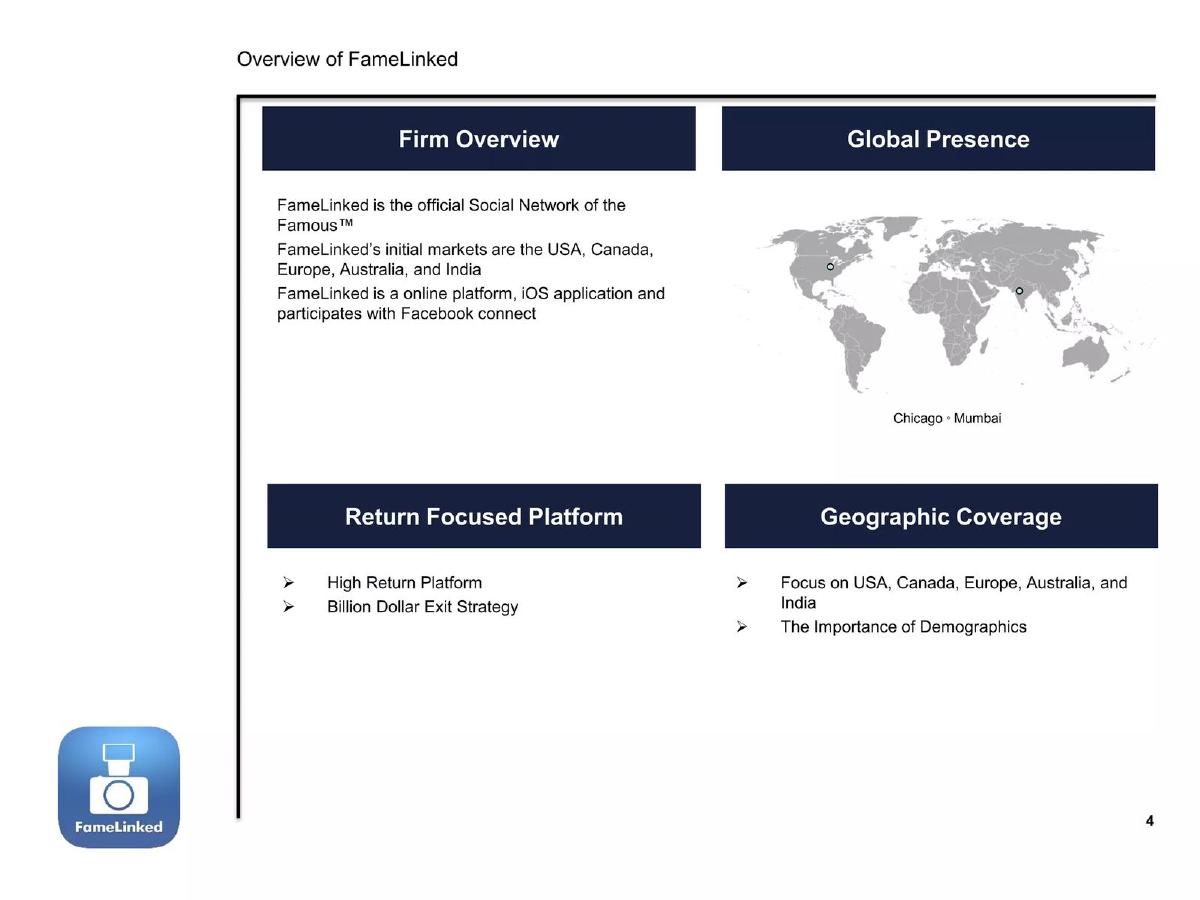
Slide 4: Overview of FameLinked
This slide provides the first look at the company's scope. It is divided into four quadrants:
Firm Overview: States the company is the 'official Social Network of the Famous' and is an online platform/iOS app that uses Facebook connect. · Global Presence: Shows a world map with dots on Chicago and Mumbai . · Return Focused Platform: Explicitly mentions a 'Billion Dollar Exit Strategy' and a 'High Return Platform.' · Geographic Coverage: Lists the USA, Canada, Europe, Australia, and India as focus markets, emphasizing the 'Importance of Demographics.'
Slide 7: FameLinked Valuation (Section Header)
This is a simple transition slide. It contains only the title 'FameLinked Valuation' and the company logo. In a 15-slide deck, using full slides for section headers contributes to the lack of dense information found in other areas of the presentation.
Slide 8: Implied Valuation
This is the most data-heavy slide in the deck. It attempts to quantify the company's worth using a 'Value Per User' model. It lists:
Users: 70,000.00 · Value Per User: 20 · Valuation of Platform: $1,400,000.00
Below this table, a note states: 'Comparable companies & comparable transactions valuations support a higher valuation in the range of $3 mm to $4 mm USD.' The deck does not name these comparable companies or explain why the 'Value Per User' is set at $20.
Slide 10: Private Offering
This slide delivers the 'Ask.' It contains a single bullet point: 'FameLinked is targeting a $4 mm valuation with a 25-45% share sale.' This implies the company is looking to raise between $1 million and $1.8 million. There is no 'Use of Funds' breakdown to explain how this capital would be deployed.
Slide 12: Investor Rationale
Under the heading 'Demand,' the slide lists three justifications for investment:
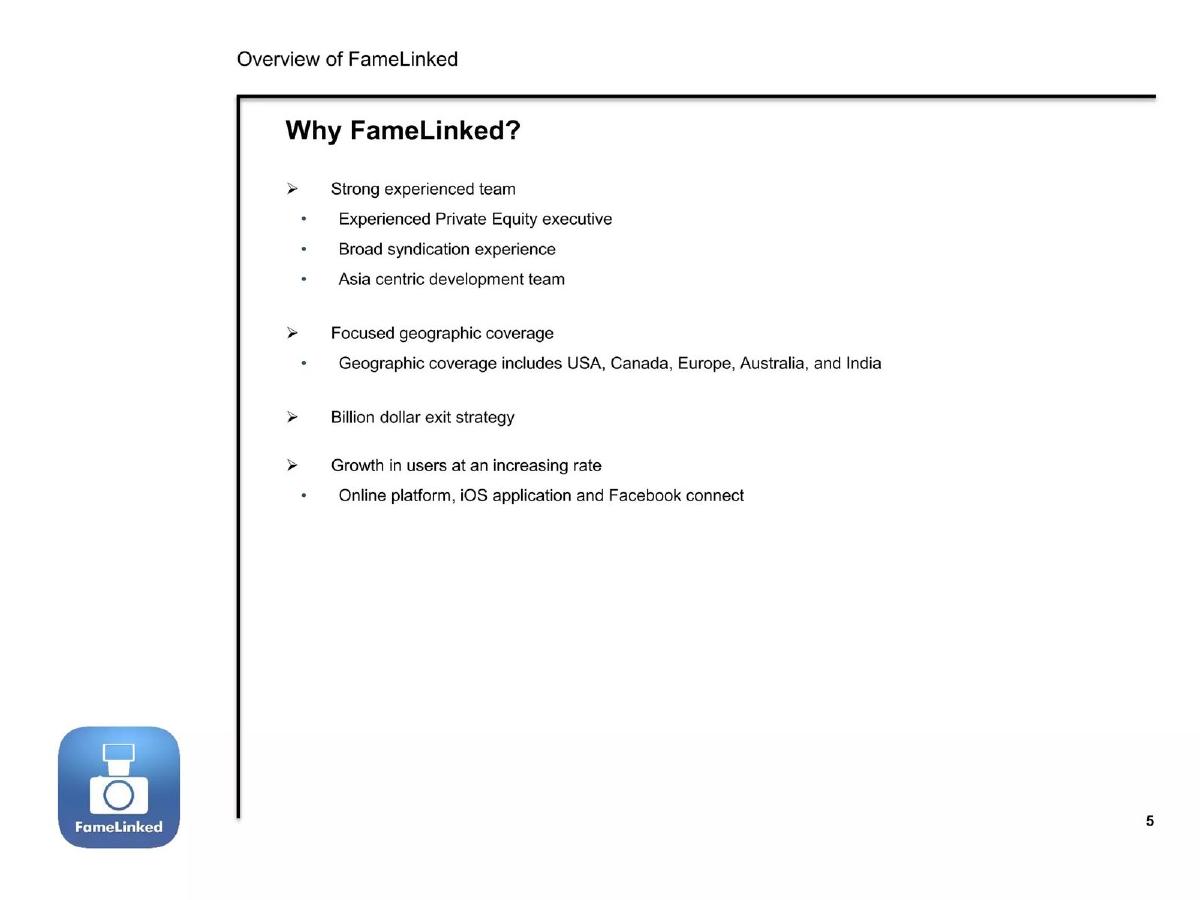
'Growth in users increasing at an increasing rate' · 'Investment early on allows for multiple expansion and exponential wealth increase' · 'Billion dollar exit strategy'
The phrase 'increasing at an increasing rate' suggests accelerating growth, but no charts, monthly active user (MAU) data, or growth percentages are provided to verify this claim.
Slide 14: Shares Sold On a Percentage Basis
This slide describes the 'Process' of the investment. It states that FameLinked runs a 'standard private share sale process' and has the 'ability to take investment from a syndicate of private investors.' This slide reinforces that the deck is primarily a solicitation for a private equity transaction rather than a traditional venture capital pitch focused on product-market fit.
What FameLinked Does Well
The deck is exceptionally clear about its financial goals. By explicitly stating the 'Billion Dollar Exit Strategy' and the specific valuation targets, the founders leave no ambiguity about their intentions for the company's financial trajectory. The geographic focus is also clearly defined, showing a specific interest in the North American and Indian markets, which are high-value areas for celebrity-driven social media.
What is Missing from the Deck
The omissions in this deck are significant and would likely be a hurdle for professional investors:
Product Screenshots: There is not a single image of the app's interface. Investors cannot see how 'the famous' interact or what makes the platform unique compared to Instagram or Twitter. · Team Slide: While Michael Herlache is named on the cover, there is no information about his background, the technical team, or any advisors. · Revenue Model: The deck mentions valuation and exits but does not explain how the app actually makes money (e.g., ads, subscriptions, transactions). · Competitive Analysis: There is no mention of how FameLinked competes with established social networks that already host celebrities. · Problem Statement: The deck never explains what problem celebrities have that current social networks aren't solving.
What a Founder Should Copy
Founders can learn from the simplicity of the 'Ask' on slide 10. Many decks bury the valuation and the percentage of equity offered in complex tables; FameLinked states it in one clear sentence. Additionally, the use of a 'Value Per User' metric (slide 8) is a common way for pre-revenue social platforms to communicate potential value, though it should ideally be backed by more robust 'comparable company' data than is shown here.
Final Analyst Thoughts
The FameLinked deck is a product of its time, leaning heavily on the social media boom of the mid-2010s. However, it functions more as a term sheet summary than a pitch deck. The lack of product detail and team credentials makes it difficult to assess the viability of the business. The reliance on 'implied valuation' without demonstrating a unique utility for its target demographic (the famous) represents a significant risk in the narrative.
Frequently asked questions
- What is the primary value proposition of FameLinked?
- According to slide 4, FameLinked is the 'official Social Network of the Famous.' It aims to provide a dedicated platform for high-profile individuals, focusing on specific demographics in major global markets like the USA and India. The deck emphasizes a 'Billion Dollar Exit Strategy' rather than specific features.
- How does the company justify its valuation?
- On slide 8, the company uses an 'Implied Valuation' table. It multiplies 70,000 users by a 'Value Per User' of $20 to reach $1,400,000. However, it then claims that comparable transactions support a higher valuation range of $3 million to $4 million USD.
- What are the terms of the investment being offered?
- Slide 10 states that FameLinked is targeting a $4 million valuation. They are looking to sell between 25% and 45% of the company. Slide 14 notes they can take investment from a 'syndicate of private investors' using a 'standard private share sale process.'
- What technical details are provided about the app?
- Very few. Slide 4 mentions it is an 'online platform' and an 'iOS application' that uses 'Facebook connect.' There are no screenshots of the user interface, no feature lists, and no mention of Android development or backend infrastructure.
- What critical startup deck elements are missing?
- The deck is missing several standard components: a Team slide (only one name appears on the cover), a Problem/Solution breakdown, a Competitor matrix, a Revenue/Business Model slide, and a detailed Use of Funds slide.