Farmpadi positions itself as 'The internet of farms,' utilizing IoT sensors to optimize resource allocation for smallholder farmers. The deck relies heavily on a single-farm case study (Josult Farms) to demonstrate value, showing a yield increase from 15 to 25 tonnes of cassava and a sales volume jump from N450,000 to N750,000. Their revenue model is diversified across hardware sales ($200 per sensor), data subscriptions (35% of revenue mix), and soil testing ($10 per plot). While the deck clearly identifies competitors like Zenvus and Cropx, it lacks a formal team slide, specific market size…
Key takeaways
- The company uses a hardware-as-a-service hybrid model, selling IoT sensors for $200 with a flexible payment plan of $100 upfront and $100 in produce equivalence post-harvest (Slide 4).
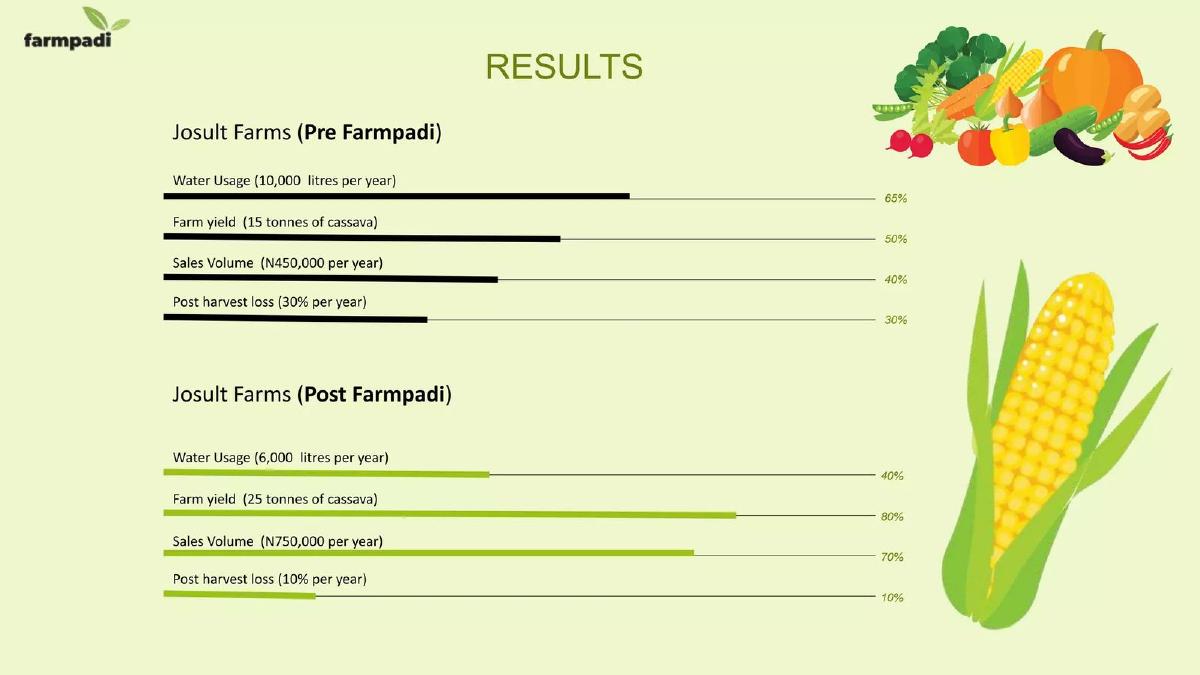
- A case study of Josult Farms shows that Farmpadi reduced post-harvest loss from 30% to 10% per year (Slide 3).
- Revenue is projected to come from three streams: Sensor Sales (45%), Data Subscriptions (35%), and Soil Testing (20%) (Slide 4).
- Farmpadi identifies its primary competitive advantages as providing extension services, advisory services, and direct market access for users (Slide 5).
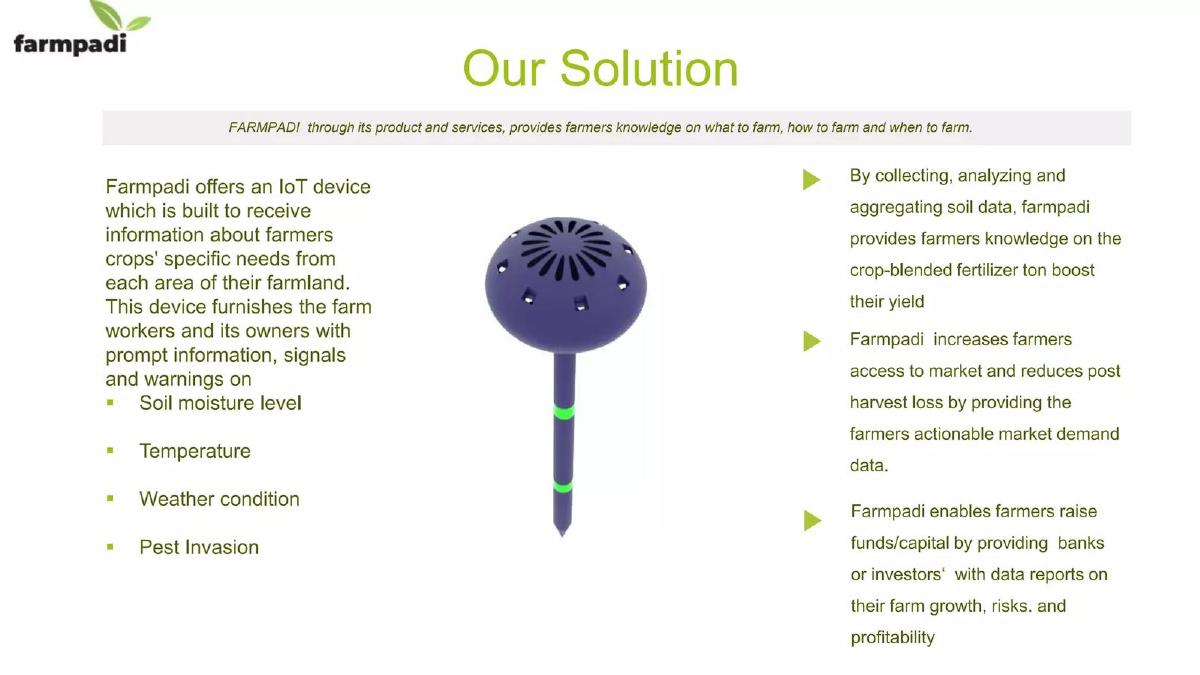
- The IoT sensor is designed to cover soil moisture, weather, and pest control, which the deck claims is broader than competitor Cropx's focus on water level (Slide 5).
- The deck omits a dedicated team slide, though Co-founder Kene Onyemaeme is listed on the title page (Slide 1).
- There is no specific funding ask or use of funds slide included in the provided sequence.
- The company is headquartered in Port-Harcourt, Rivers State, Nigeria (Slide 6).
Farmpadi Pitch Deck Analysis
Farmpadi is an agritech startup based in Nigeria that describes itself as "The internet of farms." The deck focuses on the transition from traditional, unmonitored farming to data-driven agriculture through the use of IoT sensors and soil testing. By providing hardware that smallholder farmers can afford through flexible payment terms, Farmpadi aims to build a proprietary data set that can be sold back to the industry as subscriptions.
Slide 1: Title Slide
The title slide introduces the brand and the core tagline: "The internet of farms." It identifies Kene Onyemaeme as a Co-founder and provides a direct contact email. The visual theme is agricultural, featuring a close-up of corn stalks, which sets the industry context immediately. While simple, it establishes the primary point of contact for the venture.
Slide 2: The Problem and Farmer Needs
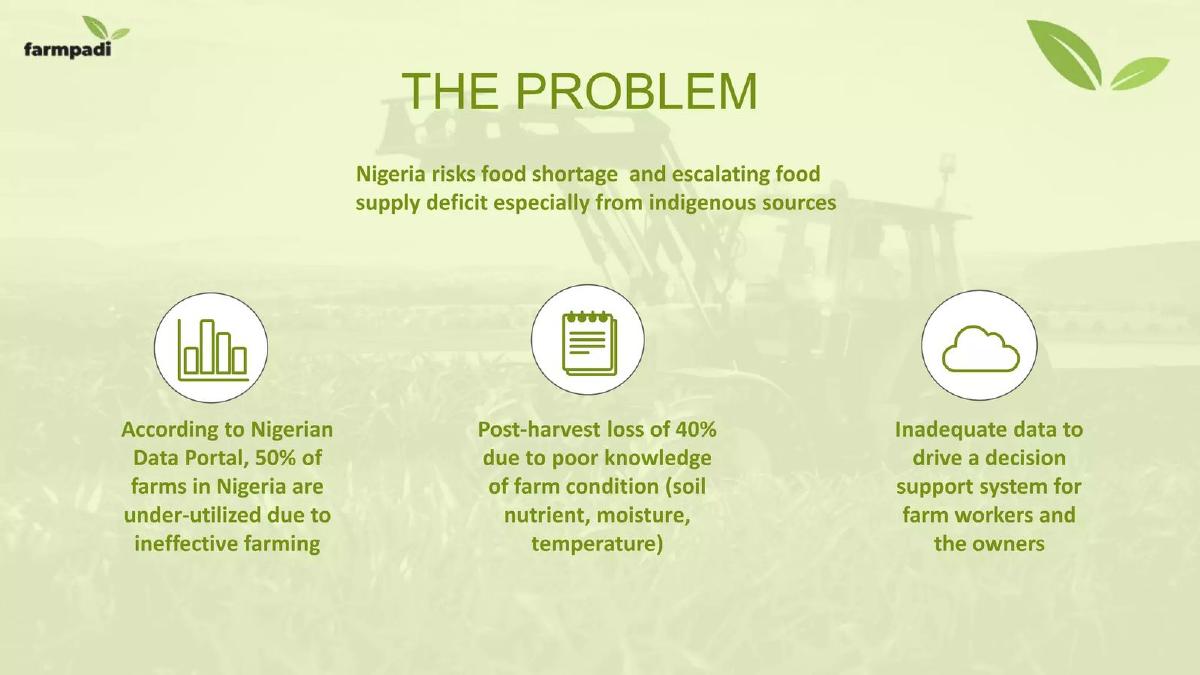
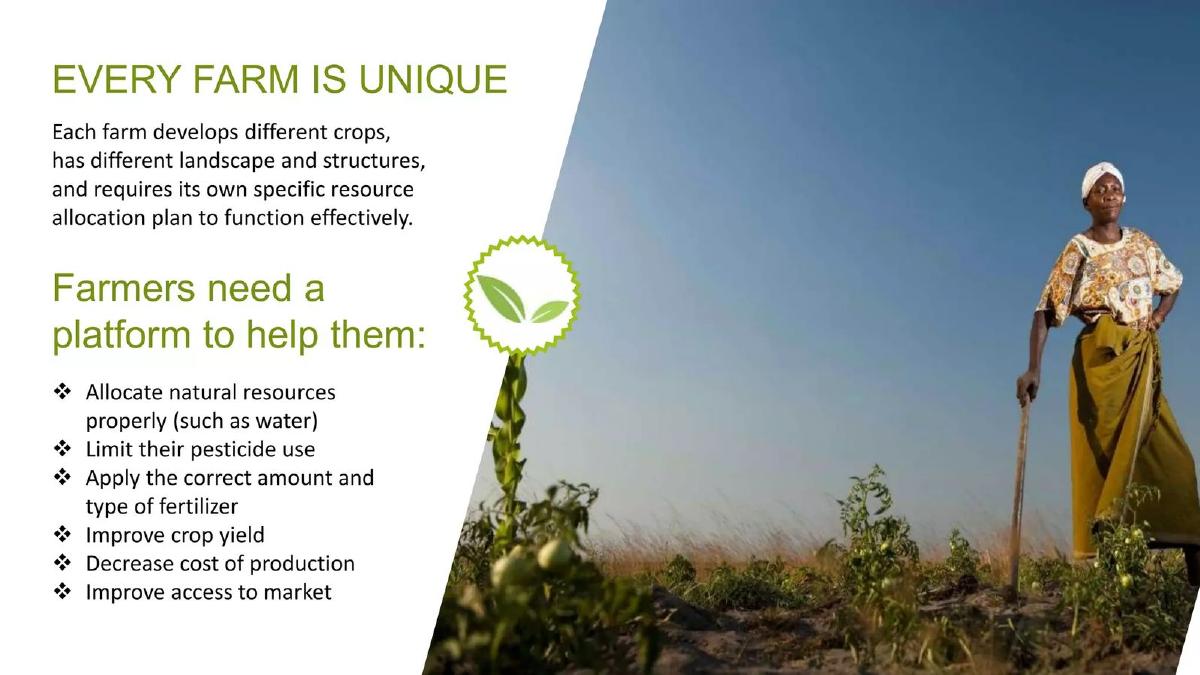
This slide establishes the premise that "Every farm is unique." It argues that because farms have different landscapes and resource needs, they require specific allocation plans. The slide lists six areas where farmers need a platform for help: allocating natural resources (water), limiting pesticide use, applying correct fertilizer amounts, improving crop yield, decreasing production costs, and improving market access. This slide serves as a combined Problem/Solution statement, though it focuses more on the "needs" than the specific pain points of the current status quo.
Slide 3: Results (Case Study)
Farmpadi uses a direct comparison of a single entity, Josult Farms, to prove their value proposition. The slide is divided into "Pre Farmpadi" and "Post Farmpadi" metrics. Key figures from Slide 3 include:
Water Usage: Reduced from 10,000 litres to 6,000 litres per year. · Farm Yield: Increased from 15 tonnes of cassava to 25 tonnes. · Sales Volume: Increased from N450,000 to N750,000 per year. · Post-Harvest Loss: Decreased from 30% to 10% per year.
This is the strongest slide in the deck because it quantifies the ROI for a potential customer in both productivity and currency.
Slide 4: Revenue Model
The revenue model is split into three distinct streams, visualized by a donut chart. According to Slide 4:
Sensor Sales (45%): The IoT sensor sells for $200. The company offers a "produce equivalence" model where farmers pay $100 upfront and $100 in crops after harvest. · Data Subscriptions (35%): Revenue comes from selling aggregated, anonymized data including farm analytics, market trends, and industry reports. · Soil Testing (20%): A flat $10 fee for soil testing per plot of farm.
This model shows a healthy mix of one-time hardware revenue, service fees, and high-margin recurring data revenue.
Slide 5: Industry Outlook & Competition
Farmpadi compares itself against two competitors: Zenvus and Cropx. The comparison uses sliders for Affordability, Locality, and Eco-friendliness. Specific claims on Slide 5 include:
Against Zenvus: Farmpadi claims Zenvus has "poor local support" and "rigid pricing," whereas Farmpadi provides extension services and market access. · Against Cropx: Farmpadi claims Cropx has "zero presence in Africa" and that their sensor is limited to water level control, while Farmpadi covers moisture, weather, and pests.
This slide effectively highlights the "local advantage" which is often a critical factor in African agritech.
Slide 6: Contact Information
The final slide provides the physical headquarters address: 24 Aggrey Road, Port-Harcourt, Rivers State, Nigeria . It also includes a phone number and a general info email. The background image of a farmer working the land reinforces the company's target demographic.
What Works in the Farmpadi Deck
The Josult Farms case study is the highlight of the presentation. By showing a 66% increase in cassava yield and a 66% increase in sales volume, the founders provide a clear economic reason for a farmer to adopt the technology. Investors look for this kind of "no-brainer" ROI when evaluating hardware solutions for low-income markets.
The flexible payment model for the $200 sensor is also a strong strategic choice. By accepting $100 in "produce equivalence," Farmpadi solves the liquidity problem faced by many smallholders while simultaneously positioning itself to participate in the supply chain (market access), which is listed as one of their competitive advantages.
What is Missing from the Farmpadi Deck
The most glaring omission is the Team Slide . While a co-founder is named on the title page, there is no information regarding the technical expertise required to build IoT sensors or the agricultural expertise required to provide advisory services. Investors need to know if the team has the engineering background to scale hardware production.
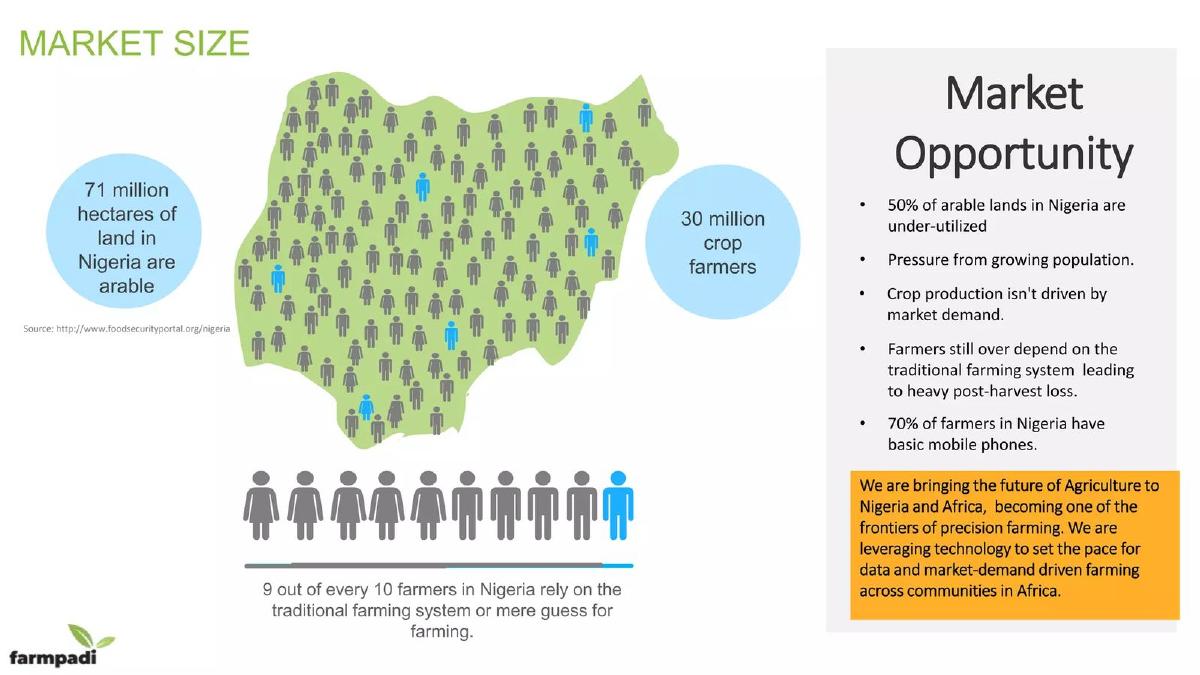
There is also no Market Size (TAM/SAM/SOM) slide. The deck explains why one farm needs the tool, but it doesn't quantify how many such farms exist in Nigeria or Sub-Saharan Africa. Without these numbers, it is difficult to judge the total revenue potential of the 35% data subscription segment.
Finally, the Funding Ask is missing. The deck does not state how much capital is being raised, what the valuation is, or how the funds will be allocated (e.g., R&D, manufacturing, or sales team expansion). This makes the deck feel more like a sales presentation for partners than a formal fundraising document.
Founder Takeaways: What to Copy
Use specific case studies: If you don't have thousands of users, go deep on one. The Josult Farms slide is effective because it uses specific units (tonnes of cassava, litres of water) rather than vague percentages. Quantify the "Post-Solution" world as clearly as Farmpadi does on Slide 3.
Address the "Multinational vs. Local" gap: If you are competing against global giants, use a slide like Slide 5 to point out their lack of local support or physical presence. In sectors like agriculture, being on the ground is a legitimate moat that software-only or remote competitors cannot easily replicate.
Diversify revenue streams early: Showing that hardware is just a gateway to high-margin data subscriptions (Slide 4) makes a hardware startup much more attractive to VCs who typically shy away from the low margins and high risks of physical device manufacturing.
Frequently asked questions
- What is the primary product Farmpadi sells?
- Farmpadi sells an IoT sensor for $200. To lower the barrier to entry for farmers, they offer a payment plan where the farmer pays $100 before harvest and the remaining $100 in 'produce equivalence' after the harvest is collected. This hardware serves as the data collection point for their broader analytics platform.
- How does Farmpadi generate recurring revenue?
- Beyond hardware sales, Farmpadi generates 35% of its revenue from data subscriptions. These subscriptions provide aggregated and anonymized farm analytics, growth reports, market trends, and regional industry reports to stakeholders who need insights into agricultural productivity and trends.
- What specific improvements did the Josult Farms case study show?
- The case study on Slide 3 highlights four key metrics: water usage dropped from 10,000 to 6,000 litres per year, cassava yield increased from 15 to 25 tonnes, sales volume rose from N450,000 to N750,000, and post-harvest loss was slashed from 30% to 10%.
- Who are Farmpadi's main competitors according to the deck?
- The deck identifies Zenvus and Cropx as the main competitors. Farmpadi differentiates itself from Zenvus by offering better local support and market access, and from Cropx by having a physical presence in Africa and a sensor that covers weather and pests, not just water.
- What critical information is missing from this pitch deck?
- The deck lacks several standard components: a TAM/SAM/SOM market size analysis, a detailed team slide with bios, a clear financial ask (how much they are raising), and a roadmap for future expansion. It also lacks a slide explaining the specific technology or 'how it works' beyond the sensor.