Fan Stream's 2015 seed deck is a study in extreme minimalism. With only 9 slides, the company successfully raised $125,000 by focusing on a specific behavioral pain point: the isolation of modern sports fans and the friction of text-based social media during live games. The deck relies almost entirely on large-scale imagery and short, punchy statements rather than data tables or financial projections. While it lacks traditional elements like a market size slide, business model, or competition matrix, it effectively communicates a 'vibe' and a clear product utility. The founders leveraged thei…
Key takeaways
- The deck positions the product as 'Fan Driven Sports Radio' on slide 1, immediately defining the category.
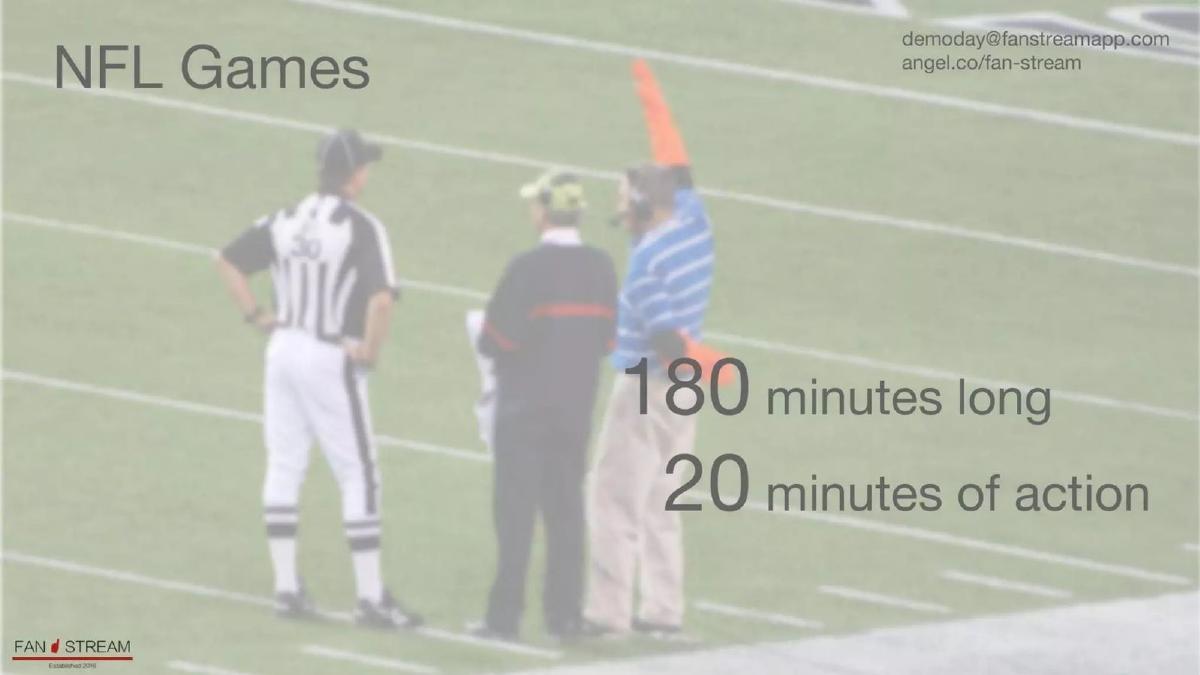
- Slide 6 highlights a specific inefficiency in NFL games: '180 minutes long' with only '20 minutes of action,' justifying the need for social engagement.
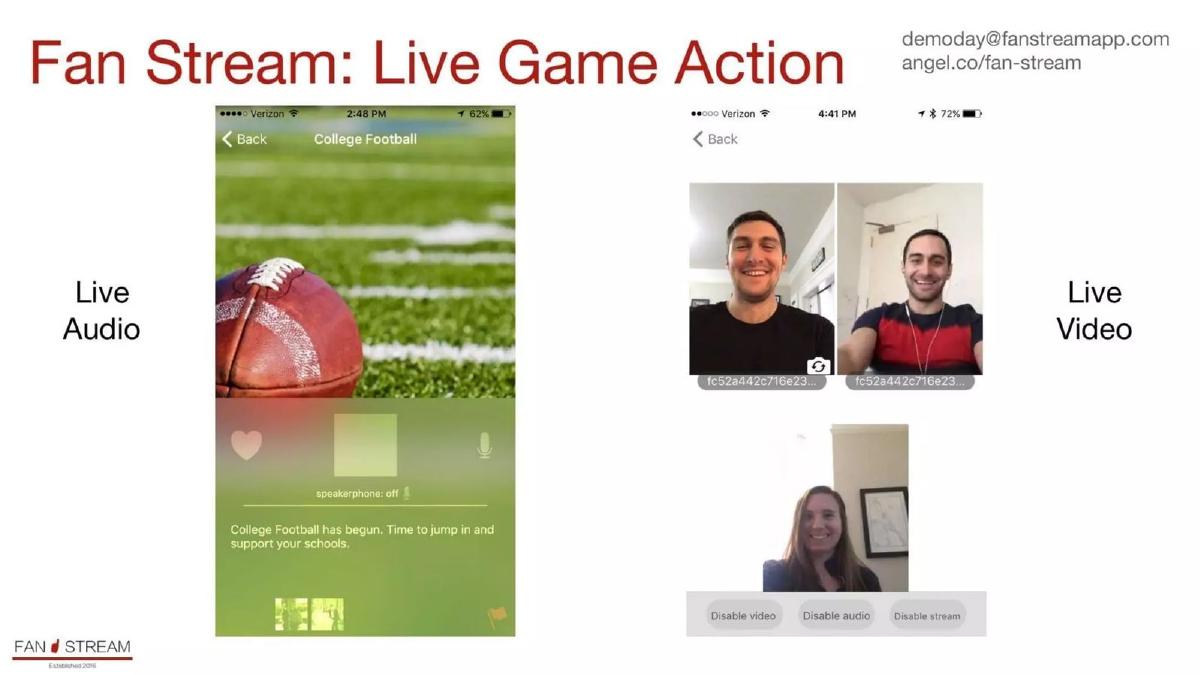
- The product interface on slide 5 shows both 'Live Audio' and 'Live Video' capabilities, suggesting a multi-modal communication platform.
- The team slide (slide 8) emphasizes a previous exit, stating the founders 'Founded company in community engagement space. Acquired.'
- There is no mention of a business model, revenue streams, or monetization strategy in the entire 9-slide deck.
- The deck completely omits a 'The Ask' slide, failing to specify how much capital was being sought or the intended use of funds.
- Market size (TAM/SAM/SOM) is entirely absent, relying instead on the universal recognition of sports fandom.
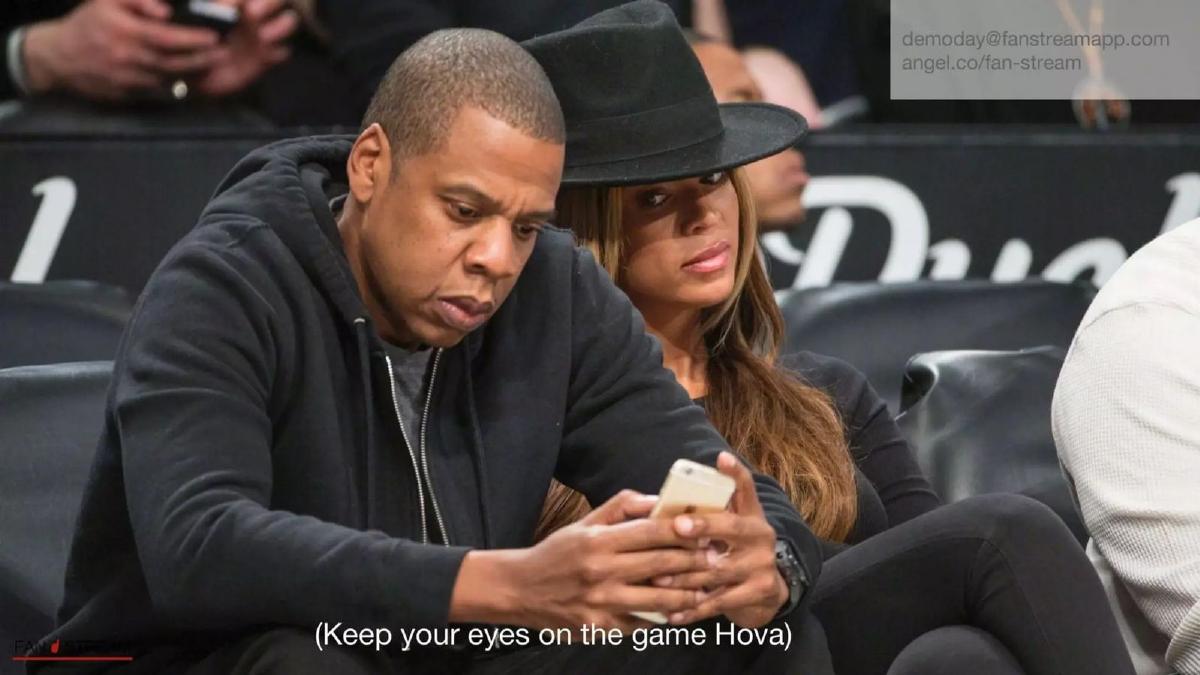
- The deck uses celebrity imagery (Jay-Z and Beyoncé on slide 4) to illustrate the 'head-down' problem of mobile phone usage during live events.
The Minimalist Narrative: Fan Stream's 9-Slide Seed Deck
Fan Stream entered the market in 2015, a period when social audio was still a nascent concept. Their pitch deck is a fascinating artifact of early-stage fundraising, prioritizing emotional resonance and behavioral observation over the data-heavy slides common in later rounds. Raising $125,000 with just nine slides—many of which contain fewer than ten words—is a testament to the power of a clear, simple hook: sports fans are lonely when they watch games at home, and they are distracted when they try to fix that loneliness with text-based apps.
The Hook and the Problem (Slides 1-4)
Slide 1: Title Slide The deck opens with a high-energy background image of a stadium crowd. The logo is simple, featuring a 'number one' foam finger as the icon between the words 'FAN' and 'STREAM'. The tagline is 'Fan Driven Sports Radio'. Crucially, the slide notes 'Established 2016', which is interesting given the catalogue data suggests the raise happened in 2015—likely indicating the company was pitching its vision for the upcoming year. The contact information is prominently displayed in the top right corner, a theme that continues throughout the deck.
Slide 2: The Nostalgia Play Slide 2 features a black-and-white, faded image of a large group of friends watching a game together on a couch. The text simply reads 'BACK IN THE DAY...'. This is a classic narrative device used to establish a 'lost' golden age of social sports consumption. It sets the stage for the 'Problem' slide by reminding the investor that sports used to be a communal, vocal experience.
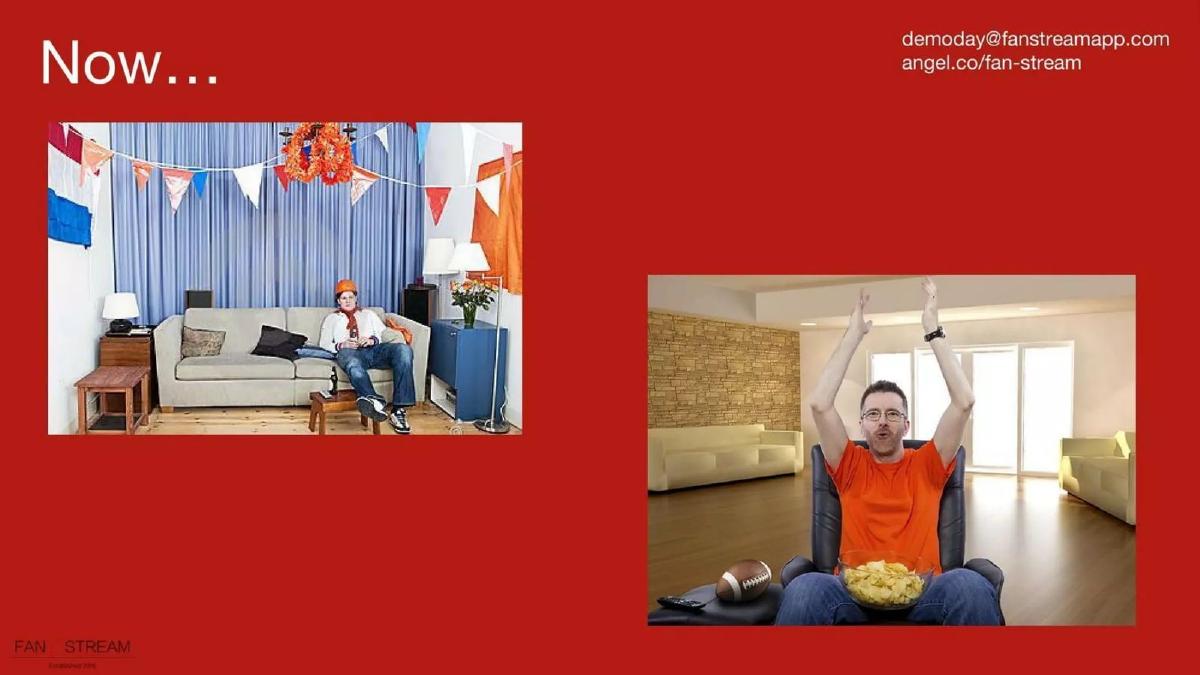
Slide 3: The Modern Reality In sharp contrast, Slide 3, titled 'Now...', shows two separate images of solitary men watching games alone in their living rooms. The red background is aggressive and emphasizes the isolation. This slide identifies the 'Problem' without using a single bullet point: the modern fan is physically alone, creating a psychological gap that the product intends to fill.
Slide 4: The Behavioral Friction Slide 4 uses a celebrity anchor to prove a point. It shows Jay-Z looking down at his phone while sitting courtside at a game with Beyoncé. The caption reads '(Keep your eyes on the game Hova)'. This is the most sophisticated 'Problem' slide in the deck. It argues that even when fans are physically at the game, the desire for digital connection (likely via text or social media) forces them to look away from the action. This justifies Fan Stream's audio-centric approach—allowing for digital connection without visual distraction.
The Solution and Product (Slides 5-7)
Slide 5: Live Game Action This slide introduces the interface. It shows two primary modes: 'Live Audio' and 'Live Video'. The audio interface features a football background with a simple 'speakerphone: off' toggle and a microphone icon. The video interface shows a three-way split screen of users talking. By showing both, Fan Stream suggests a versatile platform that can scale from low-bandwidth audio chatter to high-engagement video hangouts. The UI looks native to the iOS 7/8 era, consistent with the 2015 timeframe.
Slide 6: The Efficiency Argument Slide 6 focuses on the NFL. It states that NFL games are '180 minutes long' but contain only '20 minutes of action'. This is a brilliant use of a specific industry stat to justify the product's existence. It tells the investor that there are 160 minutes of 'dead time' per game where fans are primed for conversation. It positions Fan Stream not as a competitor to the game, but as the essential companion for the gaps between plays.
Slide 7: 365 Day Engagement To combat the concern that a sports app only gets used once a week, Slide 7 introduces '365 Day Engagement'. It lists three features: 'Hosted conversations', 'Reputation system', and 'Identify key fans'. The visual shows a 'Kyrie public station' featuring NBA player Kyrie Irving. This slide attempts to show the platform's potential as a social network where 'key fans' (influencers) can host their own shows, creating a reason for users to log in even when a live game isn't airing.
The Team and Contact (Slides 8-9)
Slide 8: The Team The team slide features Jeff Harris and Joe Geraghty. The text is minimal but powerful: 'Founded company in community engagement space. Acquired.' For a seed round, this is often the most important sentence in the deck. It tells investors that these founders have already successfully navigated the lifecycle of a startup in a related vertical. However, the slide lacks specific details—it doesn't name the previous company or the acquirer, which is a missed opportunity for building even more credibility.
Slide 9: Closing The final slide returns to the logo and provides direct email addresses for both Joseph Geraghty and Jeff Harris. It is a standard, clean exit for a pitch deck.
What Works in this Deck
The primary strength of the Fan Stream deck is its clarity of vision . By the fourth slide, the investor understands exactly what the problem is (isolation and text-based distraction) and how the product solves it (voice-driven social interaction). The use of the Jay-Z image is a clever way to illustrate a technical 'user friction' point through a relatable cultural lens.
The brevity of the deck is also a plus. In a demo day environment, where investors see dozens of pitches, Fan Stream’s focus on large images and single-sentence takeaways makes it memorable. It doesn't get bogged down in the 'how' (the tech stack) and instead focuses entirely on the 'why' (the fan experience).
Finally, the founder-market fit is established quickly. By mentioning a previous acquisition in the 'community engagement space,' the founders position themselves as experts in building the exact type of social dynamics required for a sports audio platform.
What is Missing from this Deck
While the deck is strong on narrative, it is exceptionally weak on business fundamentals . The most glaring omission is the Business Model . There is no mention of how the company plans to make money—whether through advertising, premium subscriptions, or data licensing. For a $125,000 seed round, this might be excusable, but it leaves a massive question mark for any serious investor.
The Market Size (TAM) is also missing. While it is common knowledge that sports is a massive industry, a professional deck should quantify the number of 'active fans' or the 'sports broadcasting market' to show the scale of the opportunity. Without these numbers, the pitch feels more like a feature than a standalone company.
There is also no Competition slide. In 2015, Twitter was already the 'global sports bar,' and traditional sports radio (ESPN, etc.) was the incumbent. Fan Stream fails to explain why a user would switch from a Twitter hashtag to a Fan Stream audio room. Lastly, the Ask is missing. A pitch deck should always state how much money is being raised and what the milestones for that capital will be (e.g., 'Raising $125k to reach 50k MAUs').
What a Founder Should Copy
Founders should emulate Fan Stream's visual storytelling . Instead of writing a paragraph about how 'mobile phones are distracting during live events,' they used one photo of a celebrity on his phone to make the point instantly. This 'show, don't tell' approach is highly effective for keeping an audience engaged.
The stat-backed opportunity on Slide 6 is another great takeaway. Finding a specific, non-obvious inefficiency in your market (like the 160 minutes of 'dead time' in an NFL broadcast) is a great way to prove there is a 'slot' for your product to fit into. It makes the product feel like a logical necessity rather than just a 'nice to have' app.
Lastly, if you have a previous exit , put it front and center. Fan Stream correctly identified that their past success was their strongest asset and gave it its own dedicated line on the team slide. Even if the exit was small, the fact that you have 'done it before' significantly de-risks the investment in the eyes of a seed-stage participant.
Frequently asked questions
- How did Fan Stream raise money without a business model slide?
- At the seed stage in 2015, investors often prioritized the 'problem-solution' fit and the team's pedigree over detailed financial models. By highlighting a previous acquisition in the same sector (community engagement) on slide 8, the founders signaled they had the expertise to figure out monetization later. The deck focuses on user behavior and engagement rather than immediate revenue.
- What is the 'head-down' problem mentioned in the deck?
- Slide 4 features a photo of Jay-Z looking at his phone at a basketball game with the caption '(Keep your eyes on the game Hova)'. This illustrates the core thesis: fans want to engage socially but typing on a phone distracts from the live action. Fan Stream's solution is audio-first communication, allowing fans to talk while keeping their eyes on the field.
- Is the lack of a competition slide a major red flag?
- In this specific deck, the omission of competitors like Twitter or traditional sports radio is notable. However, the founders likely addressed this during the live pitch by positioning Fan Stream as a 'third way'—more interactive than radio but less distracting than text-based social media. For a standalone deck, however, this omission makes it harder to understand the unique value proposition.
- Why does the deck emphasize '365 Day Engagement'?
- Slide 7 addresses the seasonality of sports. By mentioning 'Hosted conversations,' a 'Reputation system,' and the ability to 'Identify key fans,' the deck argues that the platform is a year-round community hub, not just a utility used during the 3-hour window of a live game. This is a play for higher user retention metrics.
- What was the primary goal of this pitch deck?
- This appears to be a 'teaser' or 'demo day' deck rather than a comprehensive due diligence deck. Its primary goal was to spark interest in the concept of 'Fan Driven Sports Radio' and showcase the founders' previous success. The inclusion of contact emails on almost every slide suggests it was designed to be shared and followed up on quickly.