Seam Social’s 11-slide deck is a masterclass in positioning a Web3 product through the lens of traditional social media failures. By identifying the 'ad-driven social sucks' problem, the company pivots toward a User-Generated Content (UGC) marketplace model, drawing direct revenue comparisons to giants like Roblox and Fortnite. The deck highlights significant early momentum, including a 36% D30 retention rate and a top-10 ranking on the iMessage app store. While the deck is light on team details and specific financial projections, it successfully uses a 'Growth Loop' and a clear roadmap of We…
Key takeaways
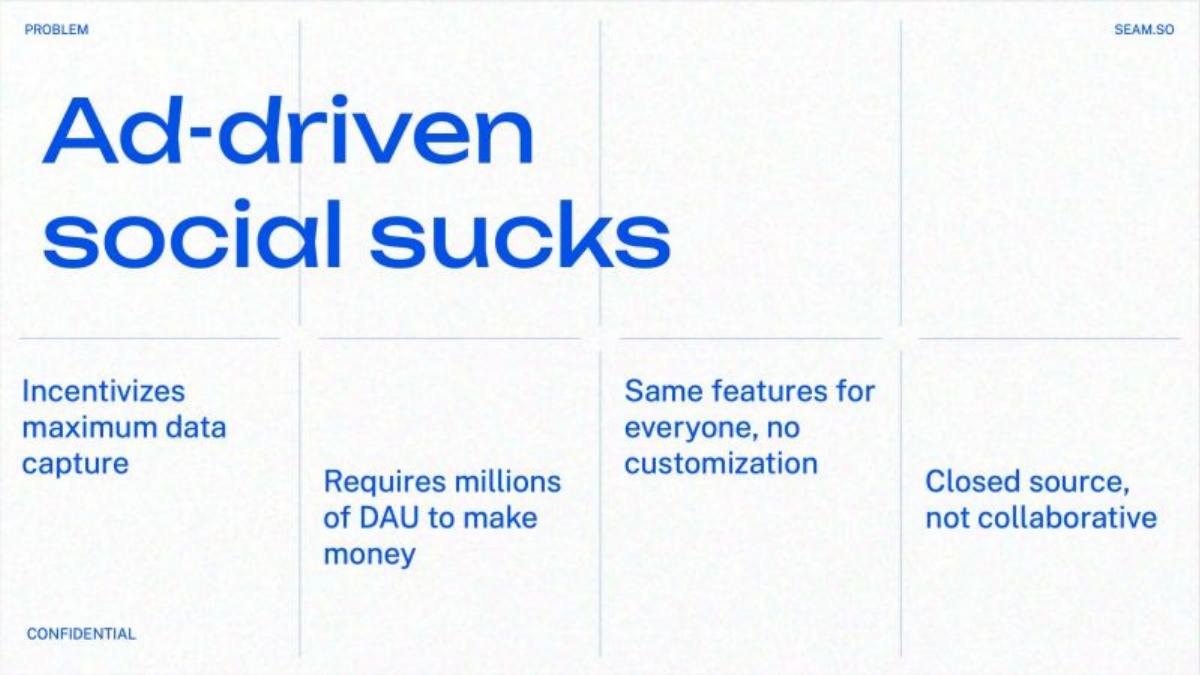
- The deck identifies four core problems with current social media: data capture incentives, high DAU requirements for monetization, lack of customization, and closed-source nature (Slide 2).
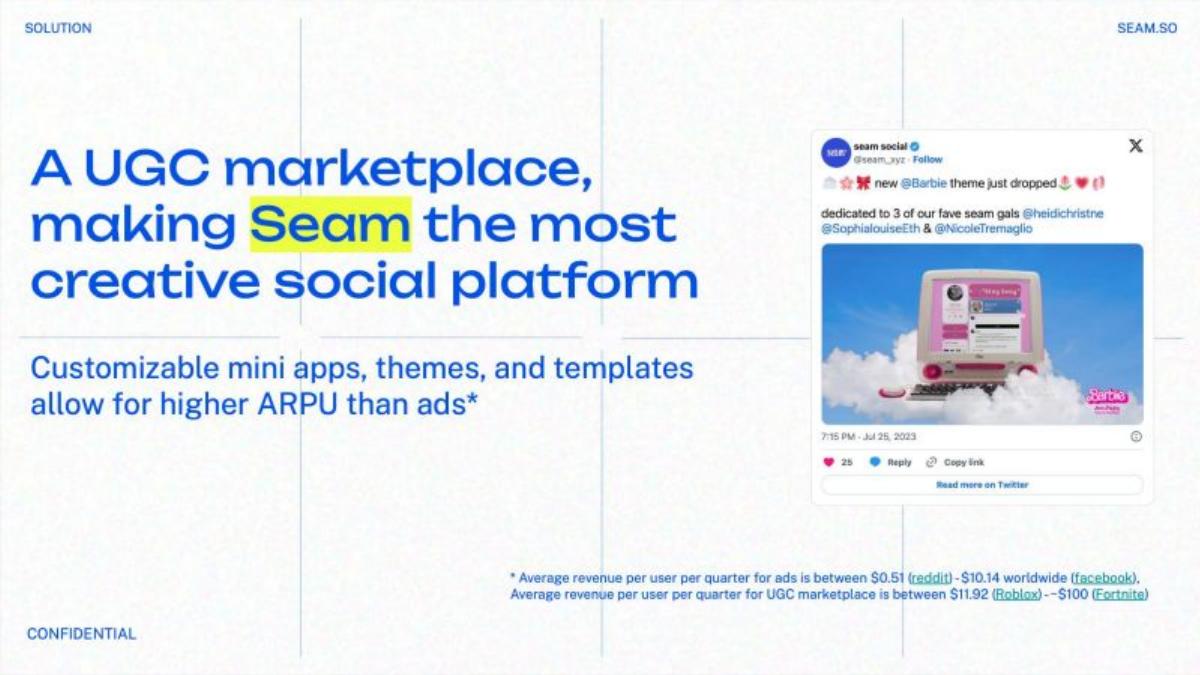
- Seam positions its UGC marketplace as a higher ARPU alternative to ads, citing Roblox ($11.92) and Fortnite (~$100) against Facebook ($10.14) (Slide 3).
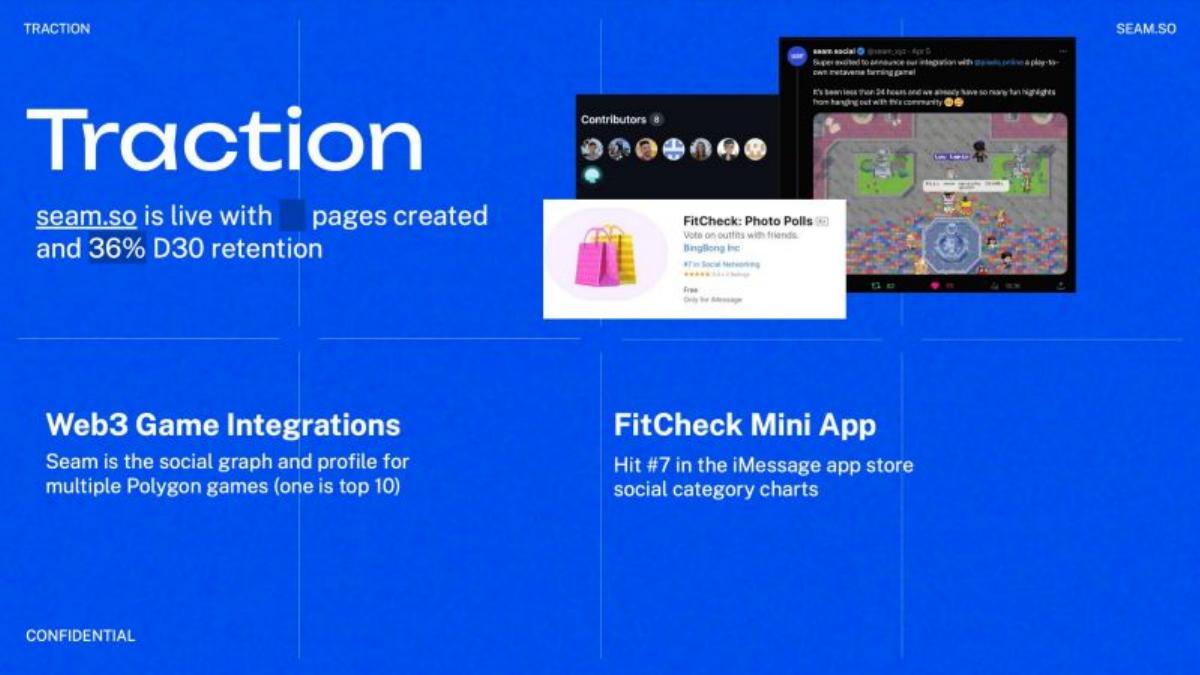
- The platform reports a 36% Day 30 (D30) retention rate, though the total number of pages created is redacted in this version (Slide 5).
- Early product validation includes the FitCheck Mini App hitting #7 in the iMessage app store social category charts (Slide 5).
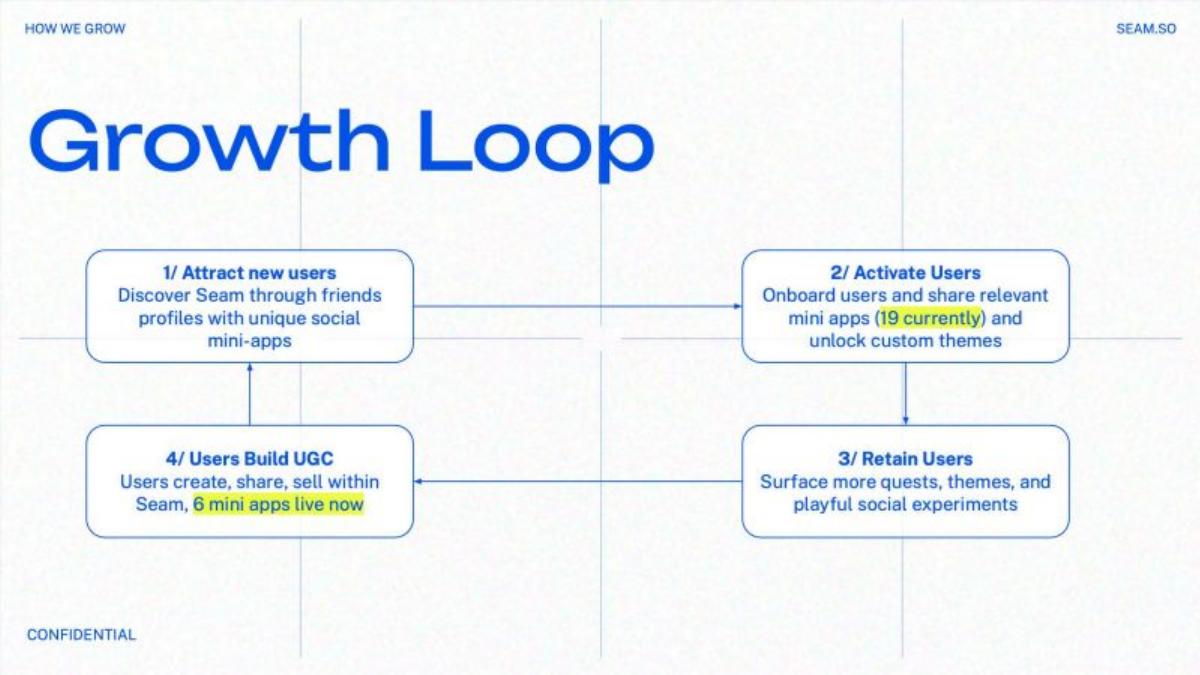
- The growth strategy relies on a four-stage loop: Attract, Activate (with 19 current mini apps), Retain, and Build (Slide 6).
- Market sizing is visualized through an intersection of the iOS App Store, Facebook, Epic Games, and LEGO, totaling over $1.3 trillion in combined market value (Slide 7).
- The roadmap shows a rapid execution pace in 2023, moving from a Block SDK launch in Q1 to NFT Gated Themes in Q3 (Slide 8).
- The 'Ask' slide specifically mentions hiring engineers for the marketplace and seeking support for a future Seam token launch and tokenomics (Slide 9).
The Narrative: Nostalgia Meets the Blockchain
Seam Social’s pitch deck is a concise, 11-slide presentation that leans heavily into the 'anti-incumbent' sentiment prevalent in the Web3 space. By framing the current social media landscape as a 'sucking' experience for users, the deck immediately establishes a need for a new paradigm. The visual style is minimalist, using a high-contrast blue and white grid system that evokes a technical yet accessible 'builder' aesthetic. The core thesis is simple: social media should be about creativity and ownership, not just data harvesting for advertisers.
Slide 1: Title Slide
The deck opens with a bold, minimalist title slide. SEAM Social PITCH DECK is displayed in a custom sans-serif font against a vibrant blue background with a subtle grid overlay. The top right corner features the URL SEAM.SO , and the top left is marked CONFIDENTIAL . This slide sets a professional, tech-forward tone without unnecessary clutter.
Slide 2: The Problem - Ad-driven social sucks
The problem statement is aggressive and direct. It lists four primary pain points of the current social media era: Incentivizes maximum data capture , Requires millions of DAU to make money , Same features for everyone, no customization , and Closed source, not collaborative . This slide effectively targets the frustrations of both users (lack of privacy and customization) and investors (the difficulty of scaling an ad-based business).
Slide 3: The Solution - A UGC Marketplace
Seam presents its solution as A UGC marketplace, making Seam the most creative social platform . The slide features a screenshot of a tweet announcing a 'Barbie' theme, showcasing the platform's aesthetic flexibility. Crucially, it includes a footnote comparing Average Revenue Per User (ARPU) per quarter. It notes that while Reddit ($0.51) and Facebook ($10.14) rely on ads, UGC marketplaces like Roblox ($11.92) and Fortnite (~$100) generate significantly more value per user. This is a vital pivot from 'social network' to 'social platform/marketplace.'
Slide 4: Product Demo
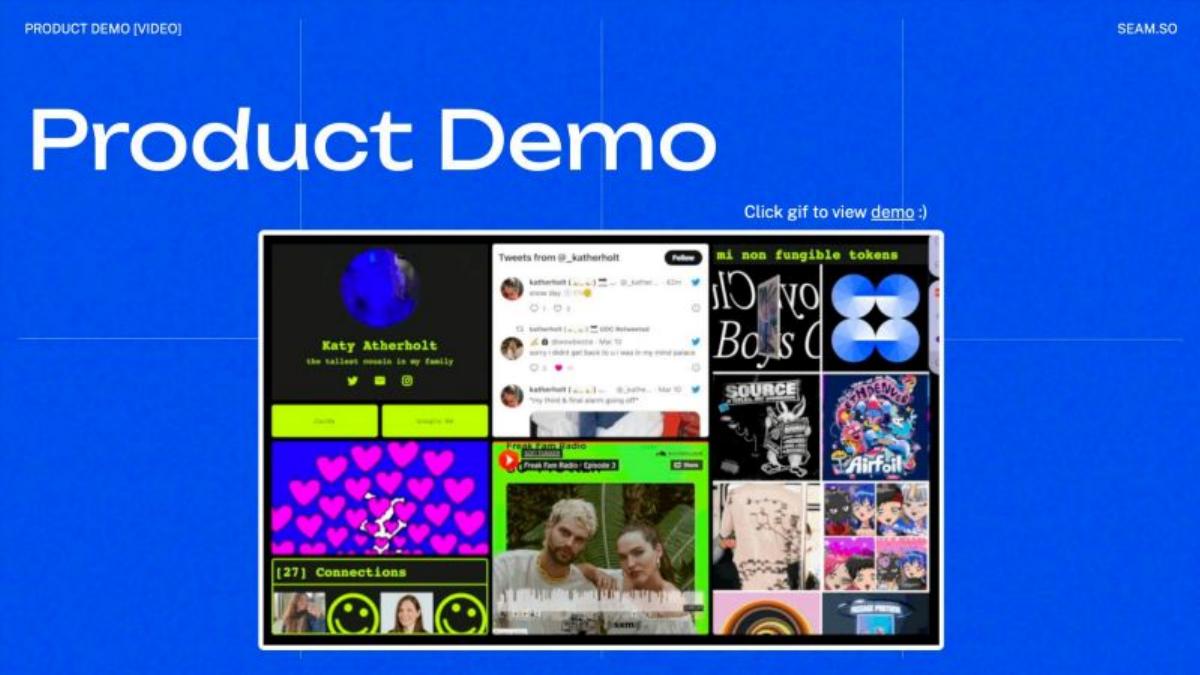
Slide 4 is a placeholder for a video demo. It shows a collage of user profiles that look like a modern, high-fidelity version of MySpace or GeoCities. The profiles feature Twitter feeds, NFT galleries, music players, and custom 'Connections' blocks . The text Click gif to view demo :) indicates that in a live setting, this slide provides the 'aha' moment by showing the product's high degree of customizability.
Slide 5: Traction - Retention and Rankings
The traction slide provides hard evidence of product-market fit. It states that seam.so is live with [redacted] pages created and 36% D30 retention . A 36% retention rate after 30 days is exceptionally high for an early-stage social app. The slide also highlights Web3 Game Integrations , noting that Seam is the social graph for multiple Polygon games, and mentions the FitCheck Mini App , which hit #7 in the iMessage app store social category charts . This demonstrates that the team can build products that go viral outside of the core Web3 bubble.
Slide 6: Growth Loop
The 'How We Grow' slide outlines a four-step circular process. 1/ Attract new users through unique social mini-apps. 2/ Activate Users by sharing relevant mini-apps ( 19 currently ). 3/ Retain Users through quests and social experiments. 4/ Users Build UGC , where they create and sell within Seam ( 6 mini apps live now ). This loop shows a clear path to organic, user-led growth rather than relying on expensive paid acquisition.
Slide 7: Sizing the Opportunity
Instead of a standard TAM/SAM/SOM chart, Seam uses a Venn diagram. It places Seam at the intersection of the iOS App Store ($635b) , Facebook ($720b) , EPIC Games ($32b) , and LEGO ($12b) . The text claims Seam is the best of these worlds . While these are massive numbers, the slide serves to position Seam as a hybrid of a social network, an app store, and a creative toy.
Slide 8: Our Progress & Roadmap
The roadmap covers 2023 in detail. Q1 saw the launch of the Block SDK and referrals. Q2 introduced gaming partnerships and 'Quests.' Q3 (the current period at the time of the deck) mentions acceptance into the Variant Founder Fellowship and the launch of NFT Gated Themes . The 'NEXT' column focuses on Monetization, Growth, and GTM (Go-To-Market).
Slide 9: The Ask
The 'Ask' slide is split into three pillars. First, $[Redacted] M seed for hiring full-time engineers to build the marketplace . Second, Partnerships intros with IP-focused NFT projects and web3 games . Third, Seam token launch support, audits, legal advising, and tokenomics . This slide makes it clear that while the product looks like a social app, the backend and future economy are firmly rooted in Web3 infrastructure.
Slide 10: Thank You
A simple closing slide with the contact email nick@getseam.xyz and a personal Seam profile link www.seam.so/nick . This reinforces the 'dogfooding' aspect of the pitch—the founder is an active user of the platform.
Slide 11: Appendix/Source
The final slide is a promotional graphic for bestpitchdeck.com , providing context for where the deck was sourced. It is not part of the original Seam Social presentation.
What Works in the Seam Social Deck
The deck’s greatest strength is its clarity of positioning . By immediately attacking the 'ad-driven' model, Seam creates a 'villain' and positions itself as the 'hero' for both users and investors. The use of ARPU comparisons (Slide 3) is a brilliant way to justify a non-traditional social media business model. Investors are often wary of new social networks because of the 'cold start' problem and the difficulty of monetization; Seam addresses both by showing high retention (36%) and a marketplace model that works at a smaller scale than ads.
Furthermore, the multi-platform traction (Slide 5) is impressive. Proving that a mini-app can rank on the iMessage App Store shows that the team understands distribution beyond the niche Web3 community. This 'Web2.5' approach—using Web3 tech but reaching users where they already are—is a highly fundable strategy.
What Is Missing
The most glaring omission is the Team Slide . In a Seed round, the 'who' is often as important as the 'what.' Without knowing the founders' backgrounds, it is difficult to assess their ability to execute such a complex vision. Additionally, there is no mention of unit economics or a detailed breakdown of how the marketplace fees will work. While they mention high ARPU for Roblox, they don't explain how Seam specifically will capture that value.
The Tokenomics section is also very thin. Slide 9 asks for help with tokenomics, which suggests that the core economic engine of the platform was not yet fully designed at the time of the raise. For a Web3 project, this is a significant 'black box' that investors would likely scrutinize during due diligence.
The Founder's Playbook: What to Copy
Founders should emulate Seam’s Growth Loop visualization (Slide 6). It’s much more effective than a bulleted list of marketing tactics because it shows how the product's features (mini-apps) naturally lead to more users and more content. Also, the Venn Diagram for market sizing (Slide 7) is a great way to show 'adjacent possibilities.' Instead of claiming they will 'replace' Facebook, they show how they sit at the intersection of several proven, multi-billion dollar industries.
Finally, the Roadmap's specificity (Slide 8) is a good benchmark. Rather than vague goals like 'improve UI,' Seam lists specific technical milestones like 'Launched Block SDK' and 'NFT Gated Themes.' This gives investors confidence that the team has a concrete plan and the technical capability to hit their marks.
Frequently asked questions
- What is Seam Social's primary business model?
- Seam Social operates as a B2C UGC marketplace. Instead of relying on advertising revenue, which the deck criticizes on Slide 2, the company focuses on selling customizable mini apps, themes, and templates. Slide 3 explicitly compares this model to high-ARPU gaming platforms like Roblox and Fortnite, suggesting that user-generated digital goods provide a more sustainable path to profitability than traditional social media ads.
- How does Seam Social integrate with Web3?
- The platform serves as a social graph and profile layer for Web3 ecosystems. According to Slide 5, Seam is integrated with multiple Polygon games, including one in the top 10. The roadmap on Slide 8 highlights the launch of NFT Gated Themes in Q3 2023, and the 'Ask' on Slide 9 includes support for a Seam token launch, audits, and legal advising for tokenomics.
- What traction did the company have at the time of the pitch?
- Seam demonstrated strong early engagement with a 36% D30 retention rate (Slide 5). They also achieved external validation through their 'FitCheck' mini app, which reached the #7 spot in the iMessage App Store's social category. Additionally, the platform had 19 mini apps available for user activation and 6 mini apps live for user creation as of the Growth Loop slide (Slide 6).
- Who are the competitors identified in the deck?
- The deck does not feature a traditional competitive matrix. Instead, it uses Slide 7 to place Seam at the center of four major industry pillars: the iOS App Store ($635b), Facebook ($720b), Epic Games ($32b), and LEGO ($12b). This suggests Seam competes for the same user attention and 'creative play' budget as these giants rather than just other Web3 social startups.
- What is missing from the Seam Social pitch deck?
- The most notable omission is a Team slide. There is no mention of the founders' backgrounds or previous successes within the 11 slides. Furthermore, the deck lacks a detailed financial breakdown, specific user acquisition costs (CAC), or a clear explanation of the underlying blockchain architecture beyond mentions of Polygon and NFTs. The 'Ask' amount on Slide 9 is also redacted in this public version.