ScorePlay’s 9-slide Seed deck is a lean, highly effective example of vertical SaaS positioning. By framing the problem as a 'media-driven paradigm shift' in a $240B+ industry (Slide 2), the founders successfully transitioned from a simple tool to 'media infrastructure.' The deck excels at identifying specific pain points through high-profile testimonials, such as Sorare CEO Nicolas Julia (Slide 3), and mapping a fragmented competitive landscape that relies on generic tools like WhatsApp and Google Drive (Slide 4). While the deck lacks a specific 'Ask' slide or detailed financial projections,…
Key takeaways
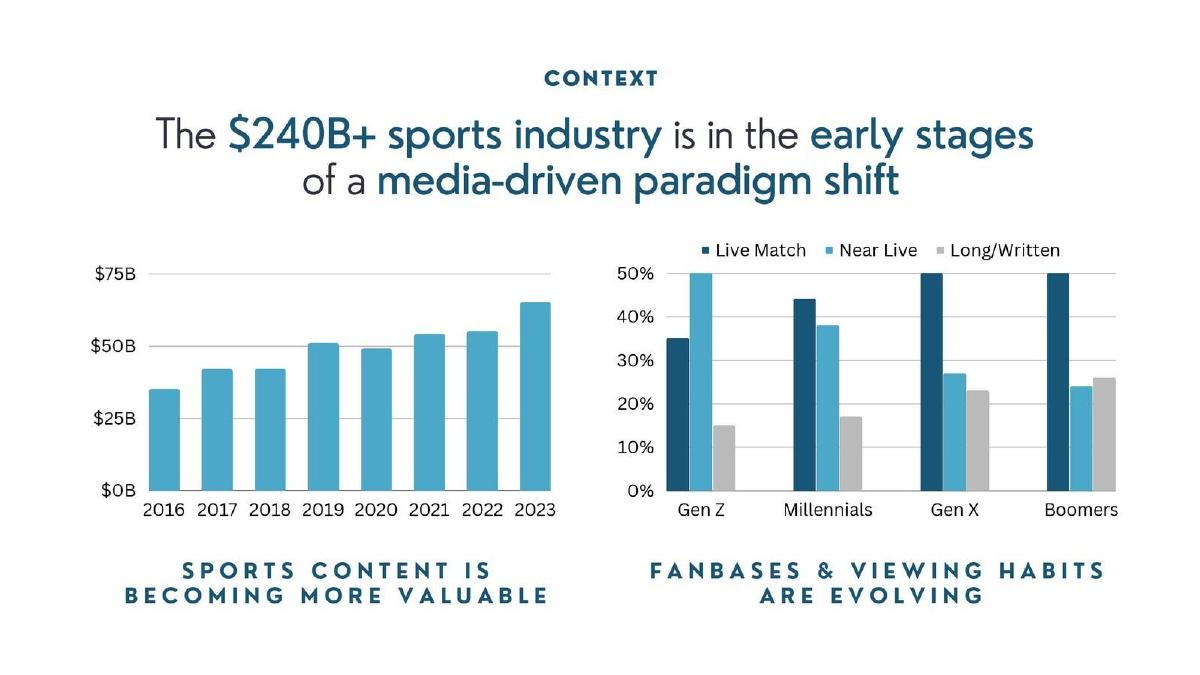
- The deck identifies a $240B+ sports industry undergoing a shift where Gen Z favors 'Near Live' content over traditional formats (Slide 2).
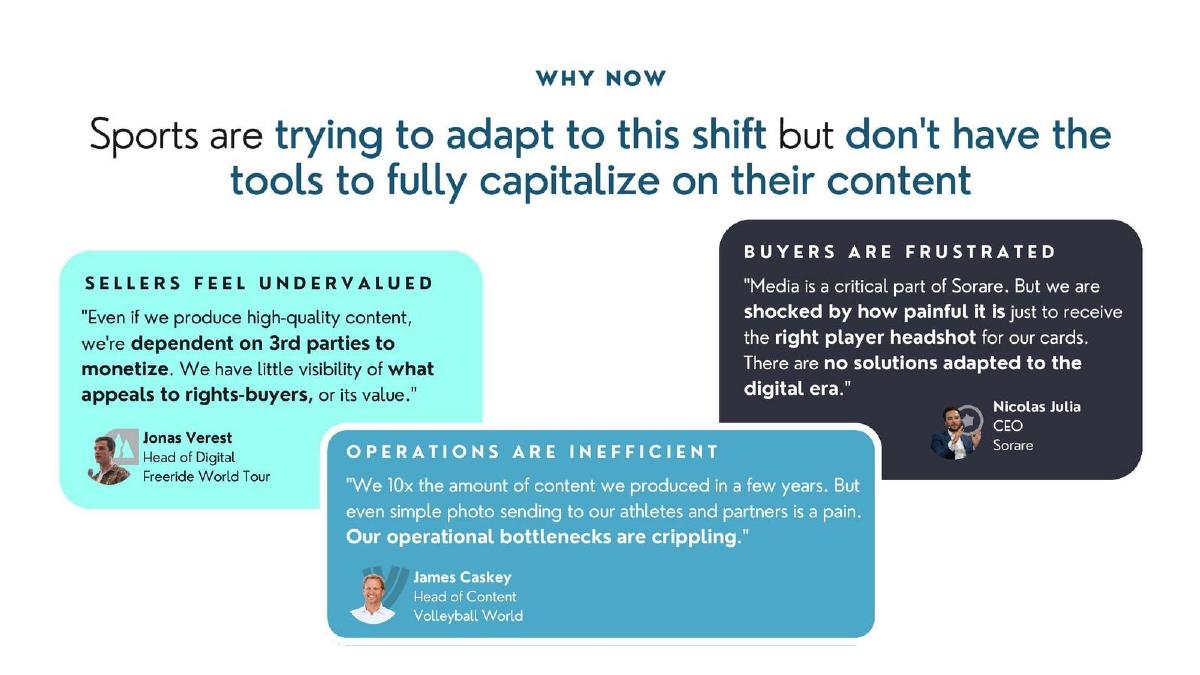
- High-signal social proof is used early, featuring quotes from the CEO of Sorare and the Head of Content at Volleyball World to validate market pain (Slide 3).
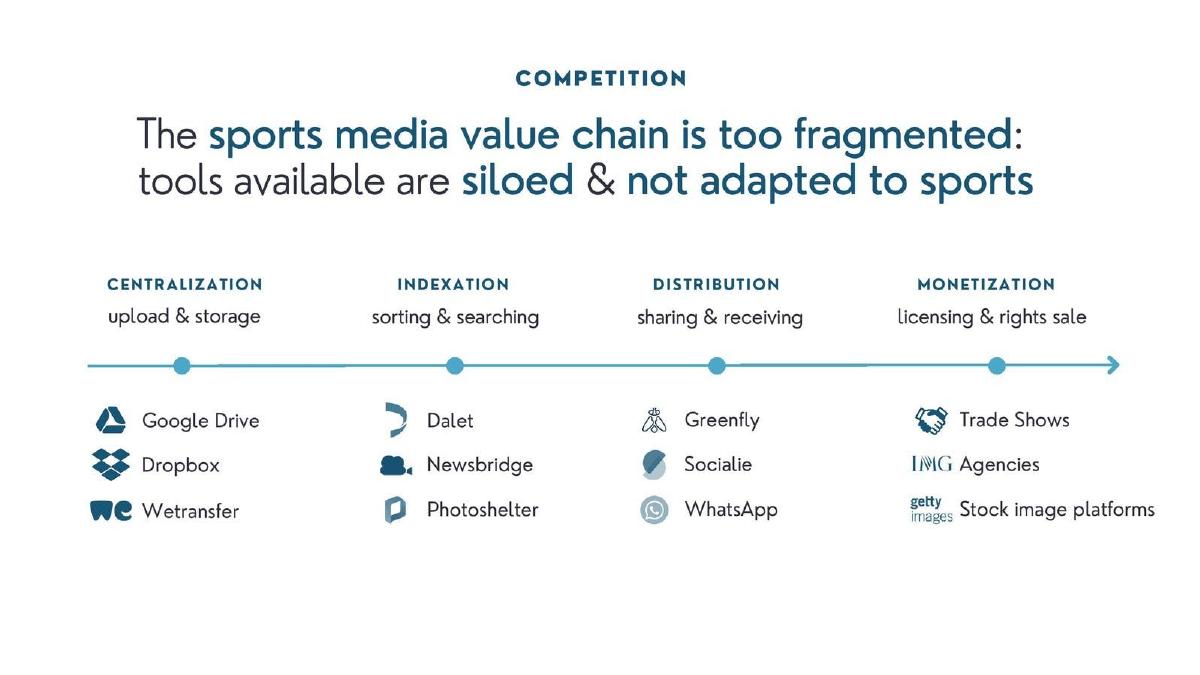
- The competitive landscape is framed not by direct rivals, but by the 'fragmented value chain' of generic tools like Dropbox and WhatsApp (Slide 4).
- ScorePlay positions itself as a central hub connecting four content sources to five distinct output channels, including an API (Slide 5).
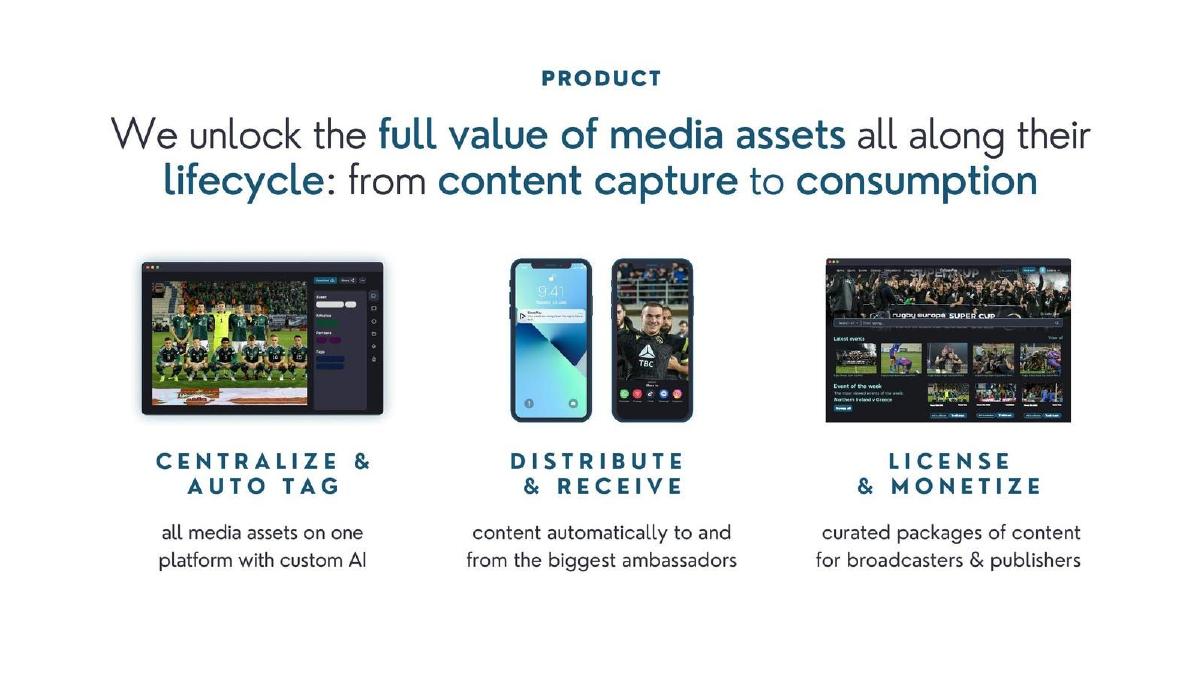
- The product slide highlights 'custom AI' for auto-tagging, moving the value prop from storage to automated metadata (Slide 6).
- Market expansion is clearly tiered, starting with 'Media Management' in pro sports before moving to broader 'Media Infrastructure' (Slide 7).
- The founding team highlights a specific relevant exit, noting their previous startup Hydra was acquired by Sofive Soccer Centers in 2020 (Slide 8).
- Investor pedigree is used as a closing strength, listing Kima Ventures and athletes like Kevin Durant and Mario Götze (Slide 8).
The 9-Slide Strategy for Vertical SaaS Dominance
ScorePlay’s deck is a masterclass in brevity. In an era where decks often bloat to 20+ slides, ScorePlay secured a reported $5M Seed round using just nine slides. The narrative is linear and disciplined: market shift, customer pain, fragmented competition, integrated solution, and a team that has done it before. By focusing on the 'Media Infrastructure' label, they elevated the company from a simple DAM (Digital Asset Management) tool to a critical piece of the sports tech stack.
Slide 1: The Vision Statement
The title slide introduces the company name and the tagline: "THE MEDIA INFRASTRUCTURE POWERING SPORTS." This is a high-level positioning statement. It avoids the word 'platform' or 'app,' opting for 'infrastructure,' which implies a higher level of necessity and stickiness within an organization's workflow.
Slide 2: Context and Market Shift
ScorePlay frames the opportunity not just as a large market, but as a market in flux. They cite a "$240B+ sports industry" that is in the "early stages of a media-driven paradigm shift." The slide uses two charts to prove this. The first shows sports content value growing from 2016 to 2023 (reaching over $60B). The second is more critical: it shows that Gen Z and Millennials overwhelmingly prefer 'Near Live' content over 'Long/Written' formats. This data justifies why a new, faster media management tool is required—traditional methods are too slow for the 'Near Live' demands of younger fans.
Slide 3: The 'Why Now' and Customer Pain
Instead of listing generic problems, ScorePlay uses three specific testimonials to illustrate frustration across the value chain. Jonas Verest (Freeride World Tour) notes that sellers feel undervalued and lack visibility into what appeals to buyers. James Caskey (Volleyball World) highlights that operational bottlenecks are 'crippling' despite a 10x increase in content production. Most importantly, Nicolas Julia (CEO of Sorare) represents the buyer's frustration, stating it is 'shocking' how painful it is to receive a simple player headshot. Using a well-known CEO like Julia as a 'frustrated buyer' is a powerful way to signal that the market is ready for a solution.
Slide 4: The Fragmented Competition
Slide 4 is one of the most effective competitive slides in recent seed decks. Rather than a standard 'feature checklist' grid, ScorePlay maps the "sports media value chain." They show that the current process is broken into four silos: Centralization (Google Drive, Dropbox), Indexation (Dalet, Photoshelter), Distribution (Greenfly, WhatsApp), and Monetization (Getty Images, Trade Shows). By listing generic tools like WhatsApp and Google Drive, they highlight that sports organizations are currently 'hacking' together a solution, creating a clear opening for a purpose-built vertical tool.
Slide 5: The Integrated Solution
This slide positions ScorePlay as the central 'hub' that connects the fragmented pieces identified in the previous slide. The graphic shows four inputs (Sports Media, Behind-the-scenes, Athlete Content, Fan UGC) flowing into the ScorePlay logo, which then distributes to five outputs (Clubs, Athletes, Brands, Rights-Buyers, and an API). At the bottom, they list integrations with Sportradar, WSC Sports, and Azzuu , proving that they aren't trying to replace the entire ecosystem, but rather act as the glue that connects existing data and publishing tools.
Slide 6: Product Capabilities
The product slide focuses on three core pillars: Centralize & Auto Tag , Distribute & Receive , and License & Monetize . They specifically mention "custom AI" for auto-tagging, which is the technical moat that solves the 'Indexation' problem mentioned on Slide 4. The visuals show a desktop interface for management and a mobile interface for athletes, emphasizing that the product serves both the back-office staff and the 'ambassadors' (athletes) who need the content.
Slide 7: Market Size and Verticals
ScorePlay breaks down their TAM (Total Addressable Market) into two phases. Phase one is "Media Management" ($65Bn) focused on winning pro sports. Phase two is "Media Infrastructure," extending through the broader "+$240Bn" sports industry. They list 7 specific verticals: Clubs, Leagues, Federations, Grassroots, College, Brands, and Publishers. This shows investors that while they are starting with pro clubs, the software is versatile enough to scale into amateur sports and corporate brand sponsorships.
Slide 8: The Team and Traction
The 'Why Us' slide features the three founders: Xavier Green (CTO, ex-Datadog) , Victorien Tixier (CEO, ex-Sofive) , and Barbara Bergeaud (COO, ex-M6) . The most important piece of information here is the track record: "Launched Hydra in 2018... acquired by Sofive Soccer Centers in 2020." Founders with a previous exit in the same niche are highly attractive to Seed investors. The slide also lists their pre-seed backers, including Kima Ventures, Apex Capital, and athlete-investors like Kevin Durant (35V) and Mario Götze. This level of industry backing at the Seed stage creates a strong sense of inevitability.
Slide 9: Contact Information
The final slide is a simple contact page with the website and the CEO's email address. It is notable for what it lacks: there is no mention of the round size, the valuation, or the specific use of funds. This suggests the deck was likely used as a conversational aid rather than a standalone document, or that the terms were being negotiated dynamically.
What ScorePlay Does Well
The deck’s greatest strength is its problem-solution alignment . Slide 4 identifies the specific tools being used (WhatsApp, Google Drive), and Slide 6 explains exactly how ScorePlay replaces them with AI-driven automation. By naming the 'messy middle' of the current workflow, they make the need for their product feel urgent.
Furthermore, the social proof is exceptional. Including a quote from the CEO of Sorare—a multi-billion dollar company in the sports space—validates that the problem is real for the biggest players in the industry. The team slide reinforces this by showing they have already successfully exited a company in this exact domain.
What is Missing from the Deck
Despite the successful raise, the deck leaves several questions unanswered for a cold reader. There is no mention of unit economics or current revenue. While the publisher reports a $5M raise, the deck itself does not state the 'Ask' or the milestones they intend to hit with the capital. There is also a lack of a detailed roadmap ; while Slide 7 shows vertical expansion, it doesn't explain the technical hurdles or the sequence of product releases planned for the next 18 months.
Founder Takeaways
Focus on the Value Chain: If you are building vertical SaaS, don't just list competitors. Map the entire value chain and show where the current process breaks down. · Leverage 'Non-Traditional' Competitors: Often, your biggest competitor isn't another startup; it's a combination of Google Drive and WhatsApp. Naming these tools makes your solution feel more practical and grounded in reality. · Use High-Signal Testimonials: A quote from a potential buyer who is a leader in your industry is worth more than three slides of market research. · Keep it Lean: ScorePlay proved that you don't need 20 slides to raise $5M. If your market, problem, and team are strong, 9 slides are sufficient to tell a compelling story.
Frequently asked questions
- What is the primary problem ScorePlay is solving?
- ScorePlay addresses the 'fragmented media value chain' in sports. According to Slide 4, current tools are siloed—organizations use Google Drive for storage, WhatsApp for distribution, and trade shows for monetization. This creates operational bottlenecks, making it difficult for sports brands to quickly get content to athletes and partners.
- How does ScorePlay use AI in its product?
- Slide 6 specifies that ScorePlay uses 'custom AI' to automatically tag media assets. This allows sports organizations to centralize their content and instantly index it, which facilitates the 'Distribute & Receive' function where content is automatically sent to athletes (ambassadors) for social media use.
- Who are the key investors mentioned in the deck?
- Slide 8 lists several high-profile backers from their $1.5M pre-seed round, including Kima Ventures, Apex Capital, and Nicolas Julia (CEO of Sorare). It also features athlete-investors Mario Götze and 35V (Kevin Durant and Rich Kleiman), providing significant industry credibility.
- What is ScorePlay's go-to-market strategy?
- Slide 7 outlines a 'product-led strategy' targeting seven verticals: Clubs, Leagues, Federations, Grassroots, College, Brands, and Publishers. They aim to first 'win the category in pro sports' via media management before extending into broader media infrastructure across the entire industry.
- Is there a financial roadmap or 'Ask' in this deck?
- No. The 9-slide deck concludes with contact information (Slide 9) without disclosing the specific amount being raised in the current round or providing revenue projections. The only financial figure mentioned is the $1.5M previously raised in 2021-22 (Slide 8).