SchoolAdmissions targets the friction-heavy private school enrollment market in India, where parents reportedly spend over $2,000 and 20 days off work to secure a spot for their children. The deck highlights a significant market opportunity, citing 40 million new admissions in 2015 and a projected 50% private school enrollment share by 2020. With 50,000 registered families already on the platform, the company outlines a multi-pronged revenue model involving parent memberships, school lead generation, and brand advertising. Seeking $500,000, the deck relies heavily on emotional imagery and mac…
Key takeaways
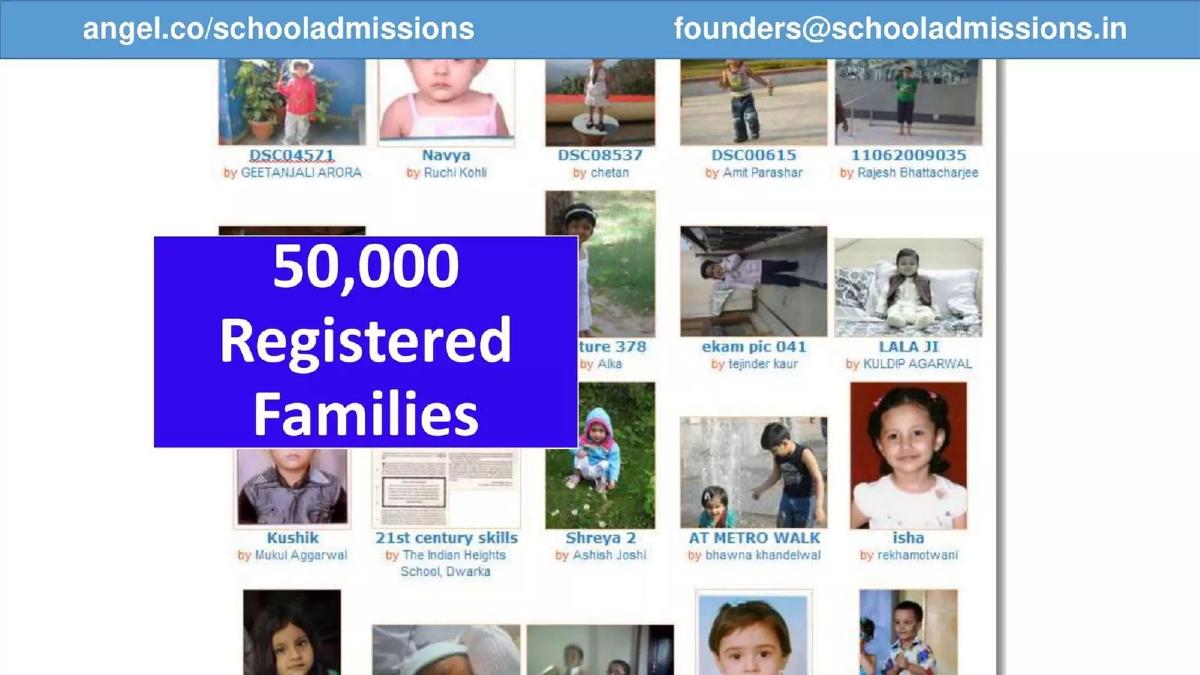
- The company claims a current user base of 50,000 registered families as shown on slide 2.
- Private school enrollment in India is projected to reach a 50% share of total enrollments by 2020 according to slide 10.
- Schools in Delhi alone earned $250 million from the sale of admission forms in 2012 as stated on slide 11.
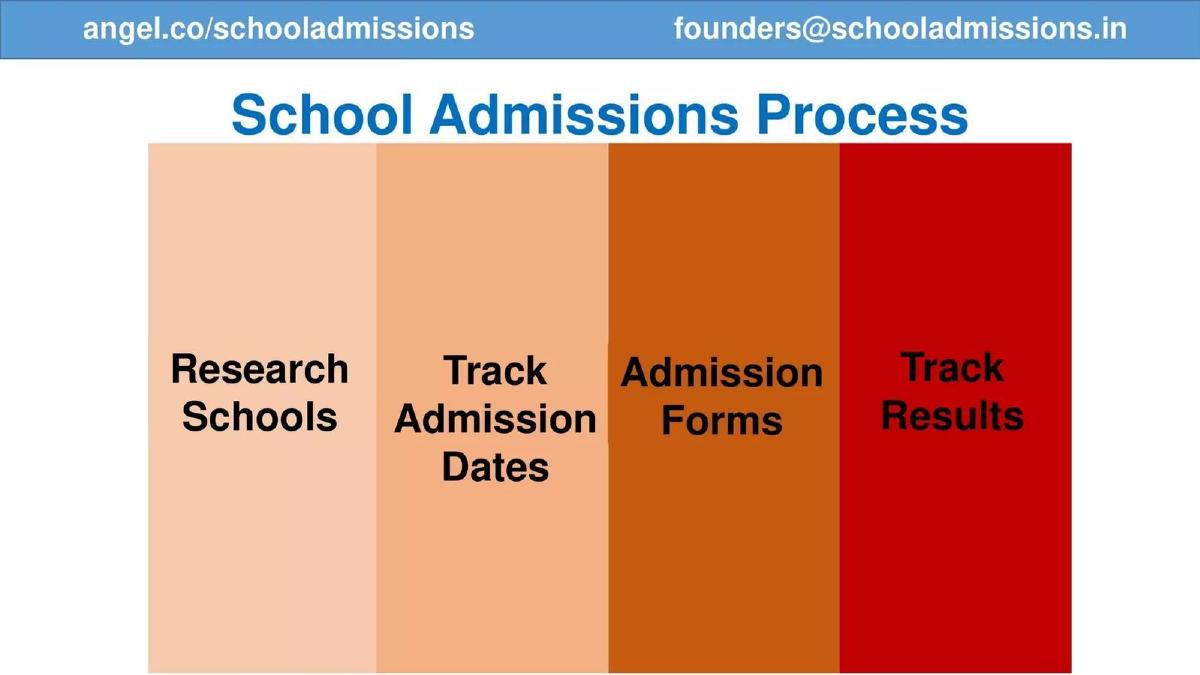
- The platform aims to digitize a four-step process: Research, Tracking Dates, Admission Forms, and Tracking Results (slide 6).
- The revenue model is diversified across parents (membership), schools (featured listings), and lead generation for brands (slide 14).
- The company highlights a partnership with Airtel, citing access to a consumer base of over 250 million on slide 15.
- The founders, Raj and Puja Arora, are both fellows of the Startup Leadership Program (slide 16).
- The deck concludes with a specific funding ask of $500,000 on slide 17.
Executive Summary: The Digitalization of Indian Schooling
SchoolAdmissions presents a 17-slide pitch deck that focuses on the logistical and emotional pain points of the Indian education system. The deck is built on a clear narrative: the current process of getting a child into a private school is manual, expensive, and archaic. By digitizing the 'School Matching Engine' and the application process, the company aims to capture a slice of a multi-million dollar market. The deck transitions from emotional 'in-the-trenches' imagery to hard macro-economic data, eventually landing on a $500,000 funding request.
Slides 1-5: The Emotional Hook and Current Traction
Slide 1 introduces the company with the tagline "Simplifying School Admissions for parents in India." It includes the website URL and contact information, establishing the brand immediately. Slide 2 is a traction slide, claiming "50,000 Registered Families" overlaid on a collage of user profile photos. This is a strong start, showing that the platform is not just a concept but has an active user base.
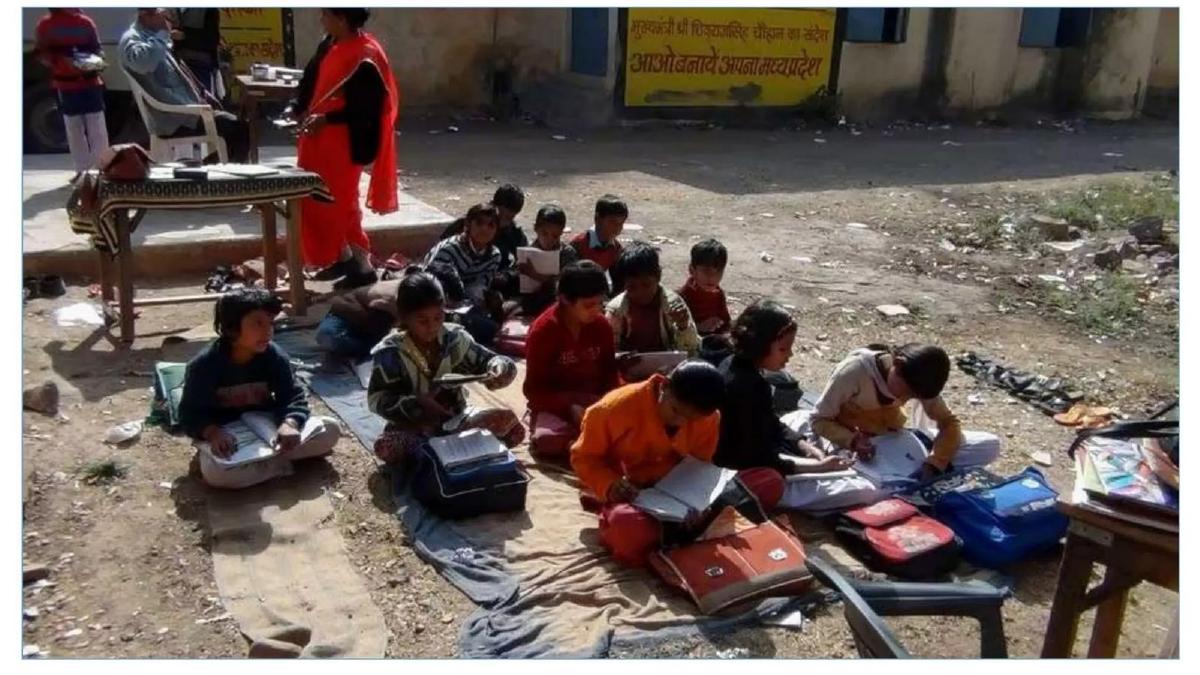
Slides 3, 4, and 5 are purely visual and lack text. They use photography to contrast different educational environments in India—from a family at Christmas to children learning in an outdoor setting, and finally, students using laptops in a modern classroom. These slides appear to be setting the stage for the socio-economic diversity of the market, though they offer no specific data points.
Slides 6-8: Defining the Problem
Slide 6 breaks down the "School Admissions Process" into four distinct, color-coded phases: Research Schools, Track Admission Dates, Admission Forms, and Track Results. This slide serves as the functional roadmap for what the product actually does. Slide 7 uses a powerful photograph of a long, crowded queue of parents on a sidewalk, illustrating the physical reality of manual admissions.
Slide 8 quantifies the 'Parental Pain.' It features a central image of a stressed professional with four callouts: "Cost >2000$", "5 Months Spent", "20 Days Off", and "Stress." By putting a dollar and time value on the problem, the founders make a compelling case for why a parent would be willing to pay for a digital solution.
Slides 9-11: Market Size and Opportunity
This section shifts to data-driven validation. Slide 9 cites the "Annual Status of Education Report 2012," stating there were "40 Million New Admissions" in 2015, with 38% in private schools. Slide 10 continues this trend, projecting that the share of private schools in enrollments will reach "50% by 2020."
Slide 11 provides a specific revenue opportunity metric: "250 Million Dollars earned by schools from sale of forms in Delhi alone in 2012." This is a critical slide because it identifies a direct cash flow—form sales—that the company intends to digitize and potentially monetize through the "Charge Per Form" model mentioned later in the deck.
Slides 12-13: The Product and Version 2.0
Slide 12 shows a screenshot of the existing web platform. It highlights a "Trusted Admissions Advisor" and a search engine that tracks schools on "more than 38 parameters." It also shows a "Top 4 schools" trending section for specific neighborhoods like R.K. Puram, New Delhi, demonstrating the localized nature of the search tool. Slide 13 introduces "SchoolAdmissions 2.0," a flow chart consisting of the School Matching Engine, Admission Alerts, Networking, and Online Admission Application. This suggests the $500k raise is intended to move the product from a search/directory tool to a full-stack application platform.
Slides 14-17: Business Model, Partnerships, and The Ask
Slide 14 answers the question "How do we make money?" with a three-pronged approach. For Parents, they offer memberships and per-form charges. For Schools, they offer featured listings and per-form charges. For Brands, they offer lead generation and advertising. This diversified model reduces reliance on a single stakeholder.
Slide 15 highlights a "partnership with Airtel," noting access to a consumer base of over 250 million. This is the deck's primary 'unfair advantage' or distribution strategy. Slide 16 introduces the team. Co-founders Raj and Puja Arora are both fellows of the Startup Leadership Program, and the advisors include Aaron Sears (500 Startups) and Vikram Upadhyay (Indian Angel Network). Finally, Slide 17 states the ask: "Raising $500,000 For Helping Parents Choose The Best For Their Kids."
What Works in This Deck
Quantified Pain Points: Slide 8 is the strongest slide in the deck. By stating that parents spend $2,000 and 20 days off work, the founders move the problem from a 'nuisance' to a 'financial drain.' This makes the value proposition of a digital tool immediately obvious to an investor.
Clear Market Segment: The focus on private school form sales in Delhi (Slide 11) provides a tangible starting point. It proves that there is already a massive amount of money changing hands in the exact niche the company wants to occupy.
Distribution Strategy: Mentioning the Airtel partnership (Slide 15) provides a credible answer to the 'how will you grow' question. In a crowded market, having a direct line to 250 million consumers is a significant validator.
What Is Missing
Competitive Landscape: The deck does not mention any other players in the Indian EdTech or school directory space. Investors would likely want to know how SchoolAdmissions differentiates itself from existing school search portals or government initiatives.
Unit Economics: While the revenue model is listed (Slide 14), there is no mention of Customer Acquisition Cost (CAC) or Lifetime Value (LTV). Given the seasonal nature of school admissions, understanding how the company maintains revenue throughout the year is a major omission.
Use of Funds: The $500,000 ask is clear, but the allocation is not. There is no breakdown of how much will go to engineering, marketing, or operations. The mention of "Version 2.0" implies product development, but specific milestones are missing.
What a Founder Should Copy
The 'Process' Slide: Slide 6 is an excellent way to show how a complex real-world problem is broken down into software features. Founders should copy this method of mapping the user journey before showing the product.
Macro to Micro Data: The transition from 40 million national admissions (Slide 9) to $250 million in local form sales (Slide 11) is a great way to show both the scale of the market and the immediate addressable opportunity.
Visual Proof of Problem: Using a photo of a physical queue (Slide 7) is much more effective than just saying "the process is slow." It provides a visceral reminder of the inefficiency the startup is trying to solve.
Frequently asked questions
- What is the primary problem SchoolAdmissions is solving?
- According to slides 7 and 8, the problem is the physical and financial burden of manual school admissions. Parents face long queues and high costs, including over $2,000 in expenses, 5 months of time spent, and 20 days taken off work. The deck positions this as a major source of stress that can be mitigated through digital automation.
- How does the company plan to generate revenue?
- Slide 14 outlines a three-pillar monetization strategy. First, from parents via memberships and per-form charges. Second, from schools through featured listings and per-form processing fees. Third, through lead generation and advertising for third-party brands and service providers looking to reach the parent demographic.
- What is the current traction of the platform?
- The deck claims 50,000 registered families on slide 2. It also showcases a functional website interface on slide 12, featuring a 'School Matching Engine' that tracks schools based on more than 38 parameters. The partnership with Airtel (slide 15) is presented as a primary growth lever for future scaling.
- What are the key market statistics cited in the deck?
- The deck relies on the 2012 Annual Status of Education Report. It notes 40 million new admissions in 2015 (slide 9), a 38% private school enrollment rate growing to 50% by 2020 (slide 10), and a $250 million market for admission forms in Delhi alone (slide 11).
- Who is behind SchoolAdmissions?
- The team consists of Co-Founders Raj Arora (CEO) and Puja Arora (COO), both with backgrounds in Ecommerce and Equity Research. They are supported by advisors Aaron Sears (500 Startups Mentor) and Vikram Upadhyay (Indian Angel Network), as detailed on slide 16.