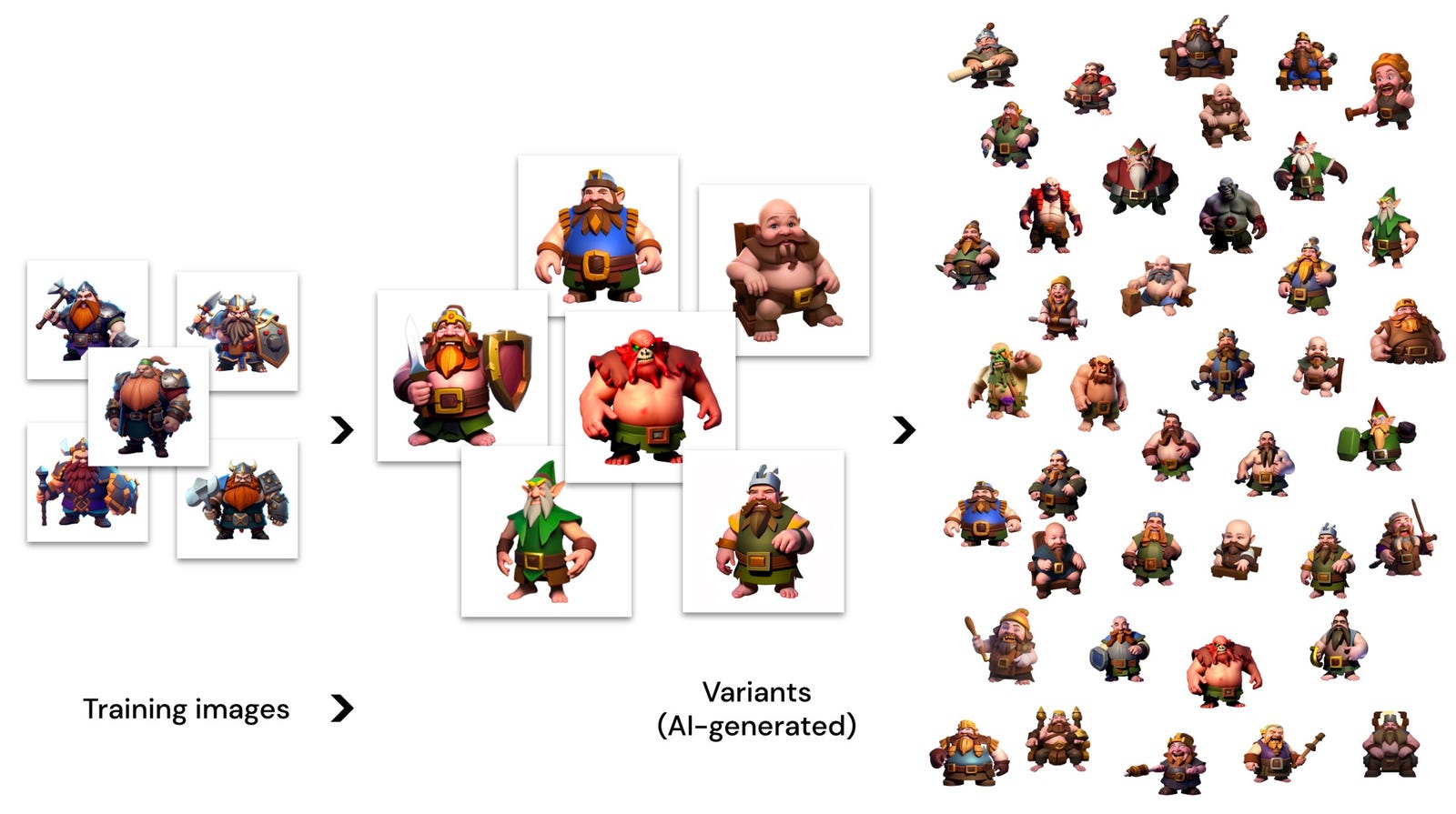
Scenario's 9-slide deck is a masterclass in leveraging early momentum and founder-market fit. Eschewing traditional graphic design for a document-style layout, the company focuses on the specific pain points of game developers using general AI tools like Midjourney: lack of style consistency and IP risk. By highlighting a 10,000-person waitlist and 2 million Twitter views on slide 1, they establish immediate market pull. The deck successfully positions the product not just as a generator, but as a workflow tool that integrates with Unity and Unreal. While it lacks a formal competition matrix…
Key takeaways
- The deck leads with massive social proof, citing 2M+ Twitter views and a 10,000-person waitlist on slide 1.
- Scenario identifies three specific failures of general AI tools (Dall-E, Midjourney) for gaming: difficulty of use, lack of consistency, and IP risk (slide 3).
- The founders are repeat entrepreneurs; CEO Emmanuel sold his previous startup Redbird to Airware (slide 2).
- Revenue strategy is clearly defined as a tiered subscription model ranging from $20 to $1,000+ per month (slide 1).
- Defensibility is built through a planned marketplace and tight integrations with industry-standard tools like Unity, Unreal, and Blender (slide 5).
- The product workflow is simplified into a three-step process: Upload, Train, and Create (slide 4).
- The deck targets three specific segments: indie/large game studios, game artists, and crypto-gaming companies (slide 6).
- Scenario addresses IP concerns directly by stating the platform uses the customer's own data to mitigate compliance risk (slide 3).
The Document-Style Pitch: Content Over Flash
Scenario’s pitch deck is an anomaly in the modern startup world. It is not a visually polished presentation; it is essentially a series of formatted text documents with embedded images. However, for a Seed round in a hot sector like Generative AI, this approach can signal a 'builder' mentality. The deck focuses entirely on the technical problem, the market pull, and the team’s pedigree. As reported by Business Insider, this deck helped secure $6M in 2024, proving that clear communication of value often outweighs high-end graphic design.
Slide 1: The Hook and The Momentum
The first slide (labeled '1' in the footer) serves as both an executive summary and a traction report. It defines the value proposition immediately: enabling developers to create 'style-consistent, proprietary game assets.' The inclusion of a November 2022 date suggests this deck was used during the height of the initial GenAI boom. The most compelling data points here are the 2 million Twitter views and the 10,000-person waitlist. For a Seed stage company, these numbers represent significant market validation before the product is even in open beta. The slide also explicitly mentions a subscription model ranging from $20 to $1,000+ per month, showing that the founders are thinking about monetization from day one.
Slide 2: The Pedigree and The Cap Table
Slide 2 focuses on the 'Who.' The founding team of Emmanuel (CEO) and Herve (CTO) are repeat entrepreneurs who previously worked together for five years at Redbird, which was acquired by Airware. This 'been through the fire' narrative is highly attractive to investors because it reduces execution risk. Furthermore, the slide lists a 'who's who' of gaming royalty as investors and angels, including names associated with Twitch, Oculus, Blizzard, and Riot Games. By the time an investor finishes this slide, the question of whether the team can build and sell a company has been answered.
Slide 3: The Problem with General AI
Slide 3 is the most important strategic slide in the deck. It identifies why existing giants like Midjourney and Dall-E aren't sufficient for the gaming industry. Scenario highlights three specific pain points: high barrier to entry (GPU-intensive or complex prompting), lack of consistency (inability to reconstruct specific subjects), and IP/compliance risks. By positioning Scenario as a 'highly focused application' that uses the customer's own data, they solve the two biggest hurdles for enterprise adoption: artistic control and legal safety.
Slide 4: Product Workflow and Expansion
Slide 4 breaks down the product into a simple three-step process: Upload, Train, and Create. This demystifies the 'AI magic' and presents it as a standard SaaS workflow. The slide also manages expectations by stating they will start with 2D assets (icons, maps, concept art) before moving into the much harder 3D and animation space. This phased approach shows a realistic understanding of the technical challenges involved in generative AI.
Slide 5: Defensibility and Ecosystem
Investors often worry that AI startups are just 'wrappers' on top of Stable Diffusion or OpenAI. Slide 5 addresses this by discussing 'A highly defensible business.' Scenario plans to build defensibility through a marketplace for custom models ('generators') and tight integrations with the industry's 'Big Three' tools: Unity, Unreal, and Blender. By becoming a part of the artist's existing workflow rather than a standalone website, Scenario aims to create high switching costs.
Slide 6 & 7: Target Audience and Social Proof
Slide 6 segments the market into indie/large studios, individual artists, and crypto-gaming companies. The mention of crypto-gaming is a reflection of the 2022-2024 market environment, where high-volume asset needs were a primary pain point for 'metaverse' projects. Slide 7 and 8 are dedicated entirely to 'What people say,' featuring testimonials from Twitter. While testimonials can sometimes feel like filler, in this case, they reinforce the '2M views' claim from slide 1 and show that the community is actively experimenting with the tool.
Slide 9: Contact
The final slide is a standard contact page. It is worth noting that the deck ends without a formal 'The Ask' slide detailing exactly how the $6M will be spent (e.g., hiring 5 engineers, marketing spend, etc.). While this information was likely shared in the meeting, its absence from the deck is a common omission in highly competitive rounds where the founders have the leverage.
What Scenario Does Well
Specific Pain Identification: They don't just say 'AI for games.' They specifically target 'style consistency,' which is the single biggest complaint professional artists have about generative AI. · Founder-Market Fit: The team's background in computer vision and 3D (Redbird) perfectly aligns with the product they are building. · Traction as a Shield: By leading with a 10,000-person waitlist, they force investors to take the 'boring' document-style deck seriously. · IP De-risking: Addressing the legal concerns of training data early is a smart move for a B2B AI company.
What is Missing from the Deck
Unit Economics: While they mention a $20-$1,000 price point, there is no information on the cost of compute or the expected margins. · Competitive Landscape: The deck mentions Midjourney and Dall-E as 'general' competitors but ignores other gaming-specific AI startups that were emerging at the same time. · Detailed Roadmap: The transition from 2D to 3D is mentioned as 'in short order,' but 3D generative AI is a significantly more difficult technical hurdle that usually requires its own dedicated R&D plan. · The Ask: The deck does not specify the round size or the valuation targets, though the publisher-reported facts confirm a $6M raise.
Founder's Guide: What to Copy
The 'Problem' Slide: Copy the way Scenario breaks down why general-purpose tools fail their specific niche. This is the best way to justify why your 'niche' startup needs to exist in a world of giants. · The Workflow Diagram: Slide 4’s 'Upload -> Train -> Create' is a perfect way to explain a complex technical product to a non-technical investor. · Social Proof Integration: If you have a viral tweet or a large waitlist, put it on Slide 1. Don't wait until the end of the deck to show that people want your product. · Document Style for Seed: If your team is elite and your traction is undeniable, you don't need a $5,000 design agency. A clean, text-heavy deck can communicate authority and a focus on building over-marketing.
Frequently asked questions
- How does Scenario differentiate itself from Midjourney or Stable Diffusion?
- According to slide 3, general tools fail game developers because they lack consistency and raise IP concerns. Scenario allows users to train proprietary models on their own assets, ensuring that every generated item matches the specific art style of the game while mitigating legal risks associated with generic training sets.
- What is Scenario's business model?
- Slide 1 outlines a subscription-based, tier-based monetization strategy. The pricing is projected to range from $20 to over $1,000 per month, depending on the user's needs and scale.
- Who are the investors in Scenario's Seed round?
- Slide 2 lists Play Ventures, Founders Inc., and Anorak Ventures as institutional backers. Notable angels include Justin Kan (Twitch), Brendan Iribe (Oculus), and executives from Blizzard, Riot Games, and Epic Games.
- What is the long-term product roadmap?
- While starting with 2D assets like characters and props, slide 4 and slide 1 indicate plans to expand into 3D models, animations, environments, voice, sounds, and VFX to eventually enable 'text-to-game' creation.
- What traction did Scenario have at the time of the pitch?
- The company reported significant top-of-funnel interest on slide 1, including 2 million views on Twitter demos and a waitlist of 10,000 people prior to their mid-December beta launch.