Scalera.ai’s 12-slide deck is a highly effective example of a Seed-stage vertical AI pitch. By focusing on a specific, high-friction workflow—construction bidding—the founders demonstrated immediate product-market fit with $955M in processed tender value within just 10 months. The deck excels by combining a high-pedigree founding team (second-time founders with NeurIPS publications) with aggressive growth metrics, including a 74% average monthly growth rate. Rather than just pitching a tool, the deck outlines a strategic evolution from a SaaS bidding assistant to a transactional infrastructur…
Key takeaways
- The company achieved $955,000,000 in processed tender value within 10 months of inception (Slide 4).
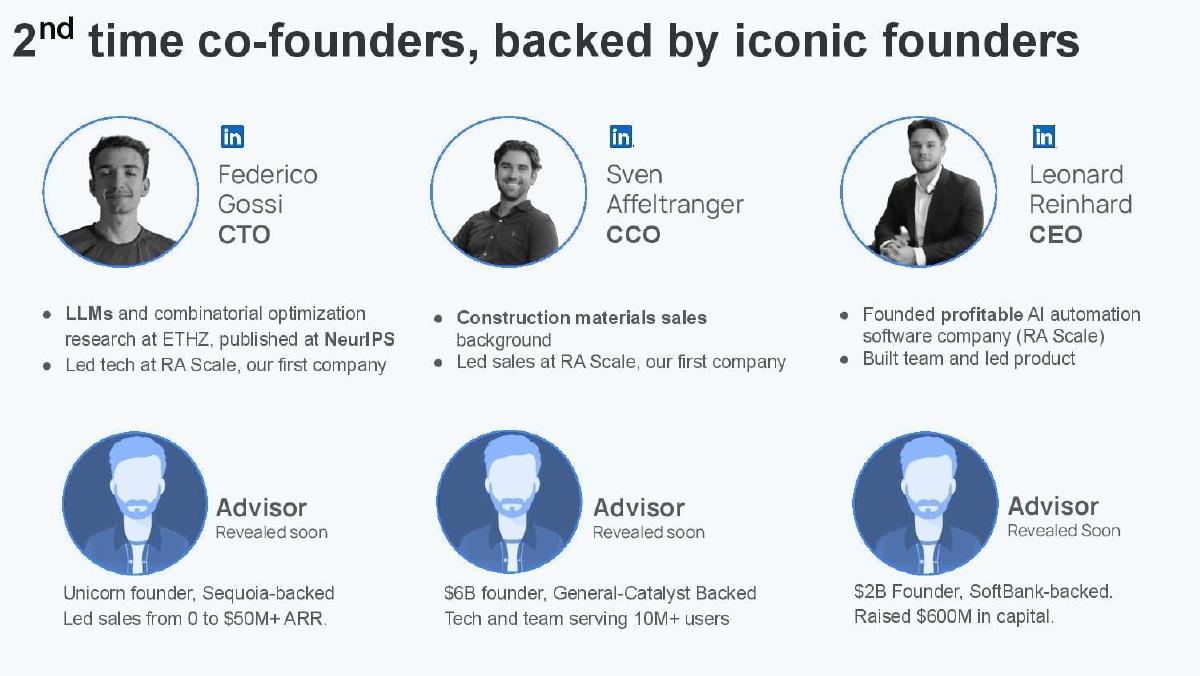
- The founding team consists of second-time founders who previously built a profitable AI automation company called RA Scale (Slide 2).
- Scalera.ai reports an average monthly growth rate of 74% and has acquired over 50 customers (Slide 4).
- The market strategy is divided into three 'Acts,' scaling from a $1.2B bid creation market to a $130B infrastructure layer for construction transactions (Slide 5).
- The current business model targets an average ticket size of $20k per year (Slide 4).
- Future revenue models include a 1% fee on construction material sales and overall transactions (Slide 5).
- The 24-month roadmap targets $4M ARR in the General Contractor segment and $8M ARR in the Supplier & Subcontractor segment (Slide 6).
- The team includes a CTO with a background in LLMs and combinatorial optimization research from ETHZ (Slide 2).
Introduction
Scalera.ai, a Swiss-based startup, raised $6.5M in Seed funding in 2024 to tackle one of the most archaic workflows in the global economy: construction procurement. According to publisher reports from Business Insider, the round was intended to fuel their expansion into North America and further develop their AI assistant platform. The deck is a lean, 12-slide presentation that prioritizes traction and team pedigree over technical deep-dives.
Slide 1: Title Slide
The deck opens with a minimalist title slide featuring the Scalera logo and the tagline 'AI for construction transactions.' The inclusion of a contact email (founders@ra-scale.ai) hints at the team's previous venture, RA Scale, establishing immediate continuity for investors who may have followed their earlier work.
Slide 2: The Team and Advisors
This is a high-signal team slide. It identifies Leonard Reinhard (CEO), Sven Affeltranger (CCO), and Federico Gossi (CTO) as '2nd time co-founders.' The slide highlights their previous success building RA Scale, a 'profitable AI automation software company.' Federico Gossi’s technical credentials—research in LLMs at ETHZ and publications at NeurIPS—provide the necessary 'AI credibility' for a 2024 fundraise. Interestingly, the slide also lists three 'Advisors' whose names are 'Revealed soon,' but whose profiles include a Sequoia-backed unicorn founder and a SoftBank-backed founder who raised $600M. This creates a sense of exclusivity and high-level backing without needing to name names immediately.
Slide 3: The Problem Statement
Slide 3 breaks down the 'Construction Contractor’s workflow' into four steps: finding tenders/extracting info, matching suppliers, requesting quotes, and applying. The slide uses specific numbers to quantify the pain: reading '1000+ pages' and matching '100+ materials.' It frames the current state as 'laborious and uncertain,' emphasizing that the outcome is unknown even after a significant time investment. This slide effectively sets the stage for a solution that can automate high-volume document processing and data matching.
Slide 4: Traction and Growth
This is the 'money slide' of the deck. It claims the company went from a 'Napkin idea to $955M worth of tenders in 10 months.' The large font size for '$955,000,000' is designed to grab attention. Below this, the company lists four key metrics: 50+ customers, a $20k average ticket size (ACV), and a 74% average monthly growth rate. The 'Avg tender size $1.2M' provides context for the total processed volume. For a Seed round, these numbers are exceptionally high, suggesting that the product hit a massive vein of demand immediately upon launch.
Slide 5: Market Expansion (The Three Acts)
Scalera uses a concentric circle diagram to explain their TAM (Total Addressable Market) expansion. Act 1 is 'Construction Bid Creation,' valued at $1.2B based on 60k users in the US and West EU paying $20k. Act 2 moves into 'Material Procurement,' aiming for a 1% fee on $1100B in material sales. Act 3 is the grand vision: 'Infra for construction transactions,' targeting a 1% fee on $13T in total construction transactions. This slide is crucial because it moves the company from a 'niche tool' category into a 'platform infrastructure' category, justifying a much higher valuation ceiling.
Slide 6: The Roadmap (1 to N)
The final content slide in the provided set outlines the '24 month targets.' The company is explicitly raising to move from '0 to 1 complete' to '1 to N.' The targets are aggressive: $12M total ARR ($4M from General Contractors and $8M from Suppliers/Subcontractors). The operational goals include launching in North America, certifying tech for large enterprise contracts, and growing the engineering and sales teams. This slide provides a clear 'use of funds' narrative by showing exactly what milestones the Seed capital is expected to buy.
What Scalera.ai Does Well
The Scalera.ai deck is a masterclass in traction-first storytelling . By placing the $955M tender volume and 74% monthly growth early in the deck, they force the investor to take the problem seriously. If the market wasn't desperate for this, those numbers wouldn't exist. Furthermore, the founding team slide is excellent. It doesn't just list titles; it lists specific achievements (profitable previous company, NeurIPS publications) that mitigate the risk of the 'AI' label being just a buzzword. Finally, the 'Three Acts' market strategy is a very effective way to show a path to a multi-billion dollar outcome without appearing to lose focus on the immediate product-market fit.
What is Missing from the Scalera.ai Deck
Despite its strengths, the deck has several notable omissions. There is no product demo or UI walkthrough in the provided slides. For an 'AI assistant,' seeing how the user interacts with the 1000+ page documents is vital to understanding the 'moat.' There is also no competitive landscape slide . The construction tech space is crowded with incumbents like Procore and newer AI startups; Scalera doesn't explicitly state why their LLM approach is superior to existing OCR or manual bidding tools. Additionally, the deck lacks unit economics beyond the ticket size. While they mention a $20k ticket, there is no mention of CAC (Customer Acquisition Cost) or LTV (Lifetime Value), which are critical for a '1 to N' scaling argument.
Founder Takeaways: What to Copy
Quantify the Pain: Use specific numbers like '1000+ pages' and '100+ materials' to make the problem feel tangible. · The 'Act' Structure: If your initial market is small, use the 'Act 1, 2, 3' framework to show how you will earn the right to play in larger markets over time. · Lead with Traction: If you have high growth (like 74% MoM), make it the centerpiece of the deck. Investors will forgive a lack of product detail if the growth is undeniable. · Highlight 'Second-Time' Status: If you have built a company before—especially a profitable one—make that the first thing an investor sees. It significantly lowers the perceived execution risk.
Frequently asked questions
- What is the primary problem Scalera.ai solves?
- Scalera.ai targets the construction bidding process, which they describe as 'laborious and uncertain.' Specifically, they automate the extraction of info from 1000+ page tender documents, the matching of 100+ materials to suppliers, and the compilation of supplier quotes, which currently results in uncertain outcomes for contractors.
- How much traction did Scalera.ai have at the time of the Seed round?
- The deck reports significant early traction: $955M worth of tenders processed in 10 months, 50+ customers, an average ticket size of $20k per year, and an average monthly growth rate of 74%.
- What is the long-term vision for the company beyond bidding software?
- The company plans a three-stage expansion. Act 1 is construction bid creation. Act 2 involves material procurement by monetizing price data and offering instant quotes. Act 3 aims to become the infrastructure for all construction transactions, including financing and insurance.
- Who are the founders and what is their background?
- The team includes CEO Leonard Reinhard, CCO Sven Affeltranger, and CTO Federico Gossi. They are second-time co-founders who previously built RA Scale, a profitable AI automation company. The CTO has a research background in LLMs from ETHZ.
- What are the company's financial targets for the next two years?
- Scalera.ai has set a 24-month target of reaching $12M in total ARR, split between $4M from the General Contractor segment and $8M from the Supplier & Subcontractor segment.