Savana's 10-slide deck is a highly technical, product-centric presentation that successfully navigated a $45 million Series A round in 2023. Rather than relying on flashy consumer metrics, the company focused on the deep structural inefficiencies of legacy banking cores. The deck positions Savana as the essential orchestration layer between ancient back-end systems and modern customer expectations. By highlighting a leadership team with deep roots in institutional finance (including FIS Global and Capital One) and providing a granular innovation timeline dating back to 2016, Savana demonstrat…
Key takeaways
- The deck identifies a specific 'digital transformation imperative' caused by legacy technology preventing banks from meeting customer expectations (Slide 2).
- Savana defines its Total Addressable Market (TAM) as over $4B within its initial target segment (Slide 4).
- The platform is positioned as 'Core Agnostic' and 'Product Agnostic,' allowing it to sit atop any existing banking infrastructure (Slide 3).
- A detailed innovation timeline shows the company's evolution from a 'Core Servicing Foundation' in 2016 to planned AI Chatbots and international expansion (Slide 7).
- The Go-to-Market strategy is segmented by bank size, targeting Regional banks ($5B - $50B) first before moving to Money Centers ($500B+) (Slide 8).
- Headcount distribution is heavily weighted toward technical execution, with 106 employees in Development out of a total shown (Slide 9).
- The leadership team features executives with experience at major financial institutions like ING Direct, Capital One, and FIS Global (Slide 9).
- The deck omits a specific 'Ask' slide, choosing instead to focus on the 'Key Imperatives' for scaling the business (Slide 8).
The Architecture of a $45M Series A
Savana’s pitch deck is a refreshing departure from the hyper-simplified decks common in the SaaS world. Because they operate in the complex world of core banking transformation, the deck leans heavily into technical diagrams and architectural roadmaps. In 2023, this approach secured $45 million in Series A funding, as reported by Business Insider. The deck serves as a blueprint for how to sell 'unsexy' but essential middleware to institutional investors.
Slide 1: Title and Positioning
The cover slide is minimal, featuring the company logo and the tagline: Orchestrating Customer Engagement . This immediately sets the tone. Savana isn't just a 'banking app'; it is an orchestrator. This implies a higher level of the tech stack, managing multiple moving parts rather than just providing a single interface.
Slide 2: The Legacy Bottleneck
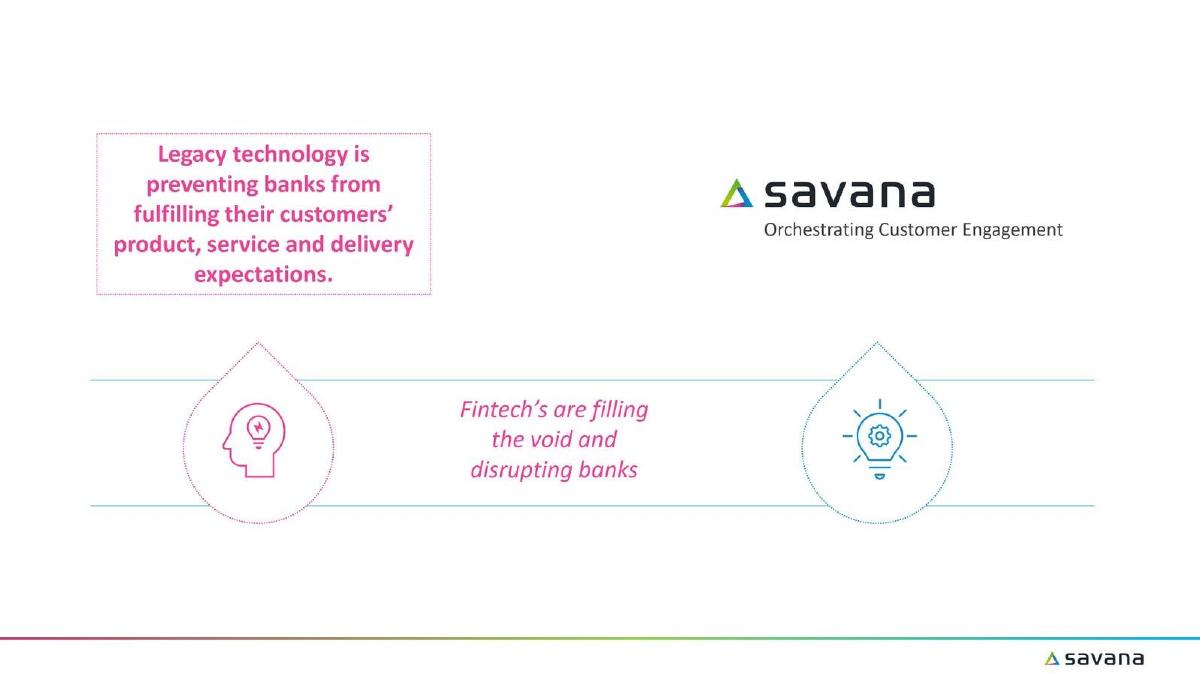
Slide 2 identifies the 'Problem.' It uses a simple dichotomy: Legacy technology is preventing banks from fulfilling their customers' product, service and delivery expectations , while Fintechs are filling the void and disrupting banks . The visual uses two lightbulb icons—one representing the 'old' way (a head with a bolt) and one representing the 'new' way (a gear inside a bulb). It’s a standard problem/solution setup but tailored specifically for the institutional banking crisis.
Slide 3: The Digital Transformation Imperative
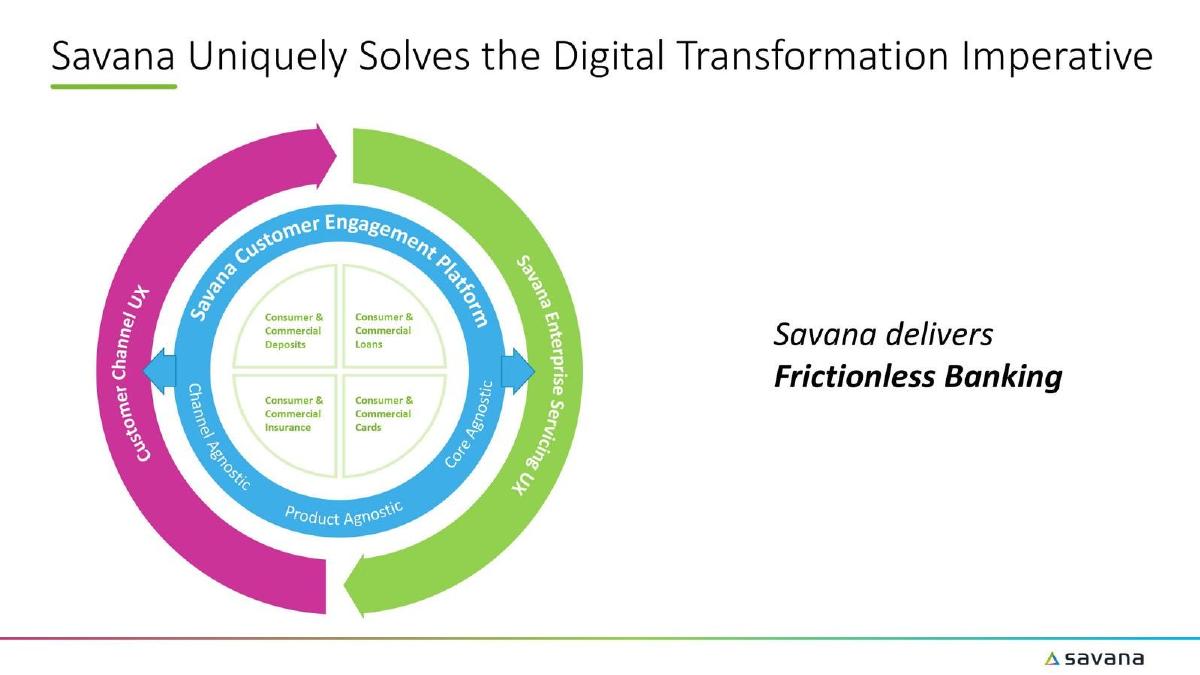
This slide introduces the solution through a circular diagram. It claims Savana uniquely solves the digital transformation imperative . The diagram shows the Savana Customer Engagement Platform at the center, surrounded by layers of Customer Channel UX and Enterprise Servicing UX . Critically, it notes the platform is Core Agnostic , Product Agnostic , and Channel Agnostic . For a bank, 'agnostic' is a magic word—it means they don't have to rip and replace their existing multi-million dollar systems to use Savana.
Slide 4: Investor Highlights
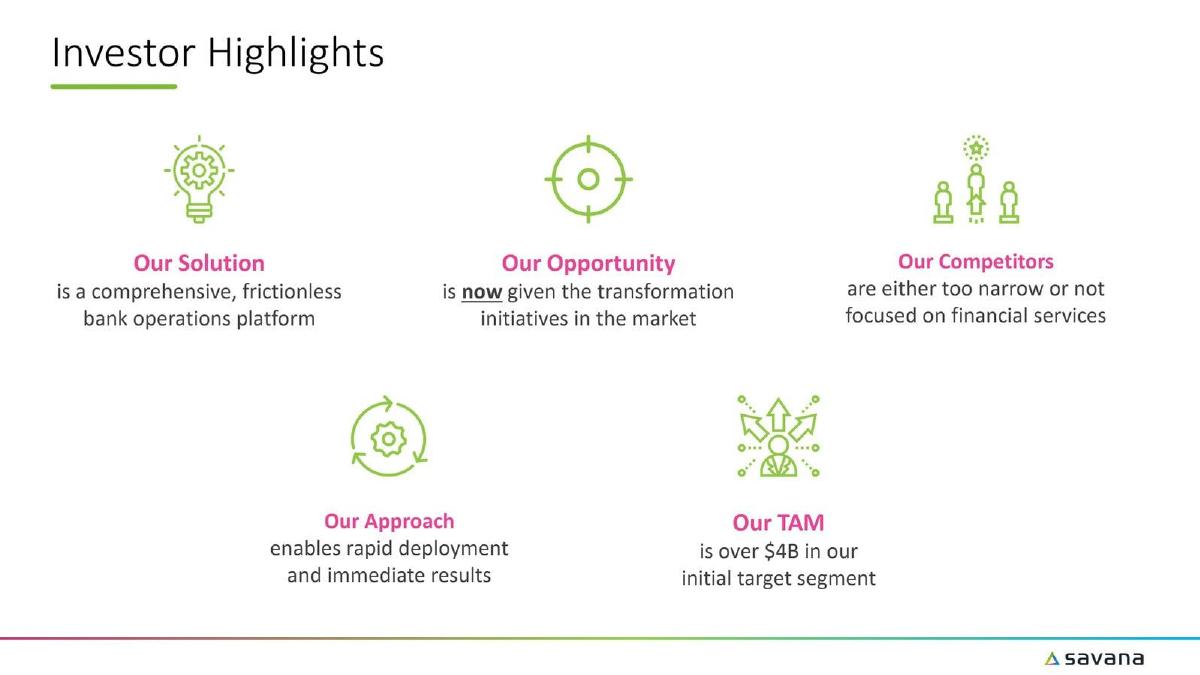
This is a summary slide that hits five key points: the solution (frictionless operations platform), the opportunity (market transformation), the competitors (too narrow), the approach (rapid deployment), and the TAM. The TAM is stated as over $4B in our initial target segment . By specifying 'initial target segment,' Savana demonstrates a realistic, phased approach to market capture rather than making an overblown claim about the entire global finance sector.
Slide 5: The Platform Deep Dive
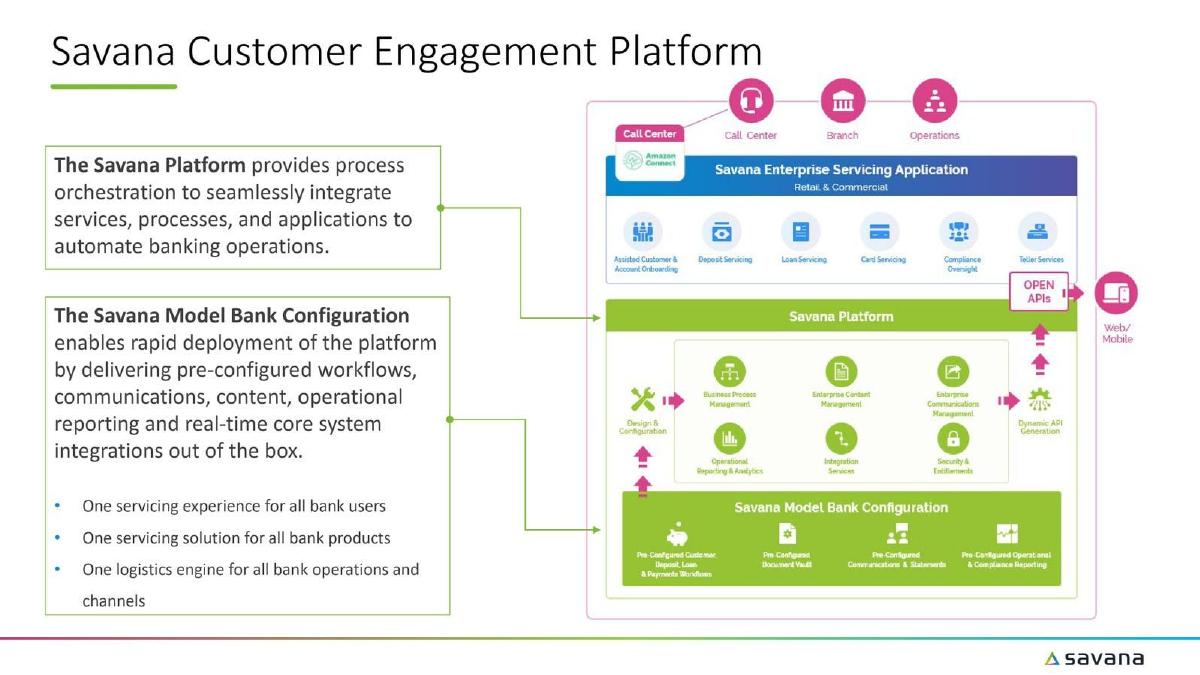
Slide 5 is the most visually dense slide in the deck. It breaks down the Savana Customer Engagement Platform into its component parts: the Enterprise Servicing Application (handling deposits, loans, cards, and compliance) and the Savana Model Bank Configuration . The slide promises pre-configured workflows and real-time core system integrations out of the box . This addresses the biggest fear in enterprise sales: implementation time. The bullet points emphasize 'One servicing experience,' 'One servicing solution,' and 'One logistics engine.'
Slide 6: LEAP Transformation Architecture
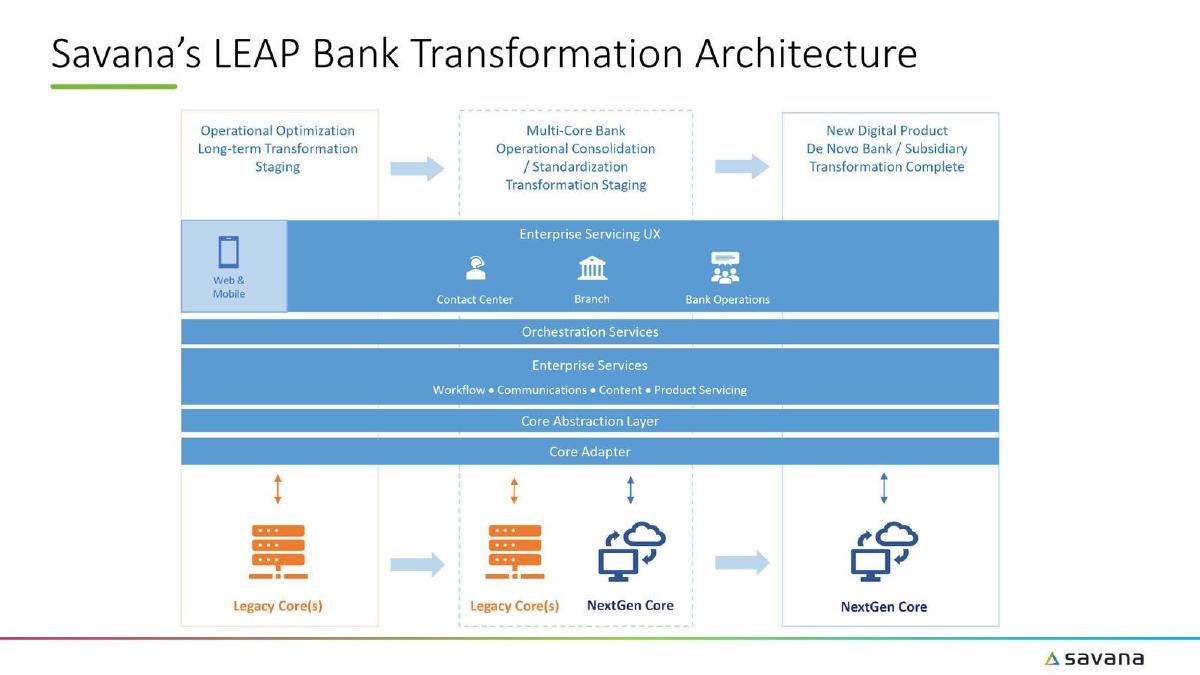
If Slide 5 was the 'what,' Slide 6 is the 'how.' It introduces the LEAP Bank Transformation Architecture . This diagram shows the transition from Legacy Core(s) to a NextGen Core . Savana positions itself as the Core Abstraction Layer and Orchestration Services that remain constant even as the underlying bank core changes. This is a powerful value proposition: Savana is the insurance policy that makes a bank's future core migration less risky.
Slide 7: Innovation Timeline
This slide provides historical context and future vision. It shows the company's journey starting in 2016 with a 'Core Servicing Foundation.' It tracks milestones like Lending (PPP) in 2020 and AWS Connect in 2021. The Future Roadmap includes a Design Studio , AI Chatbot , and expansion into International markets and Mortgage Servicing . This timeline proves that Savana is not a 'pop-up' startup but a mature entity with years of development behind it.
Slide 8: Key Imperatives and GTM
Slide 8 outlines the Go-to-Market (GTM) strategy. It lists three imperatives: Ensuring Customer and Partner Success , Bridge to SaaS Revenue (noting that scale could take 2-3 years), and Roadmap Acceleration . The GTM timeline is segmented by bank size: Regional ($5 - $50B) and FinTechs in 2020-2022, Community banks in 2022-2023, and Money Centers ($500B+) and International in 2024. This shows a disciplined 'land and expand' strategy.
Slide 9: Leadership and Headcount
The team slide is impressive. It features Michael Sanchez (CEO) , Mike Wolfel (CTO) , Nicole Venere (CPIO) , Craig Riddell (CBO) , and Steve Slone (CFO) . The logos listed under their names— Capital One, ING Direct, FIS Global —are heavy hitters in the industry. The slide also includes a headcount pie chart showing 106 employees in Development , 26 in Product, and 18 in Services. This distribution (182 total shown) signals a company that is heavily invested in building and maintaining its technical moat.
Slide 10: Conclusion
The deck ends with a simple 'Thank you' slide. There is no specific 'Ask' or 'Use of Funds' slide in this version of the deck, which is common for Series A rounds where the terms are often negotiated based on the roadmap presented rather than a fixed menu of expenditures.
What Savana Does Exceptionally Well
Savana understands its audience. Institutional investors in the fintech space are wary of 'disruptors' who don't understand the regulatory and technical complexity of legacy banking. Savana counters this by being aggressively technical . They don't hide behind buzzwords; they show the architecture. By positioning themselves as an 'abstraction layer,' they solve the bank's biggest problem (legacy debt) without requiring the bank to do the impossible (instant core replacement).
The inclusion of the headcount pie chart is a subtle but effective move. It proves that the $45M isn't just going to marketing; it’s fueling a massive engineering engine. In enterprise software, the size and quality of the dev team are often the best indicators of a company's ability to deliver on complex SLAs.
What is Missing from the Deck
The most notable omission is Unit Economics and Revenue Metrics . While the deck mentions a 'Bridge to SaaS Revenue,' it does not provide current ARR (Annual Recurring Revenue), NRR (Net Retention Rate), or customer acquisition costs. For a Series A, these are usually mandatory. It is likely these were included in a separate data room or a more detailed financial appendix not present in this 10-slide summary.
Additionally, there are no Case Studies or Logos of current bank partners. While Slide 8 mentions targeting regional banks, the deck would be significantly stronger if it named a specific bank that successfully used the LEAP architecture to migrate from a legacy core. Without these, the 'proven expertise' mentioned on Slide 9 remains theoretical to the reader.
Founder's Playbook: Lessons to Copy
Segment your GTM by asset size: If you are in Fintech, don't just say 'Banks.' Categorize them by assets (e.g., $5B-$50B) to show you understand the different sales cycles and technical needs of each tier. · Use an innovation timeline: Especially for 'deep tech' or enterprise plays, showing that you’ve been building for 5+ years (Slide 7) builds immense trust. It shows you aren't just chasing a trend. · The 'Abstraction Layer' Strategy: If your product is hard to install, position it as a layer that sits on top of what the customer already has. Use terms like 'Core Agnostic' to lower the perceived risk of adoption. · Highlight Technical Headcount: If you are raising a large round, show the investor that you have the 'boots on the ground' to build the product. A pie chart of your team (Slide 9) is a quick way to communicate organizational maturity.
Frequently asked questions
- What is the primary problem Savana is solving?
- According to Slide 2, legacy technology is the primary bottleneck. It prevents traditional banks from fulfilling modern product, service, and delivery expectations, which allows fintech competitors to fill the void and disrupt the market. Savana acts as the bridge to fix this.
- How does Savana describe its market size?
- On Slide 4, the company states that its Total Addressable Market (TAM) is over $4B within its initial target segment. This suggests a focused approach rather than a vague 'trillion-dollar' global banking claim.
- What does the 'LEAP' architecture refer to?
- Slide 6 details the 'LEAP Bank Transformation Architecture.' It is a multi-layered approach including a Core Adapter, Core Abstraction Layer, Enterprise Services, and Orchestration Services that allows a bank to move from legacy cores to 'NextGen' cores without disrupting the user experience.
- Who are the key people leading Savana?
- The leadership team (Slide 9) includes CEO Michael Sanchez (formerly of FIS Global), CTO Mike Wolfel, and CFO Steve Slone (formerly of Capital One and ING Direct). The slide emphasizes their 'strong subject matter expertise in banking.'
- What is Savana's roadmap for the future?
- Slide 7 outlines a future roadmap including a 'Design Studio,' 'AI Chatbot,' and expansion into 'Mortgage Servicing' and 'International' markets. Slide 8 further specifies a target to reach 'Money Centers' ($500B+ in assets) by 2024.