SARC MedIQ presents a healthcare SaaS solution focused on smart imaging reporting and workflow management. The deck leans heavily on a regulatory 'Why Now' argument, citing ONC mandates for digital patient data accessibility as a primary market driver. Financially, the company projects aggressive growth, targeting $110 million in ARR by 2030, supported by a claimed 80%+ gross profit margin. A notable characteristic of the company is its organizational structure; despite having only 23 employees, 14 are designated as Sales Managers, indicating a heavy emphasis on direct outbound growth. While…
Key takeaways
- The product suite includes a Diagnosis Assistant, Workflow Management, and Smart Data Mapping to reduce diagnosis and onboarding time (Slide 2).
- The business model relies on a dual revenue stream: a monthly subscription plus a per-exam fee (Slide 3).
- Management projects reaching $30 million in annual revenue within five years based on a target of 1,000 accounts at a $30k average yearly fee (Slide 3).
- Financial projections show a steep growth curve from $0.076 million in 2022 to a projected $110 million in 2030 (Slide 4).
- The company claims exceptional efficiency metrics, including a 100% client retention rate and a 10:1 LTV to CAC ratio (Slide 5).
- Regulatory compliance is the primary market catalyst, specifically the ONC Interim Final Rule requiring EHI export capability by late 2023 (Slide 7).
- The team is heavily weighted toward sales, with 14 Sales Managers out of 23 total employees (Slide 8).
- The leadership team features academic backgrounds from Stanford Business and Vanderbilt School of Medicine (Slide 8).
Slide-by-Slide Analysis
Slide 1: Title and Product Interface
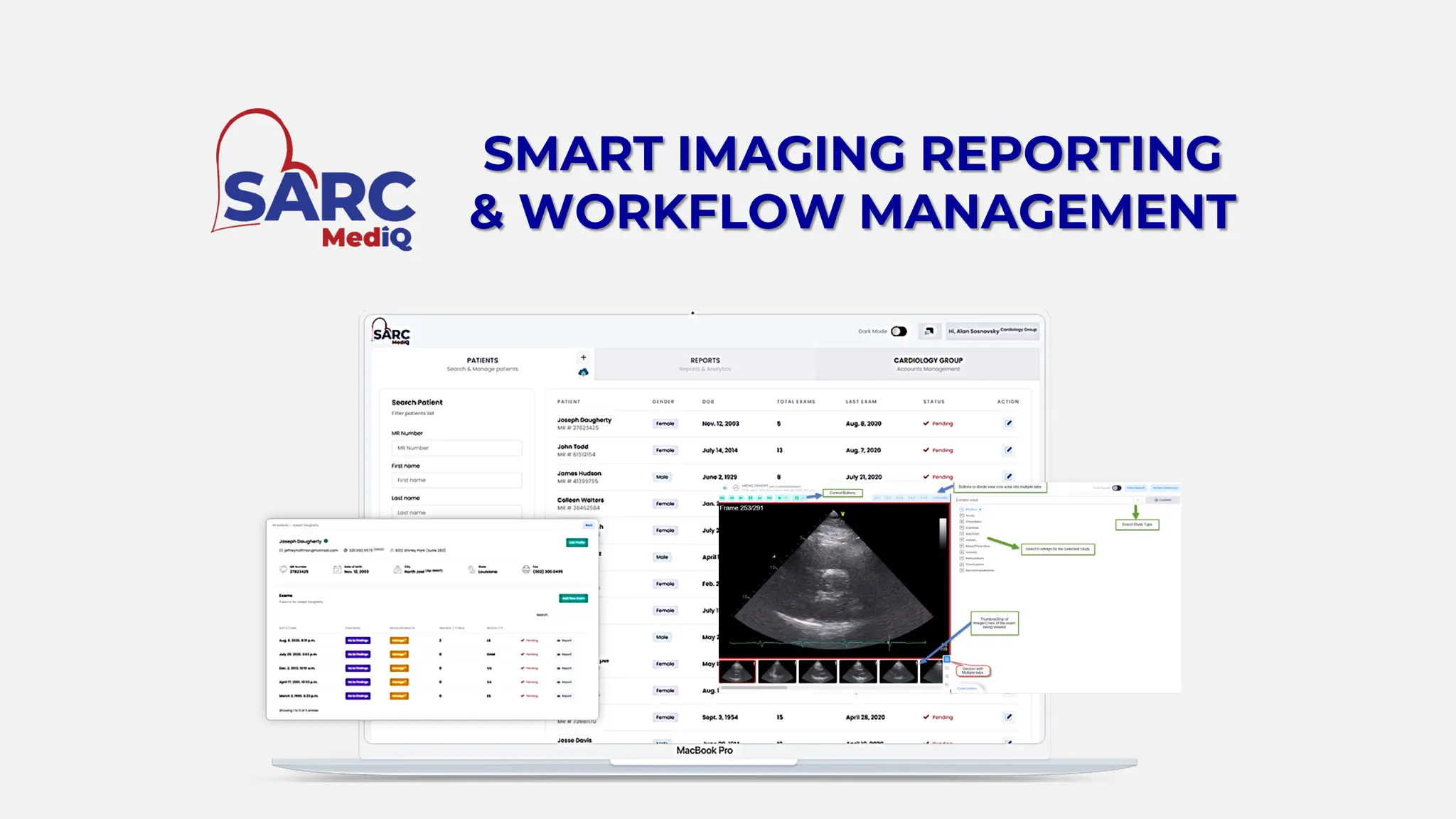
The cover slide introduces SARC MedIQ as a 'Smart Imaging Reporting & Workflow Management' solution. It features a product mockup on a laptop and mobile device, showing a clean, dashboard-style interface. The UI displays patient lists, exam statuses (e.g., 'Pending'), and a diagnostic viewer with an ultrasound image. This immediately establishes the company as a technical SaaS provider in the clinical space.
Slide 2: Product Value Pillars
This slide breaks the product into three core modules: Diagnosis Assistant (Templated AI Rules), Workflow Management (Simplified Modular Architecture), and Smart Data Mapping (AI Driven Mapping). Each module is tied to a specific business outcome: reducing diagnosis time, easing provider adoption, and reducing onboarding time. This is a standard but effective way to translate technical features into buyer benefits.
Slide 3: Business Model and 5-Year Goal
SARC MedIQ defines itself as a 'Healthcare SaaS solution company.' The revenue model is transparent: a monthly subscription combined with a per-exam fee. The slide uses a simple mathematical formula to show their path to $30 million in annual revenue: 1,000 accounts multiplied by a $30,000 average yearly fee. This provides a clear benchmark for their sales team's targets.
Slide 4: Financial Projections
The projections slide contains several high-performance metrics. For 2023, they projected $1.3 million in ARR with a gross profit of 80%+. The bar chart extends to 2030, showing a leap from $0.076 million in 2022 to $110 million in 2030. The inclusion of a 106% Net Revenue Retention (NRR) is a strong signal for SaaS investors, as it indicates that customers are spending more over time.
Slide 5: Product Stickiness and Unit Economics
This slide focuses on efficiency. It claims a 100% client retention rate, noting the oldest account is three years old. The conversion metrics are also aggressive: a 90% trial-to-client conversion rate and a 10:1 LTV to CAC ratio. The note that CAC is largely comprised of a 10% sales commission and 10-80 hours of work helps quantify the sales effort required per deal.
Slide 6: Contact Information
A simple interstitial or closing slide providing the company's website, physical address in Dublin, CA, and contact details for Asaad Hakeem. The copyright date is listed as 2020-23.
Slide 7: The Regulatory 'Why Now'
This is perhaps the most critical slide for a healthcare startup. It cites the ONC Interim Final Rule, which mandates digitally accessible patient data. By highlighting the December 2023 deadline for EHI Export Capability, the company frames its product not as an optional efficiency tool, but as a necessary compliance solution for a 'billion dollar untapped market.'
Slide 8: Org Chart and Team
The final slide in this set is a detailed organizational chart. It lists 23 employees, 14 of whom are Sales Managers. The leadership includes Founder & CEO Asaad Hakeem (Stanford Business) and Founder & CMO Sadeem Mahmood (Vanderbilt Medicine). The slide also lists advisors with affiliations to MIT, Amazon/Twitch, Google AI, and various healthcare groups like GE Healthcare and Siemens Healthineers. The sheer volume of sales managers relative to engineers (4) suggests a company that has moved past the R&D phase and is focused entirely on distribution.
What SARC MedIQ Does Well
Regulatory Alignment: The 'Why Now' slide (Slide 7) is the strongest part of the deck. In healthcare, 'nice-to-have' tools often die in long sales cycles. By anchoring their value proposition to a federal mandate (ONC Cures Act), they create urgency that transcends simple ROI arguments.
Clear Unit Economics: Slide 5 provides the kind of granular detail investors look for in a Series A or B deck. Stating that CAC is '10% of LTV' and detailing the hours required for conversion shows that management has a firm grasp on their sales funnel and cost of growth.
High Gross Margins: Claiming 80%+ gross profit (Slide 4) is standard for pure software but impressive for a tool that integrates with complex medical imaging hardware. This suggests a scalable architecture that doesn't require heavy manual implementation for every new client.
What is Missing from the Deck
The Competitive Landscape: The deck does not mention competitors. In the medical imaging and PACS (Picture Archiving and Communication System) space, there are massive incumbents and numerous AI startups. Failing to position themselves against these players leaves a gap in the narrative.
The 'Ask': None of the provided slides detail how much capital the company is seeking, the valuation, or the specific use of funds. While this might be in the remaining 15 slides not shown, its absence in the core summary slides is notable.
Case Studies or Clinical Validation: While they mention a 100% retention rate, there are no specific testimonials or data points showing how much time was actually saved at a specific clinic. In healthcare, peer-reviewed data or named case studies carry significant weight.
Founder Takeaways
Focus on the 'Forced' Move: If your industry is facing new regulations, make that the centerpiece of your pitch. SARC MedIQ does this effectively by showing a timeline of mandates that make their product a necessity rather than a luxury.
Visualize the Machine: The org chart on Slide 8 is a bold choice. By showing 14 sales managers, they are telling investors exactly how they plan to hit their $110M goal: through brute-force market coverage. If you have a lopsided team, lean into it as a strategic choice for your current stage.
Simplify the Math: Slide 3 is a masterclass in 'Back of the Envelope' math. 1,000 accounts x $30k = $30M. It’s easy to remember, easy to verify, and gives the investor a clear sense of the scale required to reach the next milestone.
Frequently asked questions
- What is the core problem SARC MedIQ is solving?
- SARC MedIQ addresses the inefficiency in medical imaging reporting and the lack of digital accessibility for patient data. By utilizing AI-driven mapping and templated rules, they aim to reduce the time clinicians spend on diagnosis and administrative workflow. The deck emphasizes that government mandates have turned these digital capabilities from a 'want' into a 'need' for healthcare providers.
- How does SARC MedIQ generate revenue?
- The company operates on a healthcare SaaS model. According to slide 3, revenue is generated through a combination of a recurring monthly subscription fee and a variable 'per exam' fee. They estimate an average yearly fee of $30,000 per account, targeting 1,000 accounts to reach their intermediate revenue goals.
- What are the key financial projections for the company?
- SARC MedIQ projects significant scaling. Slide 4 shows a 2023 ARR projection of $1.3 million with an 80% gross profit margin. Long-term, the company forecasts reaching $110 million in ARR by 2030. They also report a current Net Revenue Retention of 106%, suggesting expansion within their existing customer base.
- What is the significance of the 'Why Now' slide?
- Slide 7 focuses on the ONC (Office of the National Coordinator for Health Information Technology) Interim Final Rule. It highlights specific compliance dates, such as the requirement for EHI (Electronic Health Information) Export Capability to be available by December 31, 2023. This regulatory pressure serves as a forced adoption mechanism for SARC MedIQ’s digital infrastructure.
- What is unusual about the SARC MedIQ team structure?
- The organizational chart on slide 8 reveals a very high ratio of sales staff to other functions. Out of 23 total employees, 14 are Sales Managers. This suggests the company is in a high-growth execution phase where the product is stabilized, and the primary focus is on aggressive market capture through direct sales.