The Salesforce acquisition of Slack for $27.7 billion was a watershed moment for enterprise software, and the accompanying announcement deck serves as a blueprint for high-stakes M&A storytelling. Rather than focusing solely on financial consolidation, the deck positions Slack as the 'engagement layer' that sits atop Salesforce's data and applications. By highlighting Slack's 100+ minutes of daily active usage and its 2,400+ apps, Salesforce argued that the deal wasn't just about adding a chat tool, but about owning the interface where work actually happens. The deck successfully bridges the…
Key takeaways
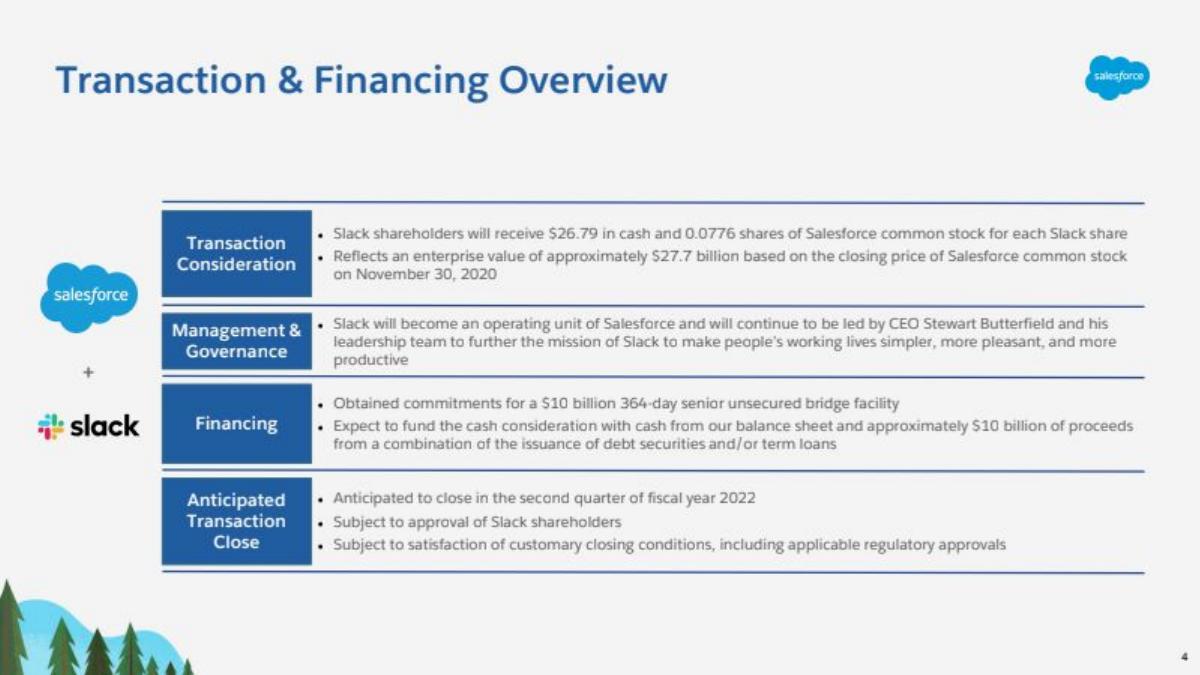
- The deal valued Slack at an enterprise value of approximately $27.7 billion as of November 30, 2020 (Slide 4).
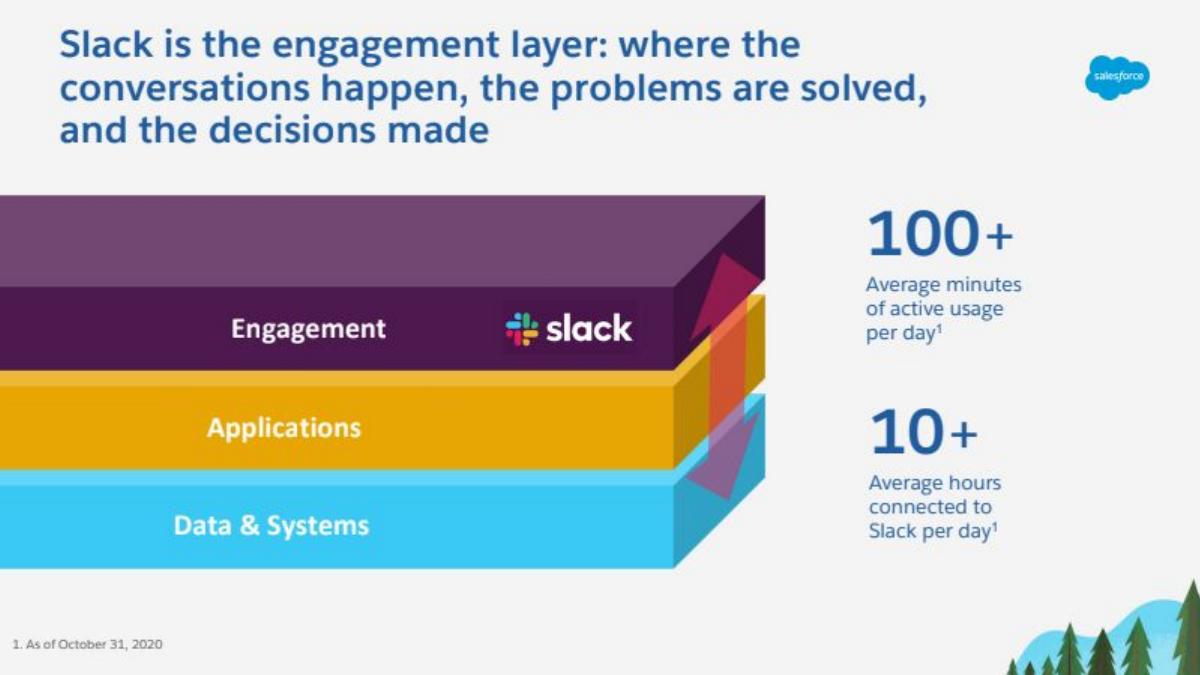
- Slack is positioned as the 'engagement layer' where conversations happen, sitting above the 'applications' and 'data' layers (Slide 5).
- Engagement metrics are central to the value prop, with users averaging 100+ minutes of active usage per day (Slide 5).
- Slack Connect showed massive momentum with 240% year-over-year growth in connected endpoints (Slide 7).
- The financial comparison shows Salesforce at $21.1B FY21E revenue vs Slack at $876M (Slide 8).
- The combined ecosystem includes 2.6M+ Salesforce 'Trailblazers' and 885K+ active developers on Slack (Slide 12).
- Salesforce highlights Slack's enterprise penetration with 1,080 paid customers spending over $100K ARR (Slide 13).
- The ultimate goal is for Slack to become the 'new interface for Customer 360' (Slide 11).
The $27.7 Billion Handshake
When Salesforce announced its intent to acquire Slack on December 1, 2020, it wasn't just a financial transaction; it was a declaration of the future of work. This 16-slide deck was the primary vehicle for communicating that vision to investors, employees, and the broader market. It is a masterclass in justifying a high-premium acquisition by focusing on strategic synergy rather than just bottom-line consolidation.
Slides 1-3: The Formalities
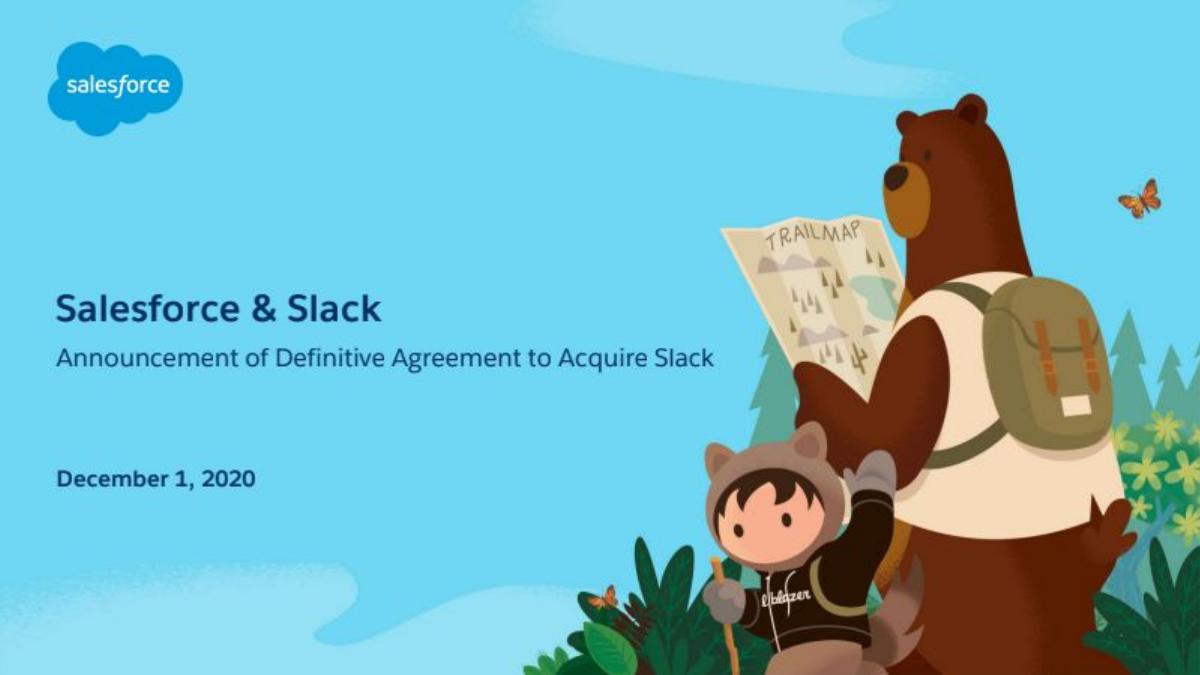
Slide 1 is a classic Salesforce-branded title slide featuring their 'Astro' and 'Bear' mascots looking at a 'Trailmap.' It sets a friendly, collaborative tone for what is a massive corporate merger. Slides 2 and 3 are dense legal disclosures regarding forward-looking statements and SEC filings. While founders often skip these, in a public-to-public acquisition of this scale, they are mandatory and critical for setting the legal boundaries of the announcement.
Slide 4: The Deal Terms
This is the 'meat' of the transaction details. Salesforce doesn't bury the lead. They clearly state the consideration: $26.79 in cash and 0.0776 shares of Salesforce stock per Slack share. The slide establishes the $27.7 billion enterprise value and confirms that Slack will remain an independent operating unit led by CEO Stewart Butterfield . It also notes a $10 billion bridge facility to help finance the cash portion of the deal. For any founder looking at M&A, this slide is the gold standard for clarity on governance, financing, and price.
Slides 5-7: The 'Engagement Layer' Thesis
This section is the heart of the strategic argument. Slide 5 introduces a three-tier architectural model: Data & Systems at the bottom, Applications in the middle, and Engagement at the top. By placing Slack at the top, Salesforce argues that Slack is where the actual work happens. The metrics provided are staggering: 100+ average minutes of active usage per day and 10+ average hours connected per day. This isn't just a tool; it's an environment.
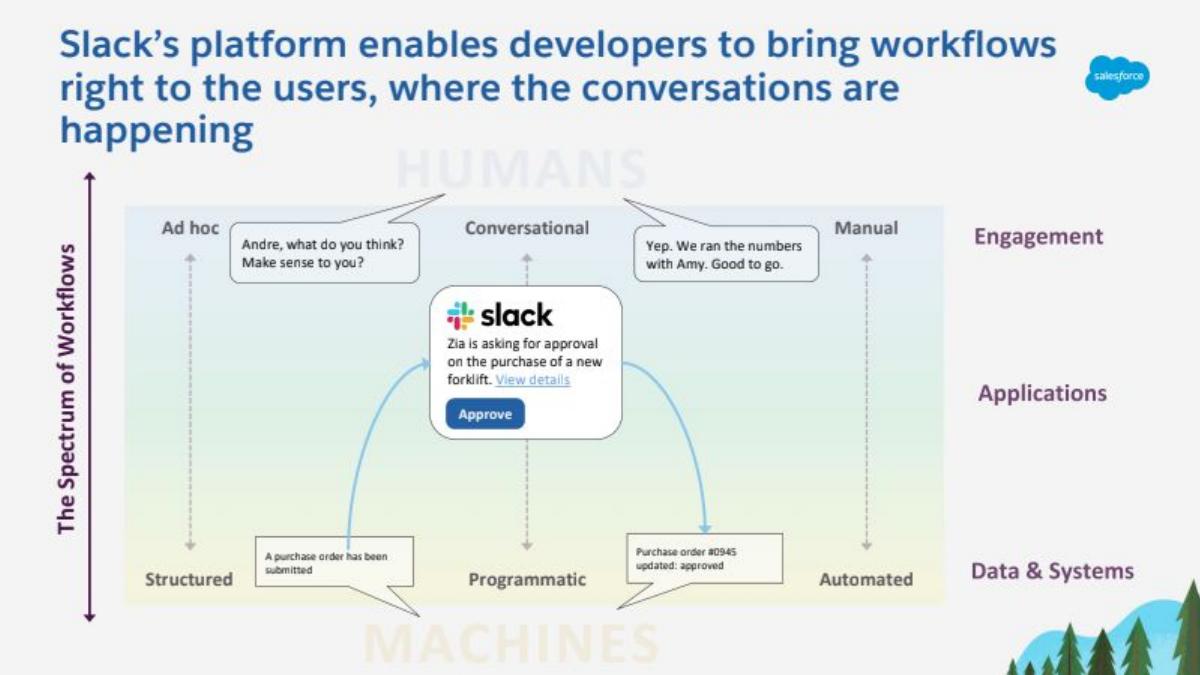
Slide 6 visualizes how Slack moves workflows from 'Machines' (Data & Systems) to 'Humans' (Engagement). It shows a purchase order being approved via a Slack notification, illustrating the 'programmatic' to 'conversational' shift. Slide 7 focuses on Slack Connect , showing a global map of shared channels. With 520,000+ connected endpoints and 240% YoY growth , Salesforce is signaling that Slack isn't just for internal chat—it is the network for inter-company commerce.
Slide 8: Financial and Scale Comparison
This slide provides a side-by-side look at the two giants. Salesforce is the scale leader with $21.1B in revenue and 54,000+ employees. Slack is the growth engine with $876M in revenue (39% growth) and 2,500+ employees. By showing these numbers together, Salesforce justifies the acquisition as a way to inject high-growth DNA and a modern app ecosystem (2,400+ Slack apps vs 5,000+ Salesforce AppExchange listings) into their massive enterprise footprint.
Slides 9-13: The Strategic Rationale
Slide 9 summarizes the four pillars of the deal: Slack as a category leader, deep product integration, ecosystem combination, and Salesforce's expansion playbook. Slide 10 reinforces Slack's 'beloved' status and its reach from small businesses to the Fortune 500 . Slide 11 is crucial for existing Salesforce customers, explaining that Slack will become the 'new interface for Customer 360,' allowing users to interact with Salesforce data without leaving their chat window.
Slide 12 quantifies the developer opportunity, combining 2.6M+ Trailblazers with 885K+ Slack developers . This is a 'platform play' argument—the more developers building on the combined stack, the stickier the product becomes. Slide 13 addresses the 'Enterprise Expansion' playbook. It highlights that Slack already has 1,080 customers paying over $100K ARR , proving it is ready for the high-end enterprise sales motion that Salesforce excels at.
Slides 14-16: The Vision and Conclusion
Slide 14 shows a 'Customer 360' wheel with Slack at the center, surrounded by Sales, Service, Marketing, Commerce, and Analytics. This is the visual representation of the 'Engagement Layer' thesis. Slide 15 is a simple brand reinforcement slide, and Slide 16 is the 'Thank You' slide featuring Salesforce characters on a roller coaster—perhaps a nod to the exciting but intense journey of a $27B integration.
What Works in This Deck
The 'Engagement Layer' Concept: This is a brilliant piece of positioning. It moves Slack from being a 'chat app' (a commodity) to an 'operating system for work' (a necessity). · Hard Usage Metrics: Citing 100+ minutes of active daily usage is a powerful way to prove value that revenue numbers alone can't capture. · Ecosystem Synergy: By highlighting the number of apps and developers, Salesforce makes the case that this is a platform-level acquisition, not just a product-level one. · Clear Deal Terms: Slide 4 is incredibly transparent about the price, the leadership, and the financing.
What is Missing
Specific Synergies: While the deck mentions 'expected synergies,' it does not quantify them in terms of cost savings or specific revenue lift targets. · Competitive Landscape: There is no mention of Microsoft Teams or other competitors. In a high-stakes acquisition, the 'why now' often relates to defensive positioning against rivals, but this deck stays strictly on the offensive 'vision' side. · Integration Timeline: Beyond a general 'Q2 FY2022' close date, there are no details on when specific product integrations (like Slack for Sales Cloud) would launch.
What a Founder Should Copy
Layered Architecture: If you are building a tool that sits on top of other data sources, use the 'Data vs. Application vs. Engagement' framework from Slide 5. It clearly explains your value add. · Network Effect Visuals: The map on Slide 7 is a great way to visualize a 'network' product. If your users are connecting with each other, show the web, don't just state the number. · The 'Playbook' Argument: If you are pitching an acquisition or a late-stage investment, show how your current success (like the 1,080 enterprise customers on Slide 13) fits into the 'proven playbook' of the larger entity. · Visual Consistency: Despite the complex financial data, the deck maintains a friendly, approachable aesthetic that aligns with both brands. It proves that 'enterprise' doesn't have to mean 'boring.'
Frequently asked questions
- What was the actual price paid for Slack?
- According to Slide 4, Slack shareholders received $26.79 in cash and 0.0776 shares of Salesforce common stock for each Slack share. This reflected an enterprise value of approximately $27.7 billion based on the closing price of Salesforce stock on November 30, 2020. The editorial context notes this represented a 70% premium to the stock's average trading price at the time.
- How did Salesforce justify the high valuation of Slack?
- The justification was built on engagement and ecosystem. Slide 5 highlights that users are connected to Slack for 10+ hours per day, making it the primary 'engagement layer' for work. Slide 12 points to the massive combined developer reach, and Slide 13 notes Slack's success in the high-end enterprise market with over 1,000 customers paying more than $100K in annual recurring revenue.
- What happens to Slack's leadership after the acquisition?
- Slide 4 explicitly states that Slack will become an operating unit of Salesforce and will continue to be led by CEO Stewart Butterfield and his leadership team. This is a common tactic in large tech acquisitions to ensure continuity and preserve the specific culture and innovation pace of the acquired company.
- How does Slack fit into the existing Salesforce product suite?
- Slide 11 explains that Slack will integrate into every Salesforce Cloud, effectively becoming the new interface for 'Customer 360.' It is compared to the MuleSoft acquisition, where Slack acts as the integration point for apps and workflows, while also complementing existing document collaboration capabilities.
- What were the key growth metrics for Slack at the time of the deal?
- Slide 8 lists Slack's FY2021E revenue at $876M with a 39% growth rate. Additionally, Slide 7 highlights the explosive growth of Slack Connect, which saw a 240% year-over-year increase in connected endpoints, reaching over 520,000 total endpoints by October 31, 2020.