Saint Harridan’s 2012 seed deck is a study in brevity and visual storytelling. Spanning just nine slides, the presentation avoids the typical text-heavy approach of early-stage startups, instead relying on high-quality lifestyle photography to define its brand identity. The deck focuses heavily on validation, citing a 150% Kickstarter success and $15,000 in sales during the first week of operation. While it lacks a formal 'Ask' slide or a detailed competitive analysis, it compensates with strong unit economics—specifically a 65% margin—and a clear identification of a high-intent use case: wed…
Key takeaways
- The deck defines its niche immediately on Slide 1 as 'Men’s Clothes for Women & Transgender Men.'
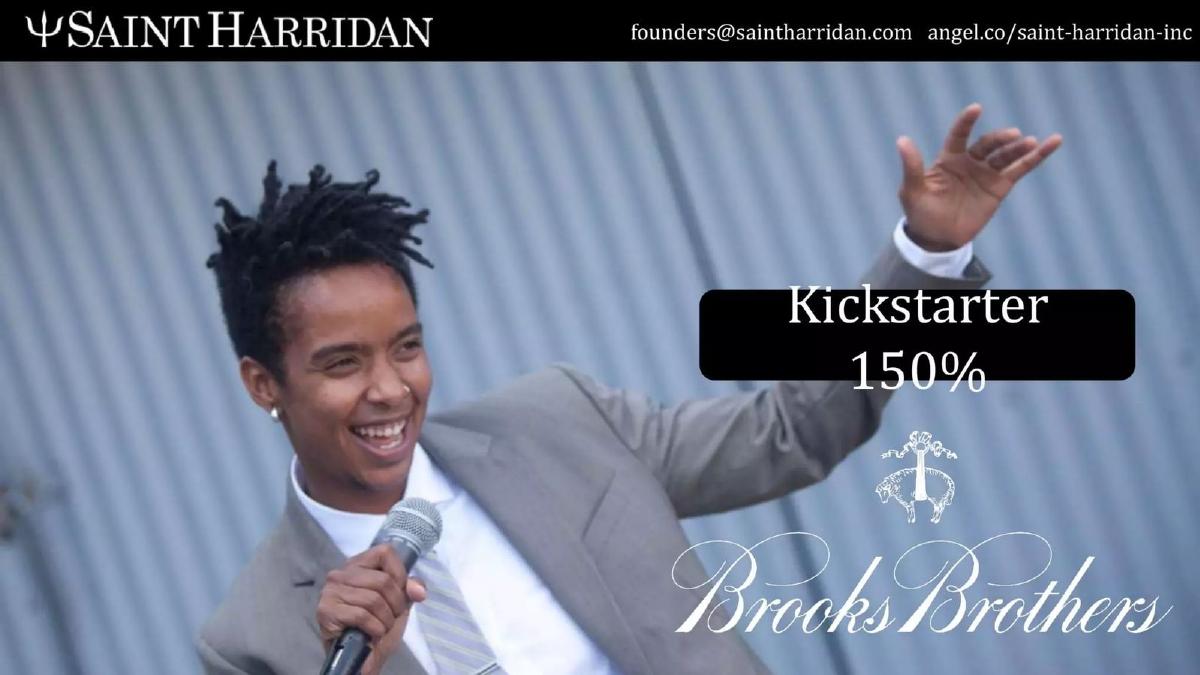
- Early validation is proven on Slide 2 through a Kickstarter campaign that reached 150% of its goal.
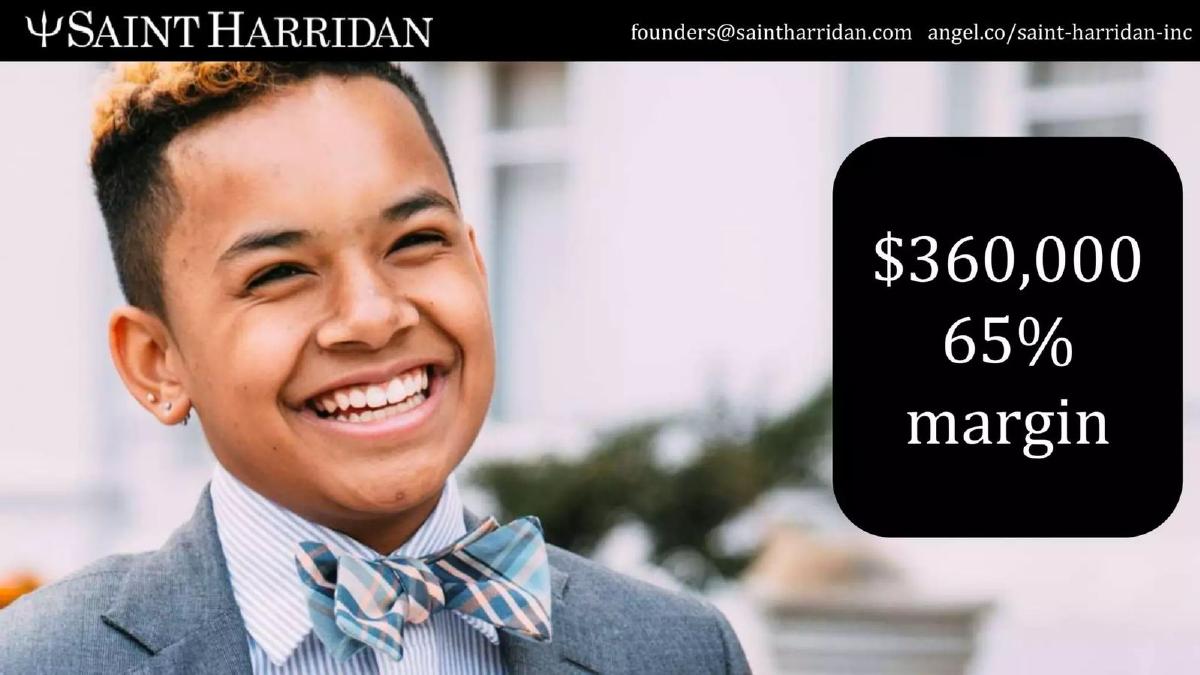
- The company highlights strong unit economics on Slide 3, claiming a 65% margin on $360,000.
- Weddings are identified as a primary market driver on Slide 4, suggesting a high-value entry point.
- Slide 7 demonstrates extreme product-market fit, noting the company was 'Completely Sold Out' in 10 hours.
- The team slide (Slide 8) showcases founder Mary Going’s history of two successful exits in 2001 and 2004.
- Lila Fox, Director of Ethical Garment Production, brings corporate pedigree from Levi’s and GAP (Slide 8).
- The deck concludes on Slide 9 with an '$8 BILLION' figure, though it lacks a breakdown of how this TAM was calculated.
The Saint Harridan Teardown: Selling the Underserved
Saint Harridan’s 2012 seed deck is a masterclass in 'show, don't tell.' At only nine slides, it is significantly shorter than the industry average of 15-20 slides. However, it manages to communicate a clear brand identity and strong early traction. The company, which focuses on masculine clothing for women and transgender men, raised $187,600 using this presentation. The deck relies on high-impact photography and large-font metrics to make its case, eschewing the traditional bulleted lists found in most corporate pitches.
Slides 1-3: Identity and Early Validation
Slide 1: Title and Mission The deck opens with a high-energy lifestyle photo of three individuals in suits. The text is minimal: the company logo at the top and the mission statement at the bottom: 'Men’s Clothes for Women & Transgender Men.' This slide immediately identifies the target demographic, leaving no ambiguity about the product or the customer. Contact information and an AngelList link are provided in the header, which is a practical addition for a deck intended for digital circulation.
Slide 2: The Kickstarter Proof Point Slide 2 uses a photo of a person speaking into a microphone, overlaid with two logos: Kickstarter and Brooks Brothers. The text 'Kickstarter 150%' is the focal point. This is a classic validation move. By showing they exceeded their crowdfunding goal by 50%, the founders prove that there is a community willing to pay for the product before it even hits mass production. The inclusion of the Brooks Brothers logo, though not explicitly explained, likely serves as a stylistic or quality benchmark for the brand's aesthetic.
Slide 3: The Financial Hook Slide 3 moves directly into hard numbers. Over a portrait of a smiling customer in a bow tie, the deck lists '$360,000' and '65% margin.' This is perhaps the most important slide in the deck for an investor. A 65% margin in e-commerce and apparel is healthy, suggesting that the company has a sustainable path to profitability and isn't just buying growth at a loss. The $360,000 figure provides a sense of scale for their early operations.
Slides 4-7: Market Drivers and Traction
Slide 4: The 'Must-Buy' Occasion Slide 4 contains a single word: 'Weddings!' This slide identifies a key market segment. In the apparel industry, special occasion wear is a high-value niche. By highlighting weddings, Saint Harridan signals to investors that they are targeting a high-intent customer base. This is a strategic 'wedge' into the broader fashion market, as wedding customers are often willing to pay a premium for a perfect fit, which aligns with the brand's value proposition.
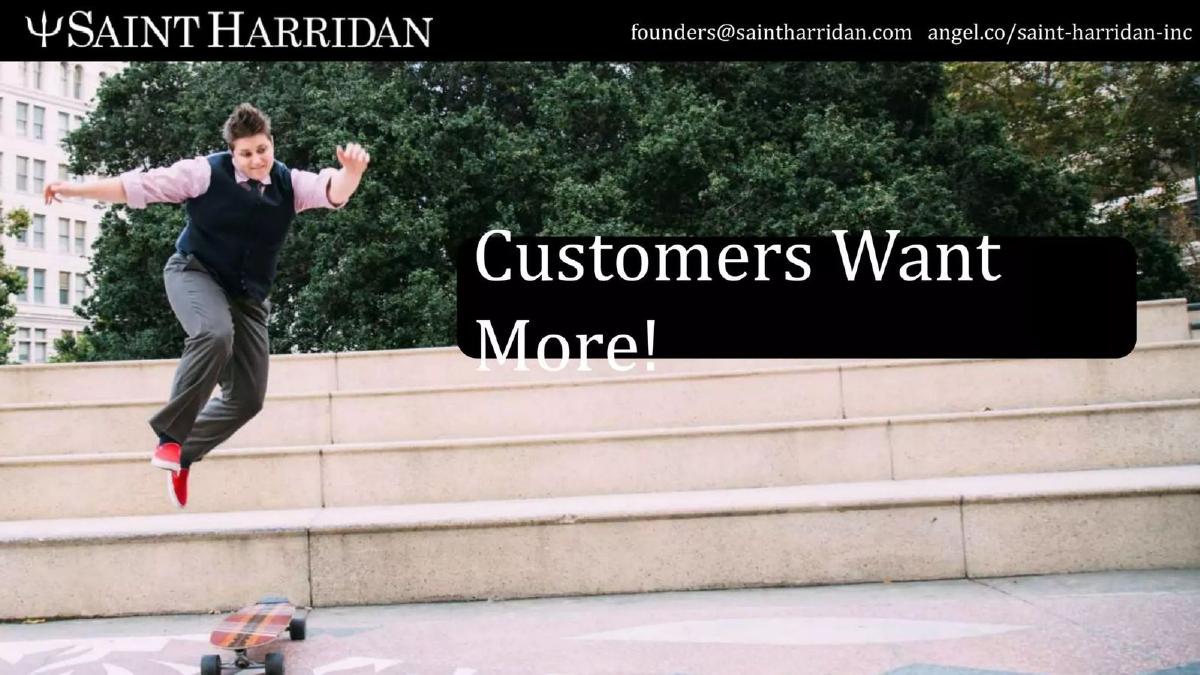
Slide 5: Customer Demand Slide 5 features an action shot of a customer on a skateboard, with the text 'Customers Want More!' This slide acts as a transition, moving from what the company has done to the potential for future growth. It frames the investment as a way to satisfy an existing, unmet demand rather than a gamble on creating a new market from scratch.
Slide 6 & 7: The Velocity of Sales Slides 6 and 7 should be viewed as a pair. Slide 6 notes '$15,000 First week of Sales.' Slide 7 adds a second text box: '10 Hours – Completely Sold Out.' This is the ultimate proof of product-market fit. For a seed-stage startup, showing that inventory moves faster than it can be stocked is a powerful signal to investors. It suggests that the primary bottleneck for the company is capital for inventory, not customer acquisition.
Slides 8-9: The Team and the Opportunity
Slide 8: The Team The team slide is robust, featuring three key members. Mary Going (Founder/CEO) is highlighted as a serial entrepreneur with two previous exits ('Sold in 2004' and 'Sold in 2001'). Martha Rynberg (Co-Founder/CMO) is credited with storytelling skills, including work on the FX TV series 'Totally Biased.' Lila Fox (Director of Ethical Garment Production) provides the industry weight, with logos for Levi’s and GAP prominently displayed. This slide effectively covers the three pillars of a successful startup: leadership/exits, marketing/brand, and technical/production expertise.
Slide 9: The Big Picture The final slide features a high-five between two customers and a large text box stating '$8 BILLION.' This is the Total Addressable Market (TAM) slide. While the number is large and exciting, the deck provides no context for how it was calculated. In a more detailed pitch, an investor would expect to see a breakdown of this figure, but as a closing slide, it serves to leave the viewer with a sense of the massive scale possible if the company can capture its niche.
What Works in This Deck
Extreme Brevity: The deck can be consumed in under 60 seconds. In a world where investors see hundreds of decks, this brevity is a competitive advantage. · High-Quality Imagery: For a fashion brand, the 'look' is everything. The photography is professional, energetic, and perfectly represents the target demographic. · Margin Focus: Mentioning the 65% margin (Slide 3) early on addresses the biggest concern investors have with e-commerce: unit economics. · Traction over Theory: The deck spends almost no time explaining why this market exists and instead spends all its time proving that the market is already buying (Slides 2, 6, and 7).
What is Missing
The Ask: There is no slide stating how much money the company is raising or what the terms are. While this information is often in the cover email, its absence in the deck makes the presentation feel incomplete as a standalone document. · Use of Funds: Even if the 'Ask' is omitted, a 'Use of Funds' slide would help investors understand if the money is going toward inventory, marketing, or team expansion. · Competitive Landscape: The deck assumes there are no competitors. While Saint Harridan was a pioneer in this specific niche, investors generally want to see how a company differentiates itself from both direct competitors and 'good enough' alternatives (like tailoring traditional men's suits). · Financial Projections: There are no forward-looking statements. While early-stage projections are often guesses, they help investors understand the founder's ambitions and the company's potential trajectory.
What a Founder Should Copy
The 'Sold Out' Metric: If you have moved product quickly, make it a standalone slide. Nothing proves demand like a lack of inventory. · Founder Exits: If you have sold a company before—even a small one—put the 'Sold in [Year]' tag right under your name. It is the fastest way to build trust. · Niche Identification: Slide 1 is a perfect example of how to define a market. It doesn't say 'Inclusive Clothing'; it says exactly who the clothes are for. Be specific. · Visual Consistency: The use of black text boxes with white text over high-contrast photos creates a consistent, modern brand feel throughout the entire deck.
Frequently asked questions
- What is the primary strength of the Saint Harridan deck?
- The primary strength is its visual proof of demand. By showing that they sold out in just 10 hours (Slide 7) and achieved $15,000 in sales in their first week (Slide 6), the founders moved past the 'idea' phase and into the 'execution' phase. This level of traction is highly persuasive for seed investors who are wary of fashion startups that haven't yet proven they can move inventory.
- How does the deck handle market sizing?
- The deck handles market sizing very aggressively but with little detail. Slide 9 simply states '$8 BILLION' over a lifestyle photo. While this suggests a large opportunity, the deck does not provide the methodology—such as Bottom-Up or Top-Down analysis—to explain how they arrived at that number for the specific niche of masculine clothing for women and transmen.
- Is the lack of a formal 'Ask' slide a problem?
- In a modern context, yes, but for a 2012 seed round, it was less uncommon. However, omitting the 'Ask' means the deck functions more as a brand teaser than a complete investment proposal. A founder using this style today should add a slide detailing how much capital is being raised and what specific milestones (e.g., new product lines, geographic expansion) that capital will unlock.
- What role does the team slide play in this specific raise?
- The team slide (Slide 8) is critical because it balances 'creative' with 'operational.' Mary Going is presented as a serial entrepreneur with two exits, which de-risks the business side. Lila Fox provides the technical apparel expertise with logos from Levi’s and GAP, which de-risks the production side. This combination suggests the company can both build a brand and manage a complex supply chain.
- Why focus on weddings specifically on Slide 4?
- Focusing on weddings is a strategic choice to highlight a 'must-buy' scenario. Apparel startups often struggle with discretionary spending, but wedding attire is a high-intent, high-margin purchase where customers are less price-sensitive. By labeling this as a key driver, Saint Harridan identifies a reliable revenue stream that can fund broader brand growth.