SafeMotos presents a compelling case for a safety-focused ride-hailing platform in Africa, specifically targeting the 10 million daily motorcycle taxi trips on the continent. By utilizing smartphone telematics to filter for high-quality drivers, they address a critical pain point: road safety. The deck, dated May 2017, showcases significant growth in Rwanda, moving from 3,500 trips in 2015 to 53,000 trips in just the first four months of 2017. Their business model relies on a 20% commission and a premium pricing strategy (110 RWF/km vs. the market standard of 100 RWF/km). While the deck excel…
Key takeaways
- SafeMotos uses smartphone sensors to monitor driver behavior and only connects customers to drivers above a safety threshold (Slide 2).
- In Rwanda, where 1 in 14,000 trips results in a serious accident, SafeMotos claims over 130,000 trips with zero serious accidents (Slide 2).
- The company charges a premium rate of 110 RWF/km compared to the standard 100 RWF/km, taking a 20% commission (Slide 4).
- Traction grew from 3,500 trips and 15 drivers in 2015 to 53,000 trips and 115 drivers by April 20, 2017 (Slide 5).
- The business model includes 'value added services' such as female drivers, all-weather drivers, and corporate accounts (Slide 4).
- SafeMotos identifies Uber, GrabTaxi, Go-Jek, and SafeBoda as competitors, claiming unique advantages in Rwanda and real-time safety tracking (Slide 6).
- The deck highlights significant press coverage from Fast Company, The Economist, and CNN, as well as a quote from the President of Rwanda (Slide 8).
- The team slide provides qualitative descriptions rather than professional resumes, noting the CEO has a decade of experience in Africa (Slide 7).
SafeMotos Pitch Deck Analysis
SafeMotos entered the African ride-hailing market with a distinct focus on safety and data. In a region where motorcycle taxis (motos) are the backbone of urban transport but are plagued by high accident rates, SafeMotos positioned itself as a tech-enabled solution for the growing middle class. This teardown examines their May 2017 pitch deck, which highlights their early success in Kigali, Rwanda.
Slide 1: Title Slide
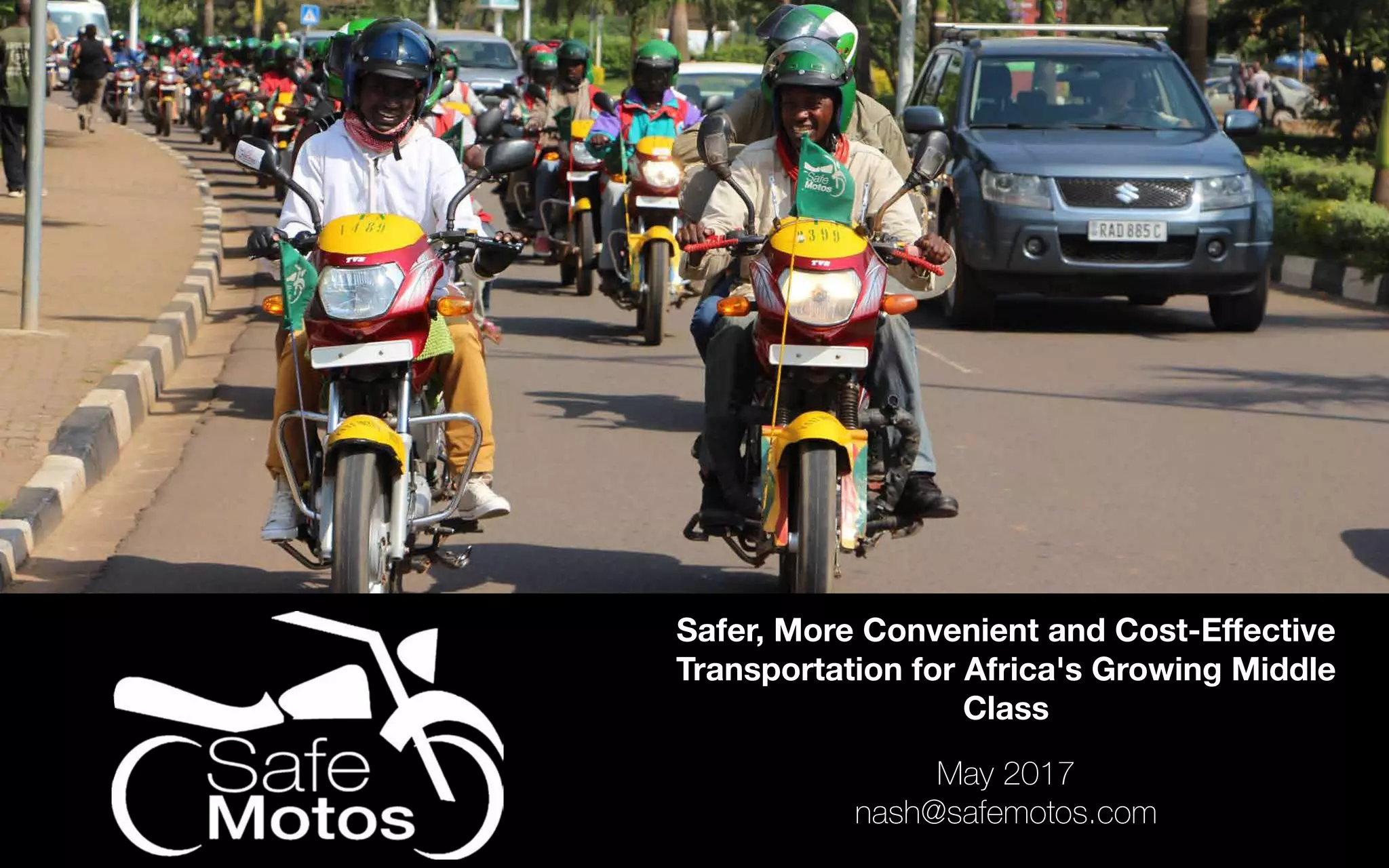
The title slide establishes the company's value proposition immediately: "Safer, More Convenient and Cost-Effective Transportation for Africa's Growing Middle Class." It includes the logo, the date (May 2017), and a contact email for the CEO, Nash. The background image shows a fleet of organized moto drivers, reinforcing the brand's professional and orderly image in contrast to the often chaotic informal moto market.
Slide 2: The Problem and Safety Solution
This slide defines the core mission. SafeMotos claims to "scalably address the dangers of emerging market motorcycle taxis." The technical differentiator is introduced here: the use of smartphone sensors to monitor how drivers behave. They set a "minimum threshold" for safety. The most powerful metric on this slide is the safety record: while Rwanda averages one serious accident per 14,000 trips, SafeMotos reports 130,000 trips with no serious accidents . This 10x safety improvement is the primary hook for both users and investors.
Slide 3: The Solution for Customers and Drivers
Slide 3 breaks down the benefits for both sides of the marketplace. For customers, the platform offers filtered "quality drivers," a set price per kilometer (removing the need for haggling), and door-to-door pickup. For drivers, the benefits are consistent demand, access to digital banking services, and education on safety and health. The inclusion of "digital banking services" suggests an early intent to move into fintech, a common evolution for ride-hailing platforms in emerging markets.
Slide 4: Business Model and Innovation
SafeMotos is transparent about its take rate: 20% commission . They provide a clear breakdown of the unit economics: a standard trip costs 100 RWF/km, but SafeMotos charges 110 RWF/km. They pay the driver 90 RWF/km, keeping 20 RWF/km. The slide also lists "innovating the business model" through corporate accounts, value-added services (female drivers, all-weather drivers), and digital financial services for drivers linked to their in-app behavior.
Slide 5: Traction and Path to Profitability
The traction slide shows significant growth. In 2015, the company had 3,500 trips and 15 drivers. By 2016, this grew to 80,000 trips and 65 drivers. For the first four months of 2017 (up to April 20), they recorded 53,000 trips and 115 active drivers. A line graph shows a steady upward trend in weekly trips, despite some volatility. The right side of the slide outlines a "Path to unit profitability," which includes new product initiatives like "Admotos" (in-app ads), selling airtime, and partnering with emergency response organizations or insurance companies to sell trip data.
Slide 6: Competition Matrix
The competition slide uses a standard grid to compare SafeMotos against SafeBoda, Go-Jek, GrabTaxi, and Uber. SafeMotos claims to be the only player that is "In Rwanda," has "Real time safety tracking," and a "Full featured app" that "Works with motos." Interestingly, they mark "Smartphone optional" as a green check for themselves and SafeBoda, implying they have a solution (likely USSD) for users without high-end devices, though the rest of the deck emphasizes smartphone telematics.
Slide 7: The Team
The team slide is informal. It introduces Peter (CTO/Co-founder, Kenyan) as "East Africa's best dev" and Nash (CEO/Co-founder, Canadian) as a "Startup guy since 18" with a decade in Africa. Clive (COO, Rwandan) is described as "wonderfully cranky." The slide lists several other team members by first name only, stating they took the "best talent from Kigali's best school." While this conveys a sense of local expertise and culture, it lacks the professional pedigree or specific past achievements typically found in high-stakes VC decks.
Slide 8: Social Proof and Press
The final slide focuses on validation. It features a cartoon of a moto driver carrying a unicorn, signaling their billion-dollar ambitions. More importantly, it lists high-tier press mentions from Fast Company, The Economist, The Guardian, and CNN. The most notable endorsement is a quote from HE Paul Kagame, President of Rwanda : "Now we have SafeMotos." This level of government recognition is a massive competitive moat in the Rwandan market.
What SafeMotos Does Well
Safety as a North Star: The deck doesn't just say they are safer; they explain how (telematics) and provide a comparative statistic (130k trips vs 14k accident rate) that is easy to grasp. · Clear Unit Economics: Slide 4 provides a simple, mathematical breakdown of how they make money per kilometer. This removes ambiguity about the revenue model. · Hyper-Local Validation: The quote from the President of Rwanda and the focus on the specific dynamics of the Kigali market demonstrate deep local integration. · Multi-Stream Revenue Potential: The "Path to unit profitability" slide shows they are thinking beyond just ride commissions, looking at data sales and advertising.
What is Missing from the Deck
The Ask: There is no slide indicating how much money they are looking to raise, the valuation, or how the funds will be allocated. · Financial Projections: While traction is shown, there are no forward-looking projections regarding revenue, burn rate, or market expansion timelines. · Market Size (TAM/SAM/SOM): Although they mention 10 million daily trips in Africa, they don't provide a detailed breakdown of the total addressable market in dollar terms or their specific target share. · Exit Strategy: There is no mention of potential acquirers or long-term outcomes for investors.
Founder Takeaways
Quantify the Impact: If your startup solves a safety or efficiency problem, find a way to quantify it against the industry standard, just as SafeMotos did with accident rates. · Show, Don't Just Tell, the Tech: Explaining that they use "smartphone sensors" to filter drivers makes the "Safe" in their name feel like a technical reality rather than just a marketing slogan. · Leverage Local Endorsements: If you have the support of local regulators or government figures, make it a centerpiece of your deck. In emerging markets, regulatory favor is often the difference between success and failure. · Keep the Business Model Simple: The 100 vs 110 RWF comparison is a masterclass in explaining a premium marketplace model in a single sentence.
Frequently asked questions
- What is the core technology behind SafeMotos?
- SafeMotos utilizes telematics data gathered from drivers' smartphones. These sensors monitor driving habits in real-time. The platform uses this data to filter out low-quality or dangerous drivers, ensuring that only those who meet a specific safety threshold are allowed to pick up passengers via the app.
- How does SafeMotos justify its premium pricing?
- While standard motorcycle taxis in Rwanda charge 100 RWF/km, SafeMotos charges 110 RWF/km. This 10% premium is justified by the increased safety (zero serious accidents in 130,000 trips), the convenience of being picked up at a specific location, and the use of 'quality' drivers who have passed telematics filtering.
- What are the primary growth metrics shown in the deck?
- The deck tracks three main metrics: annual trips, active drivers, and user registrations. Between 2015 and April 2017, trips grew from 3,500 to 53,000 (partial year), active drivers increased from 15 to 115, and registrations rose from 1,000 to 12,000.
- Who does SafeMotos consider its main competition?
- The deck lists SafeBoda, Go-Jek, GrabTaxi, and Uber as competitors. SafeMotos differentiates itself by being the only one (at the time) operating in Rwanda with real-time safety tracking and a full-featured app specifically optimized for motorcycles in that region.
- What additional revenue streams is the company exploring?
- Beyond the 20% ride commission, SafeMotos plans to monetize through 'Admotos' (in-app advertising), selling airtime, distributing flyers, branded equipment, and selling driver data (credit history and trip info) to insurance companies, regulators, and credit bureaus.