The RYU Apparel investor deck from November 2020 is less a traditional startup pitch and more a public company turnaround narrative. Following a $4.8 million recapitalization, the company uses this presentation to signal operational renewal, citing a move to Shopify and a streamlining of inefficiencies. The deck leans heavily on brand accolades—boasting 19 awards—and global partnerships with entities like the Canadian Olympic Team to establish credibility. However, the deck is notably thin on granular financial performance, such as revenue or CAC, instead focusing on high-level market growth…
Key takeaways
- The company recently completed a $4.8 million recapitalization to fund operational improvements (Slide 4).
- RYU transitioned its digital infrastructure to the Shopify platform to enhance customer experience (Slide 4).
- The brand is heavily male-skewed, with a current product split of 60% men and 40% women (Slide 13).
- Apparel dominates the product mix at 80%, though the company plans to expand its 20% accessory segment (Slide 13).
- The deck cites 19 awards and accolades, including a top 3 worldwide ranking for 'Best Work Backpack' by Carryology (Slide 10).
- RYU is a publicly traded entity on the TSX-V under the ticker 'RYU' and the OTCQB under 'RYPPF' (Slide 19).
- As of November 13, 2020, the company had a market capitalization of C $21,474,951 (Slide 19).
- Future growth strategy includes adding new product categories like Underwear and Swim, alongside increased domestic manufacturing (Slide 13).
RYU Apparel: A Public Market Turnaround Narrative
The November 2020 investor deck for RYU Apparel (Respect Your Universe) represents a pivotal moment for the Canadian activewear brand. Unlike a seed-stage startup deck that focuses on problem-solution fit, this presentation is a 'renewal' story. It is designed to communicate a fresh start to the public markets following a period of financial distress and subsequent recapitalization. The deck emphasizes brand equity, award-winning design, and a modernized operational backbone.
Slide 1: Title and Brand Identity
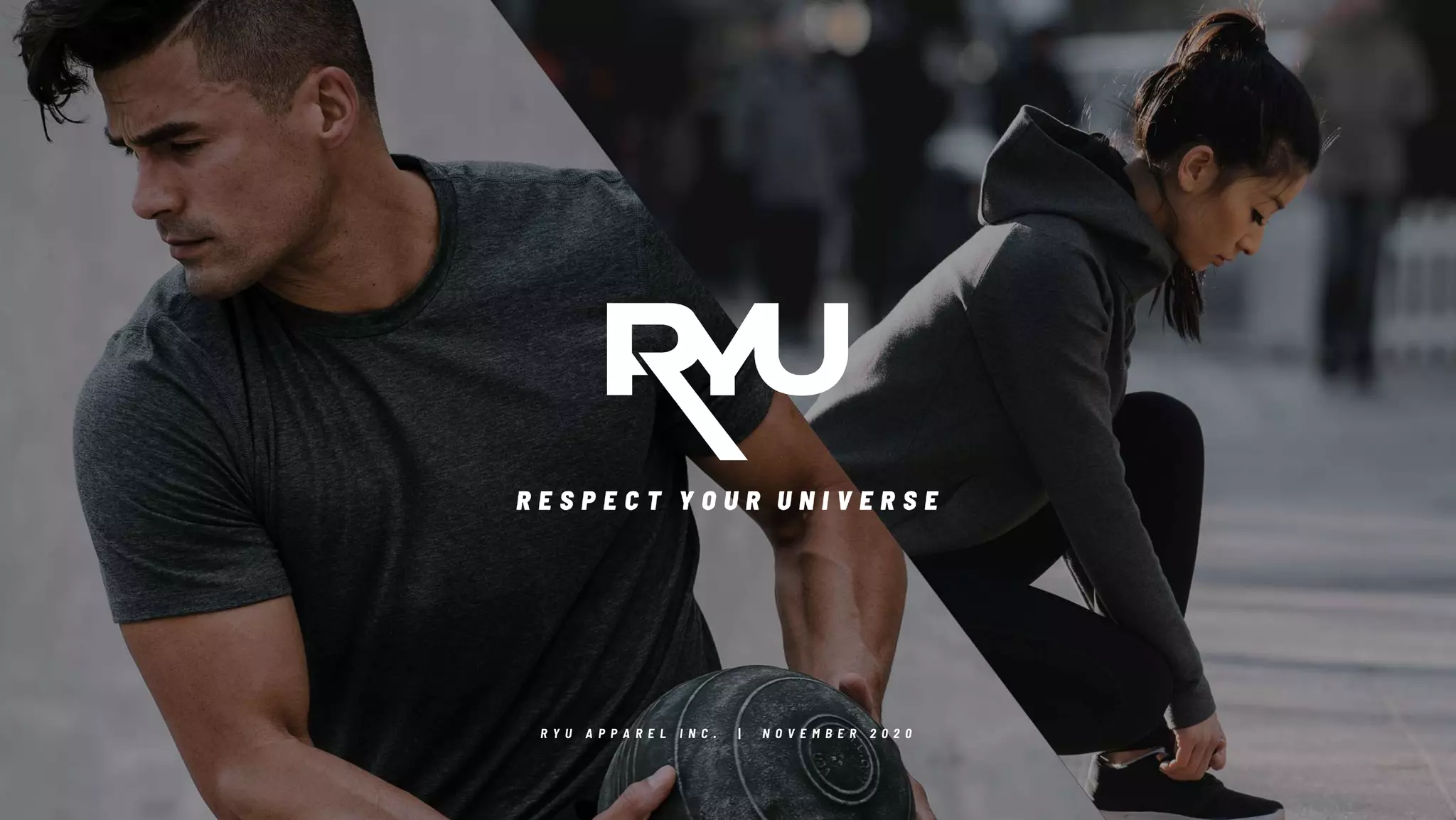
The cover slide establishes the brand's aesthetic: minimalist, urban, and athletic. The logo—a stylized 'RYU'—is centered over high-contrast imagery of athletes in motion. The tagline 'Respect Your Universe' is prominently displayed, grounding the brand in a philosophy of mindfulness and physical discipline. The date, November 2020, is significant as it places the deck in the midst of the global pandemic, a time when activewear saw a surge in demand due to the 'athleisure' trend, but also a time when physical retail faced immense pressure.
Slide 4: Highlights and Renewal
This slide serves as the executive summary of the company's current state. It explicitly mentions a 'completed recapitalized of $4.8m,' which is the most critical piece of financial news in the deck. This influx of capital is linked to three major operational improvements: a transition to the Shopify platform for better e-commerce, the decommissioning of operational inefficiencies (likely closing underperforming stores or reducing overhead), and a new 'Smart Studio' retail concept. The mention of partnerships with Zoom Media and the Canadian Olympic Team adds a layer of institutional credibility to the 'Leaders & Partners' section.
Slide 7: Market Opportunity
RYU uses macro-economic data to justify its growth potential. Citing Euromonitor, the slide notes that the global health and wellness market was expected to reach $815 billion by 2021. More specifically, it highlights that the Canadian sports apparel market grew 21% to $6.7 billion in 2017. While the data is a few years old relative to the deck's 2020 date, it paints a picture of a massive, growing category where even a small market share represents significant revenue. The $815 billion figure is used as a 'big number' anchor to excite investors about the sector's ceiling.
Slide 10: Awards and Accolades
For a brand in a turnaround phase, third-party validation is essential. Slide 10 is dedicated entirely to '19 Awards & Accolades.' It highlights the RYU Quick Pack being voted a top 3 worldwide 'Best Work Backpack' by Carryology. Logos from the World Retail Awards and WGSN are displayed to prove that the brand is respected by industry insiders and design critics. This slide aims to move the conversation from 'financial struggles' to 'product excellence,' suggesting that the core product is not the problem—the previous business model was.
Slide 13: Product Expansion Strategy
This slide provides a breakdown of the current business and the roadmap for the future. The current split is 60% men and 40% women, with apparel making up 80% of sales. The expansion plan is clear: grow the women's segment, lean into the success of the bag/accessory program, and enter new categories like Underwear and Swim. A notable strategic shift mentioned here is the 'increase in domestic manufacturing,' which is a common tactic for premium brands looking to reduce supply chain lead times and market themselves as locally produced or higher quality.
Slide 16: Global Partnerships
Building on the highlights slide, this page showcases the brand's marketing reach. The logos for Afterpay, Zoom Media, and Canada Skateboard are featured. These partnerships suggest that RYU is integrated into modern retail ecosystems (Afterpay) and high-performance athletic circles (Olympic Team). The visual of a bearded athlete in mid-stride reinforces the brand's 'hard training' persona, distinguishing it from more yoga-centric competitors like Lululemon.
Slide 19: Share Metrics
As a public company, RYU must provide transparency regarding its capital structure. This slide is a snapshot of the company's performance on the TSX-V and OTCQB as of November 13, 2020. With a share price of C $0.13 and a market cap of C $21.4 million, RYU is positioned as a micro-cap stock. The slide also details a significant number of warrants (123 million) and options (11 million), which investors would view as potential future dilution but also as a source of C $35.2 million in potential capital if the share price rises above the exercise prices.
What Works in This Deck
The deck excels at brand storytelling through imagery . The photography is consistent, high-quality, and aligns with a premium athletic positioning. By focusing on the '19 Awards,' the company successfully pivots the narrative away from financial restructuring toward product merit. The operational clarity on Slide 4 is also a strength; investors want to know exactly what was done with the recapitalized funds, and 'moving to Shopify' and 'streamlining inefficiencies' are concrete, understandable actions.
What Is Missing
The most glaring omission is historical financial performance . There are no slides showing revenue trends, gross margins, or EBITDA. For a company that just underwent a recapitalization, investors would typically want to see the 'burn rate' and the path to profitability. Additionally, while the deck mentions a 'Smart Studio' concept, it lacks unit economics for these stores. Without knowing the cost to open a store versus the expected revenue per square foot, it is difficult to evaluate the retail expansion strategy. Finally, there is no competitor analysis ; in a market dominated by Nike, Lululemon, and Alo Yoga, RYU does not explicitly state how it wins against these giants beyond 'design awards.'
What a Founder Should Copy
Founders should emulate the clear categorization of growth levers found on Slide 13. Instead of just saying 'we will grow,' RYU breaks growth down by gender split, product category expansion, and manufacturing changes. This gives investors a multi-faceted view of how the company intends to scale. Furthermore, the use of third-party validation (Slide 10) is a masterclass in building 'social proof.' If your product has won awards or been featured in reputable publications, those logos should be front and center to reduce the perceived risk for the investor.
Final Analysis
The RYU Apparel deck is a classic 'Phoenix' deck. It acknowledges a past that required a 'Renewal' and 'Recapitalization' without dwelling on the failures. It bets heavily on the idea that a great product (proven by awards) combined with a cleaned-up balance sheet and modern e-commerce tools (Shopify) will lead to a successful second act. While the lack of hard financial data is a red flag for late-stage private investors, for public market micro-cap investors, the deck provides enough 'blue sky' potential and brand equity to serve as a starting point for further due diligence.
Frequently asked questions
- What is the primary purpose of this deck?
- This deck functions as an investor update following a period of restructuring. It outlines the 'Renewal' phase of RYU Apparel, highlighting a $4.8 million recapitalization, new leadership hires, and a shift in retail strategy toward 'Smart Studios.' It aims to reassure public market investors of the brand's viability and growth potential after operational streamlining.
- How does RYU Apparel differentiate itself in the crowded activewear market?
- RYU relies on brand prestige and technical design validation. Slide 10 highlights 19 awards, specifically calling out their 'Quick Pack' as a top-tier work backpack. They also leverage high-profile partnerships, such as being the provider for Canada Skateboard and the Canadian Olympic Team, to position themselves as a premium, performance-oriented brand.
- What are the key financial metrics provided in the deck?
- The deck is light on internal P&L data but detailed on capital structure. Slide 19 shows a share price of C $0.13, a market cap of C $21.4M, and 165M shares outstanding. It also notes C $35.2M in potential proceeds from outstanding warrants, suggesting a focus on future liquidity and capital availability rather than historical revenue.
- What is the company's strategy for product expansion?
- According to Slide 13, RYU plans to balance its gender split by expanding women's offerings and diversifying into Underwear and Swim categories. They also intend to grow their lifestyle and streetwear components while increasing domestic manufacturing to improve speed-to-market, moving away from a purely athletic performance focus.
- Is RYU Apparel a startup seeking venture capital?
- No. As evidenced by Slide 19, RYU is a publicly traded company. The 'ask' in this deck is not for a specific private round but rather an invitation for public market investment or a signal to current shareholders about the company's new direction and recapitalized balance sheet.