The Rubix Health Columbia 015 pitch deck, consisting of 10 slides from a larger 49-slide presentation, outlines an early-stage concept for a web platform automating physician diagnosis into billable codes. The deck highlights customer discovery efforts, noting 54 interviews completed, and presents a detailed business model canvas covering key partners, activities, value propositions, customer relationships, and segments. It quantifies a Total Available Market of $53.8 billion and a Served Available Market of $7.8 billion for medical records and health info IT. The presentation also details di…
Key takeaways
- The deck is an early-stage presentation, indicated by 'Day 5' and '54 Interviews' on Slide 1, suggesting a focus on customer discovery and validation.
- Rubix Health aims to provide a 'Fully-automated Web Platform for transforming a physician's diagnosis into billable codes' (Slide 1).
- A detailed Business Model Canvas (Slides 2, 5) outlines key partners (HIPPA-Compliant Cloud, Hospital Systems), activities (MVP, Pitch, Coding Engine), value propositions (Cost Reduction, Convenience/Usability), customer relationships (GET, KEEP, GROW), and customer segments (Private practice physi…
- The Market Opportunity slide (Slide 6) identifies a Total Available Healthcare IT Market of '$53.8 bn/year' and a Served Available Market for Medical Records and Health Info IT of '$7.8bn/year'.
- Distribution Channels (Slide 7) include a 'Direct Channel - Website' and an 'OEM: EMR Companies' strategy, with specific tactics like 'MVP and Get Early Access Email Popup' and 'Provide NLP Billing engine built into EMR Product'.
- Customer Relationships: GET (Direct) (Slide 8) details strategies for acquiring customers, such as website optimization, early access sign-ups, and community forums.
- The deck includes 'Learning from Hypothesis/Experiment 1' (Slide 9), which states that 'Most physicians... are spending on average 20-30 minutes writing codes themselves' and that 'Around 5-8% of the total payment goes to billers'.
- Hypothesis & Experiment 3 (Slide 10) tests the 'SaaS monthly subscription model' as the 'most appealing payment method' and proposes a price of '~200 dollars/a month'.
Rubix Health Columbia 015 Pitch Deck Teardown
This teardown analyzes the provided 10 slides from the Rubix Health Columbia 015 pitch deck. The deck appears to be from an early stage of development, focusing heavily on customer discovery, problem validation, and outlining a business model. It provides insights into the company's proposed solution for healthcare billing, its market understanding, and initial customer engagement strategies.
Slide 1: Title Slide
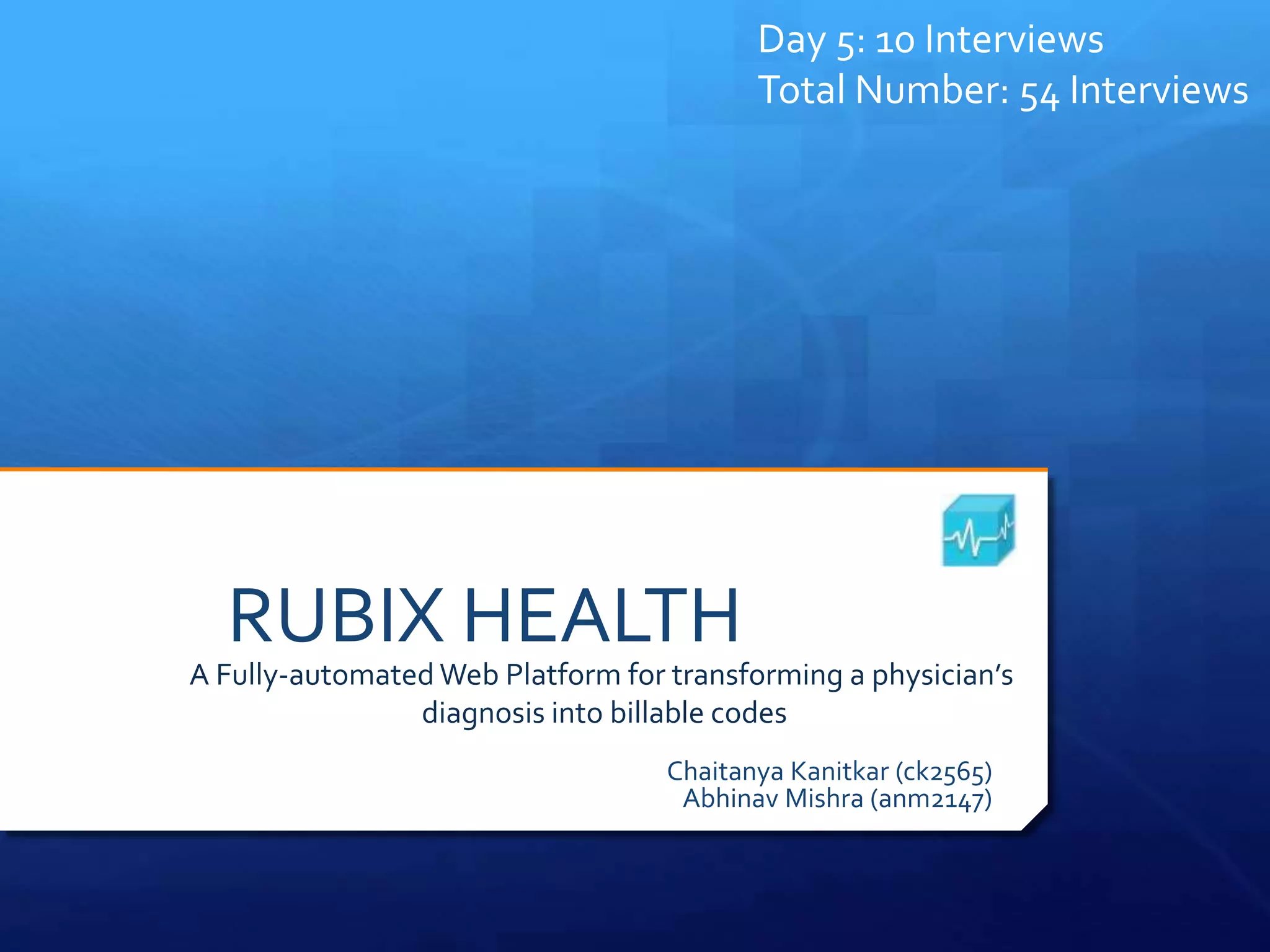
The first slide introduces Rubix Health with the tagline: “A Fully-automated Web Platform for transforming a physician's diagnosis into billable codes.” At the top left, it states “Day 5: 10 Interviews” and “Total Number: 54 Interviews,” indicating an early stage of customer discovery and validation. The slide also lists two individuals, Chaitanya Kanitkar (ck256s) and Abhinav Mishra (anm2147), who are presumably the founders or team members, along with their associated identifiers. A small, stylized icon resembling a heartbeat monitor is present next to the company name. The background is a gradient blue.
Slide 2: Business Model Canvas (Day 5)
This slide presents a detailed Business Model Canvas, divided into nine sections. The top left corner is labeled “Key Partners,” listing “HIPPA-Compliant Cloud Platform” (with examples like Aptible/TrueVault) and “Hospital Systems” (with examples like Wayne State/Detroit Medical Center Hospital System). “Key Activities” are broken down into “MVP” (Prototype User Interface/Web Platform, Advertising, Emails/connect with hospital systems, Website consolidation, Prototype sign-up list), “Pitch” (Consolidate all work, Consolidate doctor feedback, Develop pitch deck), and “Coding Engine” (Research NLP algorithm to translate unstructured doctors' notes into billable codes). “Value Propositions” include “Cost Reduction” (reducing medical reimbursement costs by eliminating the need for trained medical coders) and “Convenience/Usability” (fully automated and consistent coding engine that translates EMR diagnoses to billable CPT/ICD-10 codes).
“Customer Relationships” are categorized into “GET” (Reach out to physicians, visit hospitals, website to gauge interest), “KEEP” (offer consistent and high quality service, continually reach out for feedback), and “GROW” (increase involvement in hospital networks, expand services to include EMR and extended billing service). “Customer Segments” include “Private practice physicians,” “Physician groups,” “Hospital IT Admins,” and “Government” (Medicare/Medicaid). “Key Resources” are listed as “Financial Capital” (Friends, family, individual investment, Angel Investors, Accelerators, VC) and “Human Capital” (Software Developers/Graphic Design, Legal Advisor, Marketing/Sales, Doctors for testing). “Channels” are identified as “Web Application (Saas)” powered by a HIPPA-Compliant Cloud. “Cost Structure” includes HIPPA-Compliant Cloud, Human Resources, and Website Maintainence/Domain. “Revenue Streams” are “SAAS” (Monthly/yearly subscription model) and “Percentage of Reimbursement.”
Slide 3: Business Model Canvas (Day 5)
This slide is a duplicate of Slide 2, containing the exact same content. It is unclear why this slide is repeated in the sequence.
Slide 4: Market Opportunity
This slide focuses on the market size. It features a concentric circle diagram with three layers labeled “TAM: $53.8 bn,” “SAM: $7.8 bn,” and “Target: $4.8 bn.” The text clarifies these figures: “Total Available Healthcare IT Market: $53.8 bn/year” (growing at an annual rate of 16%, source: MarketResearch.com). “Served Available Market for Medical Records and Health Info IT: $7.8bn/year” is explained with details on the number of jobs and average salary for coders, and projected job growth (source: U.S. Bureau of Labor Statistics). “Target Market: $4.8bn/year” is described as medical/surgical hospitals, physicians' offices, and outpatient facilities, with further details on the number of jobs and average salary per category (source: medicalbillingandcoding.org/jobs).
Slide 5: Distribution Channels
This slide illustrates the company's distribution strategy using a flowchart. It shows the Rubix Health logo connected to two main channels: “Direct Channel - Website” (orange boxes) and “OEM: EMR Companies” (red boxes). Under the direct channel, tactics include “MVP and Get Early Access Email Popup,” “Community Forum for discussing billing,” and “Web Application Portal.” Under the OEM channel, tactics include examples of EMR companies (EPIC, CureMD), “Provide NLP Billing engine built into EMR Product,” and “No Web Portal.”
Slide 6: Customer Relationships: GET (Direct)
This slide details the strategies for acquiring customers through direct engagement. It lists six bullet points, each starting with a plus sign: “Website: Put more relevant terms that are searched for when searching for medical billing (track through Google),” “Get Early Access popup right at the top of website for easy way to get customers to sign up (similar to Robinhood),” “Community Forum: Empowers physicians and other experts in the field to discuss and share problems in medical billing,” “Blog: To tell our insights and provide a social forum,” “Continue to talking to physicians in private practices and hospitals,” and “Commit to one-two groups for actually developing and testing the product.”
Slide 7: Business Model Canvas (Day 5)
This slide is another duplicate of Slide 2, identical in content. The repetition of this slide three times (Slides 2, 3, and 7) is unusual for a pitch deck.
Slide 8: Learning from Hypothesis/Experiment 1
This slide outlines a customer discovery experiment. It starts with a “Hypothesis: Medical billing is a cumbersome, costly, and time-consuming process for everyday physicians.” The “Experiment” involved asking physicians about time spent learning CPT, ICD-9, and ICD-10 codes. The “Result” states: “Most physicians, especially those in larger hospitals, are spending on average 20-30 minutes writing codes themselves.” It further notes that “Around 5-8% of the total payment goes to billers (12% for academic hospitals)” and “About 60% of the doctors expressed that the billing process was extremely inefficient (one even said it was laughable).” The slide then details “Iteration” steps: “Keep collecting insights from other doctors. Also ask more details about why the coding process itself is cumbersome...” and “Iteration Result: It is a cumbersome process because of the details involved in the diagnosis, especially if a patient has a lot of history... Moreover, billing outsourcing companies are expensive and not preferred by hospitals.” A “Second Iteration” suggests: “Shadow doctors, billers, and coders to be able to visualize the problem. This will help when it comes to creating the product and the NLP engine itself.”
Slide 9: Hypothesis & Experiment 3
This slide presents another hypothesis and experiment, focusing on the payment model. The “Hypothesis: We believe that a SaaS monthly subscription model is the most appealing payment method for a healthcare provider.” The “Experiment” involved asking providers about current payment methods and desired changes. Further questions included: “Would they rather go with another route (such as percentage cut)?” The “Pass/Fail” criteria are defined: “Propose the monthly model with a reasonable price (~200 dollars/a month which is on the low end of medical software companies). If the doctors/providers approve of the number then pass, else->fail.”
Slide 10: THANK YOU!!
The final slide is a simple “THANK YOU!!” message on the same blue gradient background as the other slides.
What Works Well
The Rubix Health deck demonstrates a strong commitment to customer discovery and validation, which is critical for early-stage startups, especially in complex sectors like healthcare. The explicit mention of “54 Interviews” on Slide 1 immediately signals a data-driven approach to problem understanding. The detailed Business Model Canvas (Slides 2, 3, 7) is comprehensive, covering all key aspects of the business, from partners to revenue streams. This shows a thoughtful consideration of the entire ecosystem. The market sizing on Slide 4 is well-structured, breaking down TAM, SAM, and Target markets with specific figures and sources, providing a clear picture of the opportunity. Furthermore, the inclusion of 'Hypothesis/Experiment' slides (Slides 8, 9) is excellent. This approach directly addresses investor concerns about market fit and problem validation by showing how the team is actively testing assumptions and iterating based on feedback. The specific insights gathered, such as physicians spending 20-30 minutes on coding and the inefficiency of current billing processes, highlight a tangible pain point that Rubix Health aims to solve. The testing of a specific pricing model (SaaS monthly subscription at ~$200/month) with a clear pass/fail criterion on Slide 9 is also a strong indicator of methodical business development.
What is Missing
Despite its strengths, this deck has several significant omissions. The most glaring is the lack of a dedicated team slide. While two names are mentioned on the title slide, there is no information about their backgrounds, expertise, or why they are the right people to build Rubix Health. This is a critical piece of information for early-stage investors. There are also no detailed financial projections beyond market size; a typical pitch deck would include revenue forecasts, cost breakdowns, and profitability timelines. A competitive analysis is absent, leaving investors to wonder who else is in this space and what Rubix Health's unique differentiators are. Furthermore, there is no clear 'ask' for funding – no specific amount requested, no explanation of how the funds will be used, and no indication of the company's current stage of funding or valuation. The deck also lacks a clear problem statement slide that explicitly articulates the core pain point before diving into the solution. Finally, the repetition of the Business Model Canvas three times (Slides 2, 3, 7) is redundant and could be streamlined into a single, concise slide.
What a Founder Should Copy
Founders should emulate Rubix Health's rigorous approach to customer discovery and validation. The explicit mention of the number of interviews conducted (Slide 1) and the detailed 'Hypothesis/Experiment' slides (Slides 8, 9) are excellent examples of demonstrating market understanding and a commitment to iterative development. This shows investors that the founders are not just building a product in a vacuum but are actively engaging with potential users to refine their solution and business model. The structured market sizing (Slide 4), breaking down TAM, SAM, and Target markets with sources, is also a best practice for clearly defining the market opportunity. Additionally, the comprehensive Business Model Canvas (Slide 2) provides a holistic view of the business, which is valuable for internal planning and for communicating the overall strategy to stakeholders. The direct and OEM distribution channel strategies (Slide 5) show a thoughtful approach to market entry. By focusing on problem validation and a well-defined business model, founders can build a strong foundation for their pitch, even if other elements are still under development.
Frequently asked questions
- What problem is Rubix Health trying to solve?
- Rubix Health aims to solve the problem of physicians spending significant time and effort transforming diagnoses into billable codes. Their platform seeks to automate this process, reducing cost and improving convenience for healthcare providers by translating unstructured doctor's notes into billable codes (Slide 1, 2).
- What is the target market for Rubix Health?
- The target market for Rubix Health is medical/surgical hospitals, physicians' offices, and outpatient facilities. The deck identifies a Total Available Healthcare IT Market of $53.8 billion/year and a Served Available Market for Medical Records and Health Info IT of $7.8 billion/year (Slide 6).
- How does Rubix Health plan to acquire customers?
- Rubix Health plans to acquire customers through direct channels via their website, including an MVP and early access email popup, and by engaging with hospital systems. They also plan to partner with EMR companies to integrate their NLP billing engine directly into EMR products (Slides 7, 8).
- What is Rubix Health's proposed business model?
- Rubix Health proposes a SaaS monthly/yearly subscription model, potentially supplemented by a percentage of reimbursement. Their value proposition includes cost reduction, convenience, and usability, targeting private practice physicians, hospital IT admins, and government entities (Slides 2, 5, 10).
- What key information is missing from these 10 slides?
- These 10 slides notably omit a dedicated team slide, which is crucial for investors to assess the founding team's expertise. There are also no detailed financial projections beyond market sizing, no competitive analysis, and no clear 'ask' or funding request, which are standard components of a pitch deck.