Ryft’s 12-slide pitch deck is a masterclass in narrative-driven fundraising for technical infrastructure. By anchoring the company’s value proposition to the explosive growth of Apache Iceberg, Ryft positions itself as the essential management layer for the next generation of data storage. The deck successfully highlights a massive market opportunity ($60 billion) and a team with 15 years of shared history, which likely provided the necessary confidence for investors to commit $8M in a 2024 seed round. While the deck is light on specific unit economics and competitive deep dives, it clearly a…
Key takeaways
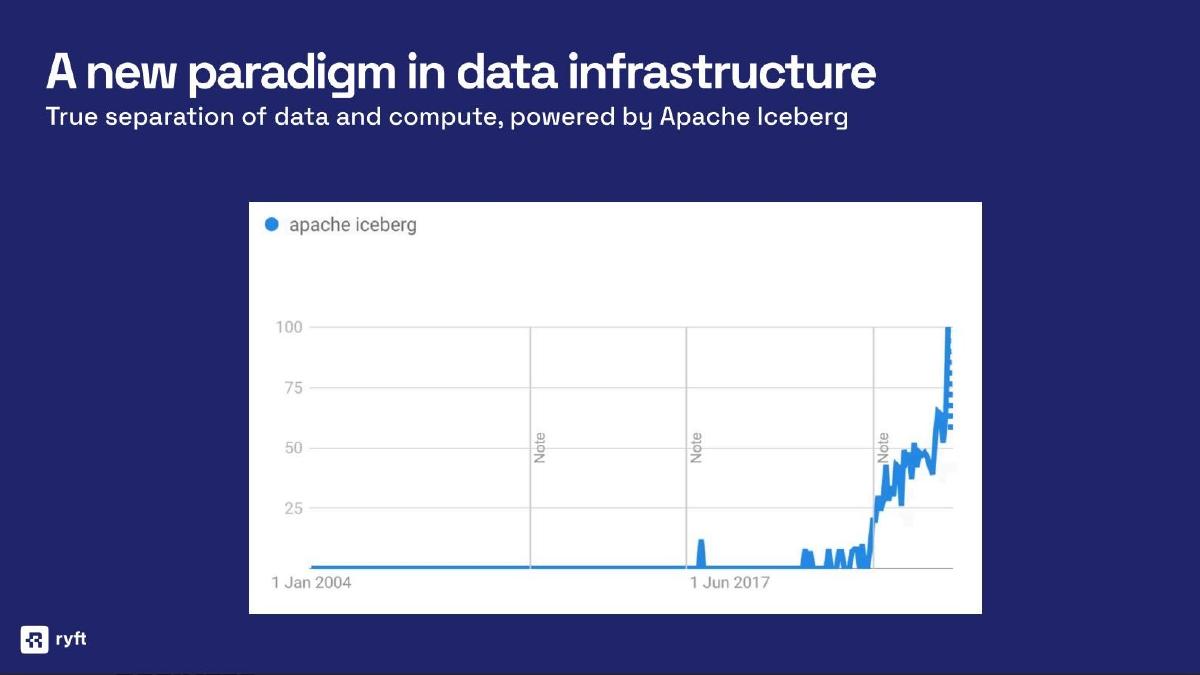
- The deck leans heavily on the 'why now' by showing a Google Trends-style chart of Apache Iceberg interest spiking significantly after 2017 (Slide 5).
- Ryft identifies a specific $60 billion cloud storage market as its primary target (Slide 11).
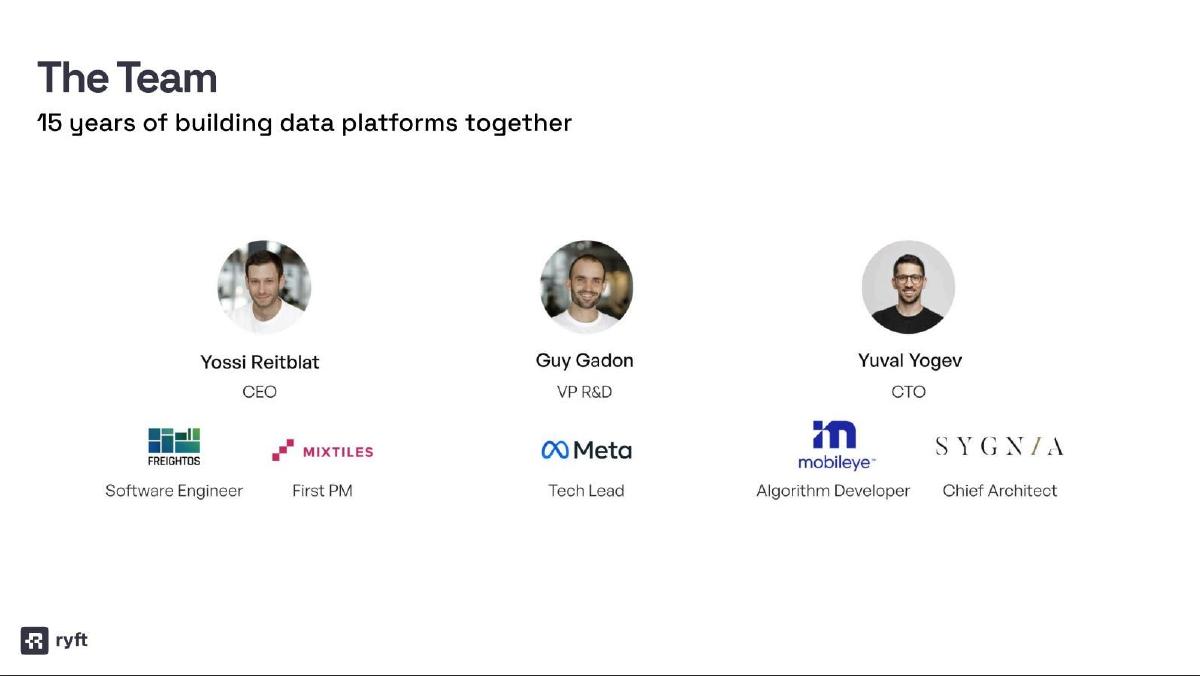
- The team slide emphasizes long-term stability, claiming the founders have 15 years of experience building data platforms together (Slide 2).
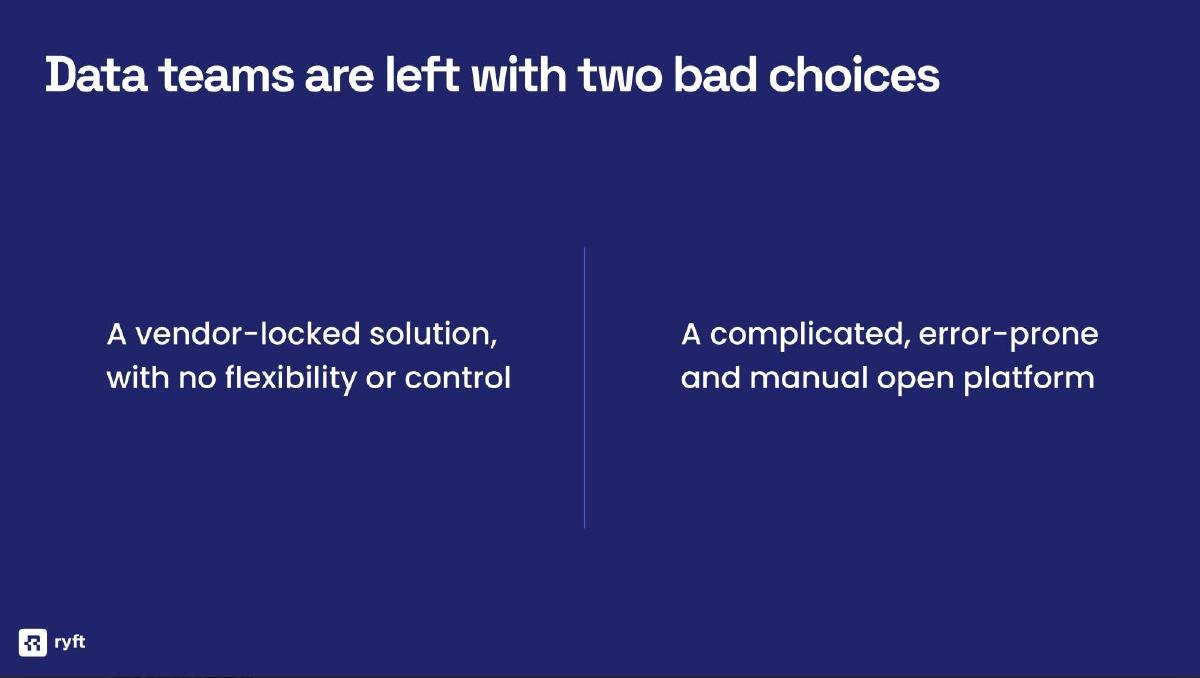
- The problem is framed as a binary struggle between skyrocketing costs of closed platforms and the manual errors of open platforms (Slide 6).
- Product features are categorized into four pillars: storage optimization, unified visibility, compliance, and disaster recovery (Slide 8).
- The deck omits a specific 'Ask' slide, though external reports confirm an $8M seed raise in 2024.
- The value proposition is centered on the 'true separation of data and compute,' a core tenet of modern data lakehouse architecture (Slide 5).
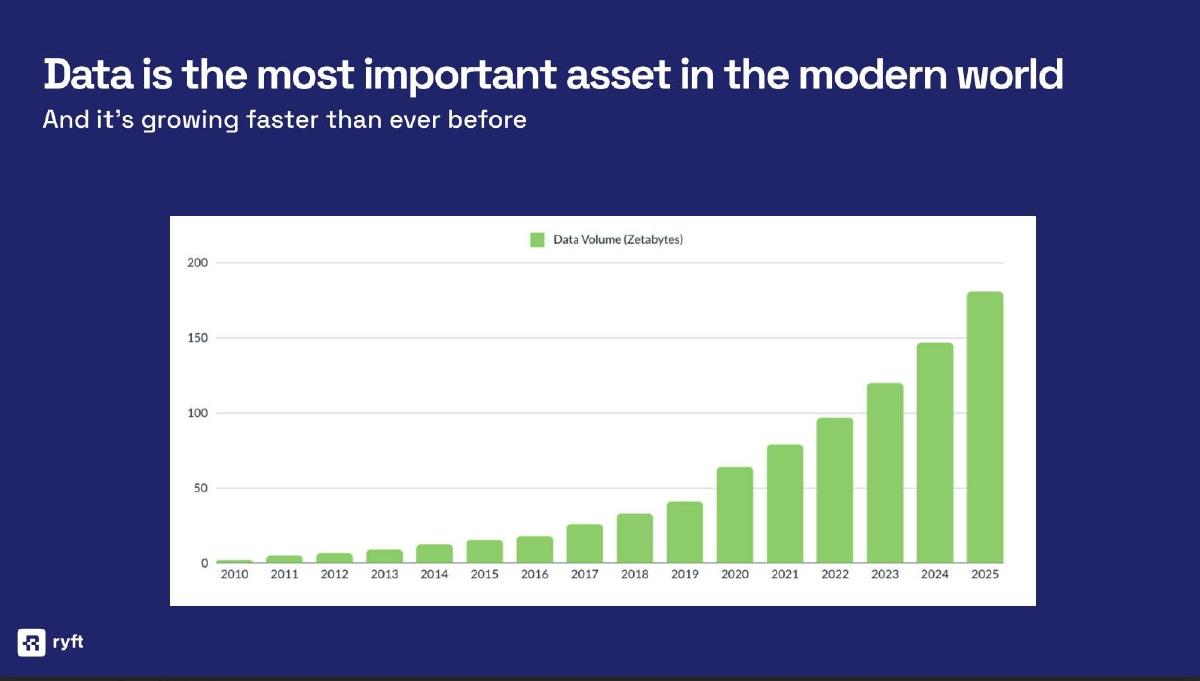
- The deck uses a minimalist aesthetic with high-contrast text, focusing on large-scale data growth projections reaching nearly 200 Zettabytes by 2025 (Slide 3).
The Narrative of Open Data Infrastructure
Ryft’s pitch deck is a concise 12-slide presentation that successfully navigated the 2024 venture landscape to secure $8M in seed funding. The deck does not rely on flashy graphics or dense technical diagrams; instead, it builds a logical progression from a macro-trend (data growth) to a specific technical shift (Apache Iceberg) to a unique team-market fit. By focusing on the 'Intelligent Management' of a specific open-source format, Ryft positions itself as a specialized tool in a massive, $60 billion market.
Slide 1: The Hook
The title slide is functional and direct: "Intelligent Storage Management for Apache Iceberg." There is no ambiguity here. By including 'Apache Iceberg' in the title, Ryft immediately signals its niche to investors who are tracking the shift away from proprietary data warehouses like Snowflake or BigQuery toward open data lakehouses. The branding is clean, using a simple logo and a high-contrast sans-serif font.
Slide 2: The Team
Placing the team slide second is a common tactic for experienced founders. The slide notes "15 years of building data platforms together." This is a powerful statement for a seed-stage company. It suggests that while the company might be new, the working relationships and domain expertise are mature. This significantly de-risks the investment by implying the team has already survived the 'forming and storming' phases of a startup.
Slide 3: The Macro Problem
Slide 3 presents a bar chart showing global data volume in Zettabytes. The chart shows a steady climb from 2010, accelerating sharply toward 2025, where it nears the 200 Zettabyte mark. The headline, "Data is the most important asset in the modern world. And it's growing faster than ever before," sets the stage for a scale problem that current infrastructure may not be equipped to handle.
Slide 4: The Pain Points
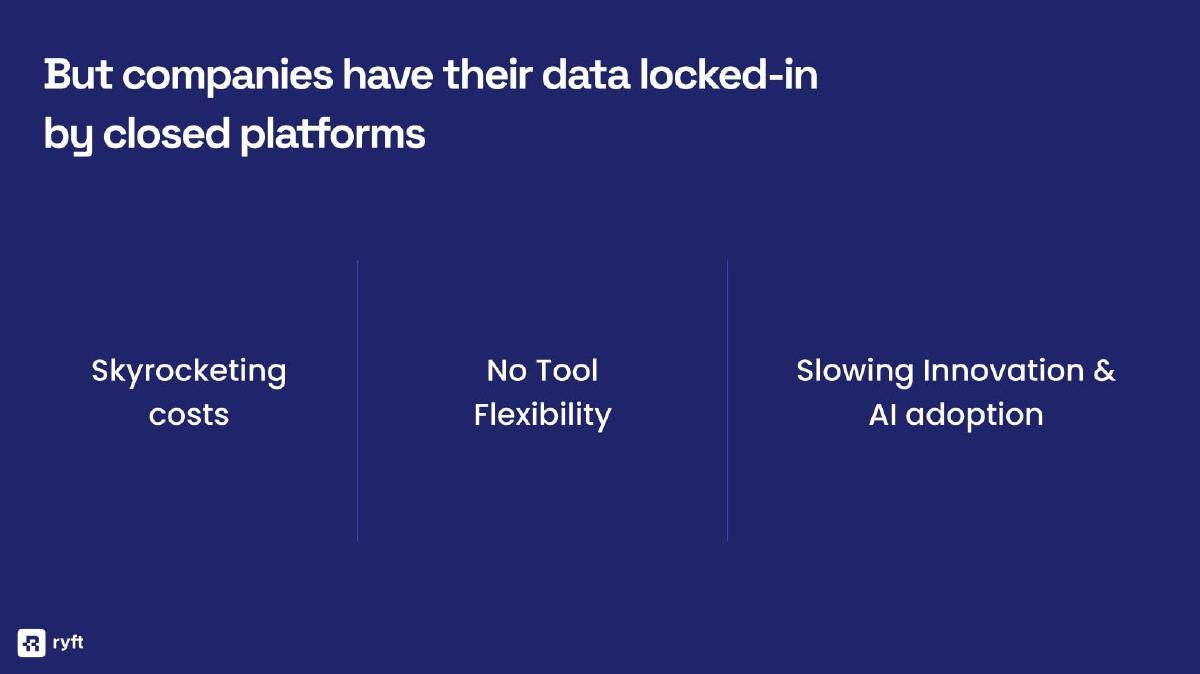
This slide transitions from the macro growth to the specific business pains. It lists four primary issues: "locked-in by closed platforms," "Skyrocketing costs," "No tool flexibility," and "Slowing innovation and AI adoption." This connects the technical problem of data storage to the executive-level problem of AI readiness, which was a primary driver of VC interest in 2024.
Slide 5: The 'Why Now' (Apache Iceberg)
Slide 5 introduces the solution's foundation: "A new paradigm in data infrastructure. True separation of data and compute, powered by Apache Iceberg." The slide features a line graph showing search or adoption interest for Apache Iceberg. The graph is flat from 2004 until approximately 2018, at which point it enters a near-vertical climb. This is the 'Why Now' slide—it argues that the industry has reached a consensus on a new standard, creating a window of opportunity for new management tools.
Slide 6: The Competitive Gap
Ryft frames the current market as a choice between two failures: "A vendor-locked solution, with no flexibility or control" or "A complicated, error-prone and manual open platform." This 'Goldilocks' framing is a classic pitch deck trope, positioning the startup as the third, 'just right' option that provides the benefits of both without the drawbacks.
Slide 7 & 8: The Reveal and Capabilities
Slide 7 introduces the product: "Enter Ryft -- Intelligent Iceberg Management, without the lock-in." Slide 8 follows up with the 'how,' listing four key pillars: "Automated storage optimization," "Unified visibility and governance," "Built-in compliance," and "Backup and disaster recovery." These are standard enterprise requirements, signaling that Ryft is building for the 'boring' but essential needs of large corporations.
Slide 9: The Value Proposition
Slide 9 reiterates the core benefits: "Simplicity, Flexibility, and no vendor lock-in." It promises "Zero manual storage management" and the ability to "Use any compute engine." This is the 'separation of data and compute' promise in practical terms—telling the customer they can keep their data in one place and swap out the tools they use to analyze it.
Slide 10: Go-To-Market (GTM)
The GTM slide is relatively high-level, stating a mission to build "the simplest solution for creating an efficient and resilient storage platform." It lacks specific details on sales channels, pricing models, or initial target verticals, which is common in early seed decks but often a point of scrutiny in later rounds.
Slide 11: Market Size
Ryft claims a stake in "The $60 billion cloud storage market." While this is a massive Top-Down number, the deck does not break this down into a Serviceable Addressable Market (SAM) or explain how much of that $60B is specifically relevant to Apache Iceberg users. However, for a seed round, establishing the sheer scale of the 'mission' is often sufficient.
Slide 12: The Vision
The final slide concludes with: "The future of data is open and in control." It serves as a thematic bookend to the initial problem of closed-platform lock-in.
What Ryft Does Well
The deck excels at narrative momentum . It starts with a universal truth (data is growing), identifies a specific catalyst (Apache Iceberg), and introduces a team that has spent 15 years preparing for this exact moment. The visual simplicity of the deck prevents the reader from getting bogged down in technical jargon, even though the subject matter is highly technical. By focusing on 'lock-in' and 'cost,' Ryft speaks to the CFO’s wallet as much as the CTO’s infrastructure needs.
What is Missing from the Deck
The most notable omission is traction and social proof . There are no mentions of pilot customers, design partners, or specific case studies showing the 'skyrocketing costs' being reduced in a real-world environment. Additionally, the deck lacks a competitive landscape slide. While it mentions 'closed platforms' generally, it does not name competitors like Tabular (which was acquired by Databricks) or other Iceberg-native startups. Finally, there is no financial roadmap or 'The Ask' slide included in this version of the deck, leaving the specific use of the $8M raise to the imagination.
What Founders Should Copy
Founders building in the 'modern data stack' or infrastructure space should emulate Ryft’s use of trend validation . The Google Trends-style chart on Slide 5 is a very effective way to prove market timing without needing internal data. Furthermore, the way Ryft categorizes its features into four enterprise-ready buckets (Optimization, Visibility, Compliance, Recovery) on Slide 8 is a great way to show that a product is 'enterprise-grade' even at the seed stage. Lastly, the emphasis on team longevity (Slide 2) is a powerful differentiator that founders with shared histories should always highlight prominently.
Frequently asked questions
- What is the core technology Ryft is built upon?
- Ryft is built specifically for Apache Iceberg, an open table format for huge analytic datasets. The deck positions Ryft as an 'Intelligent Iceberg Management' layer that provides the automation and governance typically found in closed systems while maintaining the flexibility of open-source data formats.
- How does Ryft justify its market timing?
- The deck uses two key data points: the exponential growth of global data volume (projected to hit nearly 200 Zettabytes by 2025) and the recent, sharp increase in adoption and search interest for Apache Iceberg. This suggests that the infrastructure for managing this data is currently at a tipping point.
- What specific problems does Ryft claim to solve for data teams?
- According to Slide 4 and Slide 6, Ryft addresses 'closed platform lock-in,' 'skyrocketing costs,' and 'slow innovation.' It specifically targets the dilemma where teams must choose between expensive, inflexible vendors or manual, error-prone open-source setups.
- Does the deck provide a detailed product roadmap?
- No. The deck focuses on high-level capabilities like 'Automated storage optimization' and 'Built-in compliance' (Slide 8) rather than a chronological roadmap. It emphasizes the end-state of 'Zero manual storage management' rather than the specific feature release schedule.
- Who is the target customer for Ryft based on the deck?
- The deck targets 'Data teams' (Slide 6) within companies that are currently struggling with data lock-in or are looking to adopt AI. The mention of the $60B cloud storage market suggests they are looking at enterprise-scale organizations with significant data footprints.