Orbital Witness uses a concise 7-slide deck to pitch a 'credit check for land and property.' The deck is a study in efficiency, moving quickly from the manual pain of paper-based due diligence to a sophisticated AI-driven solution. The strength of the pitch lies in its traction metrics: 120% Net Revenue Retention and a roster of blue-chip legal clients like Clifford Chance and Slaughter & May. By positioning their machine learning as a flywheel—where expert users train the system through daily use—they create a compelling narrative of defensibility. Despite missing a formal 'Ask' slide or det…
Key takeaways
- The deck identifies a £4bn market in the UK alone for real estate due diligence on slide 6.
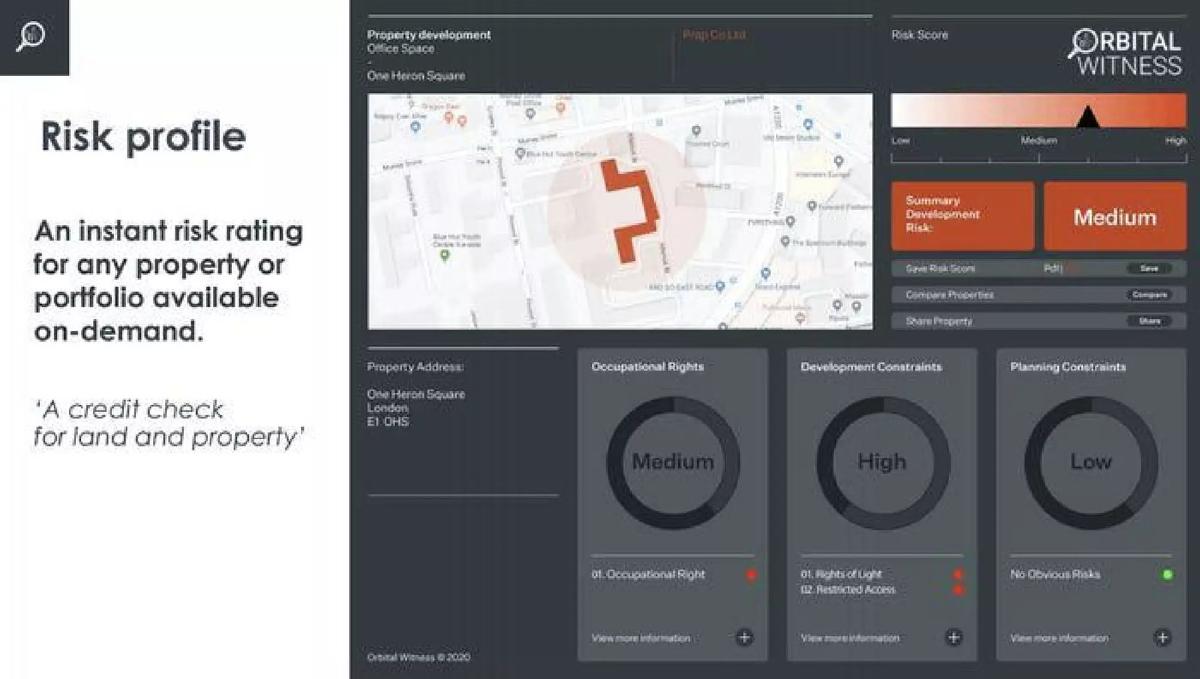
- Orbital Witness positions itself as a 'credit check for land and property' to simplify its value proposition on slide 3.
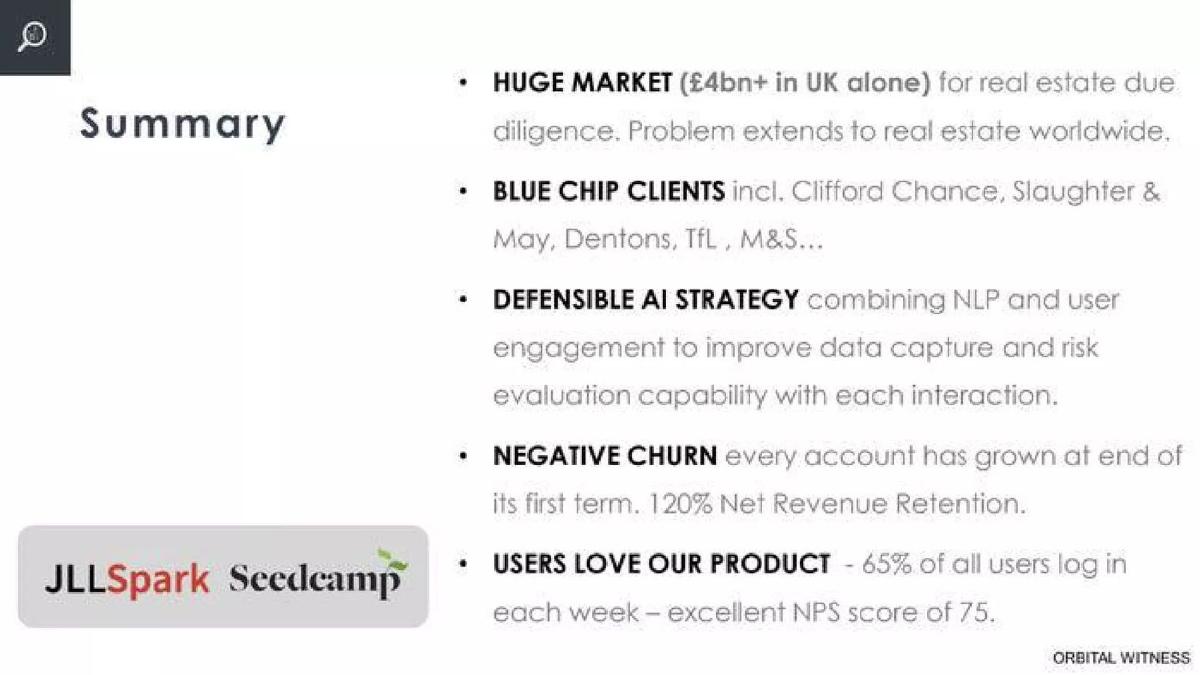
- The company claims 120% Net Revenue Retention, stating that every account has grown at the end of its first term on slide 6.
- User engagement is high, with 65% of all users logging in each week and an NPS score of 75 as cited on slide 6.
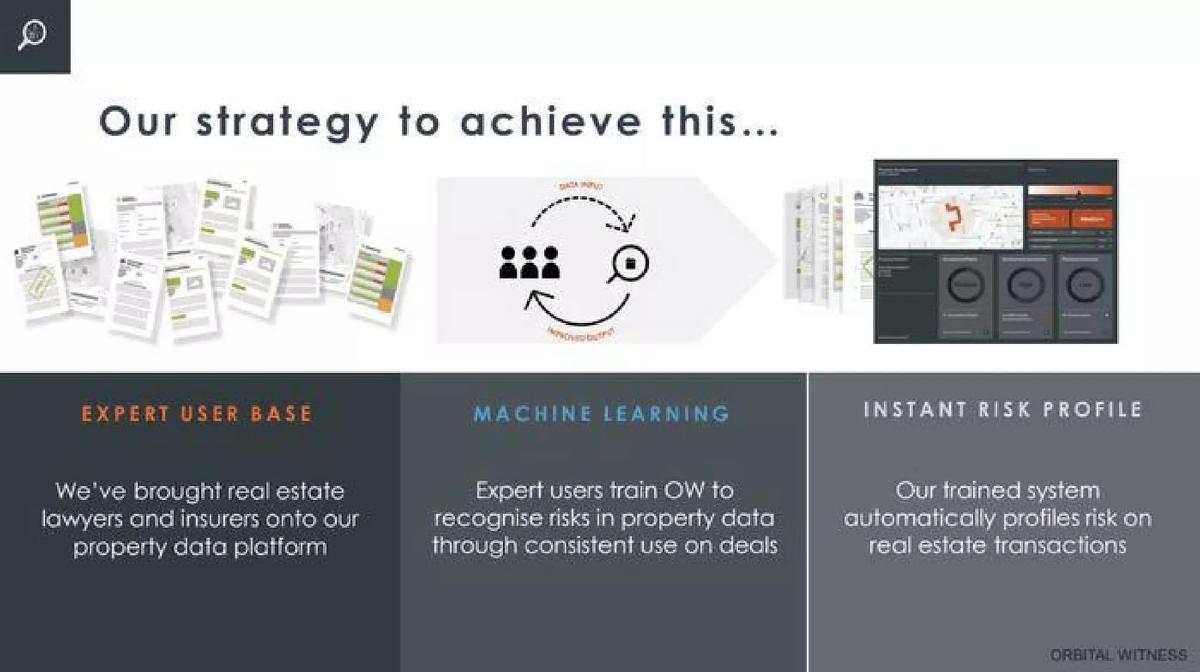
- The strategy relies on a flywheel where expert lawyers and insurers train the machine learning system through consistent use on deals as shown on slide 4.
- The team includes a Rhodes Scholar law graduate from Oxford and an economics graduate from Warwick on slide 5.
- Blue-chip clients include major law firms Clifford Chance, Slaughter & May, and Dentons, alongside TfL and M&S on slide 6.
- The deck completely omits a specific funding 'Ask' and detailed financial forecasts across its 7 slides.
The 7-Slide Seed Deck: Efficiency in Fundraising
Orbital Witness provides a masterclass in brevity with this 7-slide deck. In an era where decks often bloat to 20 or 30 slides, this presentation focuses exclusively on the highest-leverage information: the pain point, the product's simplicity, the data flywheel, and the undeniable traction. By the time an investor reaches the summary slide, the founders have already established that they have a working product, blue-chip validation, and a highly engaged user base.
Slide 1: Title and Vision
The deck opens with a clear, bold vision statement: "THE UNIVERSAL RISK RATING FOR REAL ESTATE ASSETS... allowing anyone to understand property risk." The use of the word "universal" suggests an ambition beyond a simple tool, aiming instead for a new industry standard. The imagery at the bottom—a stylized skyline—firmly roots the company in the PropTech sector.
Slide 2: The Manual Problem
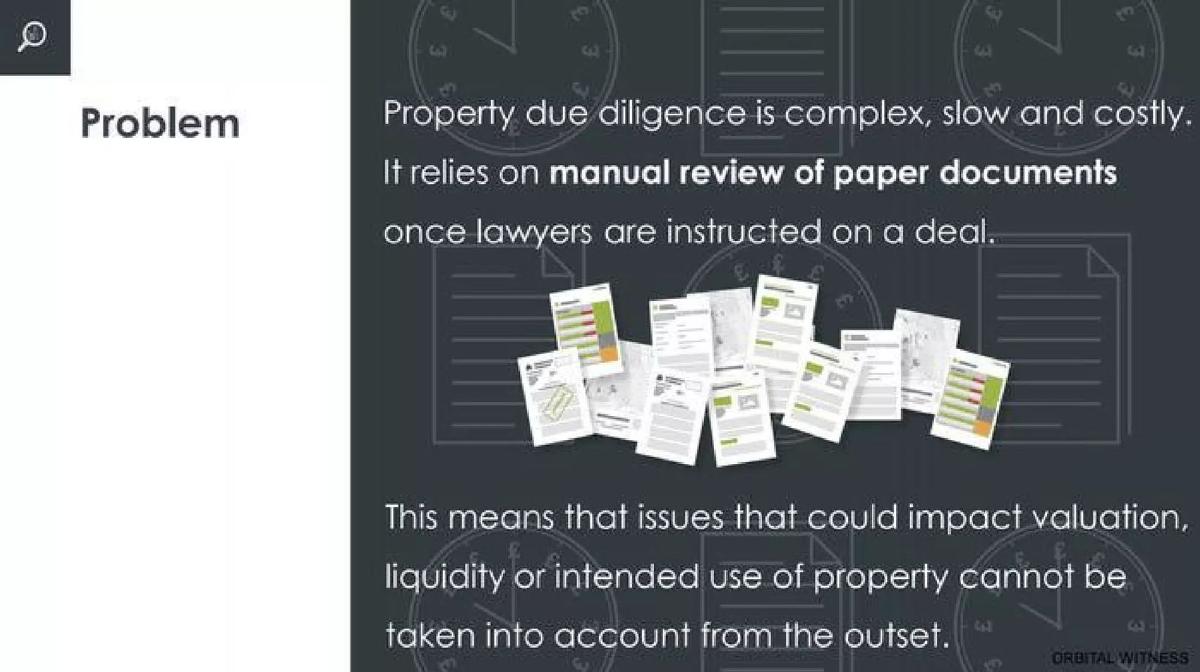
Slide 2 defines the problem as property due diligence being "complex, slow and costly." It highlights a specific bottleneck: the "manual review of paper documents." The slide notes that because this review happens only after lawyers are instructed, valuation and liquidity risks cannot be accounted for from the outset. This framing is effective because it identifies a systemic inefficiency that affects every major real estate transaction.
Slide 3: The Solution as a Category
Instead of a complex technical explanation, slide 3 uses a powerful analogy: "'A credit check for land and property.'" This immediately tells the investor what the product does without requiring a legal degree. The slide features a screenshot of the "Risk profile" dashboard, showing a map of a property (One Heron Square, London) alongside color-coded risk scores for Occupational Rights, Development Constraints, and Planning Constraints. It promises an "instant risk rating" available on-demand.
Slide 4: The Machine Learning Flywheel
Slide 4 explains the "strategy to achieve this" through a three-part process. First, they acquire an "Expert User Base" of lawyers and insurers. Second, these experts use the platform, and their interactions provide the data to train "Machine Learning" models. Third, this results in an "Instant Risk Profile" that can eventually be generated automatically. This is a classic data network effect slide, suggesting that the product becomes more defensible and accurate with every deal processed.
Slide 5: The Team
The team slide (Slide 5) emphasizes pedigree and tenure. CEO Edmond Boulle is highlighted as a Rhodes Scholar from Oxford, and COO Will Pearce as a Warwick graduate. Crucially, it mentions they have worked together for four years, reducing co-founder conflict risk. The slide also displays logos from previous employers of the broader team, including Just Eat, Doctorlink, Tessian, and PatSnap, signaling a high level of professional experience in the room.
Slide 6: Traction and Summary
Slide 6 is the "heavy lifter" of the deck. It packs five major proof points into one page: Market Size: £4bn+ in the UK alone. Client Quality: Lists Clifford Chance, Slaughter & May, Dentons, TfL, and M&S. Defensibility: Mentions a combination of NLP and user engagement. Retention: Claims 120% Net Revenue Retention. Engagement: Notes a 65% weekly login rate and an NPS of 75. This slide essentially answers every major investor objection regarding market size, product-market fit, and scalability.
Slide 7: Contact Information
The final slide is a simple contact page with the website, Twitter, and LinkedIn handles. It mirrors the cover slide's design, maintaining brand consistency.
What Works in This Deck
The Analogy: Describing the product as a "credit check for land" is a brilliant move. It takes a complex legal process and turns it into a concept that every investor understands instantly. This reduces the cognitive load required to evaluate the business.
The Traction Density: Slide 6 is incredibly dense with high-quality signals. For a Seed stage company, having 120% Net Revenue Retention and a 75 NPS is exceptional. Listing "Magic Circle" law firms as clients provides immediate institutional credibility that is hard to ignore.
The Data Flywheel: The deck clearly explains how they will move from a manual-assist tool to a fully automated AI platform. By showing that lawyers are the ones training the system, they solve the "cold start" problem of AI training data.
What is Missing
The Ask: There is no mention of how much money the company is looking to raise, what the milestones for that capital are, or what the current runway looks like. While this information is often shared in a follow-up, its absence in the primary deck is notable.
Competitive Landscape: The deck assumes there are no other players in the space or that the "legacy process" is the only competitor. A slide addressing other LegalTech or PropTech competitors would have added another layer of market intelligence.
Financial Projections: There are no charts showing revenue growth over time or projections for the next 18-24 months. The deck relies entirely on retention and engagement percentages rather than hard currency figures.
What a Founder Should Copy
The Summary Slide: Every founder should attempt to create a slide like Slide 6. It distills the entire investment thesis into five bullet points that cover market, traction, product, and defensibility. If you can't summarize your business this effectively, you might not understand your value proposition well enough.
Visual Simplicity: The deck uses a consistent, dark, professional color palette. The product screenshots are clean and highlight the most important information (the risk scores) rather than showing every single feature of the UI.
Focus on Engagement: Highlighting weekly login rates (65%) is a much stronger signal than "total registered users." It proves that the product is a daily or weekly necessity for the target audience, which is the hallmark of a successful SaaS business.
Frequently asked questions
- What is the core problem Orbital Witness is solving?
- According to slide 2, property due diligence is currently complex, slow, and costly because it relies on the manual review of paper documents. This manual process means that critical issues affecting valuation, liquidity, or intended use are often not identified at the start of a transaction, leading to delays and financial risk.
- How does the technology work according to the deck?
- Slide 4 outlines a three-step strategy: first, bringing expert lawyers and insurers onto the platform; second, using their interactions to train machine learning models to recognize risks in property data; and third, using that trained system to automatically generate instant risk profiles for real estate transactions.
- What evidence of product-market fit does the deck provide?
- The deck provides several high-signal metrics on slide 6, including a 120% Net Revenue Retention rate, a 75 Net Promoter Score (NPS), and a 65% weekly login rate among its user base. It also lists prestigious 'blue chip' clients like Clifford Chance and Slaughter & May as active users.
- Who are the founders and what is their background?
- As detailed on slide 5, the company was founded by Edmond Boulle (CEO) and Will Pearce (COO). Boulle is a Rhodes Scholar law graduate from Oxford, while Pearce is a Warwick economics graduate. They have worked together for four years and previously advised tech companies in the space industry.
- What key information is missing from this pitch deck?
- The deck is notably brief at only 7 slides. It lacks a dedicated 'Ask' slide (specifying how much they are raising and on what terms), a detailed Go-To-Market strategy, a competitor analysis, and any multi-year financial projections or unit economics beyond the retention percentage.