Moonhub’s 13-slide pitch deck, used to secure a $1.4M Seed round in 2023, centers on the transition from traditional e-learning to immersive VR training. The deck highlights a significant traction milestone: 1766% revenue growth between November 2022 and October 2023, reaching $53,000 in Monthly Recurring Revenue (MRR). A core differentiator is their patented 'spot-and-jot' scoring system, which measures five cognitive layers including spatial awareness and reaction time. The business model is bifurcated into a standardized 'Lunar Library' and bespoke 'Moonhub Studios' solutions. While the de…
Key takeaways
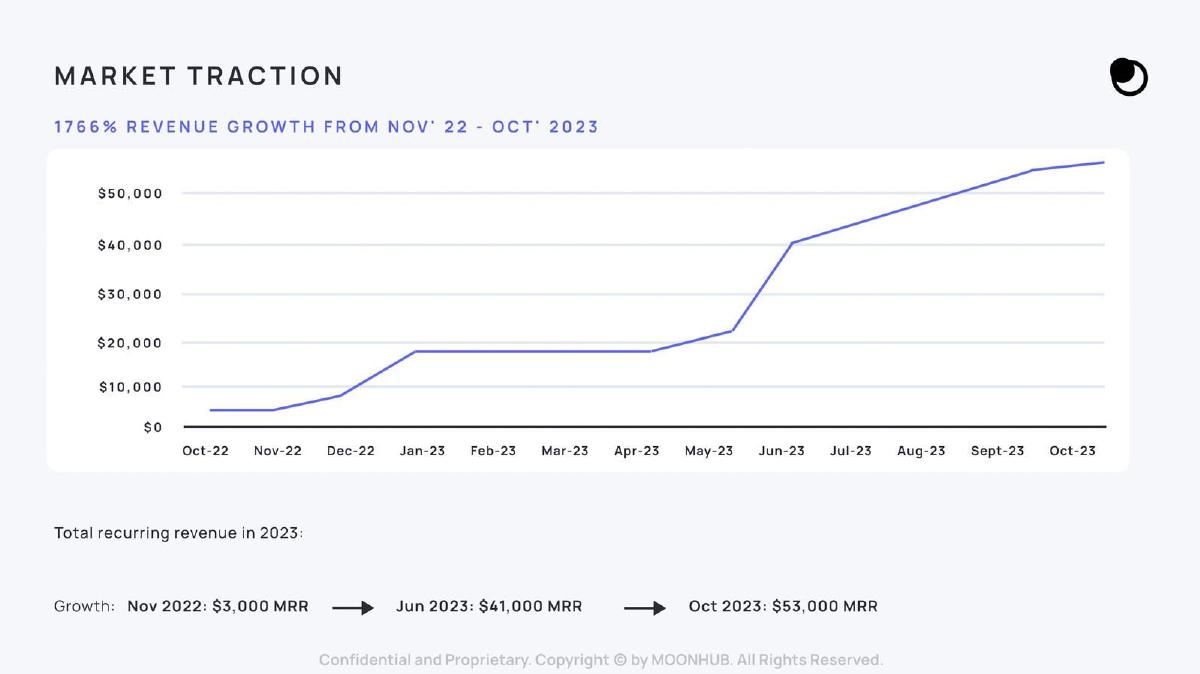
- Moonhub reported a massive 1766% revenue growth over a 12-month period, ending October 2023 at $53,000 MRR (Slide 3).
- The company utilizes a patented 'spot-and-jot' scoring system to provide data analytics on learner performance (Slide 2).
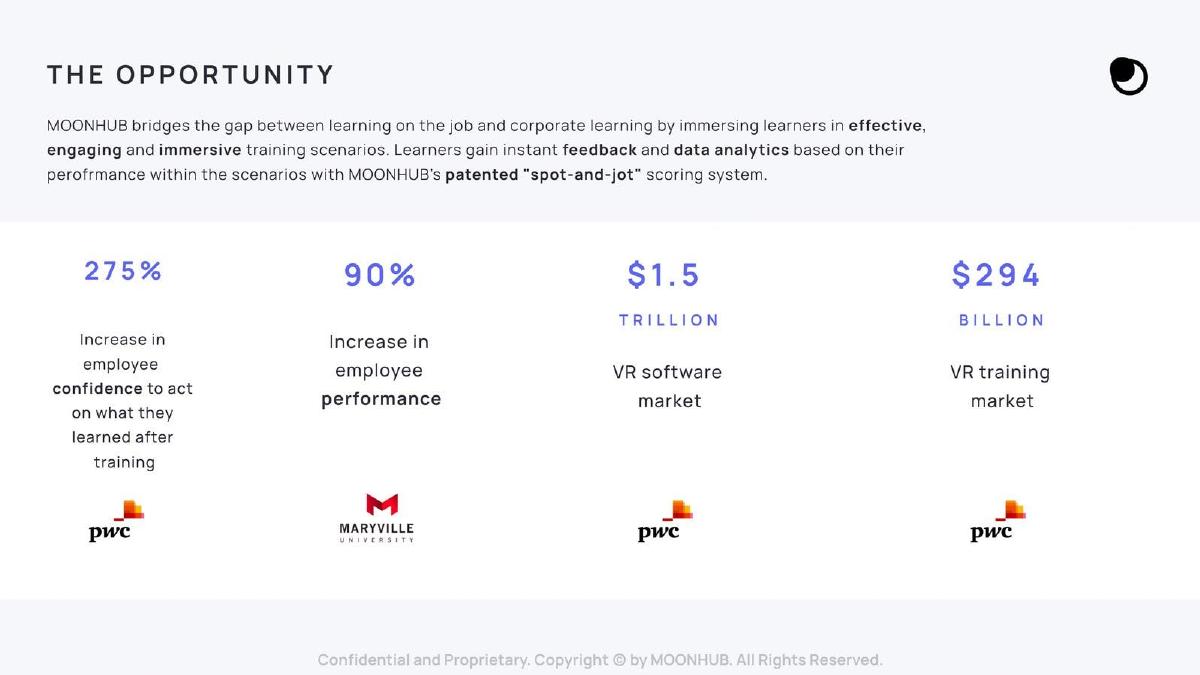
- Training effectiveness is supported by third-party data, citing a 275% increase in employee confidence and 90% increase in performance (Slide 2).
- The market opportunity is framed by a $1.5 trillion VR software market and a $294 billion VR training market (Slide 2).
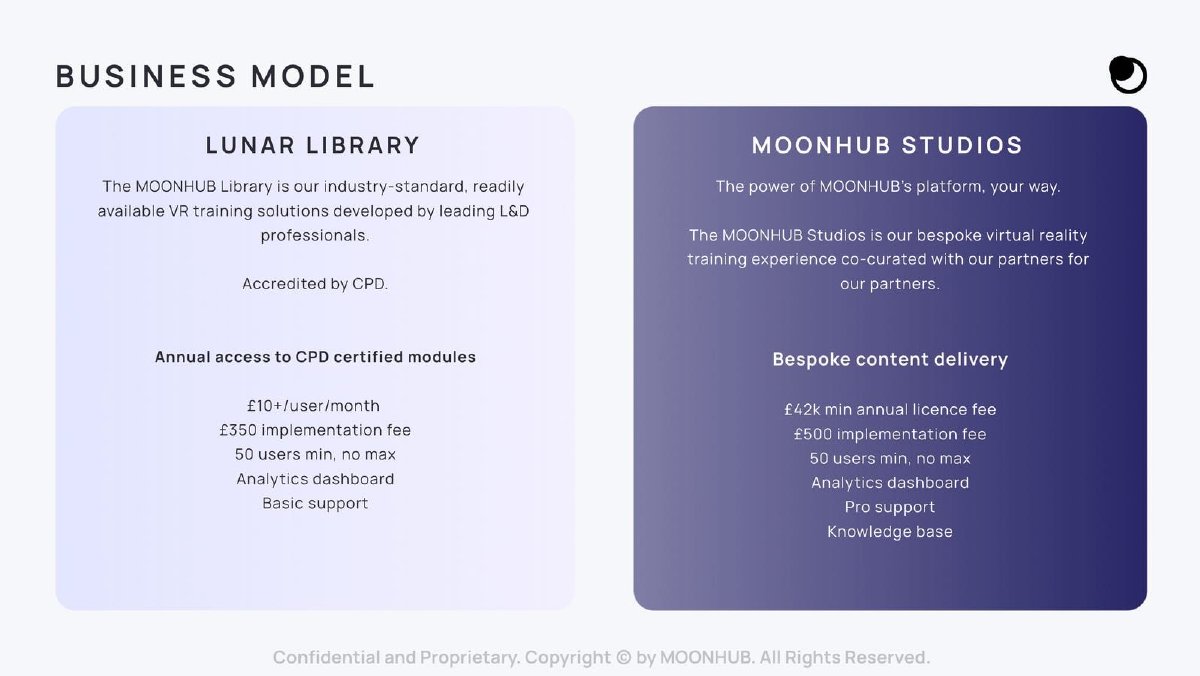
- The 'Lunar Library' product offers a low-friction entry point at £10+ per user per month with a 50-user minimum (Slide 5).
- High-value bespoke contracts are handled via 'Moonhub Studios' with a minimum annual license fee of £42,000 (Slide 5).
- The founding team leverages significant social proof, with all three founders listed as Forbes 30 Under 30 honorees (Slide 6).
- The deck identifies key leadership gaps, explicitly stating they are currently recruiting a Head of Product with VC support (Slide 6).
Executive Summary: The VR Training Pivot
Moonhub’s pitch deck is a lean, metric-driven presentation that focuses heavily on two things: explosive growth and technical defensibility. As reported by Business Insider, the company raised $1.4M in a 2023 Seed round. The deck reflects a company that has found product-market fit in the corporate training sector, moving away from the 'hype' of VR and toward the 'utility' of data-driven learning. By anchoring their value proposition in a patented scoring system, they move the conversation from 'cool technology' to 'essential HR analytics.'
Slide 1: Title and Vision
The opening slide is minimalist, featuring the Moonhub logo and the tagline: "Bridging the gap between learning on the job and e-learning through the power of VR." It includes direct contact information for CEO Dami Hastrup. This sets a professional tone, positioning the company as the middle ground between expensive, slow on-the-job training and ineffective, low-engagement e-learning.
Slide 2: The Opportunity and Market Validation
Slide 2 serves as a combined Problem/Solution/Market slide. It introduces the "spot-and-jot" patented scoring system. The slide uses heavy-hitting statistics to validate the efficacy of VR training, citing a 275% increase in employee confidence and a 90% increase in employee performance . These figures are attributed to PwC and Maryville University, providing third-party credibility. The market size is presented as massive, with a $1.5 Trillion VR software market and a $294 Billion VR training market . This slide is dense but effective at showing that the 'why now' is driven by both market size and proven results.
Slide 3: Market Traction and Revenue Growth
This is the 'money slide.' Moonhub displays a clear line graph showing 1766% revenue growth from November 2022 to October 2023. The specific milestones are listed: $3,000 MRR in Nov 2022 , jumping to $41,000 MRR in Jun 2023 , and ending at $53,000 MRR in Oct 2023 . The steepness of the curve between May and June suggests a major contract win or the successful launch of a new product tier. For a Seed round, showing $50k+ in MRR is a very strong signal of de-risking.
Slide 4: The Patented Scoring System
Slide 4 dives into the product's technical moat. It visualizes the 5-layered cognitive scoring system using a pentagon graphic. The five metrics tracked are: Spatial Awareness, Accuracy, Initiative, Knowledge, and Reaction Time . By highlighting that this is a "patented VR technology," Moonhub signals to investors that they aren't just a content agency—they own the underlying methodology for measuring human performance in virtual environments.
Slide 5: Business Model and Pricing Tiers
Moonhub presents a clear two-pronged revenue strategy. The Lunar Library is their scalable SaaS play, offering annual access to CPD-certified modules for £10+/user/month with a 50-user minimum. This is designed for high-volume, standardized training. The second prong is Moonhub Studios , a bespoke service for partners requiring custom content. This carries a £42k minimum annual license fee . This dual model allows for both high-margin recurring revenue and high-ACV (Annual Contract Value) custom deals, which is attractive for early-stage growth.
Slide 6: Team and Social Proof
The team slide is exceptionally strong in terms of pedigree. The three founders (Dami, Hannah, Vinh) are all marked with the Forbes 30 Under 30 badge. CEO Dami is also noted as being "backed by Google and Meta." The slide also lists 'Incoming Senior Leadership,' including a Head of Revenue (Bertan Halil) who has "scaled 4x companies from $0-20m." Interestingly, they use a placeholder for an "Incoming Head of Product," noting they are "currently recruiting with support from existing VCs." This transparency about hiring needs shows maturity and a clear plan for the use of new capital.
Slide 7: Closing and Call to Action
The final slide is a simple dark-themed closing with the logo and the question: "Ready to join us on this journey?" It repeats the CEO's email address. While clean, it misses the opportunity to reiterate the key 'why invest' points one last time.
What Moonhub Does Well
The deck is a masterclass in quantifying value . Instead of talking about 'immersion' or 'presence' (common VR tropes), they talk about MRR growth and patented scoring layers . The inclusion of a 1766% growth metric is the primary driver of this deck; it proves that despite the 'VR winter' some investors fear, Moonhub has found a segment that is willing to pay. The business model slide is also exceptionally clear, removing any ambiguity about how the company makes money and what the entry price point is for a customer.
What is Missing from the Moonhub Deck
The most glaring omission is the Ask Slide . There is no mention of how much they are raising (though we know it was $1.4M), what the valuation is, or what the specific milestones for the next 18 months are. Additionally, there is no Competitive Landscape slide. In the VR training space, there are several established players (like Strivr or Virti); Moonhub chooses to ignore them in the deck, relying instead on their patent to imply a moat. Finally, a Case Study slide would have been beneficial to show exactly how a client like a security firm or healthcare provider uses the 'spot-and-jot' system in practice.
Founder Takeaways: Copy These Moves
Lead with Traction: If you have a growth curve like Slide 3, make it the centerpiece. Investors will forgive many other slide omissions if the revenue growth is undeniable. · Productize Your Methodology: Moonhub didn't just say they 'test' people; they gave their system a name ("Spot-and-Jot") and patented it. This turns a service into a proprietary asset. · Tiered Pricing: Showing both a 'low-friction' SaaS entry point and a 'high-value' bespoke option shows you understand how to navigate different corporate procurement cycles. · Be Honest About Gaps: Listing the 'Incoming Head of Product' as a vacancy shows you know where your weaknesses are and that you are actively working with your current board to fix them.
Frequently asked questions
- How does Moonhub differentiate its VR training from competitors?
- Moonhub relies on its patented 'spot-and-jot' scoring system. Unlike generic VR experiences, this system tracks five specific cognitive metrics: Spatial Awareness, Accuracy, Initiative, Knowledge, and Reaction Time. This allows corporate clients to receive granular data analytics on employee performance rather than just a completion certificate.
- What is the entry price point for a corporate client?
- For the standardized 'Lunar Library,' the cost starts at £10 per user per month with a minimum of 50 users, plus a £350 implementation fee. For custom solutions through 'Moonhub Studios,' the minimum annual commitment is £42,000, which includes bespoke content delivery and professional support.
- Is the revenue shown in the deck actual or projected?
- The revenue shown on Slide 3 is presented as historical market traction. It tracks Monthly Recurring Revenue (MRR) from October 2022 ($3,000) to October 2023 ($53,000). The chart shows a steady climb with a significant jump occurring between May and June 2023.
- Who are the key members of the leadership team?
- The team is led by CEO Dami Hastrup, COO Hannah, and CTO Vinh. All three are Forbes 30 Under 30 alumni. The deck also highlights 'Incoming Senior Leadership,' including Bertan Halil as Head of Revenue, who reportedly scaled companies from $0 to $20M.
- What is missing from this pitch deck?
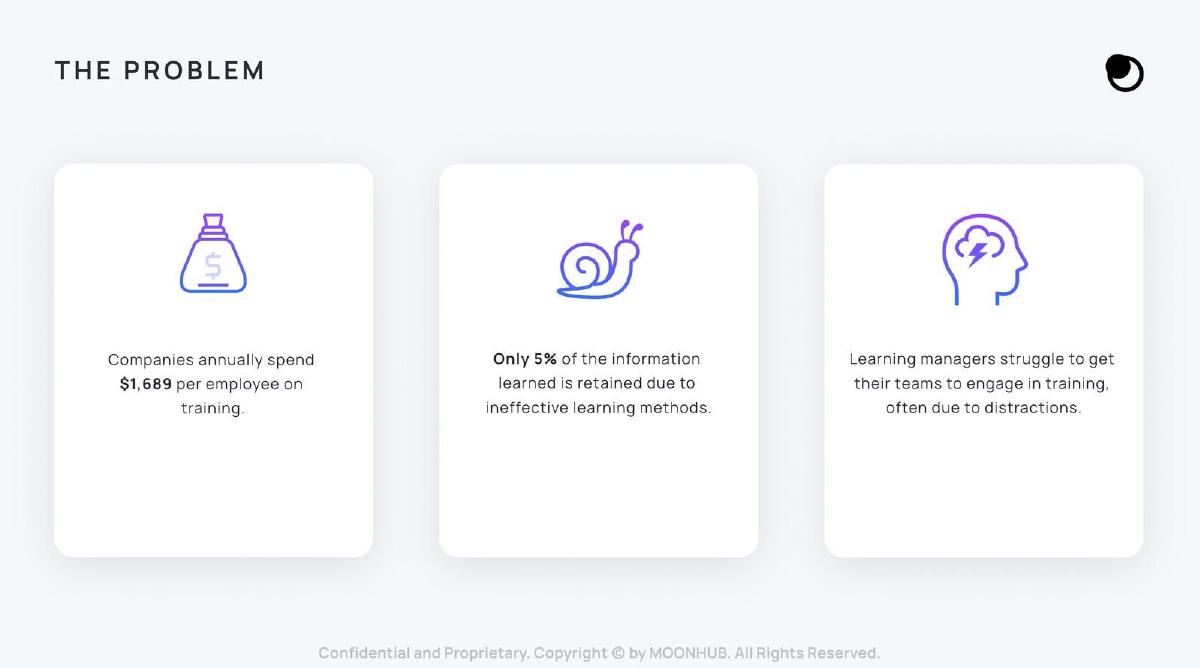
- The deck lacks a traditional 'Problem' slide that details the specific pain points of current e-learning. It also omits a 'Competitor' matrix and, most importantly, a 'Use of Funds' slide. While we know from external reports that they raised $1.4M, the deck itself does not state the target amount.