Mosaic’s pitch deck is a masterclass in framing a traditional industry problem—stagnant construction productivity—as a software engineering challenge. The company identifies a 50% drop in construction labor productivity since 1950 (Slide 3) and proposes a 'full-stack' solution: a programming language called 'Dog' that automates planning and generates field instructions (Slides 6-8). Unlike SaaS companies, Mosaic operates as a tech-enabled subcontractor, capturing value directly from the $203 billion US residential market (Slide 12). While the deck heavily redacts its specific financial tracti…
Key takeaways
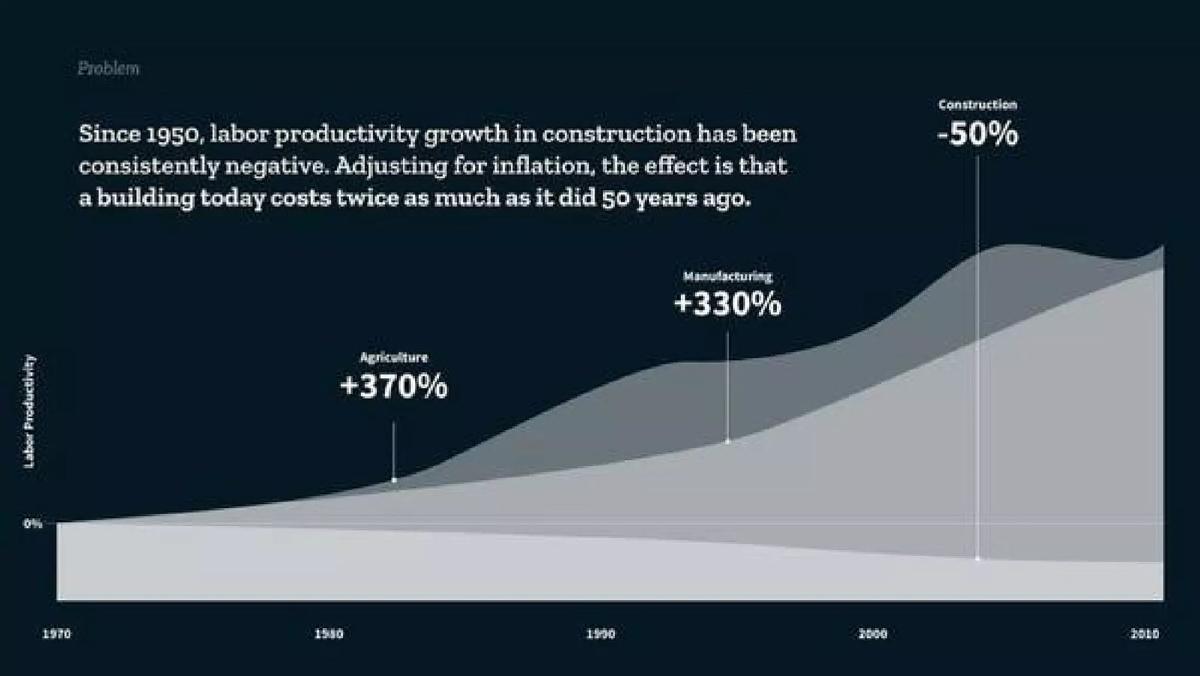
- Construction labor productivity has declined by 50% since 1950, while manufacturing has increased by 330% (Slide 3).
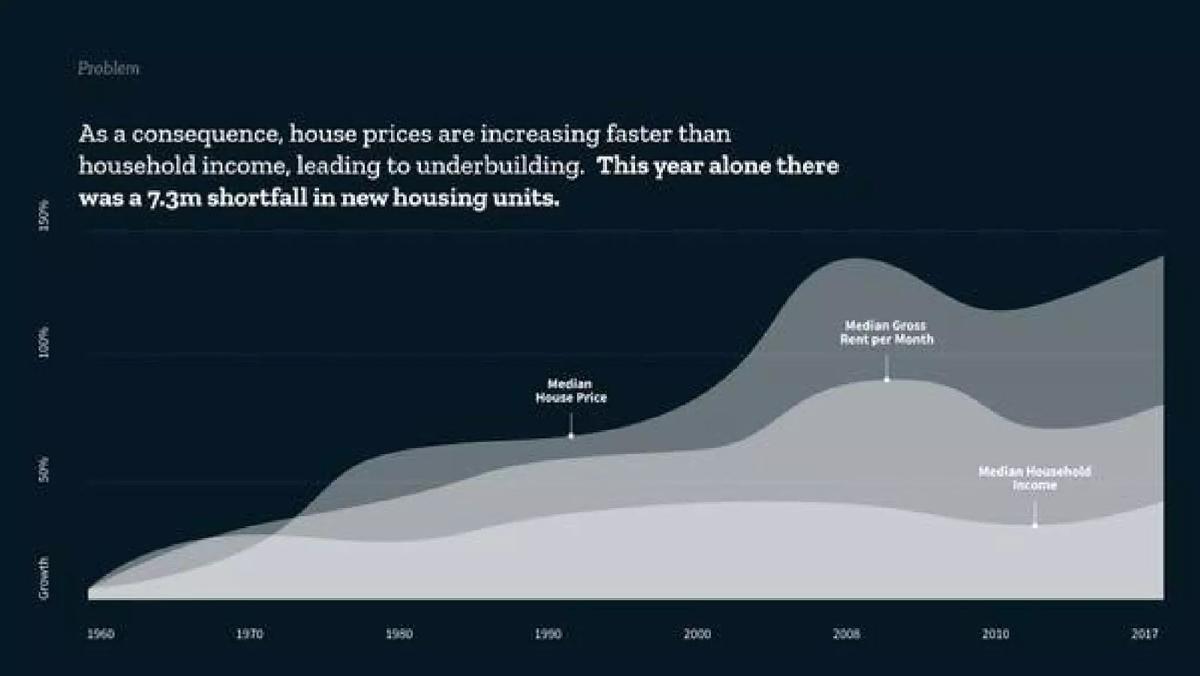
- The company identifies a 7.3 million unit shortfall in new housing due to rising costs outstripping household income (Slide 4).
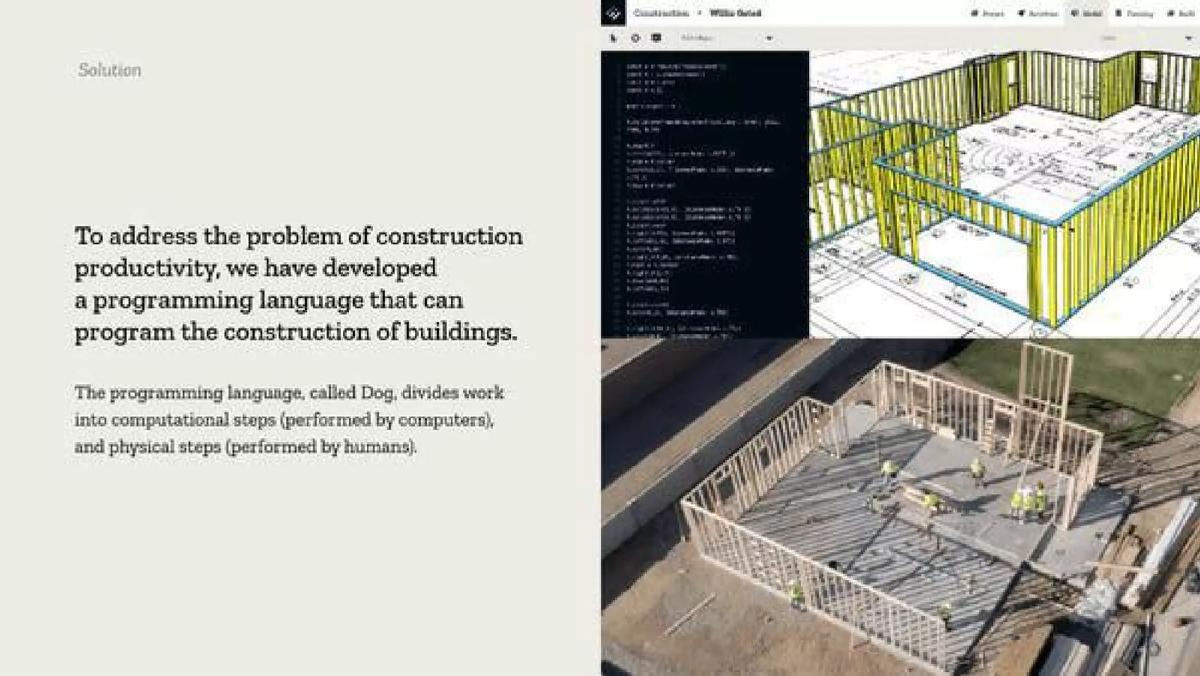
- Mosaic's core innovation is 'Dog,' a programming language that divides work into computational and physical steps (Slide 6).
- The business model is a B2B service, acting as a general or subcontractor rather than a software vendor (Slide 13).
- Mosaic targets a fragmented market where 58% of homes are built by over 16,000 small builders (Slide 12).
- The company maintains a low CapEx profile, with 54% of capital expenditure dedicated to construction equipment (Slide 14).
- Arizona is the primary focus market, specifically the Phoenix, Mesa, and Scottsdale areas (Slide 20).
- Expansion strategy is data-driven, targeting 'Sun Belt' markets with high single-family permit volumes (Slide 21).
The Macro Problem: A Productivity Crisis
Slides 1-5: Setting the Stage
Mosaic opens with a stark visual representation of the construction industry's failure to modernize. Slide 3 is the emotional and logical anchor of the deck, showing that while agriculture and manufacturing productivity have skyrocketed by 370% and 330% respectively since 1950, construction productivity has actually decreased by 50% . This is a powerful 'why now' slide that justifies the need for a radical new approach.
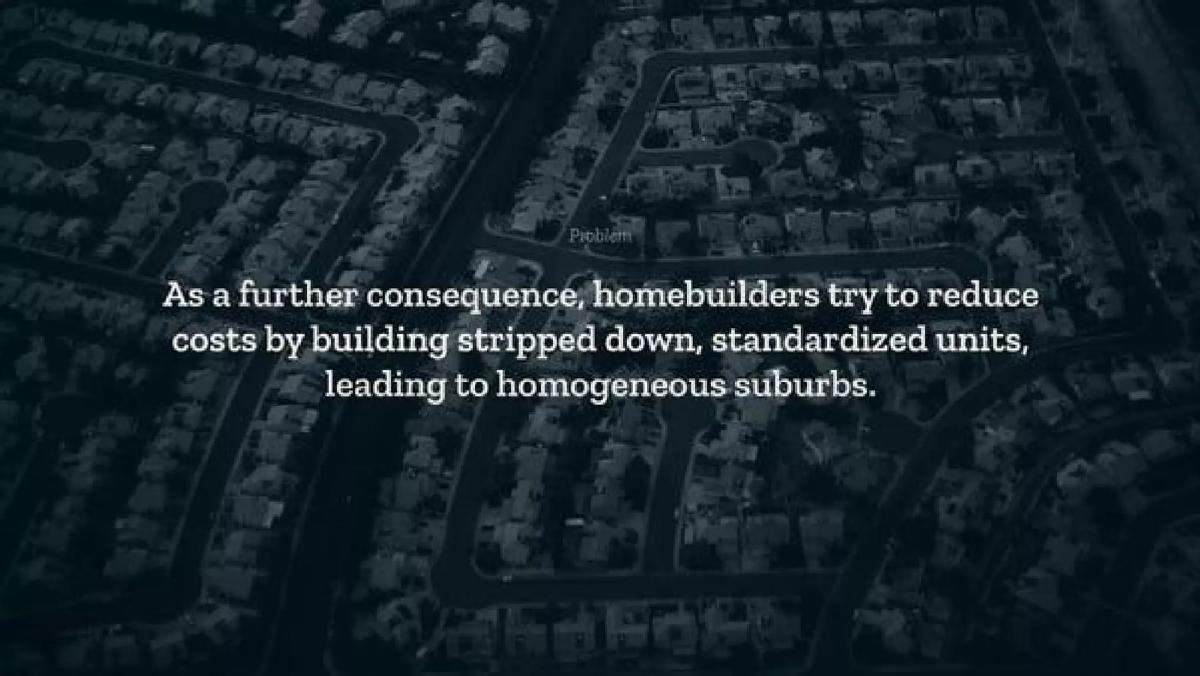
Slide 4 connects this productivity drop to the broader housing crisis. It cites a 7.3 million unit shortfall in new housing units, noting that house prices are rising faster than household income. The narrative concludes on Slide 5 by pointing out the aesthetic cost: homebuilders reduce costs by building 'stripped down, standardized units,' leading to 'homogeneous suburbs.' This sets up Mosaic not just as a cost-saver, but as a restorer of architectural variety.
The Solution: Software as a Builder
Slides 6-11: Introducing 'Dog'
The core of Mosaic’s pitch is the transition from the problem to a highly technical solution. Slide 6 introduces 'Dog,' a programming language for buildings. This is a unique framing; most construction tech startups pitch 'project management software,' but Mosaic pitches a fundamental re-architecture of how work is defined. They divide construction into computational steps (for computers) and physical steps (for humans).
Slides 7 and 8 illustrate the application of this language. It isn't just for blueprints; it automates purchasing, supply chain management, and quality control. Crucially, Slide 8 shows how the software generates 'specific instructions for homebuilding crews,' which suggests a way to utilize a less-skilled labor pool or make the existing workforce significantly faster. Slides 9 and 10 are largely placeholders for visual proof of speed and waste reduction, though the specific data points are omitted in this version of the deck.
Slide 12: The Market Opportunity
Mosaic identifies a massive, fragmented market on Slide 12 . They value the US residential homebuilder market at over $203 billion in revenue (as of 2018). The key insight here is the fragmentation: 58% of homes are built by more than 16,000 builders. This suggests that Mosaic doesn't need to win over a few giants to succeed; there is a massive 'long tail' of smaller builders who lack the resources to build their own tech stacks and would benefit from a tech-enabled subcontractor.
Business Model and Operations
Slides 13-16: The 'Full-Stack' Approach
Slide 13 contains a vital distinction: 'Mosaic operates as a general or subcontractor... We are not selling software.' This is a 'full-stack' startup strategy. By performing the work rather than selling the tool, Mosaic avoids the difficult 'sales to builders' cycle and instead captures the much larger budgets allocated to construction services. Slide 14 addresses the 'CapEx' elephant in the room. They argue for 'Low Capital Risk' and 'High Liquidity,' showing a pie chart where 54% of CapEx is construction equipment and 42% is vehicles—assets that have high resale value compared to specialized factory hardware.
Slide 15 defines their revenue terminology, distinguishing between 'Bookings' (signed contracts) and 'Pipeline' (qualified opportunities). This sets the stage for the growth slides, although the actual numbers on Slides 17 and 18 are redacted. The intent, however, is clear: to show a 'doubling of contracted revenue year over year.'
Competitive Landscape and Expansion
Slides 19-21: Strategic Positioning
Slide 19 is a competitive matrix comparing Mosaic to public homebuilders, infill developers, pre-fab, and traditional contractors. Mosaic claims the unique intersection of being Efficient, Scalable, Customizable, Capital Light, and Design Focused . Their biggest jab is at 'Pre-fab' companies, which they label as high-CapEx and design-constrained.
The deck concludes with a geographic focus. Slide 20 explains why Arizona is the starting point, citing its status as the 4th fastest-growing state in terms of jobs. Slide 21 maps out the expansion into the 'Sun Belt,' targeting markets like Dallas, Houston, and Atlanta based on single-family permit volumes. This shows a disciplined, data-driven approach to scaling a physical business.
What Works in the Mosaic Deck
The 'Dog' Metaphor: Framing construction instructions as a programming language is a brilliant way to appeal to Silicon Valley investors. It suggests that construction can be 'compiled' and 'debugged' like software. · Direct Problem-Solution Link: The transition from the productivity decline (Slide 3) to the automation solution (Slide 7) is seamless and logical. · Full-Stack Clarity: Being explicit about NOT being a software company (Slide 13) prevents confusion about their business model and sales cycle. · Asset-Light Argument: By showing that their capital is tied up in liquid assets like trucks and equipment (Slide 14), they mitigate the fear of 'heavy' construction investments.
What is Missing from the Mosaic Deck
Unit Economics: There is no mention of the margin profile. While they claim to be 'efficient,' the deck doesn't show the gross margin of a Mosaic-built home versus a traditional one. · The Team Slide: This version of the deck lacks a team slide. In a 'full-stack' play, the mix of software engineering talent and construction operational experience is a critical 'must-see' for investors. · The Ask: There is no slide detailing how much capital is being raised or how it will be allocated (e.g., R&D vs. fleet expansion). · Case Studies: While they mention 'Timber Sky' in Flagstaff (Slide 11), the deck lacks specific 'before and after' data on a completed project to prove the speed and waste claims.
What a Founder Should Copy
The Macro-Trend Slide: Slide 3 is a perfect example of how to use historical data to create a sense of urgency. Every founder should have a 'productivity gap' or 'market failure' slide this clear. · Standardizing the Process, Not the Product: The argument on Slide 11—that technology should allow for more diversity in output, not less—is a great way to counter the 'automation leads to boring products' narrative. · Geographic Focus: Instead of saying 'we are going national,' Slide 20 shows a deep understanding of why a specific local market is the right place to start. This builds confidence in the operational plan. · Clear Definitions: Slide 15 defines exactly what 'Bookings' means for their specific business. This prevents misunderstandings during the due diligence process.
Frequently asked questions
- What is Mosaic's 'Dog' programming language?
- According to Slide 6, 'Dog' is a proprietary programming language designed to 'program the construction of buildings.' It functions by breaking down the complex process of homebuilding into discrete computational steps for computers and physical steps for human workers. It generates specific instructions for crews across different trades, effectively acting as the operating system for the job site to ensure speed and reduce waste.
- How does Mosaic make money?
- Mosaic explicitly states on Slide 13 that they are not a software company. Instead, they operate as a tech-enabled B2B service provider, taking on the role of a general contractor or subcontractor for homebuilders. This allows them to capture revenue from the actual construction spend rather than just charging a software licensing fee, positioning them deeper in the value chain.
- Why did Mosaic choose Arizona as its initial market?
- Slide 20 outlines that Arizona, particularly the Phoenix MSA, has one of the strongest single-family residential markets in the US. The deck cites factors such as being the 14th largest state, high population growth (capturing 6% of US growth), and a business-friendly environment with low regulatory hurdles. This concentration allows them to prove their model in a high-demand, high-volume environment.
- What is the competitive advantage over pre-fab housing?
- On Slide 19, Mosaic notes that pre-fab and modular companies are typically 'high cap ex' and constrained by building design. Mosaic claims a 'Design Focus' and 'Customizability' advantage because their software standardizes the *process* rather than the *product*. This allows them to build diverse communities rather than the homogenous suburbs typically associated with standardized construction methods.
- What are the biggest risks identified in the deck?
- While the deck highlights 'Low Capital Risk' on Slide 14, the primary operational risk is the reliance on the 'existing workforce' to adopt new technology (Slide 8). Additionally, as a tech-enabled service provider, they are subject to the same labor shortages and material constraints as traditional builders, though they argue their efficiency mitigates these effects.