Wasabi’s 2020 investor presentation is a clinical exercise in competitive positioning. The company identifies a massive, growing market—global cloud storage, valued at $57 billion in 2019 (Slide 6)—and attacks the incumbent, Amazon S3, on two primary fronts: price and performance. By offering storage at $.0059/GB/month compared to S3’s $.023/GB/month (Slide 3), Wasabi positions itself as the high-performance, low-cost alternative. The deck leans heavily on the pedigree of its founders, David Friend and Jeff Flowers, who previously built and sold Carbonite for $1.4 billion (Slide 2). With a cl…
Key takeaways
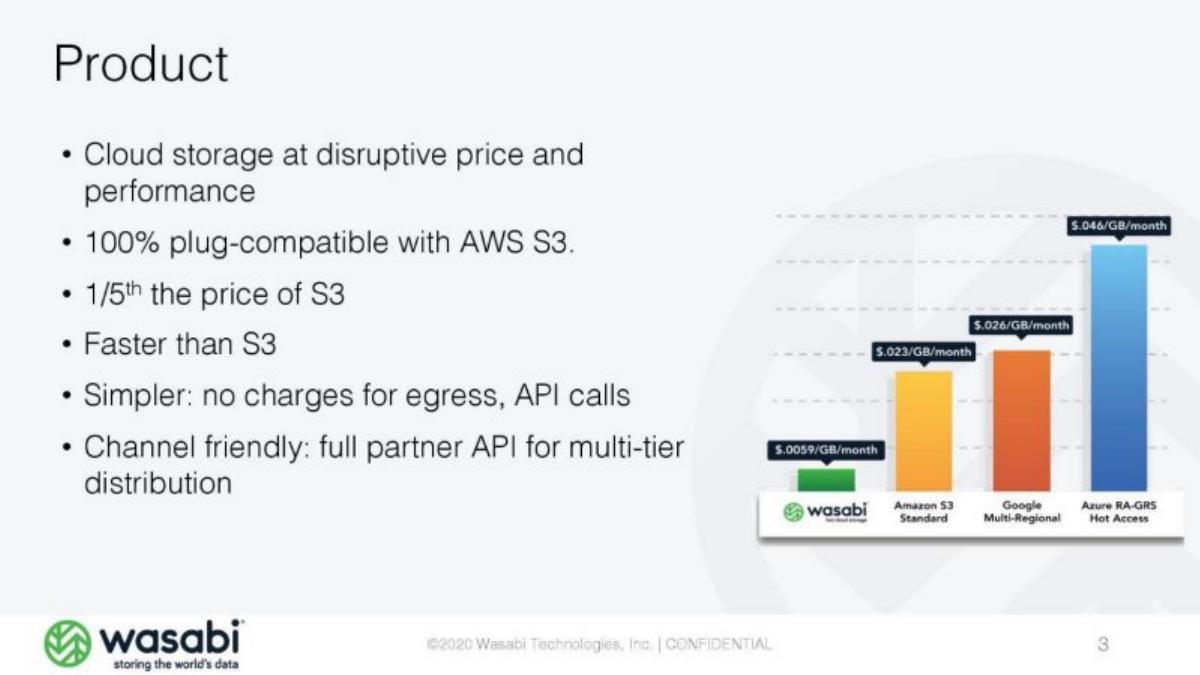
- Wasabi positions itself as 1/5th the price of Amazon S3, charging $.0059/GB/month versus $.023/GB/month (Slide 3).
- The company eliminates egress and API call charges, which they claim can often double the costs of using Amazon S3 (Slide 7).
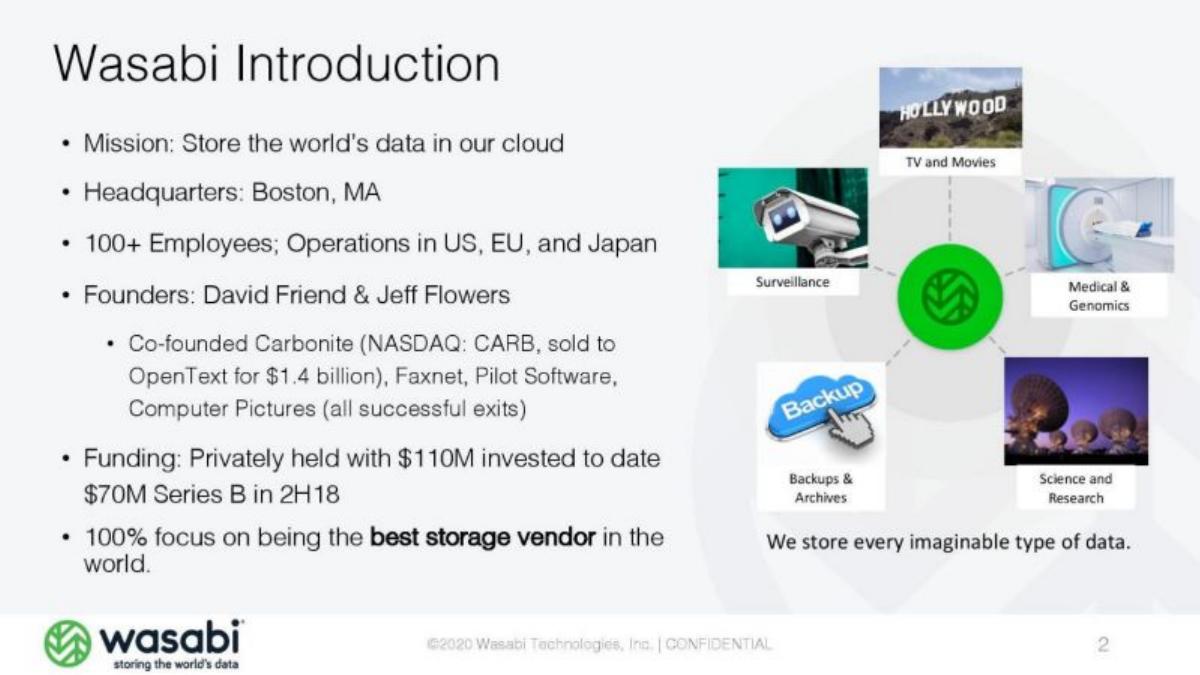
- Founders David Friend and Jeff Flowers bring significant credibility, having co-founded Carbonite, which sold for $1.4 billion (Slide 2).
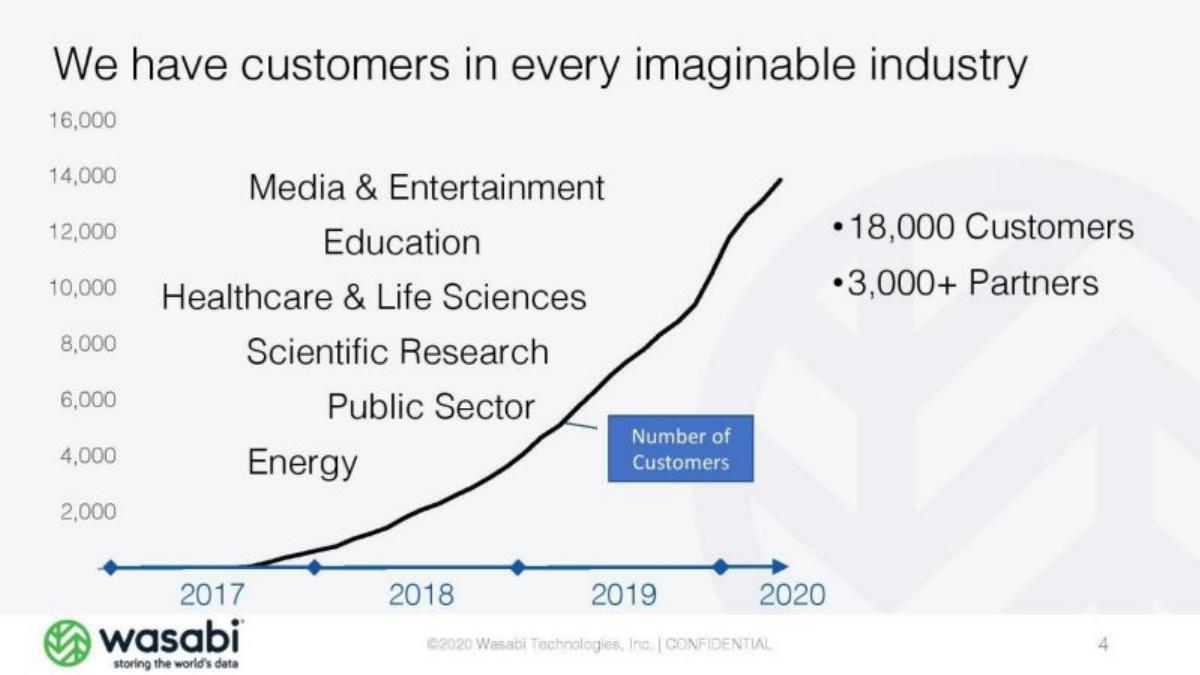
- The growth trajectory is steep, moving from near zero in 2017 to 18,000 customers and 3,000+ partners by 2020 (Slide 4).
- A core strategic pillar is the channel partner model, which accounts for 45% of revenue and 100% of revenue in Europe and Japan (Slide 8).
- Wasabi uses 'Reserved Capacity Storage' (RCS) to compete directly with hardware vendors like NetApp and Dell EMC, often pricing 5 years of storage lower than just the maintenance costs of hardware (Slide 11).
- The deck explicitly addresses the 'Amazon threat,' arguing that Amazon would have to sacrifice $5 billion in revenue to match Wasabi's pricing (Slide 14).
- The technical advantage is attributed to a patented, purpose-built distributed file system that allows for higher disk utilization and lower operating costs (Slide 13).
Wasabi Pitch Deck Teardown: Disrupting the Cloud Giants
Wasabi’s 2020 investor presentation is a masterclass in how to position a startup against the most formidable incumbents in technology. By the time this deck was circulated, Wasabi had already raised $110 million and was seeking a Series B to fuel what they described as a "land grab" in the cloud storage market. The deck is characterized by its aggressive tone, clear value proposition, and heavy reliance on founder pedigree.
Slide 1-2: The Mission and The Pedigree
The presentation opens with a simple, bold mission: "Storing the World’s Data." Slide 2 serves as a high-level introduction that immediately establishes credibility. It lists the headquarters in Boston, a headcount of 100+ employees, and operations spanning the US, EU, and Japan. However, the most critical element on this slide is the mention of founders David Friend and Jeff Flowers. Their track record—specifically co-founding Carbonite and selling it for $1.4 billion—is a powerful signal to investors that this team knows how to build and exit a storage company. The slide also notes that $110M has been invested to date, including a $70M Series B in the second half of 2018.
Slide 3-4: The Product and Traction
Slide 3 introduces the core product value proposition: "Cloud storage at disruptive price and performance." It highlights that Wasabi is 100% plug-compatible with AWS S3 but at 1/5th the price. A bar chart visually reinforces this, showing Wasabi at $.0059/GB/month compared to Amazon S3 Standard at $.023, Google Multi-Regional at $.026, and Azure at $.046. Slide 4 provides the evidence that this pricing is working. A steep growth curve shows the customer count rising from near zero in 2017 to 18,000 by 2020, supported by over 3,000 partners. This slide effectively demonstrates product-market fit through rapid adoption across diverse industries like Media, Education, and Healthcare.
Slide 5-6: Leadership and Market Opportunity
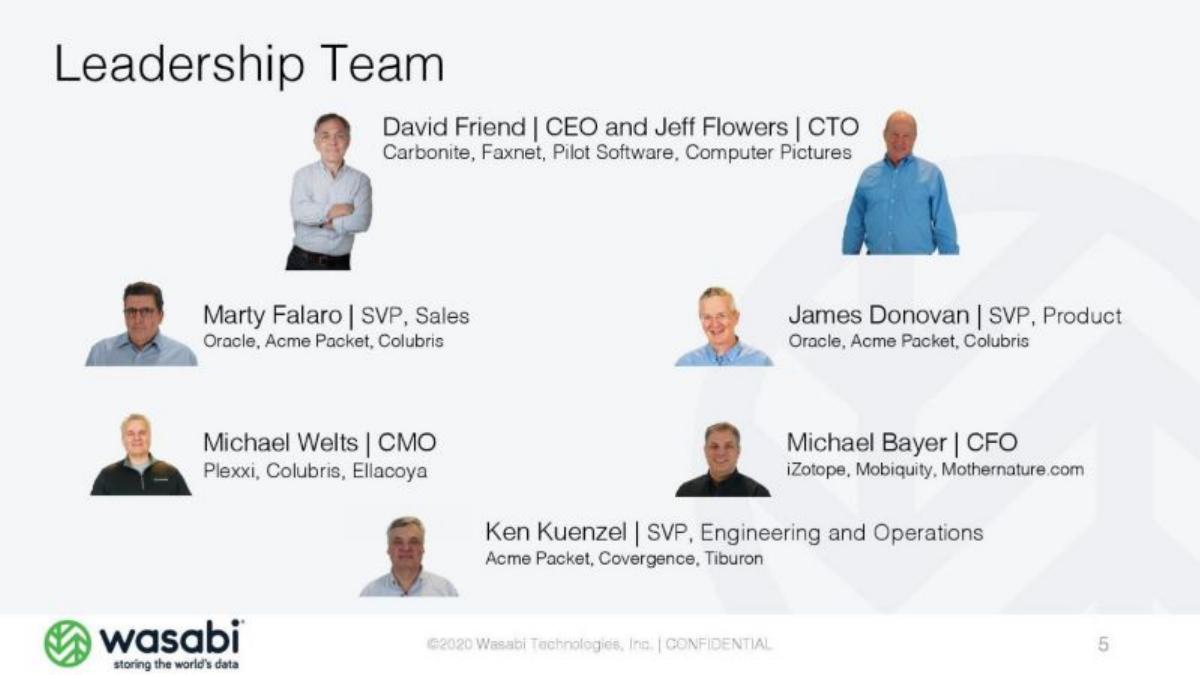
Slide 5 provides headshots and brief bios for the leadership team, emphasizing their experience at companies like Oracle, Acme Packet, and iZotope. This reinforces the "safe pair of hands" narrative. Slide 6 pivots to the market opportunity, citing Gartner data that the global cloud storage market was $57 billion in 2019 with a 27.5% ACGR. It makes a staggering claim: with worldwide data expected to grow to 175 zettabytes by 2025, Wasabi’s pricing model represents a $12 trillion market opportunity. The slide frames the current era as a "once-in-a-generation opportunity" as enterprises migrate from on-premises storage to the cloud.
Slide 7-9: Competitive Advantages and Go-To-Market
Slide 7 dives deeper into the "Price and performance wins." Beyond the base storage cost, it emphasizes the lack of egress or API charges, which can often double a customer's bill on S3. It also claims Wasabi is faster than S3 while maintaining the same "11 nines" of durability. Slide 8 outlines the Go-To-Market strategy, which is heavily focused on the channel. With 45% of revenue coming from partners (and 100% in international markets), Wasabi is positioning itself as the preferred partner for MSPs and VARs who are moving away from hardware sales. Slide 9 showcases the brand's marketing collateral, which consistently hammers home the "1/5th the cost" and "no egress fees" messaging.
Slide 10-11: Competing with Hardware
One of the most interesting sections of the deck is Slides 10 and 11, which focus on "Reserved Capacity Storage" (RCS). Wasabi isn't just competing with other cloud providers; they are attacking the traditional hardware market. Slide 11 provides a direct cost comparison against NetApp, Dell EMC, and Cloudian. For 100 TB over 5 years, Wasabi’s price of $38,456 is shown to be significantly lower than NetApp’s $246,483. The deck notes that Wasabi’s pricing is often lower than just the maintenance costs of physical hardware, providing a compelling financial reason for IT managers to switch.
Slide 12-13: Technical Capabilities and Cost Structure
Slide 12 lists features that "IT Managers Dream About," such as replication to the core, "bottomless" local storage, and local caching. This addresses the technical requirements of enterprise clients. Slide 13 answers the inevitable question: "How can we be so much cheaper?" The company points to its patented, purpose-built distributed file system. By achieving higher disk utilization and density, and using techniques to extend disk drive life, Wasabi claims to have fundamentally lower operating and capital costs than competitors burdened by legacy infrastructure.
Slide 14-15: The Competitive Moat and Strategy Summary
Slide 14 addresses the "Amazon threat" head-on. It argues that Amazon cannot easily drop prices because it would cannibalize billions in existing revenue. It also claims that building cloud storage at scale is difficult, and Wasabi’s first-mover advantage in the channel creates a significant barrier to entry for new competitors. Slide 15 summarizes the strategy as a "land grab," emphasizing the need to scale fast, lock up channel partners, and build a brand as the "trusted, always-the-best-value" cloud storage provider.
Slide 16-18: Conclusion and Contact
The deck concludes on Slide 16 with a confident "There’s no stopping us now" and contact information for CEO David Friend. Slide 17 and 18 are promotional slides for the platform where the deck was hosted and do not contain company-specific information.
What Works in the Wasabi Deck
The Founder-Market Fit: The deck does an excellent job of leveraging the founders' past success. In a capital-intensive industry like cloud storage, investors need to know the team has the experience to manage large-scale operations and navigate complex exits. Mentioning the $1.4 billion Carbonite sale early is a strategic masterstroke.
The Clear Value Proposition: The "1/5th the price of S3" and "No Egress Fees" messaging is consistent throughout the deck. It is easy to understand, easy to verify, and addresses a major pain point for cloud customers. The visual comparisons against AWS, Azure, and Google (Slide 3 and 7) make the advantage undeniable.
The Channel Strategy: By showing that 45% of revenue comes from the channel (Slide 8), Wasabi demonstrates a scalable, capital-efficient way to acquire customers. This proves they aren't just relying on direct sales, which would be difficult against the marketing budgets of the Big Three cloud providers.
What is Missing from the Wasabi Deck
Unit Economics: While the deck explains why they are cheaper (Slide 13), it lacks specific unit economics. Investors would likely want to see the gross margins on that $.0059/GB/month price point to ensure the business is sustainable and not just a race to the bottom.
Churn and Retention Metrics: The growth curve on Slide 4 is impressive, but there is no mention of net revenue retention (NRR) or churn rates. In a commodity business, keeping customers is just as important as acquiring them, and the deck stays silent on these critical SaaS metrics.
The Ask: Surprisingly, the deck does not include a specific "Ask" slide. While the catalogue facts state this was for a $30M Series B, the slides themselves do not detail how much they are raising or how the funds will be allocated (e.g., R&D vs. Sales vs. Infrastructure).
What Founders Should Copy
Direct Competitive Positioning: Don't be afraid to name your competitors and show exactly how you beat them on price or performance. Wasabi’s use of bar charts to compare themselves to AWS and Azure is a highly effective way to communicate a competitive advantage.
Addressing the Elephant in the Room: Every investor will ask, "What if Amazon/Google/Microsoft does this?" Wasabi addresses this proactively on Slide 14 by explaining the economic disincentives for incumbents to match their pricing. This shows strategic depth and foresight.
Visualizing the Market Shift: Slide 6 and Slide 10 effectively frame the business not just as a better cloud tool, but as a beneficiary of a massive, inevitable shift from on-prem hardware to the cloud. Framing your startup as part of a "once-in-a-generation" trend helps create a sense of urgency for investors.
Frequently asked questions
- How does Wasabi justify its significantly lower pricing compared to Amazon S3?
- Wasabi attributes its lower costs to a patented, purpose-built distributed file system designed for higher disk utilization and density (Slide 13). By optimizing for I/O and extending disk drive life, they claim to have lower operating and capital costs. Furthermore, they argue that as a pure-play storage provider without legacy infrastructure limitations, they can operate more efficiently than diversified giants like Amazon.
- What is Wasabi's strategy for competing with traditional on-premises hardware?
- Wasabi uses a 'Reserved Capacity Storage' (RCS) model, which allows customers to buy cloud storage in a way that mimics hardware procurement (Slide 10). They present data showing that 100 TB of storage for 5 years costs $38,456 with Wasabi, compared to $246,483 for a NetApp solution, making the cloud option significantly cheaper even when including premium support (Slide 11).
- Who are the key people leading Wasabi, and what is their track record?
- The leadership team is anchored by CEO David Friend and CTO Jeff Flowers, who co-founded Carbonite (sold for $1.4 billion) and several other successful ventures including Faxnet and Pilot Software (Slide 5). The broader executive team includes veterans from Oracle, Acme Packet, and iZotope, providing a deep bench of experience in sales, engineering, and finance.
- How does Wasabi handle the risk of Amazon dropping prices to compete?
- Wasabi argues that Amazon is unlikely to drop S3 prices because it would require wiping nearly $5 billion off their existing $6 billion storage revenue line to match Wasabi's rates (Slide 14). They believe Amazon won't care about Wasabi until they are much larger, by which time Wasabi hopes to have secured the market through aggressive channel partnerships.
- What role do channel partners play in Wasabi's go-to-market strategy?
- Channel partners are central to Wasabi's growth, representing 45% of total revenue and 100% in international markets like Europe and Japan (Slide 8). They target Managed Service Providers (MSPs), Cloud Service Providers (CSPs), and Value-Added Resellers (VARs) who are transitioning from selling hardware to selling cloud services, offering them a simpler and more profitable alternative to other vendors.