The Flipkart Group investor presentation is a masterclass in justifying a high-premium acquisition through macro-economic tailwinds and ecosystem dominance. Rather than focusing on immediate profitability, the deck emphasizes India's status as the '2nd largest internet market globally' (Slide 7) and Flipkart's #1 position in high-growth categories like Fashion, Mobile, and Large Appliances (Slide 11). By framing Flipkart not just as a retailer but as an ecosystem including logistics (Ekart) and payments (PhonePe), Walmart illustrates a comprehensive 'eCommerce transformation' (Slide 9). The d…
Key takeaways
- India is positioned as a critical growth market with a 9.4% GDP CAGR over the previous 10 years (Slide 7).
- The deck highlights a massive demographic opportunity with 443 million Millennials and Gen Z individuals, representing 66% of India's population (Slide 7).
- Flipkart is presented as an 'ecosystem' rather than a single app, featuring Ekart for logistics (500k daily deliveries) and PhonePe for payments (Slide 9).
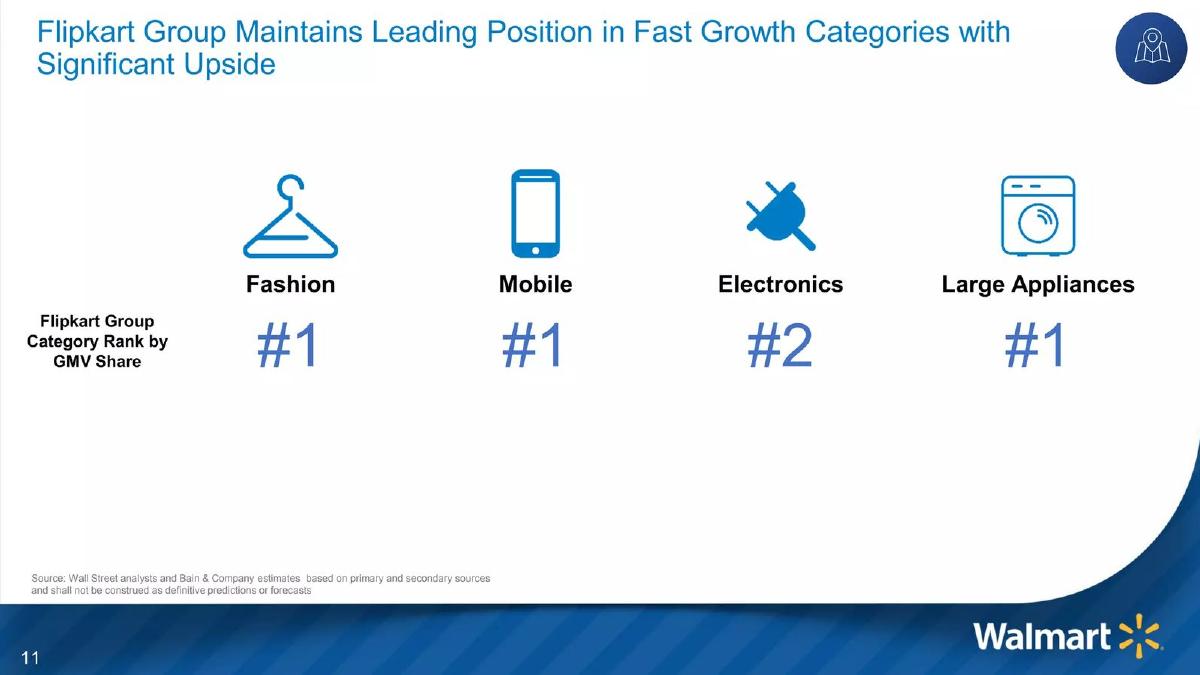
- Market dominance is quantified by GMV share, where Flipkart holds the #1 spot in Fashion, Mobile, and Large Appliances, and #2 in Electronics (Slide 11).
- The acquisition is framed within Walmart's broader international strategy of 'Active portfolio management' alongside other key growth markets like China (Slide 5).
- Strategic partnerships are emphasized by showcasing co-investors Tencent, Tiger Global, and Microsoft to validate the asset's quality (Slide 13).
- Mobile connectivity is a core thesis, noting that 79% of India's internet traffic is mobile, significantly higher than the 50% global average (Slide 7).
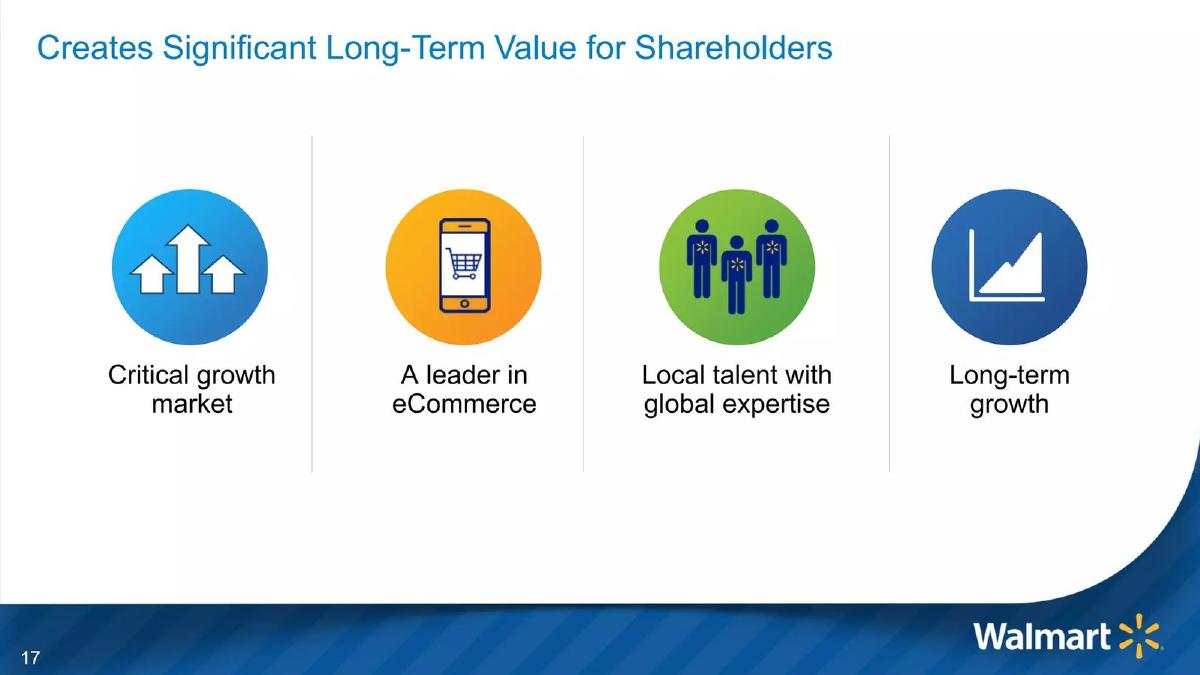
- The presentation concludes by summarizing the deal's value drivers: critical growth market, eCommerce leadership, local talent, and long-term growth (Slide 17).
Introduction: The Strategic Rationale for a $16 Billion Bet
The Walmart-Flipkart Group Investor Presentation, dated May 9, 2018, is a document designed to communicate the strategic necessity of one of the largest acquisitions in retail history. At the time, Walmart was facing pressure to find growth outside of its saturated North American core. This deck represents the narrative used to convince the market that paying $16 billion for a majority stake in an unprofitable Indian eCommerce company was not just a luxury, but a requirement for future survival.
Slide 1: Title and Branding
The cover slide establishes the joint identity of the two companies. It features a high-resolution image of a consumer using a mobile device, which sets the theme for the entire presentation: mobile-centric commerce in an emerging market. The date, May 9, 2018, marks the official announcement of the deal.
Slide 3: Strategy Transition
Slide 3 is a simple transition slide titled Strategy . It uses imagery of an Indian consumer, reinforcing the demographic focus of the acquisition. In large-scale M&A decks, these transition slides serve to pace the narrative, moving from the 'what' to the 'why.'
Slide 5: International Portfolio Management
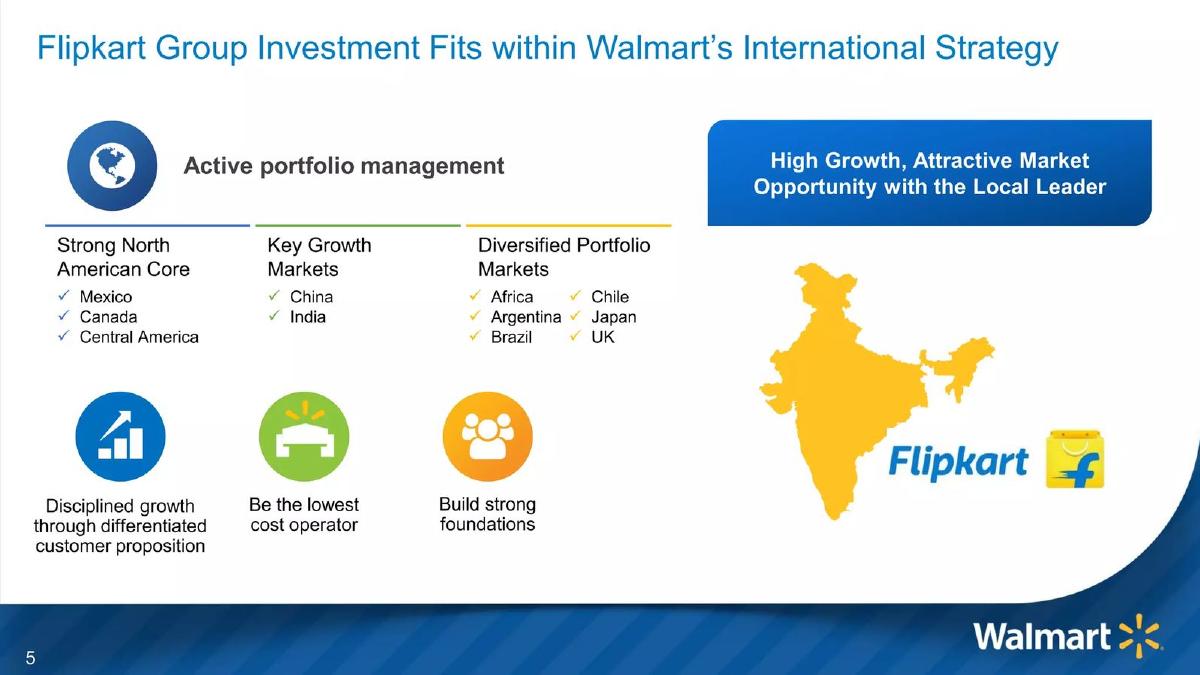
This slide, titled Flipkart Group Investment Fits within Walmart’s International Strategy , is crucial for context. It categorizes Walmart's global presence into three buckets: Strong North American Core (Mexico, Canada, Central America), Key Growth Markets (China, India), and Diversified Portfolio Markets (Africa, Argentina, Brazil, Chile, Japan, UK). By placing India in the 'Key Growth' category, Walmart justifies the capital allocation. The slide explicitly states the goal is High Growth, Attractive Market Opportunity with the Local Leader . It also lists three strategic pillars: disciplined growth, being the lowest cost operator, and building strong foundations.
Slide 7: The Macro-Economic Thesis
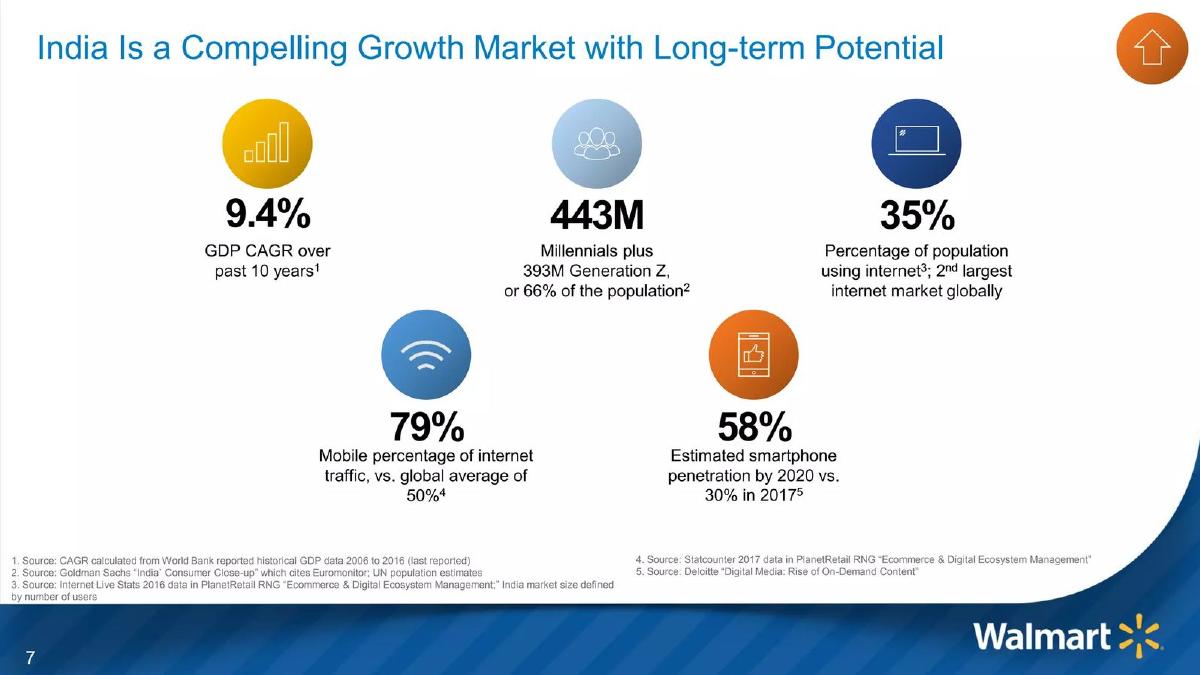
Slide 7, India Is a Compelling Growth Market with Long-term Potential , provides the data-heavy justification for the deal. It cites five key metrics:
9.4% GDP CAGR over the past 10 years. · 443M Millennials and Gen Z , making up 66% of the population. · 35% Internet Penetration , noting India is the 2nd largest internet market globally. · 79% Mobile percentage of internet traffic , compared to a 50% global average. · 58% Estimated smartphone penetration by 2020 , up from 30% in 2017.
This slide is designed to show that the market is at an inflection point, making it the right time for a massive entry.
Slide 9: The Flipkart Ecosystem
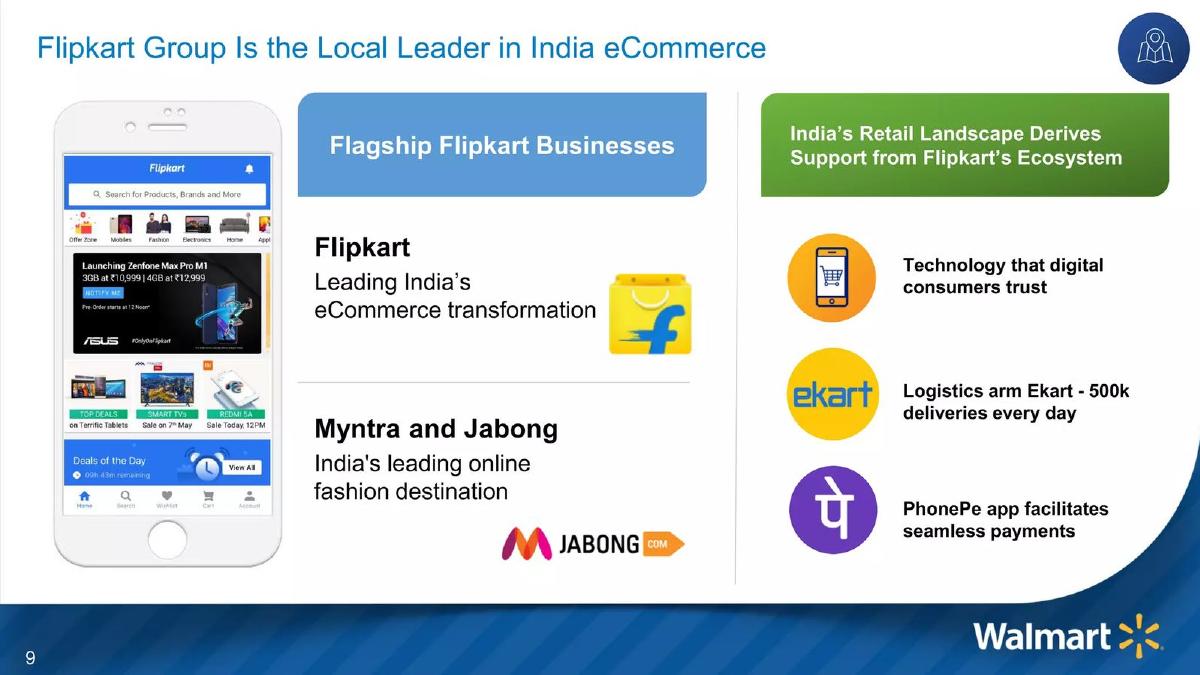
Titled Flipkart Group Is the Local Leader in India eCommerce , this slide moves from the market to the specific company. It highlights that Flipkart is not just a storefront but an integrated ecosystem. It lists:
Flipkart: The flagship eCommerce brand. · Myntra and Jabong: The leading online fashion destinations. · Ekart: The logistics arm handling 500,000 deliveries every day. · PhonePe: A payments app facilitating seamless transactions.
By highlighting logistics and payments, Walmart is pitching Flipkart as the 'Amazon + UPS + PayPal' of India, a much more valuable proposition than a simple retail site.
Slide 11: Market Dominance by Category
Slide 11 quantifies Flipkart's leadership. It shows the Flipkart Group Category Rank by GMV Share . The company claims the #1 spot in Fashion , Mobile , and Large Appliances , and the #2 spot in Electronics . This slide is intended to prove that Flipkart has already won the most important 'battleground' categories in retail, leaving competitors to fight for smaller niches.
Slide 13: The Power of Partnerships
Slide 13, Walmart Is Working with Strong Shareholder Partners , displays the logos of Walmart, Tencent, Tiger Global, and Microsoft . This is a classic 'social proof' slide. It signals to investors that Walmart is not acting alone and that other world-class technology and investment firms have vetted the asset and remain committed to its success.
Slide 15: Transaction Details
This is a transition slide titled Transaction Details and Guidance . While the specific financial mechanics are often detailed in the following pages of a full deck (which are not all present here), the inclusion of this section indicates that the presentation moved from strategic vision to the hard numbers of the $16 billion deal.
Slide 17: The Summary Conclusion
The final slide, Creates Significant Long-Term Value for Shareholders , summarizes the four pillars of the investment:
Critical growth market: Reiteration of the India opportunity. · A leader in eCommerce: Reiteration of Flipkart's #1 status. · Local talent with global expertise: A nod to the management team. · Long-term growth: The ultimate promise to Walmart shareholders.
What Works in This Deck
The deck is exceptionally strong at macro-narrative building . Instead of getting bogged down in the minutiae of Flipkart's quarterly losses (which were significant at the time), it focuses on the inevitability of the Indian market. By citing the 9.4% GDP CAGR and the massive youth population (Slide 7), Walmart makes the acquisition feel like a defensive necessity rather than a risky gamble. If India is the future of retail, Walmart must be there, and Flipkart is the only viable vehicle for that entry.
Another effective element is the ecosystem framing on Slide 9. By highlighting Ekart and PhonePe, the deck addresses the two biggest hurdles to eCommerce in India: logistics and trust in payments. Showing that Flipkart owns these solutions suggests a level of vertical integration that protects the investment from third-party failures.
What is Missing
The most glaring omission in these slides is profitability and unit economics . There is no mention of Customer Acquisition Cost (CAC), Lifetime Value (LTV), or a path to break-even. While this is common in high-growth M&A decks, the absence of these metrics highlights that this was a 'land grab' deal based on GMV (Gross Merchandise Volume) share rather than traditional earnings.
Additionally, there is no competitive analysis . While Slide 11 claims #1 and #2 rankings, it does not name the competitors (such as Amazon India). Acknowledging the strength of the competition and explaining why Flipkart's ecosystem is superior would have added more depth to the 'moat' argument.
What Founders Should Copy
Founders should study Slide 7 (Market Potential) . It doesn't just list a TAM (Total Addressable Market) number; it explains the behavioral shifts (mobile traffic, smartphone penetration) that make the market ready. When pitching a large market, don't just say it's big—show why it's changing in your favor.
Founders should also emulate the ecosystem approach on Slide 9. Even if your company is small, showing how your different product lines or services support each other to create a 'flywheel' is much more compelling than presenting a single-feature product. It demonstrates that you are building a platform, not just a tool.
Finally, the Strategic Fit slide (Slide 5) is a great template for any startup pitching to a strategic acquirer or a corporate VC. It shows that you understand the buyer's broader portfolio and how you fill a specific gap in their global or regional strategy.
Frequently asked questions
- What was the primary justification for the $16 billion price tag?
- The justification was based on market leadership in a high-growth geography. Slide 11 shows Flipkart holding the #1 GMV share in three major categories. By acquiring the 'Local Leader' (Slide 5) in a market where smartphone penetration was expected to jump from 30% to 58% in three years (Slide 7), Walmart argued the long-term growth outweighed the immediate transaction costs.
- How does the deck address competition?
- The deck largely ignores specific competitors by name, instead focusing on Flipkart's internal ecosystem. By highlighting Ekart's 500,000 daily deliveries and the PhonePe payment app on Slide 9, the presentation suggests that Flipkart has built a defensive moat through infrastructure and fintech that is difficult for rivals to replicate.
- What demographic data did Walmart use to sell this deal to investors?
- Walmart leaned heavily on India's youth and connectivity. Slide 7 cites that 66% of the population (443 million people) are Millennials or Gen Z. Furthermore, it points out that India is the 2nd largest internet market globally, with mobile traffic (79%) far outpacing the global average (50%), signaling a 'mobile-first' consumer base ready for eCommerce.
- Why are Microsoft and Tencent mentioned in the deck?
- Slide 13 lists Walmart, Tencent, Tiger Global, and Microsoft as 'Strong Shareholder Partners.' This is a social proof tactic. By showing that other global tech giants and sophisticated institutional investors are also backing Flipkart, Walmart reduces the perceived risk of the $16 billion investment for its own shareholders.
- Does the deck provide financial projections or unit economics?
- The provided slides do not include detailed unit economics, burn rates, or specific revenue figures. Instead, it uses 'GMV Share' rankings (Slide 11) and macro-economic indicators like GDP CAGR (Slide 7). The 'Transaction Details and Guidance' section (Slide 15) is a transition slide, suggesting that specific financial terms were likely handled in a separate, more restricted section of the full presentation.