Warlands entered the 2021 market with a pitch centered on the convergence of eSports and blockchain. The deck positions the company as a developer of a 'remunerative' 5vs5 competitive game that blends MOBA and Battle Royale mechanics. While the visual presentation is thematic and high-quality, the core of the deck is a highly granular (and speculative) economic model. It details 15 different monetization paths, from 'Scholarship Fees' to 'Immersive Ads,' projecting revenues based on theoretical Daily Active User (DAU) tiers. The deck is notable for its strategic acquisition of a Brazilian eSp…
Key takeaways
- The company identifies as a multidisciplinary team of 55 professionals with 8 years of experience in game development (Slide 5).
- Warlands claims to be the first '+AAA Hybrid Esports game' combining traditional gaming with NFT ecosystems (Slide 4).
- The product is a multiplatform (PC and Mobile) 5vs5 game mixing Battle Royale and MOBA genres (Slide 4).
- A core strategic move was the acquisition of 'Daikotsu,' an eSports club from Brazil, to launch a tokenized DAO (Slide 12).
- The economic model is exceptionally complex, listing 15 distinct revenue typologies including 'Ticket to Play' and 'Team Profit Share' (Slide 15).
- Revenue projections are tiered by DAU, ranging from 1,000 DAU (€16,500 daily) to 500,000 DAU (€8.25M daily) (Slide 16).
- The deck includes a detailed monthly expense breakdown of €340,620 to support 1,000 daily users (Slide 17).
- Tokenomics are defined by a fixed supply of 100,000,000 'Warlands Coins,' with 52% allocated to 'Play & Earn' (Slide 18).
Executive Summary and Mission
Slides 1-4: The Vision for Remunerative eSports
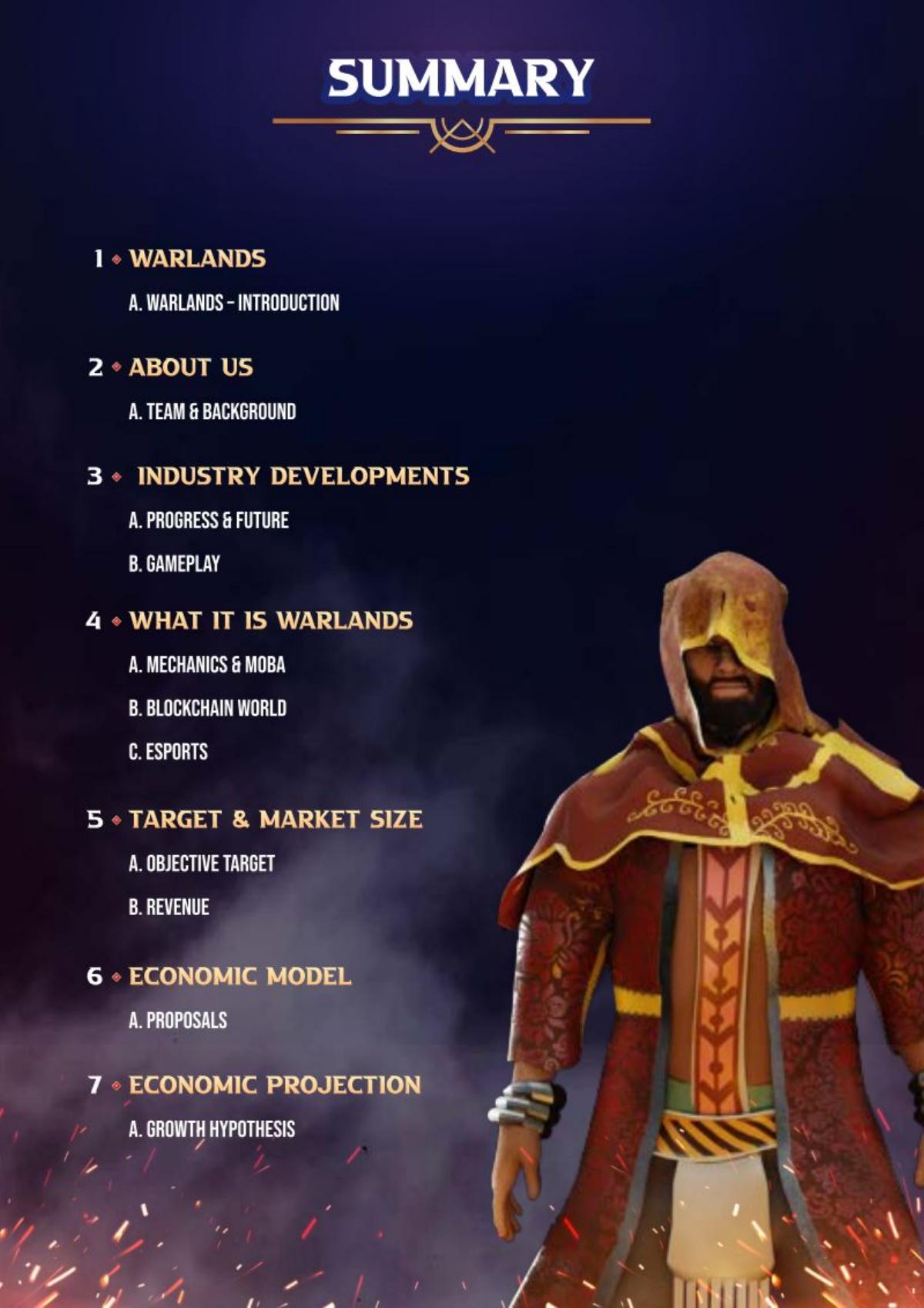
Warlands opens with a high-fantasy aesthetic, immediately establishing its brand as a gaming entity. The title slide (Slide 1) introduces the tagline: "The First Remunerative Esports Game." This sets the stage for a pitch that is as much about finance as it is about entertainment. The table of contents (Slides 2-3) suggests a standard flow, moving from team and industry trends to mechanics and economic projections.
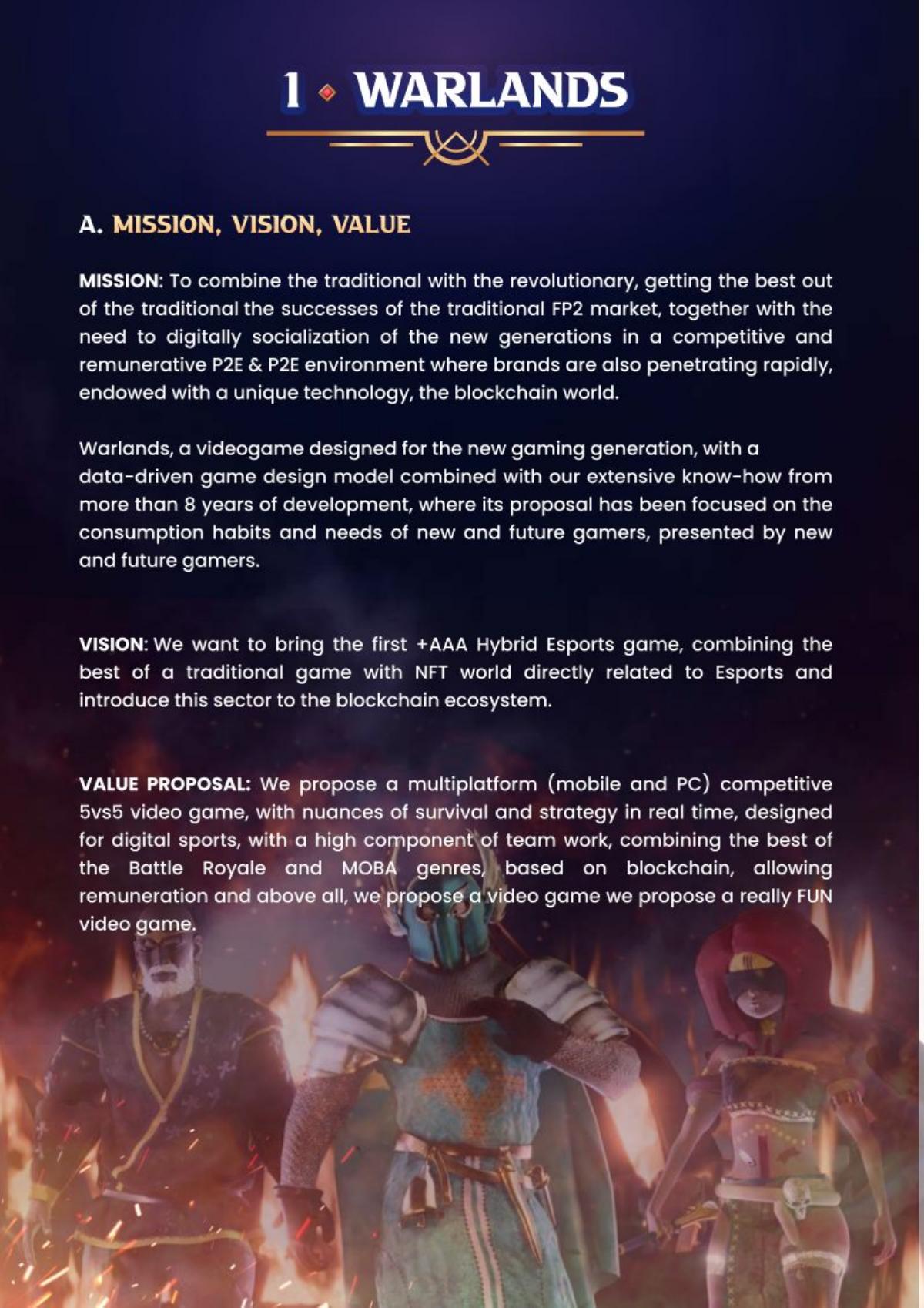
On Slide 4, the company defines its Mission, Vision, and Value Proposal. The mission is to combine "traditional FP2 [Free to Play] market" successes with "remunerative P2E" (Play-to-Earn) environments. Notably, the deck claims the team has "more than 8 years of development" experience. The vision is to deliver a "+AAA Hybrid Esports game." The value proposal specifically targets the 5vs5 competitive format, blending MOBA and Battle Royale genres. A key phrase here is the promise of a "really FUN video game," an implicit acknowledgement of the common criticism that P2E games often prioritize earning over gameplay.
Team and Market Context
Slides 5-7: Experience and Industry Evolution
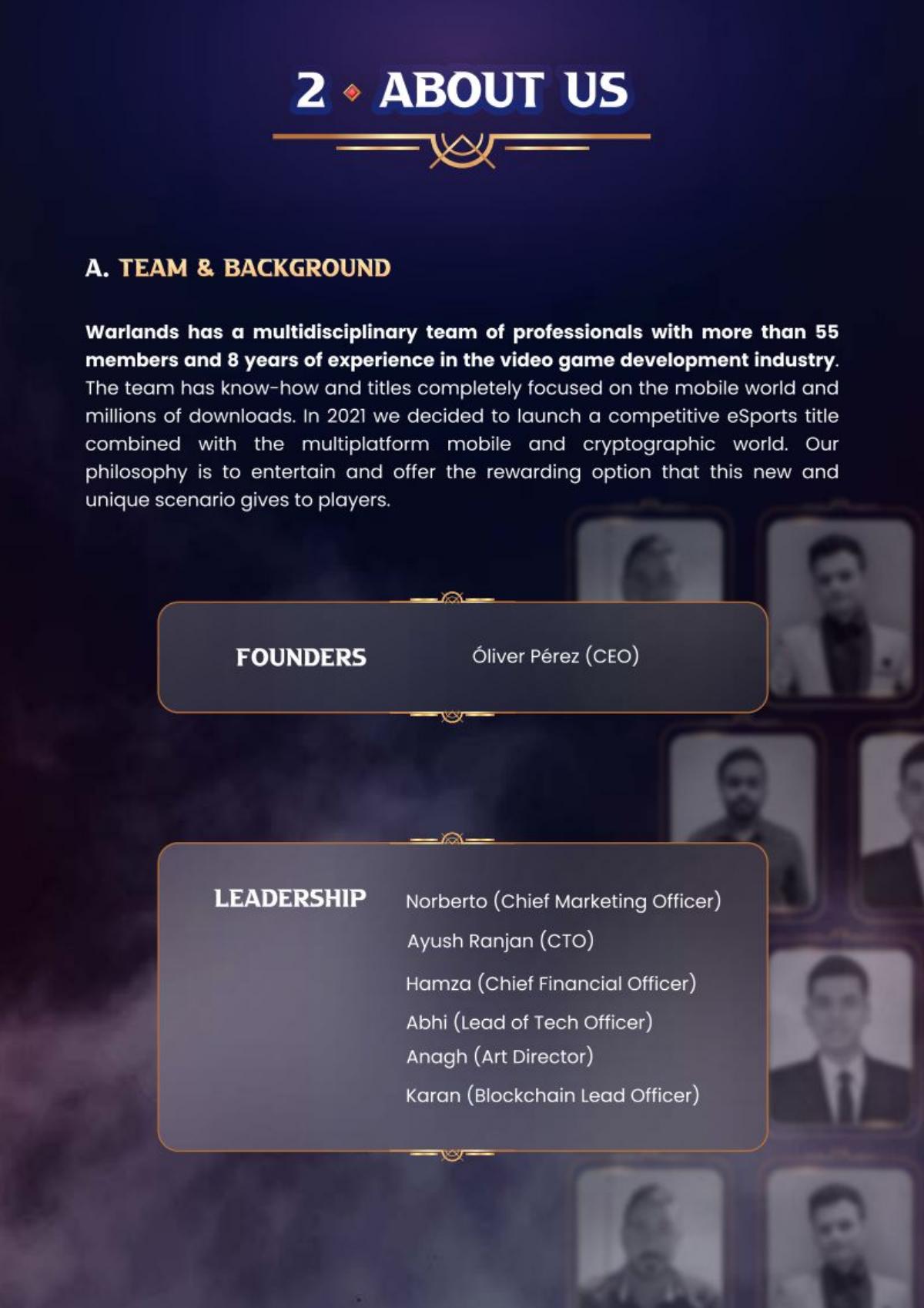
Slide 5 introduces the leadership. While it lists Óliver Pérez as CEO and provides titles for six other leads, it lacks professional bios or specific past company names. However, it reiterates the scale of the operation: a "multidisciplinary team of professionals with more than 55 members." This is a significant headcount for a seed-stage project, suggesting a high burn rate or a pre-existing studio pivot.
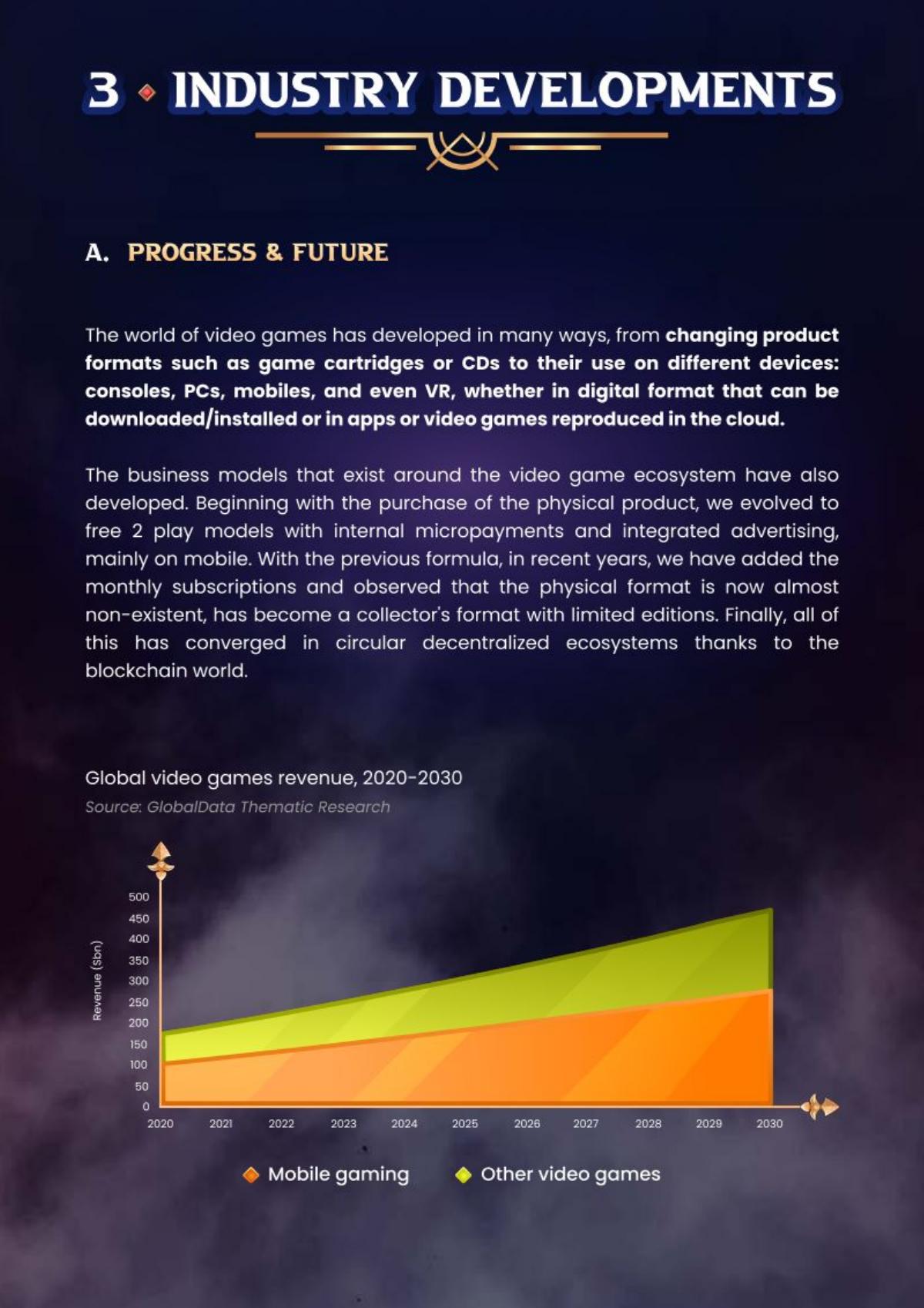
Slides 6 and 7 provide the "Why Now" context. Slide 6 tracks the evolution of gaming from cartridges to cloud and blockchain, using a GlobalData chart to show video game revenue reaching nearly $500 billion by 2030. Slide 7 focuses on the "Blockchain World," describing an "open circular system" where gamers are remunerated. This section is theoretical, serving to educate the investor on the P2E model rather than providing specific Warlands data.
Product and Market Positioning
Slides 8-12: Mechanics and Strategic Acquisitions
Slide 8 features a "See More" link for gameplay, though the static image shows a third-person perspective in a stylized environment. Slide 9 uses H1 2021 data to show that Battle Royale and MOBA are the top subgenres by time spent (16% and 12% respectively). By positioning Warlands at the intersection of these two, the company argues it is targeting the most engaged segments of the market.
Slides 10 and 11 delve into the eSports and streaming markets. Slide 10 projects the eSports market to reach $5.58 billion by 2028. Slide 11 highlights the growth of streaming platforms, noting that Twitch reached 6.3 billion hours watched in Q1 2021. The strategy here is clear: Warlands isn't just a game; it's a spectator sport designed for the streaming era.
Slide 12 introduces a concrete business milestone: the acquisition of "Daikotsu," a Brazilian eSports club. The goal is to transform this club into a DAO. This is a sophisticated move for a startup, indicating that Warlands intends to own the entire value chain—from the game development to the professional teams that play it.
The Economic Engine
Slides 13-16: Monetization and Projections
This is the densest part of the deck. Slide 13 and 14 outline six "basic elements" of the economic model: Ticket to Play (entry fees), Commissions/Fees on transactions, Scholars & Guilds (monthly subscriptions for managing players), Advertising (interstitial and immersive), Monthly Memberships , World Connection (real-world discounts), and Team Profit Share (spectator participation). The "Team Profit Share" is particularly novel, suggesting spectators can earn a share of prizes by purchasing access tickets.
Slide 15 defines the "Economic Projection" methodology, using ARPU (Average Revenue Per User) and retention metrics. Slide 16 provides a granular table of 15 revenue typologies. For example, it estimates that 100% of players will be exposed to "Inmersive Ads" with an ARPU of 5, while 5% will buy "Chests" with an ARPU of 75. These figures lead to massive theoretical revenues: at 500,000 DAU, the deck projects a daily revenue of €8,250,000 and a monthly revenue of €247,500,000. These are extremely aggressive projections that assume high conversion rates across every single monetization vertical simultaneously.
Operations and Tokenomics
Slides 17-19: Expenses, Capital, and Partners
Slide 17 provides a "Growth Hypothesis" based on 1,000 DAU. It lists monthly expenses totaling €340,620. This includes €27,000 for a 15-person dev team (averaging €1,800 per person) and €60,000 for advertising. Interestingly, it lists "Taxes" (25% of billed) and "Insurance" (10% of billed) as major line items. The slide calculates a "Monthly Net" of €3,496,380 at 1,000 DAU, which seems to conflict with the revenue table on Slide 16, where 1,000 DAU generates €495,000 monthly. This discrepancy suggests the "Monthly Net" on Slide 17 might be based on a different user tier or a calculation error.
Slide 18 covers Capital Acquisition and Tokenomics. The "Warlands Coin" has a supply of 100 million. The largest chunk (52%) is reserved for "Play & Earn," which is standard for the sector to ensure ecosystem sustainability. The capital acquisition pie chart shows that 50% of raised funds go to the Developer Team and 20% to Promotion. However, the deck never states the total amount of capital they are seeking to raise.
Finally, Slide 19 lists partners and advisors, including Nexxyo Labs, Multiverse Venture, and Conwork. These logos provide some industry validation, though the specific nature of the partnerships is not disclosed.
What Warlands Does Well
Visual Identity: The deck uses consistent, high-quality game art that makes the project feel "real" and professional. · Strategic Breadth: The acquisition of an eSports club (Slide 12) shows a level of strategic thinking beyond just making a game; they are building an ecosystem. · Monetization Detail: Unlike many gaming decks that just say "in-app purchases," Warlands provides a comprehensive list of how value flows through the system (Slides 13-14).
What is Missing from the Deck
The Ask: There is no slide stating how much money is being raised or the valuation being sought. · Traction Data: While the team claims 8 years of experience and "millions of downloads" (Slide 5), they do not name their previous titles or provide specific metrics for those successes. · Gameplay Depth: For a game pitching itself as "+AAA," there is very little information on the actual characters, lore, or unique mechanics that will make it competitive with established giants like League of Legends or Fortnite. · Risk Mitigation: The economic model is highly dependent on a circular token economy, which was notoriously volatile in 2021. There is no discussion of how they will manage token inflation or player churn.
Founder's Guide: What to Copy
The Revenue Typology Table: Even if the numbers are speculative, showing investors that you have thought through 15 different ways to monetize (Slide 16) demonstrates a deep understanding of the business model. · The Expense Breakdown: Providing a clear list of what it costs to run the studio (Slide 17) builds trust. It shows the founder knows exactly where the money goes, from server costs to insurance. · Vertical Integration: The idea of owning the eSports team that plays your game (Slide 12) is a compelling "moat" strategy that other gaming founders should consider.
Frequently asked questions
- What is the core gameplay of Warlands?
- According to slide 4, Warlands is a 5vs5 competitive game that combines the mechanics of MOBA (Multiplayer Online Battle Arena) and Battle Royale. It is designed for both PC and mobile platforms. The deck emphasizes that the game is 'remunerative,' meaning it incorporates play-to-earn mechanics where players can earn value through the blockchain ecosystem.
- How does Warlands plan to make money?
- The deck outlines a highly diversified revenue model on slides 13 and 14. Key streams include 'Ticket to Play' entry fees (similar to poker), transaction commissions, monthly subscriptions for 'Scholarships and Guilds,' immersive advertising, and a 'Team Profit Share' model where spectators can buy tickets to watch tournaments and earn a share of the prize if their team wins.
- Who is behind the project?
- Slide 5 identifies Óliver Pérez as the CEO. The leadership team includes Norberto (CMO), Ayush Ranjan (CTO), Hamza (CFO), Abhi (Lead of Tech), Anagh (Art Director), and Karan (Blockchain Lead). The deck claims the broader team consists of 55 professionals with a collective 8 years of experience in the video game development industry.
- What is the 'Daikotsu' acquisition mentioned in the deck?
- On slide 12, Warlands reveals it acquired an eSports club from Brazil called Daikotsu. The goal of this acquisition is to create the first DAO (Decentralized Autonomous Organization) of a tokenized competitive eSports club. This is intended to allow fans to share in the decision-making, earnings, and achievements of the club.
- What are the tokenomics for the Warlands Coin?
- Slide 18 details a total supply of 100,000,000 Warlands Coins. The distribution is as follows: 52% for Play & Earn, 10% for the Team (development expenses), 10% for Presale, 10% for Liquidity, 8% for Marketing, 5% for Reserve/Partners, and 5% for Airdrops. The deck notes that these figures are subject to change based on future negotiations.