Tokenstreet’s 12-slide deck is a masterclass in visual simplicity and targeted problem-solving. By identifying a specific macroeconomic pain point—the declining returns of the traditional 60/40 portfolio—the founders positioned their platform as a necessary tool for the 99% of investors currently locked out of private markets. The deck highlights a low entry point of €100 (Slide 6) and a clear legal structure using tokenized bearer bonds (Slide 9). While it lacks detailed financial projections or a specific capital 'ask' slide, the strength of its team and the clarity of its first product, 'V…
Key takeaways
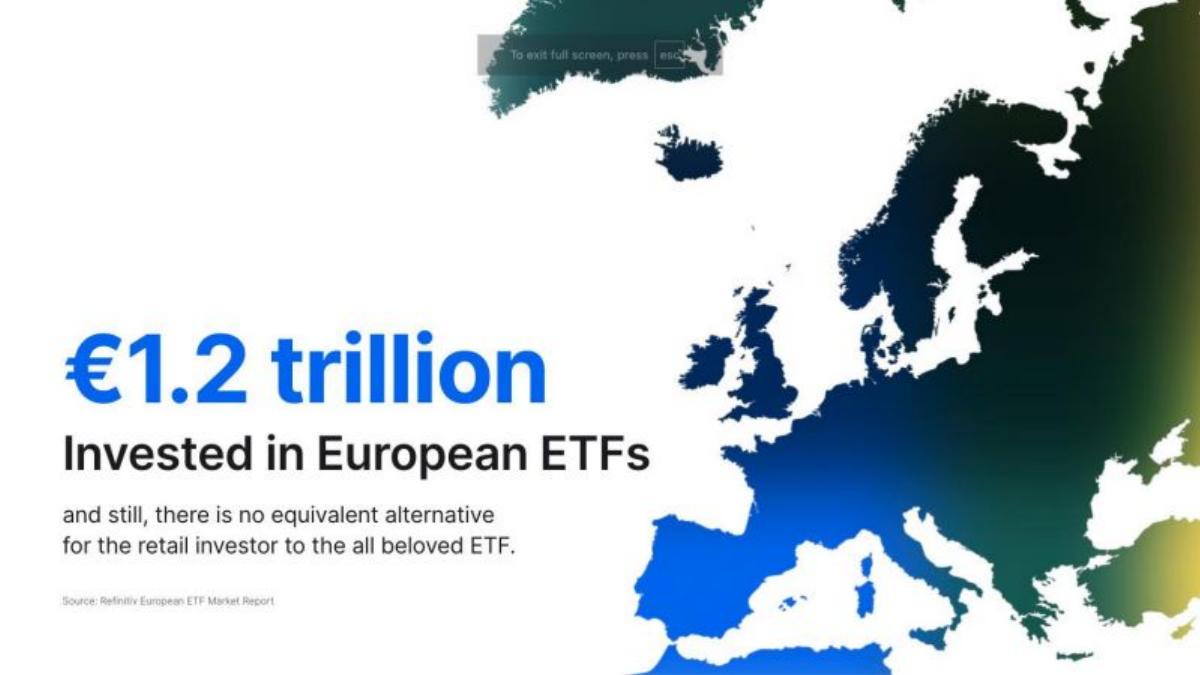
- The deck identifies a massive market opportunity by citing €1.2 trillion currently invested in European ETFs without a retail alternative for private equity (Slide 3).
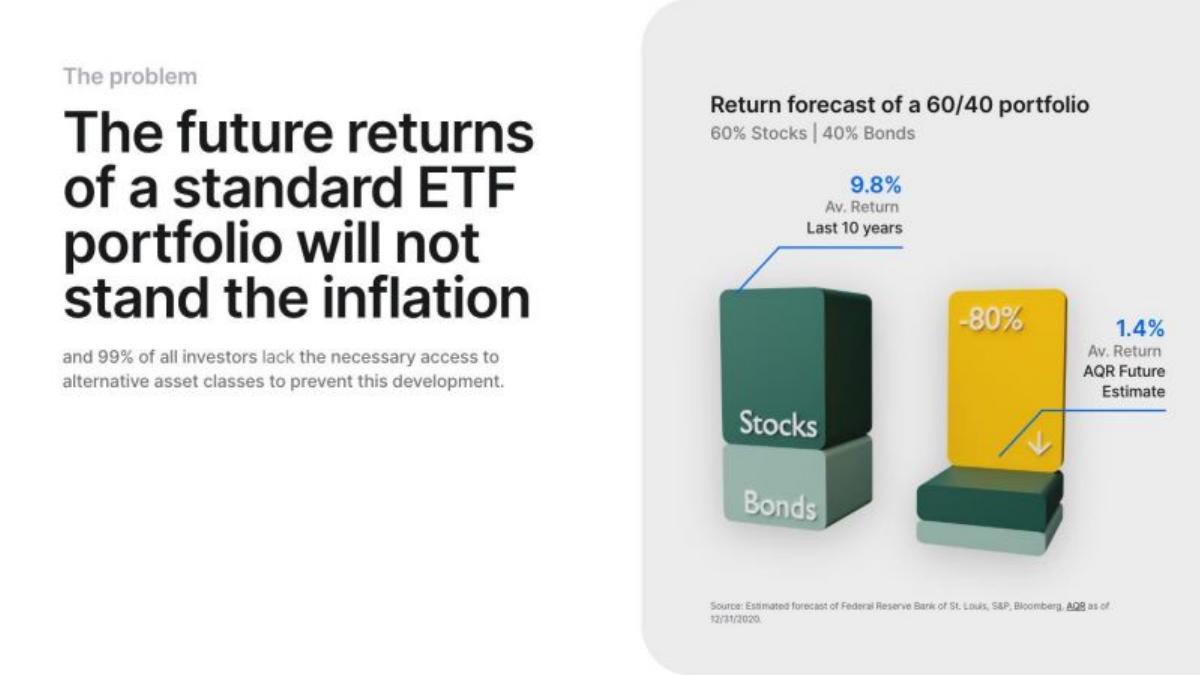
- It uses a stark visual comparison to show that a standard 60/40 portfolio's future return is estimated at just 1.4%, an 80% drop from the last decade (Slide 4).
- The solution lowers the barrier to entry for exclusive asset classes to a minimum investment of just €100 (Slide 6).
- The team slide emphasizes a mix of 'young and driven' tech founders and experienced shareholders from the private equity sector (Slide 7).
- Tokenstreet plans to monetize through a transparent cost structure of 1% p.a. (Slide 8).
- The legal framework is explicitly detailed, explaining the use of a tokenized bearer bond issued by an SPV to pool retail capital (Slide 9).
- The first product, Venture I, offers exposure to 3 funds and over 200 companies with a target return of 12% p.a. (Slide 10).
- Future roadmap items include a secondary market and savings schemes slated for Q2 2023 (Slide 8).
The Hook: Access to the Exclusive
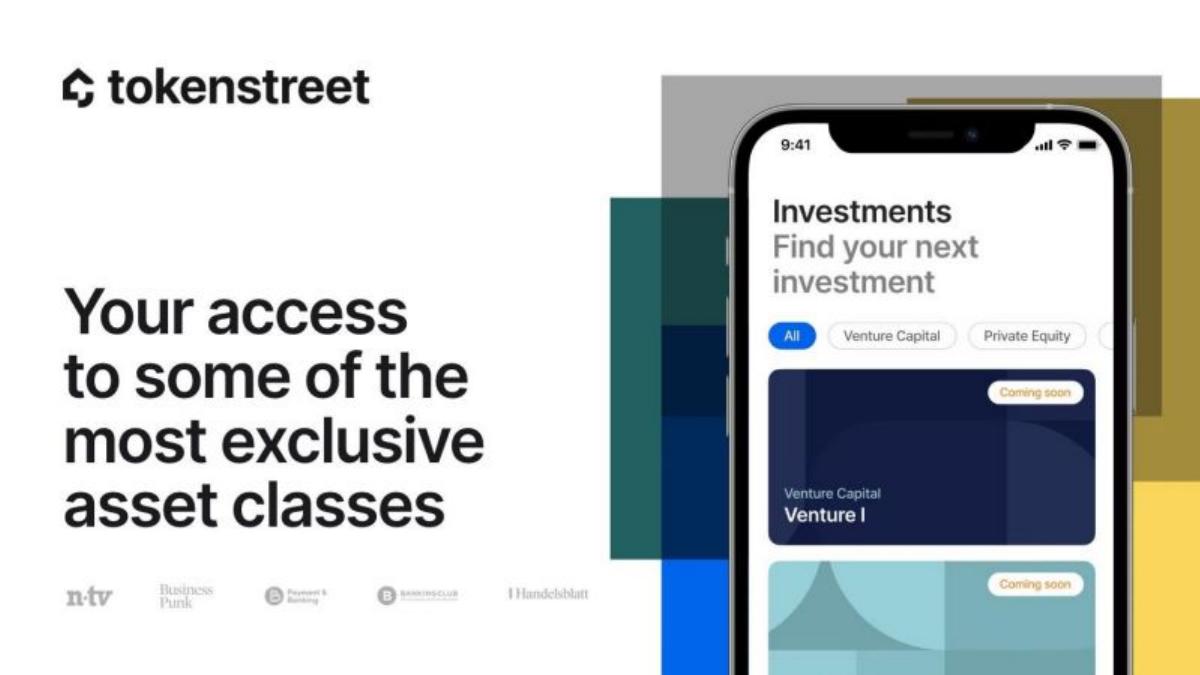
Tokenstreet opens its deck with a high-fidelity mobile mockup and a clear value proposition: "Your access to some of the most exclusive asset classes." The cover slide sets a professional, fintech-forward tone, immediately signaling that this is a product-led company. By including logos of reputable German media outlets like n-tv, Handelsblatt, and Business Punk at the bottom, they establish instant third-party credibility before the first page is even turned.
Slide 1: The Mission Statement
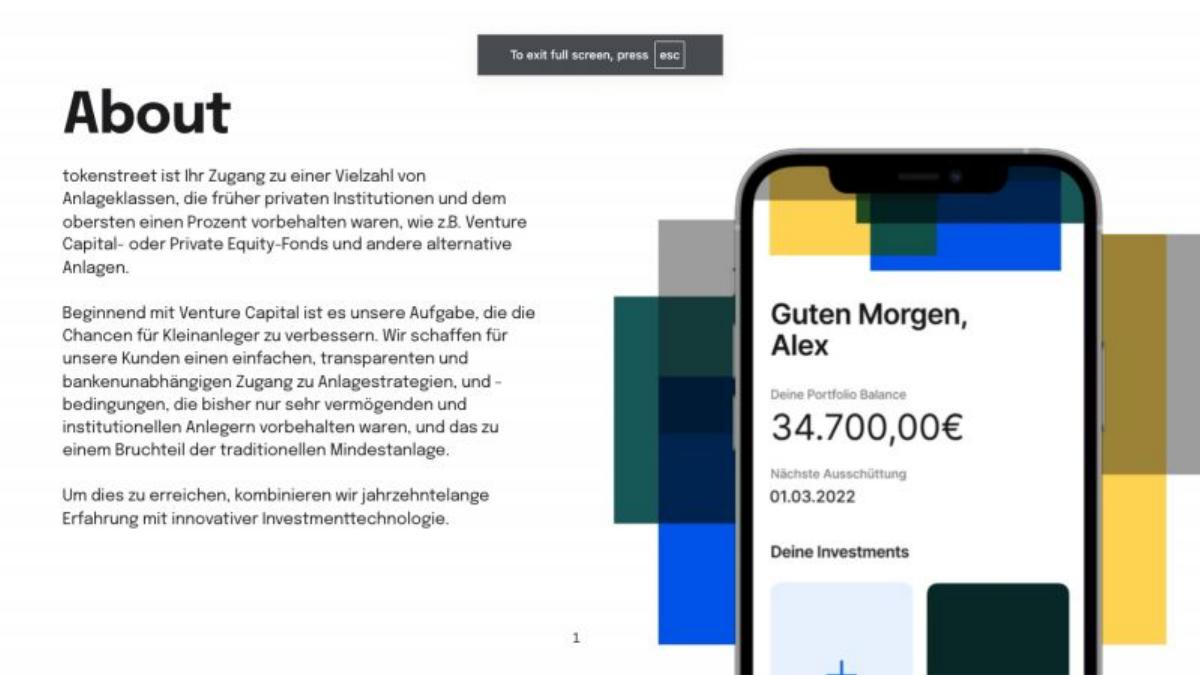
Slide 1, titled "About," is the only slide in the deck that uses significant blocks of German text. It defines Tokenstreet as a gateway to asset classes previously reserved for institutional investors and the "top one percent." The mission is clearly stated: to improve opportunities for small investors by providing simple, transparent, and bank-independent access to investment strategies at a fraction of traditional minimum investments. The visual of a portfolio balance of €34,700.00 reinforces the target demographic—mass affluent retail investors rather than ultra-high-net-worth individuals.
Slide 2 & 3: The Macro Problem
Slide 2 highlights a massive market inefficiency: €1.2 trillion is invested in European ETFs, yet there is no equivalent alternative for retail investors to access private markets. Slide 3 deepens the pain point by attacking the "standard 60/40 portfolio." Using data from the Federal Reserve and AQR, the deck claims that future returns for this traditional mix will drop from a historical 9.8% to a measly 1.4%—an 80% decrease. This creates a sense of urgency; investors aren't just missing out on gains; they are actively losing ground to inflation.
Slide 4 & 5: The Solution and Product
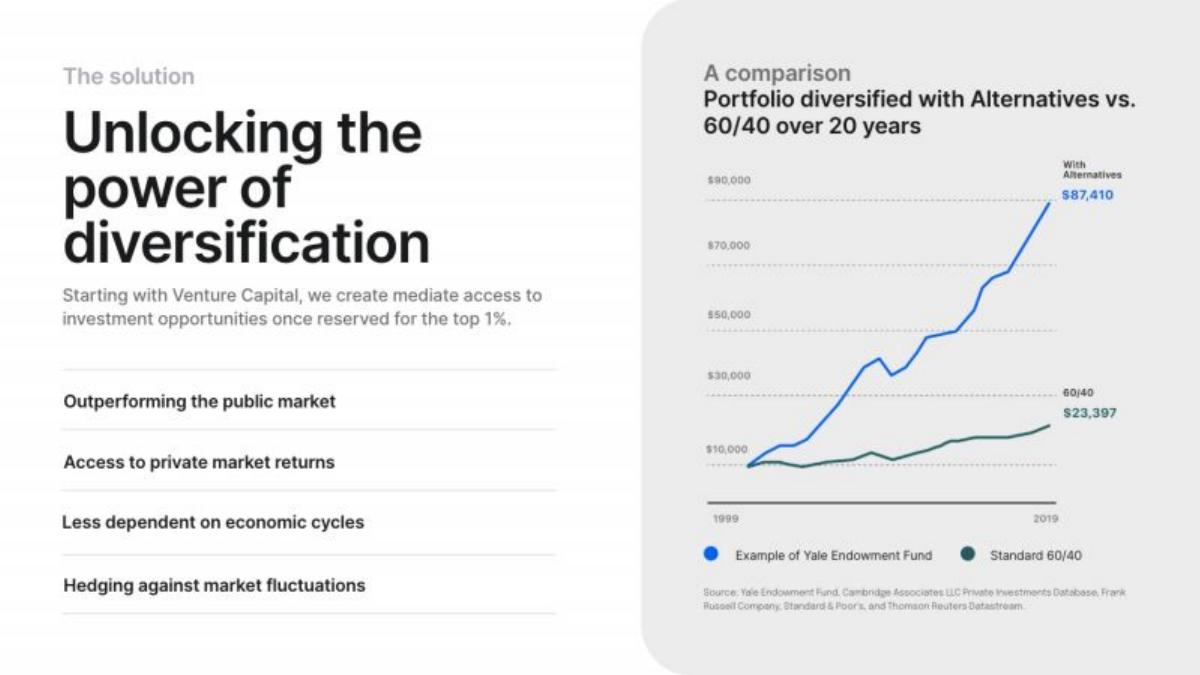
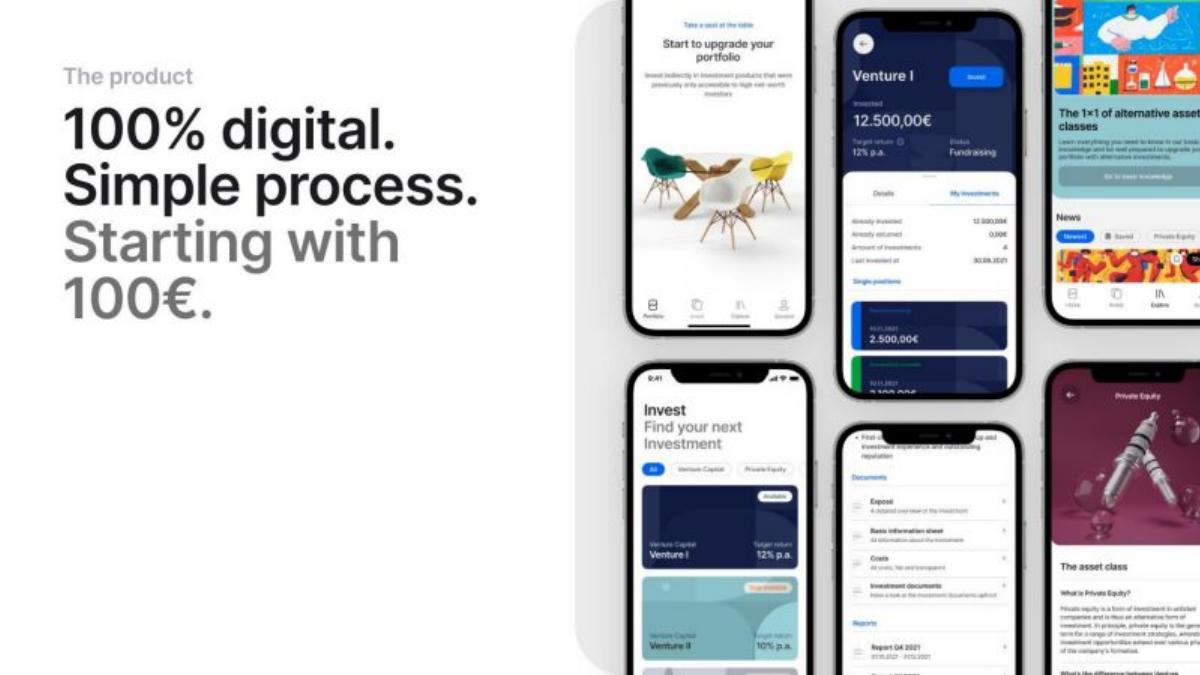
Slide 4 introduces "The Power of Diversification." It compares a standard 60/40 portfolio against the Yale Endowment Fund model, which is heavily diversified with alternatives. The chart shows a staggering difference: $23,397 vs. $87,410 over 20 years. Slide 5 then transitions to the "Product," emphasizing a "100% digital" experience and a "Simple process" starting with just €100. The UI mockups show a clean, intuitive interface for browsing funds, reading reports, and tracking target returns (e.g., 12% p.a. for Venture I).
Slide 6: The Team and Shareholders
The "Teamwork" slide is strategically split. On the left are the four young co-founders (Vincent Amm, Mona Feder, Alexander Borowski, and Lenny-Campino Hartmann). On the right, they showcase their "deeply rooted" shareholders, including Dr. Olaf Neubert and Alexander Mettenheimer. This balance is crucial for a fintech startup; the founders provide the tech and growth energy, while the older shareholders provide the regulatory and industry gravitas necessary to handle millions of euros in retail capital.
Slide 7: Core Drivers and Roadmap
Slide 7, "Our promises," breaks down the value prop into three pillars: Access, Flexibility, and Transparency. Key details here include the mention of a secondary market and savings schemes coming in Q2 2023. Most importantly, it discloses the business model: "Transparent costs of 1% p.a." This slide serves as a mini-roadmap and a trust-building exercise, noting that founders have "skin in the game."
Slide 8: The Legal Infrastructure
For any blockchain-based investment platform, the "How it works" slide is the most scrutinized. Slide 8 explains the legal structure: investors buy a "tokenised bearer bond" issued by a Tokenstreet SPV. This SPV then invests as a Limited Partner (LP) into various Venture Capital funds. This structure is a clever way to bypass the high minimums of VC funds while staying within European regulatory frameworks for debt instruments.
Slide 9: The First Product (Venture I)
Slide 9 presents the proof of concept: "Venture I." This product offers exposure to 3 funds and over 200 companies in a single investment. It lists a target return of 12% p.a. and shows the app interface for the specific investment. This slide is vital because it proves the company isn't just building a platform—they have already secured the underlying assets to populate it.
Slide 10: Contact
The deck concludes with a simple "Get in touch" slide featuring Co-Founder Mona Feder. It provides a direct email, LinkedIn, and website. While standard, it maintains the clean aesthetic of the rest of the deck.
What Tokenstreet Does Well
Visual Storytelling: The deck uses a consistent color palette and high-quality mockups that make the product feel "finished." The contrast between the 60/40 portfolio and the Yale model (Slide 4) is a powerful visual anchor that justifies the company's existence.
Regulatory Clarity: By dedicating a full slide to the legal structure of the tokenized bond (Slide 8), the founders preempt the most common investor question: "Is this legal?" They clearly map out the flow of capital from the retail investor to the startup via the SPV.
Low Friction: The repeated emphasis on the €100 minimum investment (Slide 5) and the 100% digital process makes the "democratization" claim feel tangible rather than just a marketing buzzword.
What is Missing from the Deck
The Ask: Surprisingly, the deck does not include a slide detailing how much money they are raising, the valuation, or the specific use of funds. While we know from catalogue facts they raised €350K, a standard pitch deck usually includes a slide outlining the milestones this capital will unlock.
Competitor Analysis: There is no mention of other players in the retail private equity space (like Moonfare or Liqid). Investors need to know why Tokenstreet's tokenization approach is superior to traditional feeder fund models.
Unit Economics: While they mention a 1% p.a. fee, there is no data on Customer Acquisition Cost (CAC) or Lifetime Value (LTV). For a B2C-facing fintech, these metrics are usually the difference between a sustainable business and a cash-burn machine.
Founder's Playbook: What to Copy
The "Macro to Micro" Flow: Follow Tokenstreet's lead by starting with a massive global problem (€1.2T in ETFs) and narrowing it down to a specific product solution (Venture I). This creates a logical funnel that makes the investment feel inevitable.
Leverage Your Board: If you are a young founding team in a highly regulated industry, give your experienced advisors and shareholders prominent placement. Tokenstreet’s "Teamwork" slide (Slide 6) is a perfect example of how to project maturity through association.
Simplify Complex Tech: Tokenstreet uses blockchain, but they don't lead with it. They lead with "Access" and "Returns." The word "blockchain" is secondary to the benefit it provides (lower costs and smaller ticket sizes). Founders in Web3 or AI should copy this "benefits-first" approach.
Frequently asked questions
- What is the core technology behind Tokenstreet?
- Tokenstreet utilizes blockchain technology to facilitate the issuance of tokenized bearer bonds. As described on Slide 9, retail investors acquire these digital shares in a specific Special Purpose Vehicle (SPV), which then acts as a Limited Partner in venture capital or private equity funds. This structure automates transactions and reduces the administrative costs typically associated with private market investing.
- How does Tokenstreet make money?
- According to Slide 8, the company operates on a transparent fee model. They charge investors a cost of 1% per annum (p.a.). While the deck classifies the business as B2B/SaaS in catalogue listings, the slide content suggests a wealth management fee structure typical of investment platforms, though the underlying technology is offered as a digital service.
- What problem are they solving for retail investors?
- The deck argues that retail investors are facing a 'return crisis.' Slide 4 shows that traditional ETF portfolios (60% stocks, 40% bonds) are projected to yield only 1.4% in the future due to inflation and market shifts. Tokenstreet provides access to alternative assets like Venture Capital, which historically outperformed public markets (Slide 5), but were previously reserved for the top 1%.
- Who is the team behind the company?
- The founding team consists of Vincent Amm (Investment), Mona Feder (Product), Alexander Borowski (Growth), and Lenny-Campino Hartmann (Tech). They are supported by a heavy-hitting group of shareholders including Dr. Olaf Neubert and Alexander Mettenheimer, who bring deep roots in the private equity industry (Slide 7).
- What is the minimum investment required on the platform?
- One of Tokenstreet's primary value propositions is accessibility. Slide 6 explicitly states that the process is '100% digital' and allows users to start investing with as little as €100. This is a significant reduction from traditional private equity minimums, which often reach six or seven figures.