Todd and Rahul's Angel Fund II deck is a masterclass in leveraging personal brand and founder-market fit within the venture capital ecosystem. Raising $25M in 2020, the GPs focused heavily on their track record from Fund I, which included 42 investments and 9 markups (Slide 3). The deck emphasizes their 'unfair advantage'—the ability to win competitive deals because they are active operators who provide tactical advice on product and growth (Slide 5). By showcasing high-profile portfolio companies like Clubhouse and Mercury, and securing testimonials from notable founders like Celine Halioua…
Key takeaways
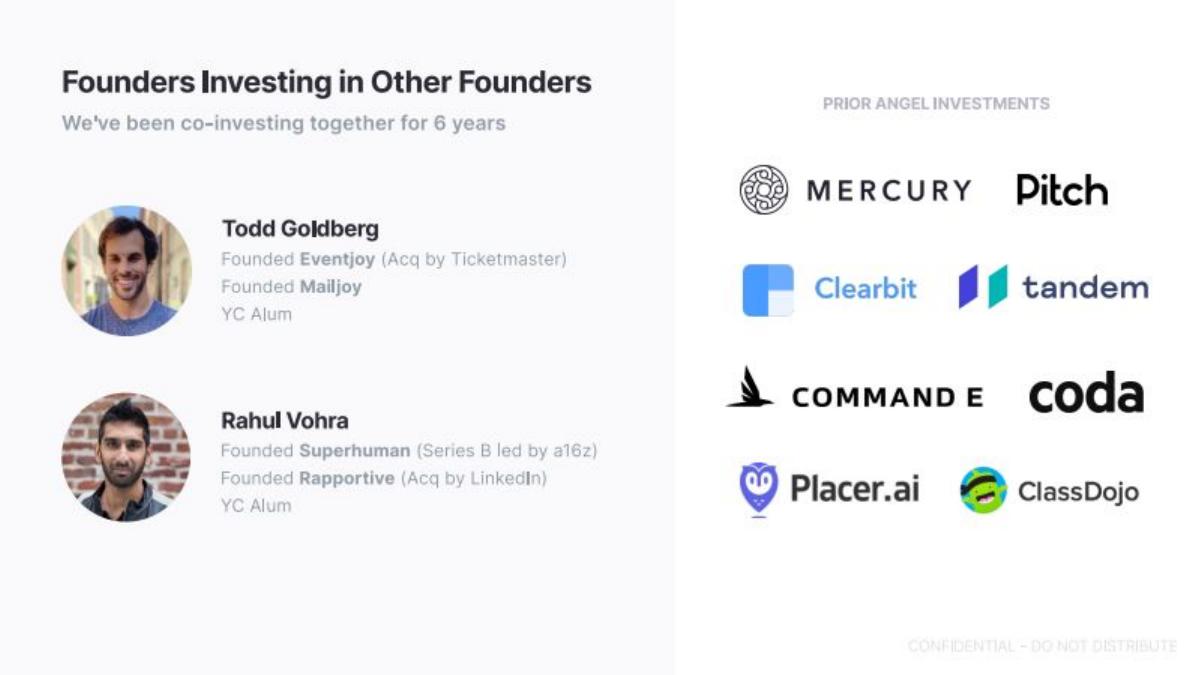
- The fund is led by two YC alumni with successful exits to Ticketmaster and LinkedIn (Slide 2).
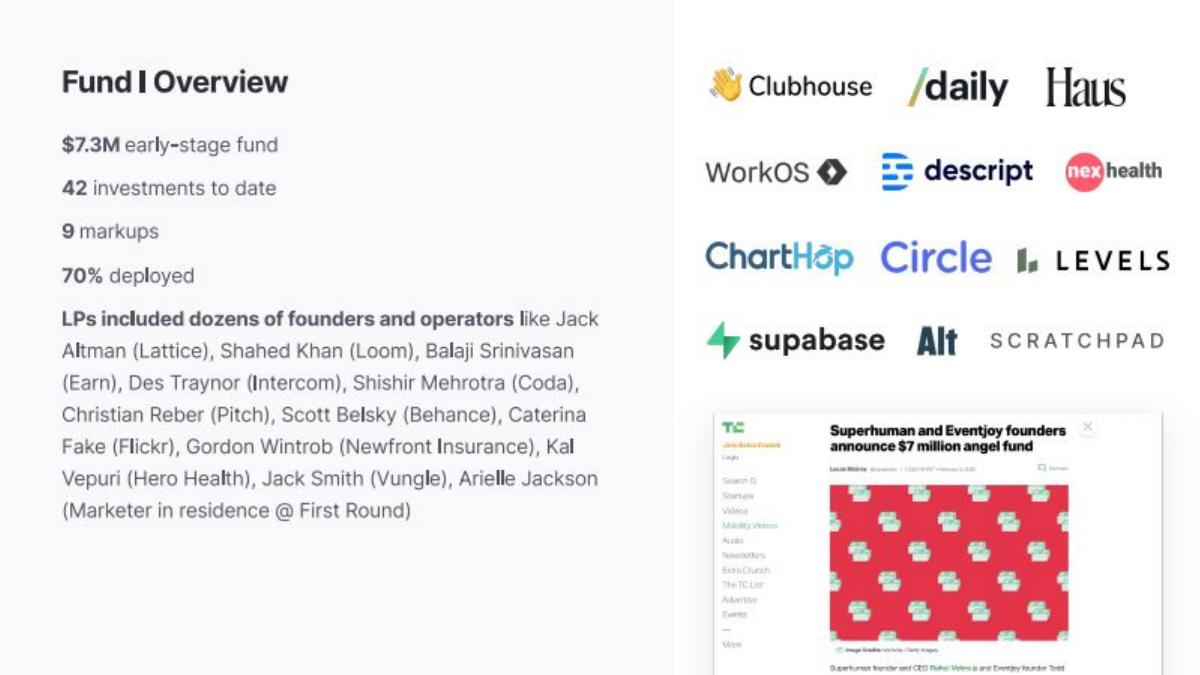
- Fund I consisted of a $7.3M vehicle with 42 investments and a 70% deployment rate at the time of the deck (Slide 3).
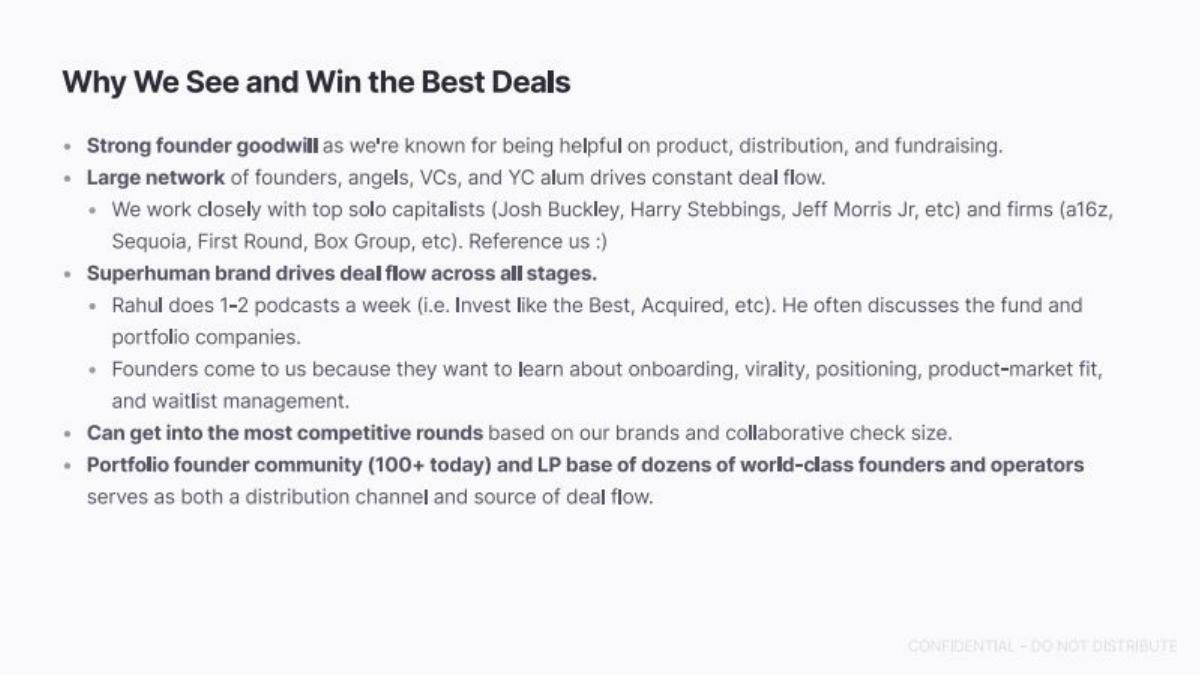
- The GPs cite 'Superhuman brand' and Rahul's podcast appearances as primary drivers of deal flow (Slide 5).
- The investment strategy is split into Core (60%), Opportunistic (25%), and Exploratory (15%) buckets (Slide 8).
- Fund II targets 30-40 core companies with check sizes between $200k and $300k (Slide 8).
- The deck highlights specific high-multiple markups, including a 9x markup on Clubhouse and a 4.29x markup on Daily (Slides 13, 14).
- LPs in Fund I included a 'who's who' of tech, such as Balaji Srinivasan, Scott Belsky, and Caterina Fake (Slide 3).
- The fund uses AngelList for back-office operations to maintain a lean GP structure (Slide 9).
The GP Brand as a Fundraising Asset
Todd and Rahul's Angel Fund II deck is an example of how 'Solo Capitalists' or small GP teams can raise significant capital by productizing their personal reputations. The deck does not lead with a market opportunity or a macroeconomic thesis; it leads with the people. Todd Goldberg and Rahul Vohra are the product. By the second slide, they have established deep credibility through their exits (Eventjoy to Ticketmaster, Rapportive to LinkedIn) and their current high-growth roles (Superhuman).
Slides 1-2: Identity and Track Record
The deck opens with a minimalist title slide followed immediately by the 'Founders Investing in Other Founders' slide. This is the core value proposition. Slide 2 lists their prior angel investments, which include heavy hitters like Mercury, Pitch, Clearbit, and Coda. This establishes that they already have access to the 'alpha' deals in the ecosystem before they even ask for Fund II capital.
Slide 3-4: Fund I Performance Metrics
Slide 3 provides the hard data for Fund I. It was a $7.3M fund with 42 investments. The most important metric here is the '9 markups' and the list of LPs. By listing LPs like Balaji Srinivasan and the founders of Loom and Intercom, they are signaling to potential Fund II investors that the smartest people in tech have already vetted them. Slide 4 is a placeholder for a table of markups, showing the name, markup multiple, and the follow-on lead investor. This is a standard but essential slide for any Fund II raise, proving that their 'judgment' leads to institutional follow-on capital.
Slide 5-6: The Unfair Advantage and Social Proof
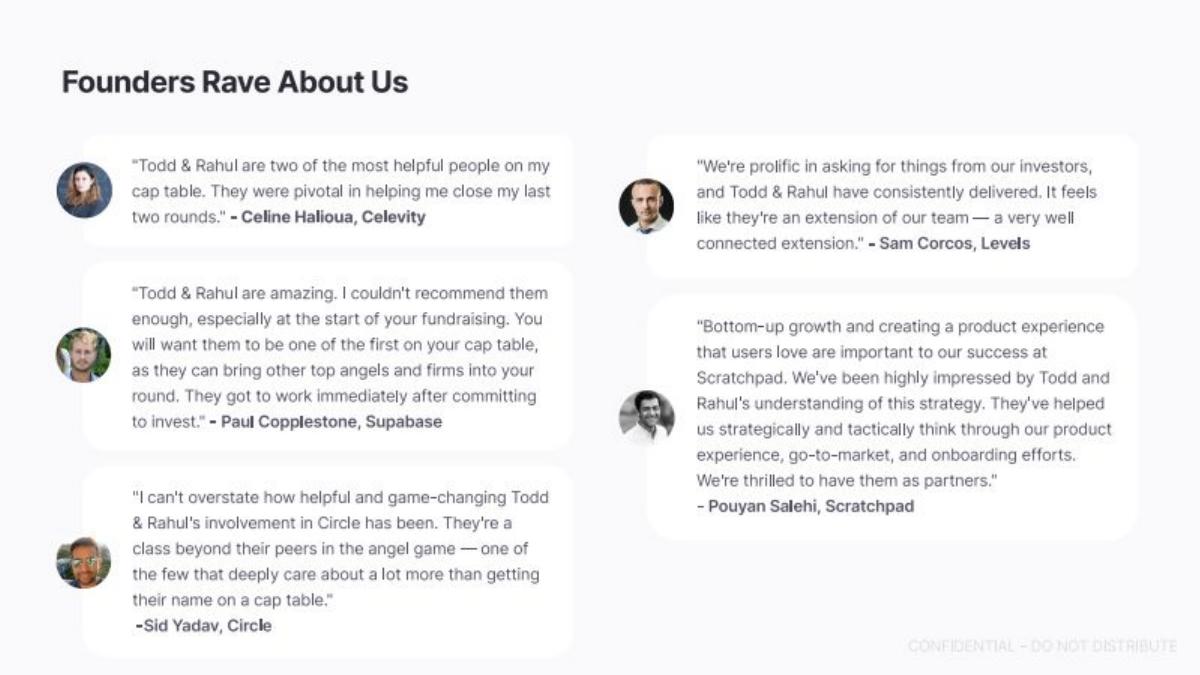
Slide 5, 'Why We See and Win the Best Deals,' is perhaps the most important slide for an LP. It explains their 'distribution engine.' They cite Rahul’s podcast appearances (Invest Like the Best, Acquired) as a top-of-funnel for deal flow. They also mention 'Founder Goodwill,' specifically helping with 'waitlist management'—a nod to the famous Superhuman launch strategy. Slide 6 reinforces this with testimonials. Unlike many decks that use generic quotes, these quotes from CEOs of companies like Supabase and Levels specifically mention how the GPs helped with fundraising and product strategy.
Slides 7-8: The Strategy Shift
Slide 7 compares Fund I to Fund II. Fund I was about 'proving access and judgement.' Fund II is about 'doubling down' with larger checks. Slide 8 breaks down the capital allocation: 60% Core, 25% Opportunistic, and 15% Exploratory. This level of transparency is helpful for LPs to understand the risk profile. They are targeting 30-40 core companies with $200k-$300k checks, aiming for a 100x multiple. The 'Exploratory' bucket (15%) allows them to maintain a presence in very early or hyper-competitive rounds with smaller $50k-$100k checks.
Slide 9-10: Operations and Call to Action
Slide 9 details the fund structure. Notably, they use AngelList for their back office. This tells LPs that the GPs are focused on investing, not administration. It also lists what LPs should expect: 1-2 updates per quarter and early access to 'hot products.' Slide 10 is a simple 'Join us' with contact information.
Slides 11-16: The Appendix and Case Studies
The deck includes a robust appendix. Slides 11 and 12 are snapshots of the Fund I portfolio (redacted in some versions but intended to show the breadth of their reach). Slides 13 through 16 are 'Spotlight' slides for Daily, Clubhouse, NexHealth, and Levels. Each spotlight includes the investment stage, the markup (e.g., 9x for Clubhouse, 4.29x for Daily), and a list of co-investors like a16z and Tiger Global. These slides serve as the 'proof of work,' showing that they don't just pick winners, they pick them early—often at the pre-seed or seed+ stage.
What Works in This Deck
Specific Value Add: Most VCs claim to be 'founder friendly.' This deck specifies how . By mentioning 'waitlist management' and 'onboarding virality,' they appeal to a specific type of high-growth software founder. This specificity makes their brand defensible.
LP Pedigree: The list of LPs in Fund I is a massive signal. If the founders of the most successful startups of the last decade are giving Todd and Rahul money to manage, it creates a 'fear of missing out' (FOMO) for institutional LPs.
Clarity of Allocation: The 60/25/15 split in Slide 8 is very clear. It shows they have a disciplined approach to portfolio construction and aren't just 'spraying and praying.'
What is Missing
Exit Data: While the deck is heavy on markups (unrealized gains), there is no mention of realized exits or DPI (Distributed to Paid-In Capital) for Fund I. Given the fund's age in 2020, this is expected, but it is a risk factor for LPs.
Market Thesis: The deck assumes that 'investing in good founders' is enough. There is no discussion of specific sectors they are bullish on (e.g., AI, Fintech, SaaS), other than the tags associated with their prior wins. They are betting entirely on their ability to spot talent regardless of the sector.
Team Depth: The fund is entirely dependent on Todd and Rahul. There is no mention of associates, analysts, or a succession plan. If either GP steps away, the 'distribution engine' described on Slide 5 breaks.
What Other Founders Should Copy
The 'Spotlight' Format: Slides 13-16 are excellent. Instead of just a logo wall, they explain the 'why' and the 'result' for each key investment. Founders raising for startups can use this same format for 'Customer Case Studies.'
The 'Why We Win' Slide: Every founder should have a version of Slide 5. It shouldn't just be 'we have a good product.' It should be 'here is the specific, repeatable engine that gives us an advantage over incumbents.'
Minimalist Design: The deck uses a clean, high-contrast design that stays out of the way of the data. It feels professional and modern, mirroring the 'Superhuman' aesthetic that Rahul Vohra is known for.
Frequently asked questions
- What is the primary investment thesis of Todd and Rahul's Angel Fund?
- The thesis is 'Founders Investing in Other Founders.' They leverage their operational experience at companies like Superhuman and Eventjoy to provide tactical help that traditional VCs might lack. They focus on early-stage companies (pre-seed to Series A) where their expertise in product-market fit, virality, and onboarding can provide the most leverage to a cap table.
- How does the fund differentiate its deal flow from larger VC firms?
- They rely on a 'distribution engine' and founder goodwill. Slide 5 notes that Rahul Vohra's frequent podcast appearances and the Superhuman brand attract founders directly. Additionally, they maintain a network of over 100 portfolio founders and dozens of operator-LPs who act as a referral source, allowing them to enter highly competitive rounds alongside firms like Sequoia and a16z.
- What are the specific financial targets for Fund II?
- According to Slide 8, the fund seeks a 100x multiple on its 'Core' investments (60% of capital) and a >10x multiple on its 'Opportunistic' investments (25% of capital). The core strategy involves writing $200k-$300k checks into 30-40 companies, while the opportunistic side targets breakout companies with $500k-$750k checks.
- Who are the Limited Partners (LPs) in this fund?
- The fund is unique in that its LP base is heavily comprised of other successful founders and operators. Slide 3 lists notable LPs such as Jack Altman (Lattice), Des Traynor (Intercom), and Shishir Mehrotra (Coda). This creates a virtuous cycle where the LPs also provide deal flow and support to the portfolio companies.
- What operational support do the GPs provide to their portfolio?
- The GPs provide specific tactical advice rather than general guidance. Slide 5 and 6 highlight their help with product positioning, distribution, fundraising, and waitlist management. Testimonials from portfolio CEOs emphasize that the GPs act as an 'extension of the team' and were 'pivotal' in closing subsequent funding rounds.