Tiun’s pre-seed deck is a study in efficiency, using just nine slides to secure $2.5M in funding. The company addresses 'subscription fatigue' by offering a pay-per-use infrastructure for digital media, targeting a 99% bounce rate on traditional paywalls. The deck excels by blending high-level vision with concrete technical progress, reporting 50+ clients and 12 months of live operations with 99% uptime. While it lacks a formal 'Ask' slide and detailed financial projections, the strength of the founding team—hailing from institutions like ETH Zurich and HBS—and the backing of high-profile inv…
Key takeaways
- The deck identifies a massive conversion gap: only 1% of users subscribe while 99% leave without buying (Slide 3).
- Tiun claims a 70% churn rate within 3-6 months for traditional subscription models (Slide 3).
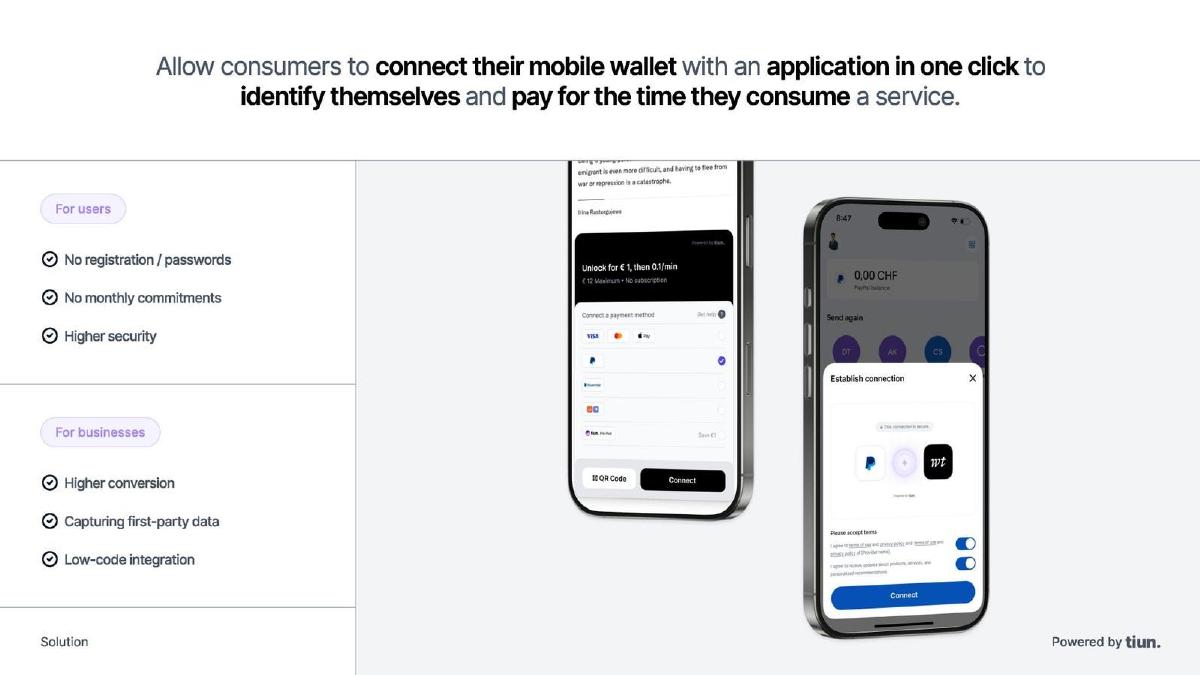
- The solution offers a 'one click' connection to mobile wallets to pay for time consumed, removing registration hurdles (Slide 5).
- The product is already operational, boasting 12 months of life with 99% historical uptime (Slide 8).
- Tiun has already secured 50+ clients across three European markets: Switzerland, Germany, and Austria (Slide 8).
- The founding team features a CTO from ETH Zurich and a CEO with HBS and Parsons credentials (Slide 7).
- The deck leverages significant social proof by listing a16z Scout and Founderful as investors (Slide 8).
- The vision extends beyond news to include conferences, concerts, and streaming (Slide 4).
The Anatomy of a 9-Slide Pre-Seed Powerhouse
Tiun’s pitch deck is a refreshing departure from the 20-slide behemoths that often plague the fintech and media sectors. In just nine slides, the team manages to articulate a complex infrastructure play as a simple, inevitable shift in consumer behavior. The deck, which helped secure a $2.5M pre-seed round in 2024, focuses on the 'subscription fatigue' epidemic and positions Tiun as the cure. By the time an investor reaches the final slide, the logic is circular and difficult to argue: consumers hate subscriptions, media companies need revenue, and Tiun has the plumbing to connect the two.
Slide 1: The Hook
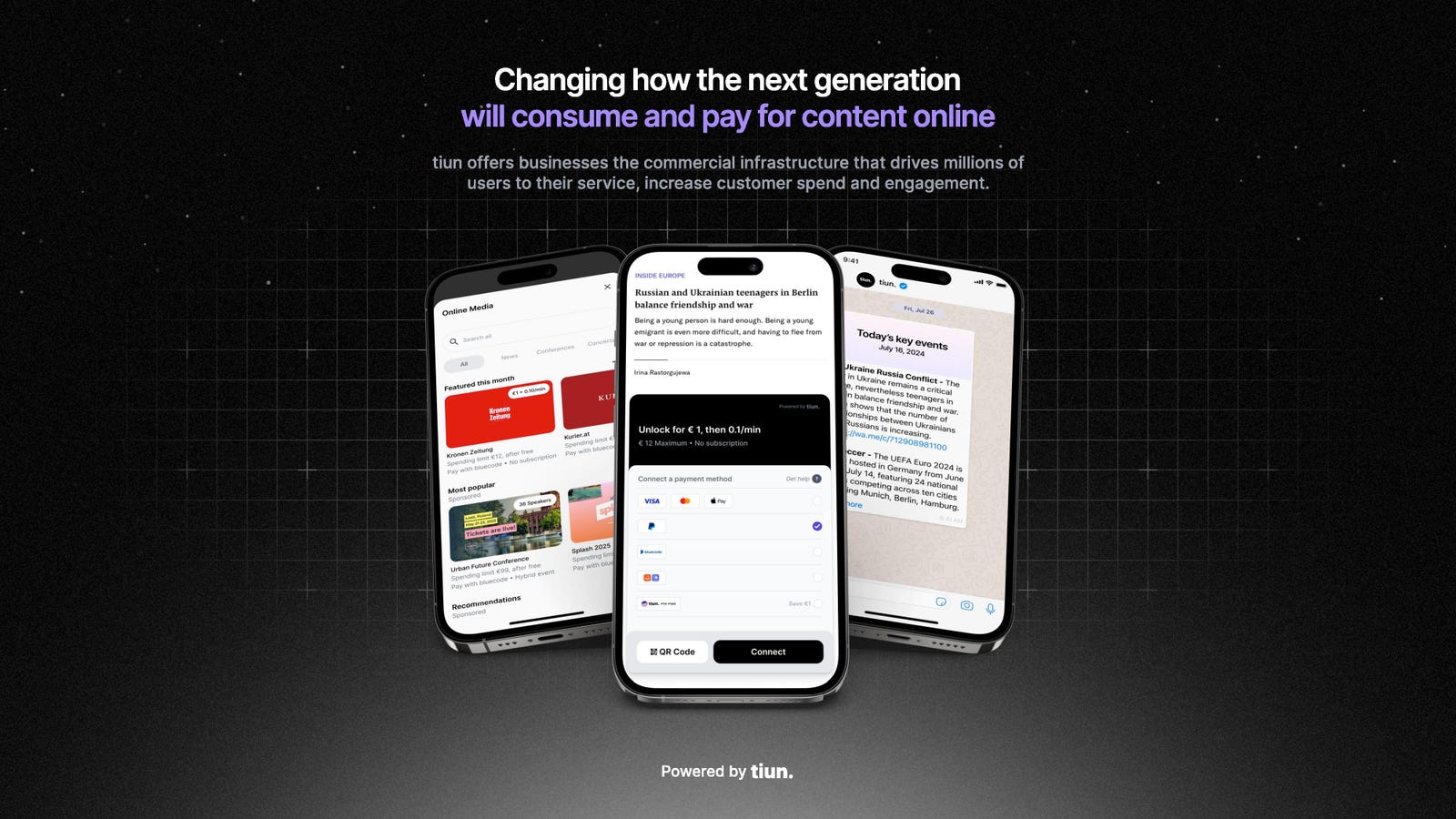
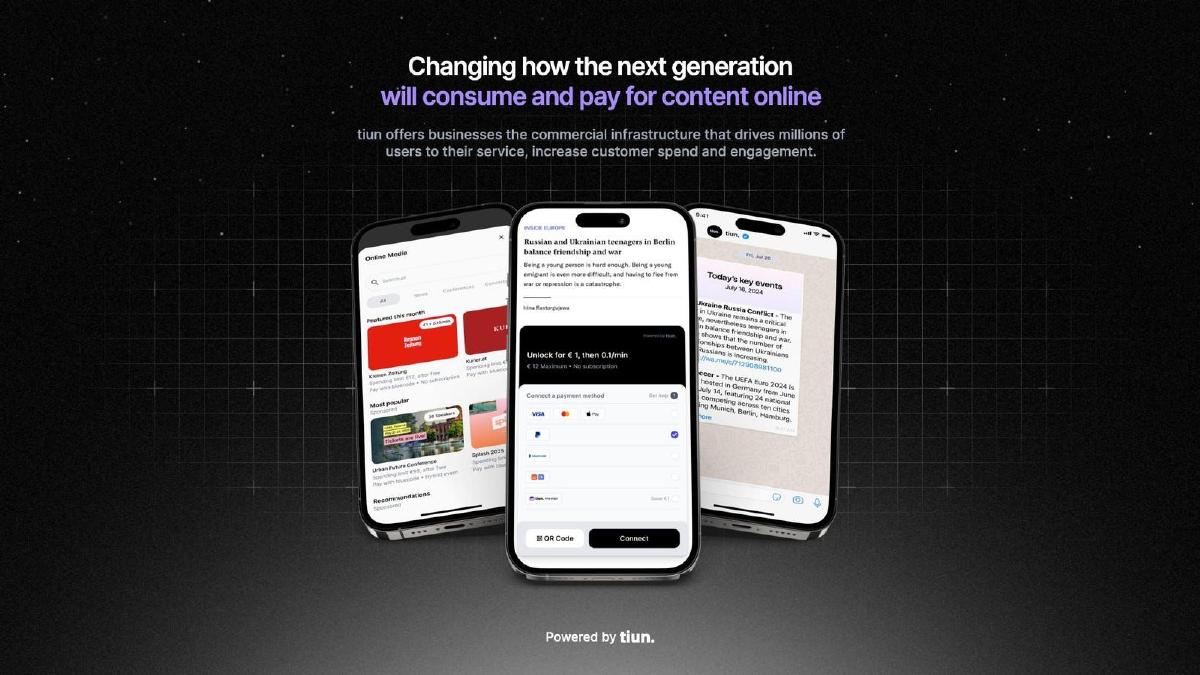
The title slide is minimalist, featuring the company logo and a high-level vision statement: 'Changing how the next generation will consume and pay for content online.' It immediately identifies the target demographic—the 'next generation'—and the core utility—'consume and pay.' The sub-text clarifies that Tiun is a B2B infrastructure play, promising to drive millions of users and increase spend. The visual of three smartphones showing the interface in action (including a WhatsApp-style news feed and a payment modal) provides immediate context for what the product actually looks like in the wild.
Slide 2: The Snapshot
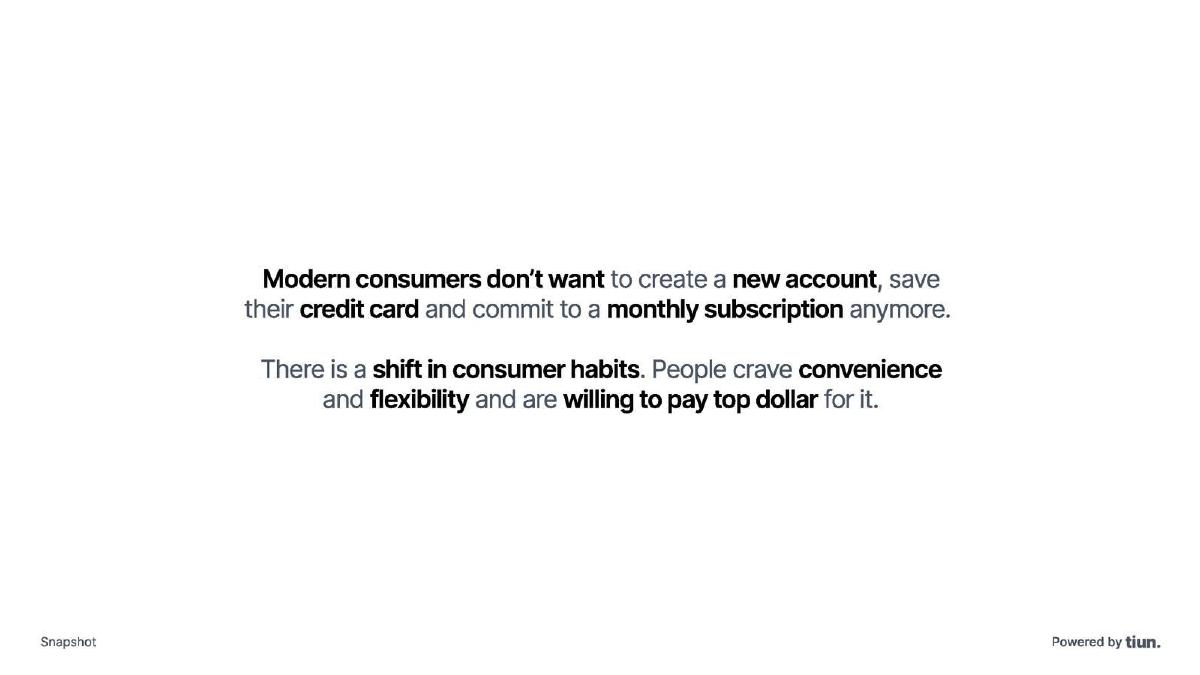
Slide 2 serves as a thesis statement. It identifies three specific friction points: creating accounts, saving credit cards, and committing to monthly subscriptions. By highlighting that consumers 'crave convenience and flexibility and are willing to pay top dollar for it,' Tiun sets the stage for a premium pay-as-you-go model. This slide is light on data but heavy on psychological alignment, forcing the reader to agree with a widely observed trend before seeing the hard numbers.
Slide 3: The Problem (The 99% Gap)
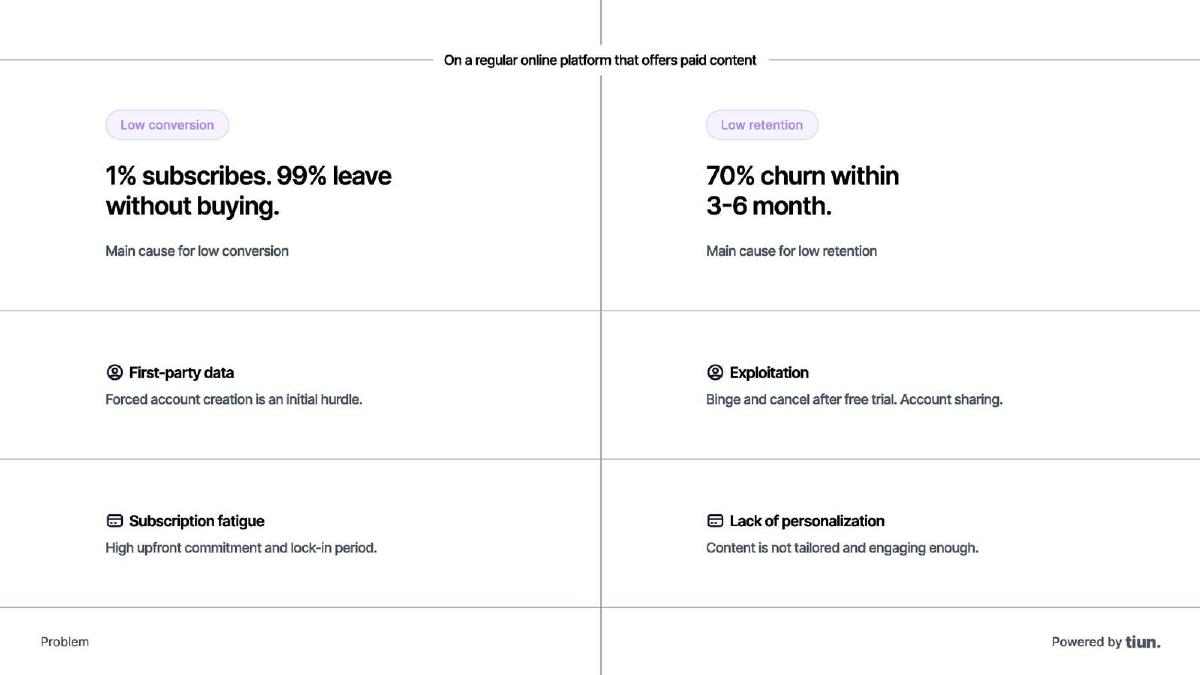
This is arguably the most important slide in the deck. Tiun quantifies the failure of the current media model with two devastating statistics: '1% subscribes. 99% leave without buying' and '70% churn within 3-6 month.' By breaking down the causes—forced account creation, subscription fatigue, exploitation (binge and cancel), and lack of personalization—they demonstrate a deep understanding of the publisher's pain points. This isn't just a 'nice to have' tool; it’s a solution for a 99% failure rate.
Slide 4: The Vision
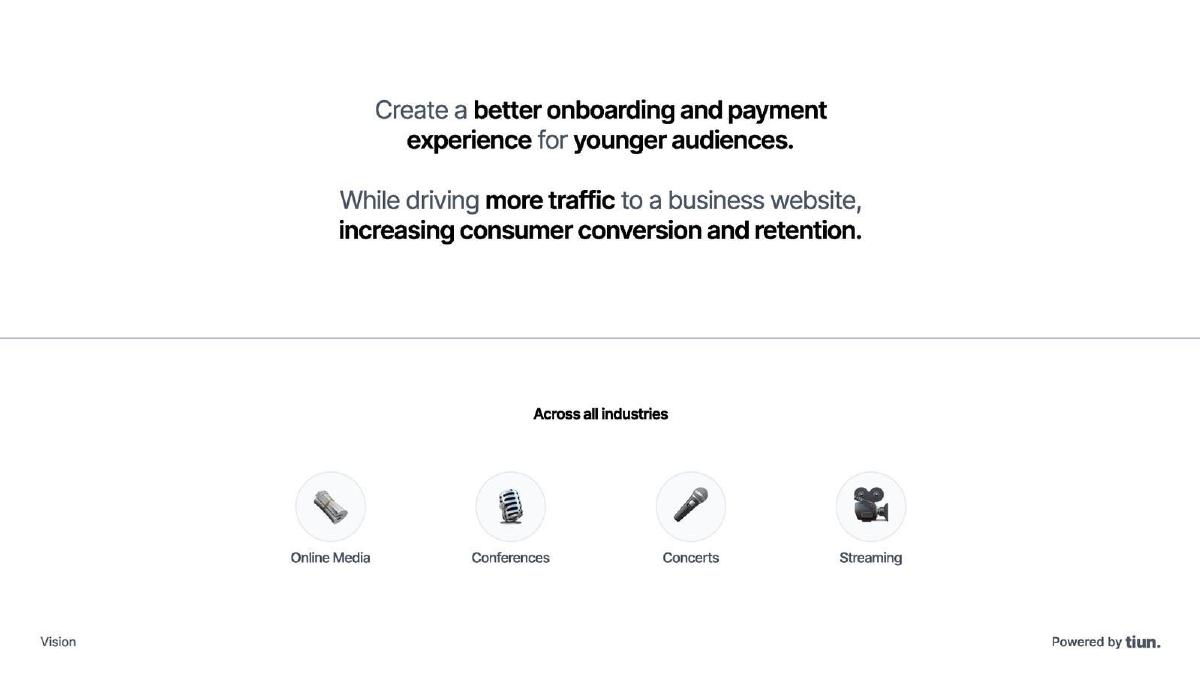
Slide 4 expands the scope. While the initial focus is online media, the icons for 'Conferences,' 'Concerts,' and 'Streaming' signal that Tiun views itself as a horizontal payment layer for all time-based or access-based digital services. The goal is clearly stated: 'Create a better onboarding and payment experience for younger audiences.' This slide transitions the deck from a niche media tool to a broad infrastructure play.
Slide 5: The Solution
The solution slide is split between user benefits and business benefits. For users, it’s 'No registration / passwords' and 'No monthly commitments.' For businesses, it’s 'Higher conversion' and 'Low-code integration.' The visual shows a mobile wallet connection (PayPal, Visa, Apple Pay) with a specific price point: 'Unlock for € 1, then 0.1/min.' This is the first time the deck explicitly shows the micro-payment mechanics, making the abstract 'flexibility' mentioned earlier very concrete.
Slide 6: The Product (Tiun Business)
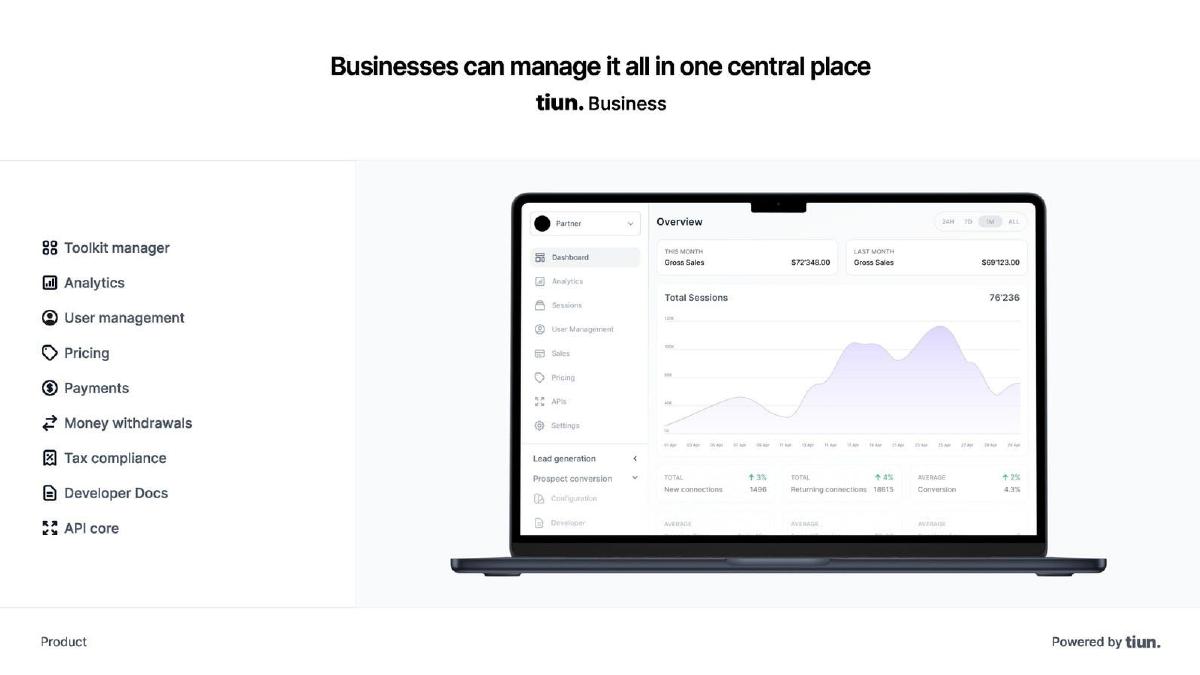
To prove this isn't just a front-end wrapper, Slide 6 showcases the 'Tiun Business' dashboard. It lists features like a toolkit manager, analytics, user management, and tax compliance. The mockup shows a professional-grade SaaS interface with metrics like 'Gross Sales' ($72,348.00) and 'Total Sessions' (76,236). This slide reassures investors that the backend infrastructure is robust enough to handle enterprise-level reporting and money withdrawals.
Slide 7: The Team
The team slide is a masterclass in 'pedigree signaling.' Sandro Zweig (CEO) brings credentials from Parsons, ETH, and HBS. Christian Heiduschke (CTO) is an ETH alum and software engineer. Nikolaos Christoforakos (CRO) comes from TUM and ESCP with a background in sales and growth. By listing only the most prestigious institutions and clear functional roles, they present a 'complimentary skill set' that covers product, engineering, and revenue.
Slide 8: Status Quo (Traction)
Slide 8 provides the proof of life. The company reports being live for 12 months with 99% uptime and having 50+ clients. They show geographic focus (Switzerland, Germany, Austria) and a wide array of payment partners (Google Pay, Apple Pay, Amex, Visa, etc.). Most importantly, they list their investors: BWC, Founderful, and a16z Scout. The 'Advisory network' includes logos like Adyen, Snowflake, and The New York Times, which adds a final layer of industry validation.
Slide 9: The Contact
The final slide returns to the core theme: 'The next generation wants more flexibility. Let’s give it to them.' It includes a QR code and the URL. Notably, there is no mention of how much money they are looking for or what the valuation is. This suggests the deck was designed to be a teaser or a leave-behind for a round that was already moving quickly.
What Tiun Does Exceptionally Well
1. Data-Driven Problem Identification: The '1% vs 99%' statistic on Slide 3 is the ultimate 'hair on fire' problem. It makes the current industry standard look like a total disaster, which makes the need for Tiun feel urgent.
2. Extreme Brevity: At only 9 slides, the deck respects the investor's time. It avoids the common mistake of over-explaining the technology and instead focuses on the business outcome (conversion and retention).
3. Social Proof as a Shield: By including a16z Scout and Founderful on the traction slide, Tiun effectively tells new investors that the 'smart money' has already done the due diligence on the technical feasibility of the product.
4. Clear Product-Market Fit: The deck doesn't just say they have a product; it shows the dashboard, the mobile interface, and the specific pricing model (pay-per-minute). This removes the ambiguity often found in pre-seed decks.
What is Missing from the Tiun Deck
1. The Ask: There is no slide detailing how much capital is being raised, the terms of the round, or the specific milestones the funding will enable. While this may have been intentional for a public-facing version, it is a critical component of a fundraising deck.
2. Unit Economics: While the deck mentions '0.1/min' for users, it doesn't explain Tiun's take-rate or how they handle the high transaction fees associated with micro-payments. For a fintech play, the margin structure is a major question mark.
3. Competitive Landscape: The deck ignores competitors. Whether it's traditional paywall providers (like Piano) or other micro-payment startups, investors need to know why Tiun’s 'low-code' approach is defensible against incumbents.
4. Go-To-Market Strategy: We see that they have 50+ clients, but we don't know how they got them or how they plan to scale to 5,000. Is this a direct sales play, or are they partnering with CMS providers?
Founder's Playbook: What to Copy
Use the '99% Bounce' Logic: If your startup addresses a massive inefficiency in a standard business model, quantify the failure of the status quo as Tiun did on Slide 3. It is much easier to sell a solution to a 99% failure rate than a 10% improvement on a working system.
Lead with Pedigree: If your team has degrees from top-tier institutions (HBS, ETH), put them front and center. In the pre-seed stage, investors are betting on the 'who' as much as the 'what.'
Show, Don't Just Tell: The inclusion of the 'Tiun Business' dashboard (Slide 6) is vital. It proves the product is more than just a landing page and that the team has considered the operational needs of their B2B customers.
Focus on a Specific Region First: By showing the flags of Switzerland, Germany, and Austria, Tiun demonstrates a disciplined, localized launch. Founders should avoid the 'global from day one' trap and show they can dominate a specific geographic or vertical niche first.
Frequently asked questions
- How much did Tiun raise with this deck?
- As reported by Business Insider, Tiun raised $2.5M in a pre-seed round in 2024. The deck itself does not state the amount raised or the terms of the round, which is common for decks shared after a round closes or used in early-stage conversations where the 'Ask' is handled verbally.
- What is Tiun's core value proposition for media companies?
- Tiun provides the infrastructure to capture the 99% of traffic that currently bounces from subscription paywalls. By offering a frictionless, pay-per-minute or pay-per-use model, they help businesses increase consumer conversion and retention without forcing long-term commitments.
- Which markets is Tiun currently operating in?
- According to Slide 8, Tiun is active in Switzerland, Germany, and Austria. The slide displays the flags of these three nations under the 'Markets' header, indicating a focused DACH-region launch strategy.
- Who are the key investors mentioned in the deck?
- Slide 8 lists BWC, Founderful, and a16z Scout as investors. This level of institutional backing at the pre-seed stage serves as a powerful signal of credibility to other potential investors.
- Is there a roadmap or financial projection included?
- No. The deck focuses entirely on the current status quo, the problem, the solution, and the team. It lacks a multi-year roadmap, revenue projections, or a detailed breakdown of how the $2.5M will be spent.