Titan Academy's 13-slide Seed deck focuses on the transition from a niche sim-racing tool to a broad sports gaming platform. By highlighting 2M+ monthly content impressions and a 60k+ social following with only 1% monthly churn, the founders demonstrated a rare level of community stickiness for a gaming utility. The deck successfully bridges the gap between 'gaming hobby' and 'data enterprise' by positioning their technology as a unique B2B data stack. While the deck lacks a specific financial 'Ask' slide in the public version, the strength of the team—featuring experience from Amazon, Porsch…
Key takeaways
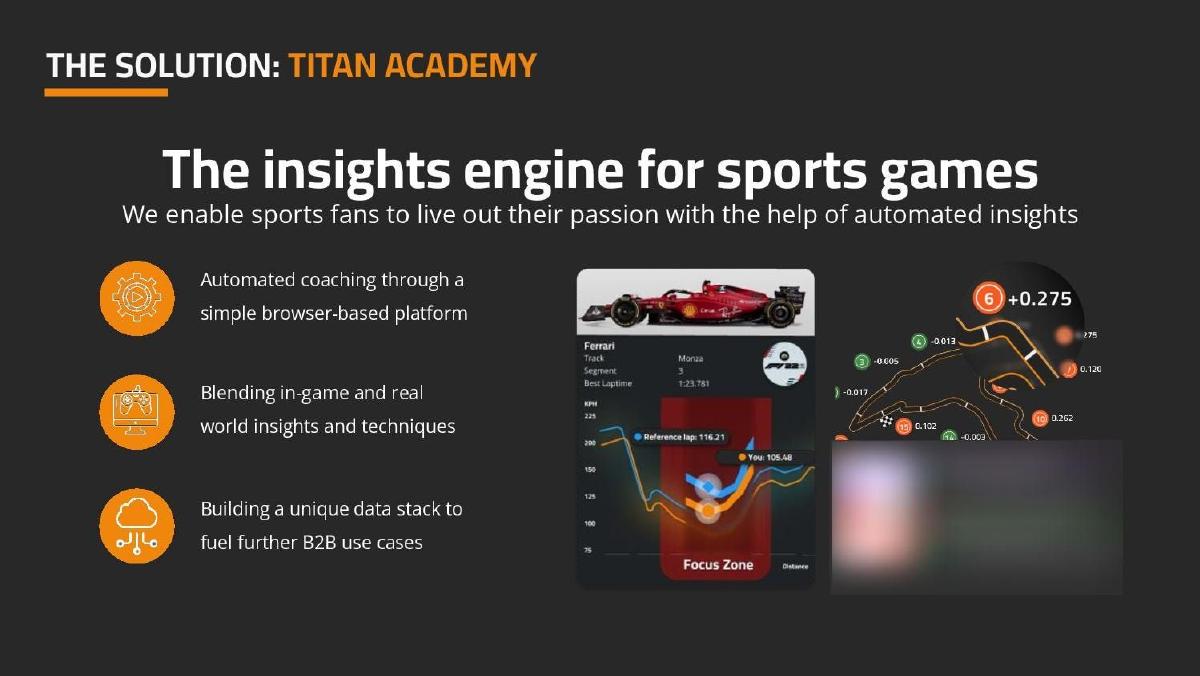
- The company positions itself as an 'insights engine' rather than just a coaching app, signaling a B2B data play (Slide 2).
- Titan Academy demonstrates massive organic reach with 2M+ monthly content impressions and 60k+ social followers (Slide 4).
- The platform maintains high retention in a fickle market, reporting only 1% monthly churn among social followers (Slide 4).
- The deck identifies FIFA as a 'mega opportunity,' citing EA's $1.62bn revenue from Ultimate Team as a market validator (Slide 3).
- The team slide highlights a mix of pro-gaming experience and high-scale engineering from Amazon and Williams Racing (Slide 6).
- Titan Academy uses a browser-based platform to lower the barrier to entry for automated coaching (Slide 2).
- The roadmap slide explicitly targets milestones leading toward a Series A, though specific dates are obscured (Slide 7).
- The deck emphasizes 'owning the value chain' from community building to insight monetization (Slide 4).
The Insights Engine for Sports Games
Titan Academy’s pitch deck is a masterclass in positioning a niche product for a mass-market expansion. The company, which raised $1.8M in 2024 as reported by Business Insider, focuses on the intersection of data analytics and consumer gaming. By starting with the highly technical world of sim-racing (F1) and moving toward the massive FIFA audience, they demonstrate a clear path from a specialized tool to a broad platform.
Slide 1: Title Slide
The deck opens with a clear value proposition: "The insights engine for sports games." The imagery is focused on the hardware—a controller and a screen—immediately grounding the pitch in the gaming sector. The branding is professional and minimalist, avoiding the over-the-top aesthetics often found in gaming decks, which helps signal to investors that this is a data-first company.
Slide 2: The Solution
Slide 2 defines Titan Academy as a browser-based platform for automated coaching. It highlights three core pillars: automated coaching, the blending of real-world and in-game techniques, and the creation of a "unique data stack to fuel further B2B use cases." This last point is crucial for venture scale; it suggests the company isn't just selling subscriptions to gamers but is building a proprietary dataset that could be valuable to game developers, sponsors, or betting platforms.
Slide 3: The FIFA Opportunity
Titan Academy uses Slide 3 to justify their expansion. They label FIFA as their "next mega opportunity." To validate this, they quote Eurogamer and Esports Insider, noting that EA made "$1.62bn from Ultimate Team" in a single year and that Better Collective acquired FUTBIN for "€105m." By citing these figures, they prove that the ecosystem around sports games is already heavily monetized and that there is a precedent for high-value exits in the space.
Slide 4: Community and Traction
This is arguably the strongest slide in the deck. Titan Academy presents impressive organic growth metrics: "2M+ content impressions each month," "60k+ social media followers," and "3k+ Discord members." The most notable figure here is the "1% churn p.m." among social followers. In the attention economy of gaming, maintaining a 99% retention rate on social platforms suggests a highly engaged and loyal audience. They explicitly state they "own the entire value chain," which reduces their dependence on expensive paid acquisition.
Slide 5: Vision and Revenue
Slide 5, titled "A core with a grand vision and multiple revenue streams," uses a blurred diagram to illustrate their ecosystem. While the specific details are obscured in the public version, the structure implies a flywheel effect where community engagement feeds into data collection, which in turn drives multiple monetization channels. This slide is intended to show depth beyond a simple SaaS subscription model.
Slide 6: The Team
The team slide provides the technical and industry credibility required for a data-driven startup. Max (CEO) is described as a "former pro gamer and coach" who was an early employee at startups that raised "more than $200M." Jack (Tech Lead) brings "ML research for Formula 1 car simulations" and experience scaling applications at "Amazon Prime Video." The slide also lists logos from Porsche, Stripe, and Williams Racing, reinforcing the idea that the founders have operated at the highest levels of both tech and motorsport.
Slide 7: The Roadmap
The final visible slide, "Zooming Out: Roadmap towards Series A and beyond," outlines the trajectory of the company. It categorizes milestones into funding rounds, product milestones, and traction milestones. Although the specific text is blurred, the visual layout shows a clear progression of increasing complexity and market reach, signaling to Seed investors that the founders are already thinking about the requirements for a Series A raise.
What Titan Academy Does Well
Titan Academy excels at market validation through proxy . Instead of just saying "gamers want to get better," they point to the $1.62bn spent on FIFA Ultimate Team. This proves that players are already spending massive amounts of money to gain a competitive edge. If players will spend billions on virtual cards, they will likely spend millions on the data needed to use those cards effectively.
The deck also handles the transition from niche to mass market effectively. Sim-racing is a high-barrier-to-entry hobby that requires deep data analysis (telemetry). By proving they can solve the hardest data problems in racing, they make the move into FIFA seem like a natural and easier progression. This "wedge" strategy is a classic startup tactic that clearly resonated with their Seed investors.
What is Missing from the Deck
The most glaring omission in the provided slides is a detailed breakdown of unit economics . While they mention 1% churn on social media, they do not provide the Customer Acquisition Cost (CAC) or Lifetime Value (LTV) for their paying subscribers. For a Seed round, investors typically want to see how much it costs to convert one of those 2M monthly impressions into a paying user.
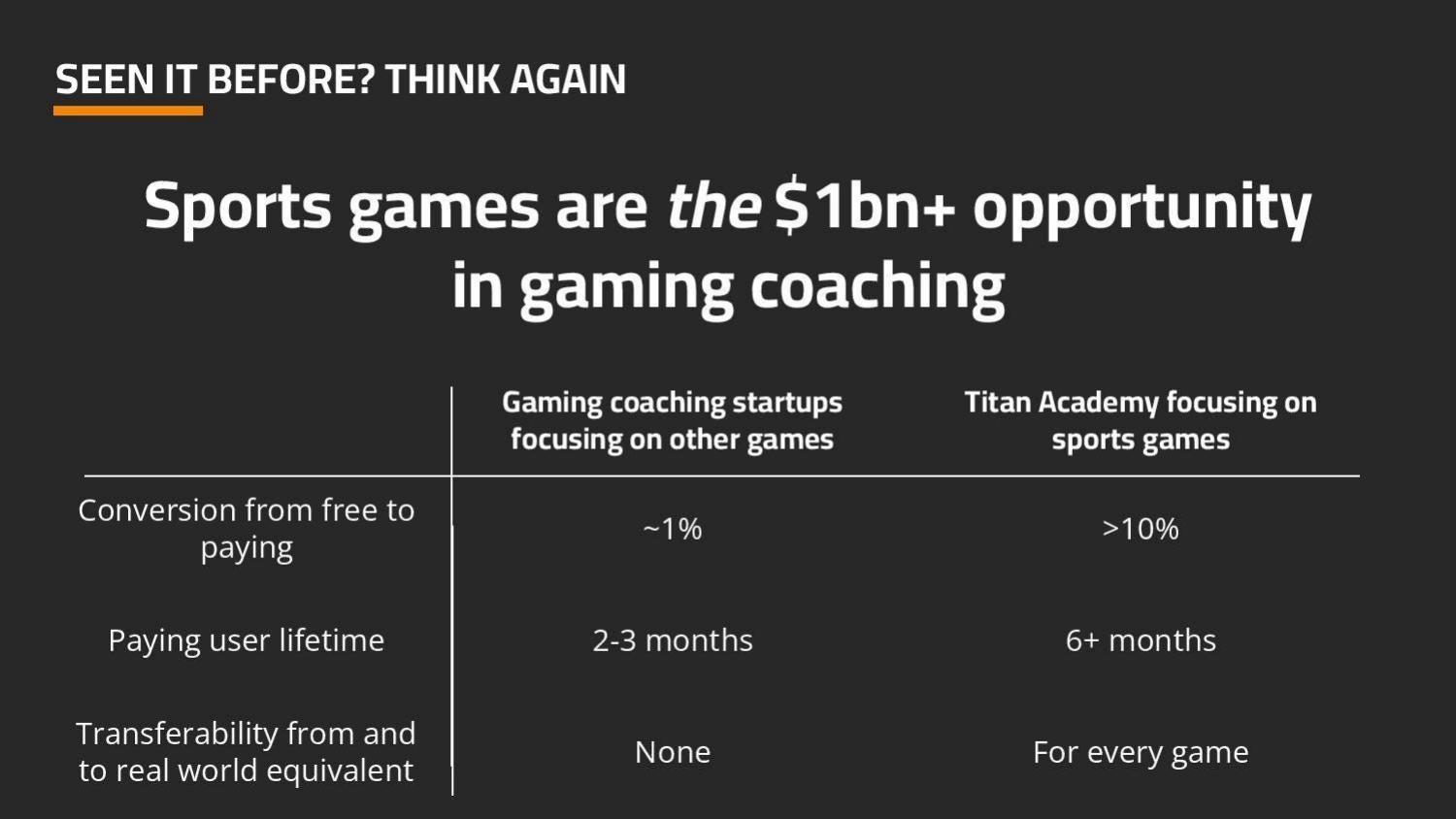
Additionally, the competitive landscape is not explicitly addressed in these slides. There are other coaching platforms and YouTube-based creators in the sports gaming space. Titan Academy relies on their "automated insights" and "data stack" to differentiate themselves, but a direct comparison slide would have strengthened the argument for their technical moat.
Finally, the specific 'Ask' is missing from the public version of the deck. While we know from publisher reports that they raised $1.8M, the deck should ideally specify how that capital will be allocated—whether it's for hiring more ML engineers, expanding marketing for the FIFA launch, or securing B2B partnerships.
Founder Takeaways: What to Copy
Quantify Community: Don't just say you have a community; list the impressions, followers, and churn rates. Titan’s 2M+ impressions figure is a powerful indicator of top-of-funnel health (Slide 4). · Use Industry Benchmarks: If you are in a new or emerging category, use the revenue of the dominant player (like EA Sports) to prove the market's willingness to pay (Slide 3). · Highlight Technical Pedigree: If your product relies on ML or complex data, show that your team has done it at scale elsewhere (e.g., Amazon, Williams Racing) (Slide 6). · Position for the Next Round: Always include a roadmap that shows you understand what the Series A milestones look like. It shows you are thinking like a professional operator, not just a builder (Slide 7). · The 'Wedge' Strategy: Start with a difficult, data-rich niche (sim-racing) to build your tech, then expand into a larger, more accessible market (FIFA). This makes your expansion feel inevitable rather than speculative (Slide 2 & 3).
Frequently asked questions
- What is the core product of Titan Academy?
- Titan Academy is an automated coaching platform for sports games. It uses a browser-based interface to analyze player data and provide insights. According to Slide 2, it blends in-game and real-world techniques to help gamers improve their performance, specifically starting with sim-racing and expanding into titles like FIFA.
- How does Titan Academy acquire users?
- The company relies heavily on organic community building. Slide 4 highlights 2M+ monthly content impressions and a Discord community of 3k+ members. They position themselves as experts in 'organic learning communities,' which allows them to own the entire value chain from initial engagement to monetization.
- What is the market size for their expansion into FIFA?
- While the deck doesn't provide a total addressable market (TAM) figure, Slide 3 cites that EA made $1.62bn from Ultimate Team in a single financial year. This serves as a proxy for the high-spending, competitive player base Titan Academy intends to target.
- Does the team have relevant industry experience?
- Yes. Slide 6 shows that CEO Max is a former pro gamer and coach with experience at three startups that raised over $200M. Technology Lead Jack has a background at Amazon Prime Video and Williams Racing, specifically in ML research for Formula 1 simulations.
- What is the long-term business model?
- Beyond consumer coaching, Slide 2 and Slide 5 suggest a B2B data play. They are building a 'unique data stack' to fuel further use cases, implying that the data collected from thousands of players can be monetized through partnerships or deeper analytics services.