Timeless Ventures attempts to redefine the venture capital model by positioning itself as a 'Startup Factory' for the masses, specifically targeting ambitious individuals without Ivy League degrees. The deck is exceptionally long at 111 slides, yet the 23-slide sample reveals a heavy reliance on external analogies—most notably Uber—and macro-societal problems like the 'Creativity Crisis' and student loan debt. While the deck successfully identifies a gap in the market (the exclusivity of top-tier accelerators), it fails to provide specific unit economics, a named leadership team, or a clear f…
Key takeaways
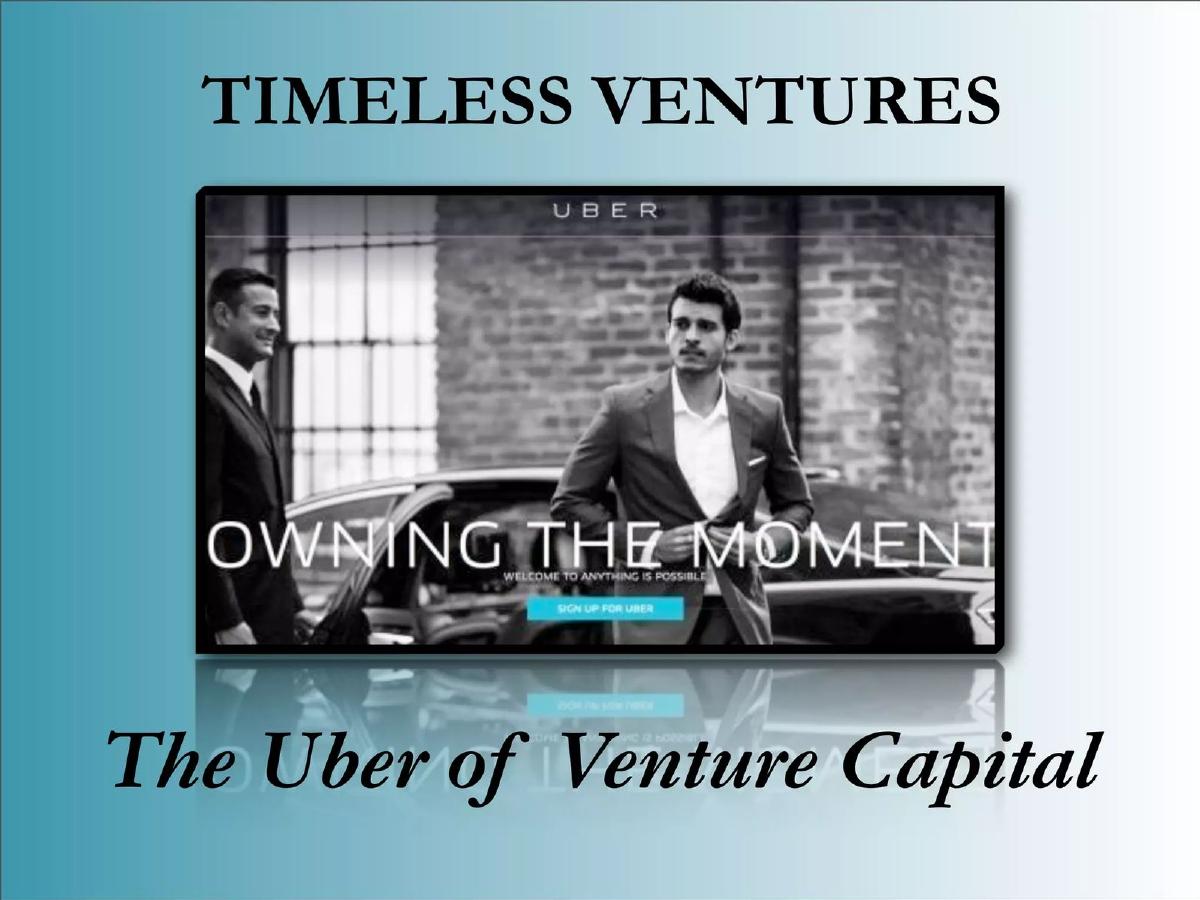
- The company positions itself as 'The Uber of Venture Capital,' emphasizing convenience and speed in the investment process (Slide 1).
- The deck identifies a 'Creativity Crisis' where American creativity scores are allegedly plummeting, particularly among children (Slide 26).
- A core pillar of the problem statement is the student loan crisis, noting that 48% of adults aged 18 to 34 without degrees cannot afford college (Slide 31).
- Timeless Ventures critiques current 'startup factories' like Google and Techstars for only admitting Stanford and Ivy League graduates (Slide 46).
- The 'Startup Factory' model is visualized as a wheel including Diligence, Strategy, Implementation, and Mentoring (Slide 56).
- The target market is split between ambitious people 'too big' for school and those who simply cannot afford a degree (Slide 86).
- The deck claims competition is fierce, citing Andreessen Horowitz raising $2 billion for the 'exact same idea' (Slide 76).
- Marketing strategy includes a 'Timeless Music Tour,' citing Nielsen data that 51% of consumers favor brands that sponsor concerts (Slides 91, 96).
The Visionary Manifesto: A 111-Slide Deep Dive
Timeless Ventures presents a deck that is, by modern standards, extraordinarily long. At 111 slides, it moves past the territory of a pitch and into the realm of a manifesto. The 23 slides analyzed here suggest a company deeply concerned with brand positioning and societal trends, but perhaps less focused on the granular mechanics of venture operations. By labeling itself 'The Uber of Venture Capital,' the firm sets a high bar for disruption and speed.
Slides 1-11: Positioning and the 'Uberification' Thesis
The deck opens with a bold claim on Slide 1 : 'The Uber of Venture Capital.' This is a classic 'X for Y' pitch strategy, intended to instantly communicate a value proposition of speed, technology, and disruption. Slide 6 reinforces this with a simple 'Brand Positioning' header, leading into Slide 11 , which introduces 'The Uberification of Everything.' At this stage, the deck is selling a philosophy rather than a product. It assumes the investor agrees that the venture capital industry is antiquated and requires a 'convenience tech' makeover.
Slides 16-21: The Psychology of Convenience
Slide 16 asks, 'What makes Uber so addicting?' The answer, provided on Slide 21 , is 'uber-convenience.' The company defines this as 'technology that buys you time and saves you effort.' The implication is that Timeless Ventures will remove the friction, long wait times, and 'gatekeeping' typically associated with raising venture capital. However, the deck does not explain how it achieves this 'magic'—whether through an automated platform, proprietary AI, or a streamlined legal process.
Slides 26-31: The Macro Problem Statement
The deck takes a sharp turn into sociological data. Slide 26 cites 'The Creativity Crisis,' claiming that American creativity scores have been plummeting for two decades. This is followed by Slide 31 , which focuses on the student loan crisis. It highlights a statistic that 'Nearly half of adults aged 18 to 34 without degrees (48%) can't afford to go to college.' By framing these as the core problems, Timeless Ventures positions itself as a social impact vehicle as much as a financial one. The 'problem' isn't just that VC is slow; it's that the talent pool is being stifled by debt and a lack of creative outlets.
Slides 36-41: The Philosophy of Entrepreneurism
Slide 36 argues that 'You Can't Teach Entrepreneurism,' suggesting that distribution and marketing are more important than product quality. It emphasizes 'pounding the pavement' and 'closing deals.' Slide 41 is a stock-heavy visual of the traits of an entrepreneur: Leader, Independent, Innovative. These slides serve to define the 'ideal founder' that Timeless Ventures seeks to back—someone who is a natural-born hustler rather than a classroom-trained academic.
Slides 46-56: The 'Startup Factory' Solution
On Slide 46 , the deck critiques 'Current Solutions.' It gives a 'thumbs down' to Google, Uber, and Techstars, claiming they lack 'availability' because they only admit Stanford and Ivy League grads. This is the company's strongest competitive differentiator: inclusivity. Slide 56 introduces 'The Timeless Ventures Startup Factory,' using a circular diagram to show their process: Diligence, Strategy, Implementation, Products & Technology, Market Opportunities, Sales Strategy, Finance & Funding, and Mentoring. This is the first glimpse of the actual service offering, though it remains high-level.
Slides 61-71: Market Dynamics and Demographics
Slide 61 uses patriotic imagery ('Put Americans to Work') to align the company with national economic interests. Slide 66 pivots to retail data, noting that loyalty programs increase profit by 88%, which seems disconnected from the core VC thesis unless it refers to a specific portfolio strategy. Slide 71 highlights the demographic shift, stating that by 2030, Millennials will outnumber Boomers by 22 million. This suggests that Timeless Ventures is building for a new generation of founders who value different things than their predecessors.
Slides 76-86: Competition and Target Market
Slide 76 acknowledges heavyweights like Andreessen Horowitz, claiming they raised $2 billion for the 'exact same idea.' This is a risky claim; if a top-tier firm is already doing this with billions of dollars, the deck needs to explain why Timeless Ventures can win with presumably fewer resources. The answer is provided on Slide 86 : the target market is the 'other half'—the people who couldn't afford a degree or were 'too ambitious' for school. The deck explicitly states they are looking for the 'next Mark Zuckerberg' who is currently 'out there... and needs our help.'
Slides 91-111: Marketing and Conclusion
The final section of the sample focuses on 'Experiential' marketing. Slide 91 and Slide 96 discuss a 'Timeless Music Tour,' using Nielsen data to show that consumers favor brands that engage through music. This suggests the firm intends to use lifestyle marketing to attract founders, a significant departure from traditional VC networking. The deck ends on Slide 111 with the Apple slogan 'Think different.' Notably, the final slide does not include contact information, a call to action, or a summary of the investment terms.
What Works
Clear Differentiation: The deck successfully identifies a gap in the venture market—the 'un-pedigreed' founder. By attacking the Ivy League bias of firms like Techstars, Timeless Ventures carves out a specific niche. · Strong Narrative Arc: The deck moves logically from a macro-societal problem (the creativity and education crisis) to a specific solution (the startup factory). · Bold Branding: The use of the 'Uber' analogy is memorable and sets a clear expectation for the user experience, even if the mechanics are not yet explained.
What is Missing
The Team: In venture capital, the 'who' is often more important than the 'what.' This deck provides no biographies, no track records of successful exits, and no information on who is managing the 'Startup Factory.' · The Ask: There is no slide detailing how much money is being raised, the valuation, or how the funds will be deployed. · Traction and Proof of Concept: For a 111-slide deck, there is a surprising lack of evidence. There are no case studies of companies already built in the 'factory' and no data on the 'Simplified Venture Capital Experience' in practice. · Unit Economics: The deck mentions a 'Startup Factory' model but does not explain the equity split, the cost of the mentoring program, or the projected ROI for investors.
Founder's Summary
The Timeless Ventures deck is a masterclass in visionary storytelling but a cautionary tale in investor utility . Founders can learn from the way this deck builds a 'moral imperative' for its existence by linking the business to large-scale societal problems like student debt. However, the sheer length (111 slides) is likely to deter most professional investors, who typically prefer a concise 15-20 slide narrative. The reliance on stock imagery and high-level analogies ('The Uber of...') can sometimes mask a lack of operational depth. A founder copying this style should ensure that for every 'vision' slide, there is a corresponding 'execution' slide backed by data and a qualified team.
Frequently asked questions
- What is the primary business model of Timeless Ventures?
- Based on the slides, Timeless Ventures operates as a 'Startup Factory' or venture studio. It aims to find, educate, and empower non-traditional founders—specifically those without Ivy League degrees—by providing infrastructure, mentoring, and funding. It positions itself as a more accessible version of elite accelerators like Techstars or Y Combinator, though specific equity terms or fund structures are not detailed in the provided slides.
- How does the deck use the Uber analogy?
- The deck uses Uber as a proxy for 'convenience tech.' It argues that just as Uber made hailing a taxi 'magic' through a smartphone, Timeless Ventures will provide a 'Simplified Venture Capital Experience.' It leans heavily on the term 'Uberification' to suggest that the venture capital industry is ripe for a transition toward high-speed, on-demand service for entrepreneurs.
- What social issues does the company aim to solve?
- Timeless Ventures frames its mission around two major societal 'crises.' First, a decline in national creativity scores. Second, the student loan and education crisis, which prevents nearly half of young adults from attending college. The company views itself as an alternative path to success for the 'next Mark Zuckerberg' who might be priced out of or uninterested in formal higher education.
- Who are the competitors mentioned in the deck?
- The deck explicitly names Google, Uber, Techstars, and Andreessen Horowitz as competitors or entities operating 'startup factories.' It claims these firms have raised billions for the 'exact same idea' but argues they suffer from a 'diversity issue' because they primarily recruit from elite universities like Stanford and the Ivy League.
- What is missing from this pitch deck?
- The deck is missing several critical components required for a professional investment round. There is no 'Team' slide identifying the founders or their track records. There are no financial projections, no details on the current fund size, no specific 'Ask' (amount of capital being raised), and no evidence of existing portfolio companies or traction to date.