Tiferet Academy’s parlor meeting slides present a proposal for a new Jewish day school on Long Island, scheduled for a 2013 launch. The deck centers on a 'Blended Learning Model' that combines online instruction, teacher-led sessions, and collaborative activities to drive 'Accelerated Learning' and 'Sustainable Tuition.' By citing successes from Acton Academy and endorsements from educational reformers like Sir Ken Robinson and Seth Godin, the founders argue that technology-integrated classrooms can outperform traditional models. However, the deck reveals a project in its early stages: the cu…
Key takeaways
- The school planned to launch on Long Island in 2013 with a focus on sustainable tuition (Slide 1).
- The educational model is built on a three-way intersection of Real-World Skill Focus, Blended Learning, and Project-Based Learning (Slide 2).
- Students rotate through three modalities: Online Instruction, Teacher-led Instruction, and Collaborative Activities led by an assistant (Slide 3).
- The deck cites Acton Academy data showing 1st-grade students gaining 2.5 grade levels in math and reading in a single year (Slide 4).
- The curriculum is not yet set; the school was 'evaluating multiple educational consulting firms' at the time of the presentation (Slide 8).
- The growth plan involves opening with Pre-K through 2nd Grade and adding one new grade each year thereafter (Slide 7).
- Technology strategy is pending, with the team still researching blended learning providers and setting up a website (Slide 9).
- The school explicitly addresses the 'myth' that cheaper education equals lower quality, arguing that blended learning environments improve performance (Slide 10).
Tiferet Academy: A Vision for Modern Jewish Education
The Tiferet Academy Parlor Meeting slides represent a specific moment in the Jewish day school landscape, where the 'tuition crisis' prompted founders to look toward the 'Blended Learning' movement of the early 2010s. This teardown examines the first 10 slides of a 48-slide deck, focusing on the school's pedagogical framework and launch strategy for its 2013 opening on Long Island.
Slide 1: Title and Mission
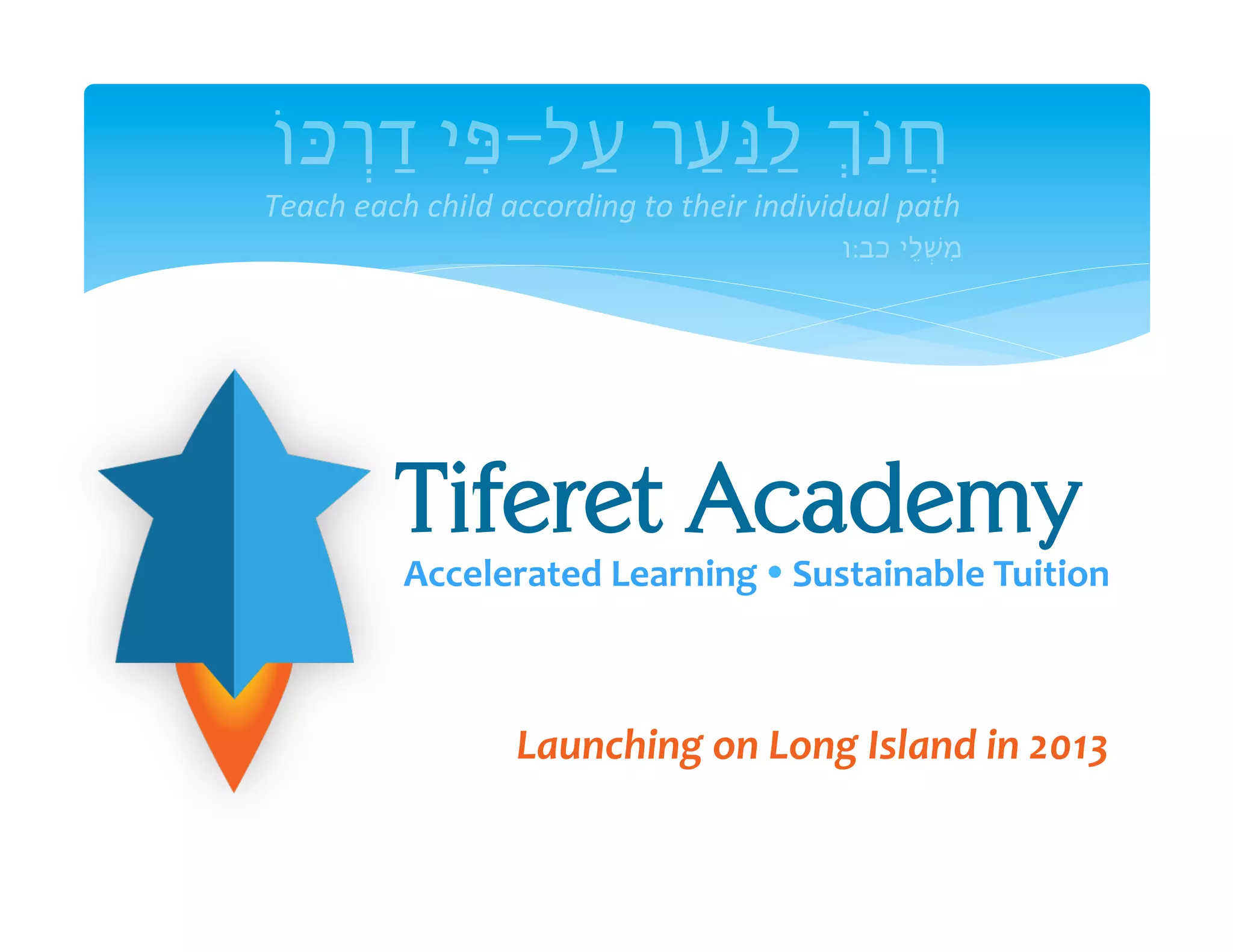
The cover slide establishes the school's identity: Tiferet Academy. It features a rocket-shaped Star of David logo, signaling a launch and a forward-thinking approach. The subtitle, 'Accelerated Learning • Sustainable Tuition,' immediately addresses the two biggest pain points in private religious education: academic rigor and affordability. The inclusion of the Hebrew verse 'Chanoch l'na'ar al pi darko' (Teach each child according to their individual path) from Proverbs 22:6 provides the religious justification for the individualized, technology-driven model that follows.
Slide 2: The 21st Century Classroom
Slide 2 uses a Venn diagram to define their educational philosophy. The '21st Century Classroom' sits at the intersection of Real-World Skill Focus , Blended Learning , and Project-Based Learning . This is a standard pedagogical framework for 'New School' models, emphasizing that the institution is not merely a traditional school with computers added, but a complete redesign of the learning environment.
Slide 3: The Blended Learning Model
This is the most important operational slide in the deck. It illustrates a rotation model where students move between three modalities: Online Instruction , Teacher-led Instruction , and Collaborative Activities . The diagram shows a clear flow, indicating that the teacher is not the sole source of information but a facilitator who works with small groups while other students engage with software or peers. This model is intended to increase the 'student-to-teacher' ratio for direct instruction without increasing the total number of staff, which is the primary driver of 'Sustainable Tuition.'
Slide 4: Proof of Concept (Acton Academy)
Since Tiferet Academy had not yet launched, they relied on external validation. Slide 4 cites Acton Academy , a private school in Austin, TX. The slide presents a bar chart showing that Acton students, who were already one grade level ahead of public school peers in September 2010, gained 2.5 grade levels in math and reading by June 2011. This data is used to prove that the blended learning model can produce outsized academic results in a short timeframe.
Slide 5: Intellectual Endorsements
To further build credibility, the deck quotes three prominent figures in education and creativity: Sir Ken Robinson , Geoff Mulgan , and Seth Godin . The quotes emphasize that learning should be active, collaborative, and 'something you choose to do' rather than something 'done to you.' This aligns the school with the broader educational reform movement of the era, appealing to parents who may be dissatisfied with the 'factory model' of traditional schooling.
Slide 6: Tiferet Values
This slide bridges the gap between modern pedagogy and traditional Jewish education. It lists ten core values, ranging from Torah & Mitzvot and Ivrit B'Ivrit to Entrepreneurial skills and Critical thinking . By placing 'Individual development' and 'Healthy, active lifestyle' alongside 'Tikun Olam,' the school promises a holistic approach that prepares children for both the 'modern real world' and a committed Jewish life.
Slide 7: Plan for Growth
The roadmap for the school is conservative and demand-driven. According to Slide 7, the school planned to open with one section each for Kindergarten, 1st Grade, and 2nd Grade , with Pre-K being optional based on demand. The strategy is to 'Add a new grade each year going forwards.' This is a typical 'slow-growth' model for new private schools, allowing the institution to refine its culture and operations before scaling to middle or high school levels.
Slide 8: Education / Curriculum Status
Slide 8 reveals that the project was in its early stages. The 'Current Status' indicates they were still 'evaluating multiple educational consulting firms' and that the curriculum would not be finalized until a 'Head of School search' was concluded. The slide also calls for volunteers for a committee to research best practices and interview parents. This suggests the deck was used as a recruitment tool for both students and founding board members.
Slide 9: Technology Strategy
Similar to the curriculum slide, the technology slide shows work in progress. The team was 'Researching multiple Blended Learning providers' and 'Setting up [a] website.' The tasks for the technology committee included selecting vendors and overseeing the hardware and app strategy. For a school whose value proposition is built on technology, this slide indicates that the specific tools (e.g., Khan Academy, DreamBox, etc.) had not yet been selected.
Slide 10: Myth & Reality
The final slide in this set addresses common objections. It tackles the 'Myth' that cheaper education is lower quality by asserting that data shows students perform better in blended environments. It also refutes the idea that computers replace teachers, arguing instead that the model is 'teacher-centric' because it frees teachers to do what they do best: teach. This is a defensive but necessary slide to reassure parents who might fear their children will spend all day staring at screens.
What Works in This Deck
Clear Value Proposition: The deck identifies a clear problem (tuition costs and academic stagnation) and offers a specific structural solution (blended learning). The 'Sustainable Tuition' hook is particularly effective for the target audience of Jewish day school parents.
Use of External Data: By citing Acton Academy's 2.5-grade-level gain, the founders provide a 'reason to believe' in a model that they haven't yet implemented themselves. This is a standard and effective tactic for pre-launch ventures.
Visualizing the Model: The rotation diagram on Slide 3 is excellent. It demystifies the term 'blended learning' and shows exactly how a student's day is structured, which helps parents visualize the experience.
What Is Missing
The Team: In the first 10 slides, there is no mention of the founders' backgrounds. In education, the 'who' is as important as the 'what.' Investors and parents need to know if the founders have experience in school administration, finance, or technology.
Financial Specifics: While 'Sustainable Tuition' is a key pillar, the deck does not define what that means in dollars. Is it $10,000? $15,000? Without a price point or a basic budget, the sustainability claim is just a theory.
The 'Ask': As a parlor meeting deck, there should be a clear call to action. While Slide 8 and 9 mention committee tasks, there is no slide in this set detailing the capital requirements to open the doors in 2013.
Founder Takeaways
Address the 'Myth' Early: If your business model involves a trade-off that people perceive as a negative (e.g., 'cheaper must be worse'), address it head-on as Tiferet did on Slide 10. Don't let the objection fester in the audience's mind.
Borrow Credibility: If you don't have your own metrics yet, find a 'comparable' company or institution that does. The Acton Academy slide is a perfect example of how to use a proxy to prove a concept.
Align Values with Innovation: Tiferet successfully blended ancient religious values with modern educational technology. For any niche market, showing how your 'disruption' actually supports the community's core values is essential for adoption.
Frequently asked questions
- What is the primary value proposition of Tiferet Academy?
- Tiferet Academy aims to solve the 'tuition crisis' in Jewish education by using a blended learning model. According to Slide 1 and Slide 10, the goal is to provide high-quality, 'accelerated' learning while maintaining 'sustainable tuition.' They argue that technology-integrated classrooms allow for a more efficient use of resources without sacrificing academic outcomes, citing external data where students gained 2.5 grade levels in one year.
- How does the school's 'Blended Learning Model' actually work?
- As detailed on Slide 3, the model uses a rotation system. Students move between three distinct stations: Online Instruction (individualized computer work), Teacher-led Instruction (small group direct teaching), and Collaborative activities led by a paraprofessional assistant. This structure is designed to allow teachers to focus on high-impact instruction while students progress at their own pace through digital curriculum.
- What was the status of the school's curriculum at the time of this deck?
- The curriculum was in the development phase. Slide 8 states that the school was 'currently evaluating multiple educational consulting firms' and that the final curriculum would only be finalized after a Head of School was hired. This indicates the deck was used for early-stage community building and fundraising before the operational details were fully solidified.
- What are the core Jewish values integrated into the school?
- Slide 6 lists several foundational values, including Torah & Mitzvot, Middot & Derech Eretz (character and ethics), Am Yisrael & Eretz Yisrael (Jewish peoplehood and Israel), and Tikun Olam (repairing the world). The school also emphasizes 'Ivrit B'Ivrit,' suggesting a Hebrew-immersion approach to Judaic studies alongside secular academic goals like entrepreneurial skills and critical thinking.
- What is missing from this deck compared to a standard startup pitch?
- This deck is a 'Parlor Meeting' presentation, which is more community-focused than a venture capital deck. It lacks a formal 'Team' slide with bios, a detailed 'Ask' (specific dollar amount), a budget or five-year financial projection, and a competitive analysis of other Jewish day schools in the Long Island area. It functions primarily as a vision-casting document.