Tines, an enterprise automation platform founded in 2018, utilized this 9-slide deck to articulate a clear solution to the 'Cambrian Explosion of Software.' The deck is notable for its brevity, eschewing traditional team bios and detailed financial projections in favor of high-impact customer testimonials from McKesson and OpenTable. By framing the problem through the lens of a technical skills gap—where 32% of organizations take six months to fill a security role—Tines positions its no-code automation as a necessity rather than a luxury. The deck successfully bridges the gap between a niche…
Key takeaways
- The deck identifies a specific 'Technical Skills Gap' where 32% of organizations take six months to fill cybersecurity positions (Slide 3).
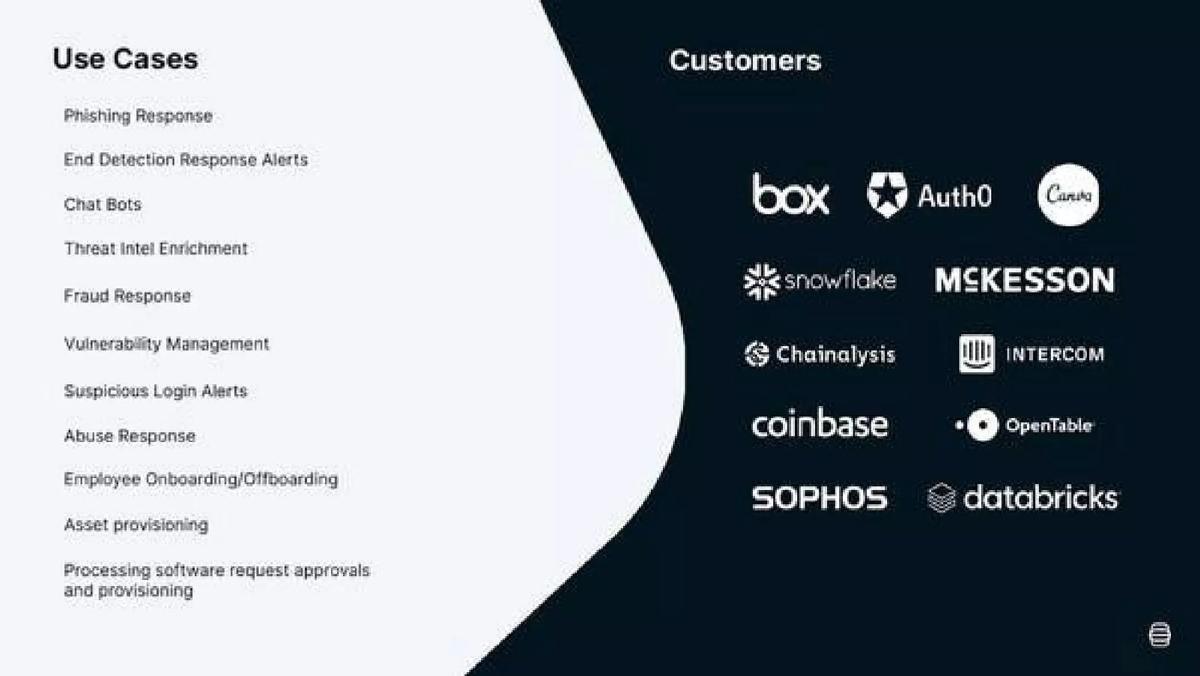
- Tines leverages high-profile enterprise logos including Box, Coinbase, and Snowflake to demonstrate market fit (Slide 6).
- The 'Why Now' narrative is supported by a 67% increase in security breaches since 2014 (Slide 4).
- Product efficiency is quantified via a McKesson testimonial stating one implementation frees up 1.5 analysts per week (Slide 8).
- The market opportunity is framed as a shift from a $4.26 billion market in 2016 to an $18.45 billion market by 2023 (Slide 9).
- The deck omits a dedicated team slide, instead mentioning founders' backgrounds at eBay, PayPal, and DocuSign within the introductory text (Slide 2).
- There is no explicit 'Ask' or 'Use of Funds' slide included in this 9-slide sequence.
- The product is positioned as 'vendor agnostic,' connecting to any REST API or web application in minutes (Slide 8).
Introduction: The 9-Slide Series B Narrative
Tines, founded in 2018, is a Dublin-based enterprise automation platform that has successfully navigated the transition from a specialized security tool to a broad enterprise utility. This 9-slide deck represents a lean approach to fundraising, focusing on high-level market dynamics and social proof rather than granular operational metrics. According to catalogue facts, the company has raised a total of $96,200,000, and this deck serves as a window into how they positioned themselves during their Series B phase.
Slide 1: Title and Value Proposition
The cover slide is minimalist, featuring the Tines logo and the tagline: "Powerful automation, made simple." It sets a tone of efficiency and clarity, which aligns with their core product promise of simplifying complex security workflows.
Slide 2: Defining the Platform
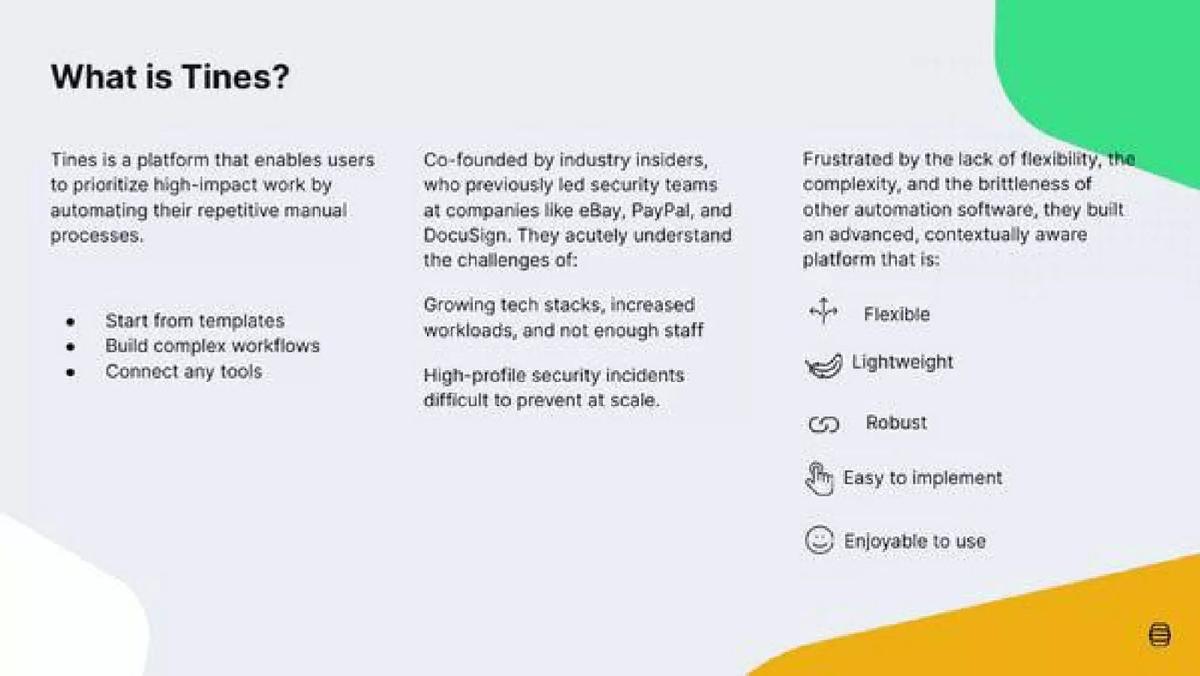
Slide 2, titled "What is Tines?" , provides a three-pronged introduction. It defines the platform as a tool to prioritize high-impact work by automating repetitive processes. Crucially, it introduces the founders not through a dedicated team slide, but as "industry insiders" who previously led security teams at eBay, PayPal, and DocuSign . The slide lists five core attributes: Flexible, Lightweight, Robust, Easy to implement, and Enjoyable to use. This addresses the common pain points of legacy enterprise software which is often perceived as bloated and difficult to deploy.
Slide 3 & 4: The 'Why Now' and Macro Trends
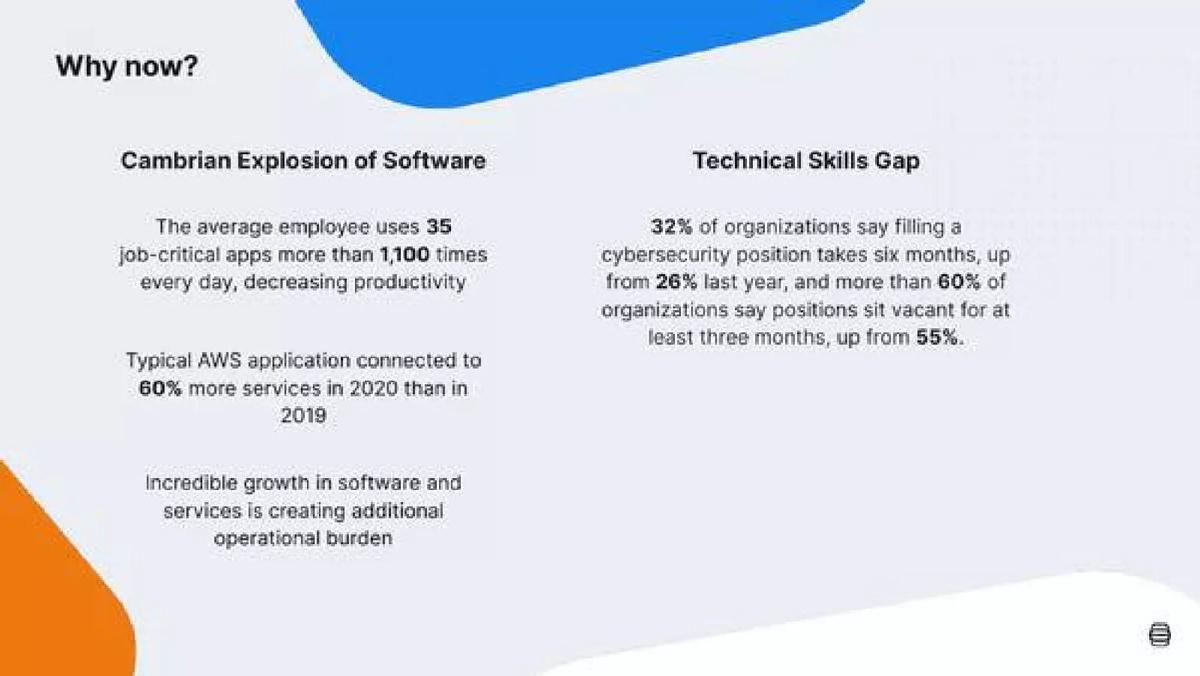
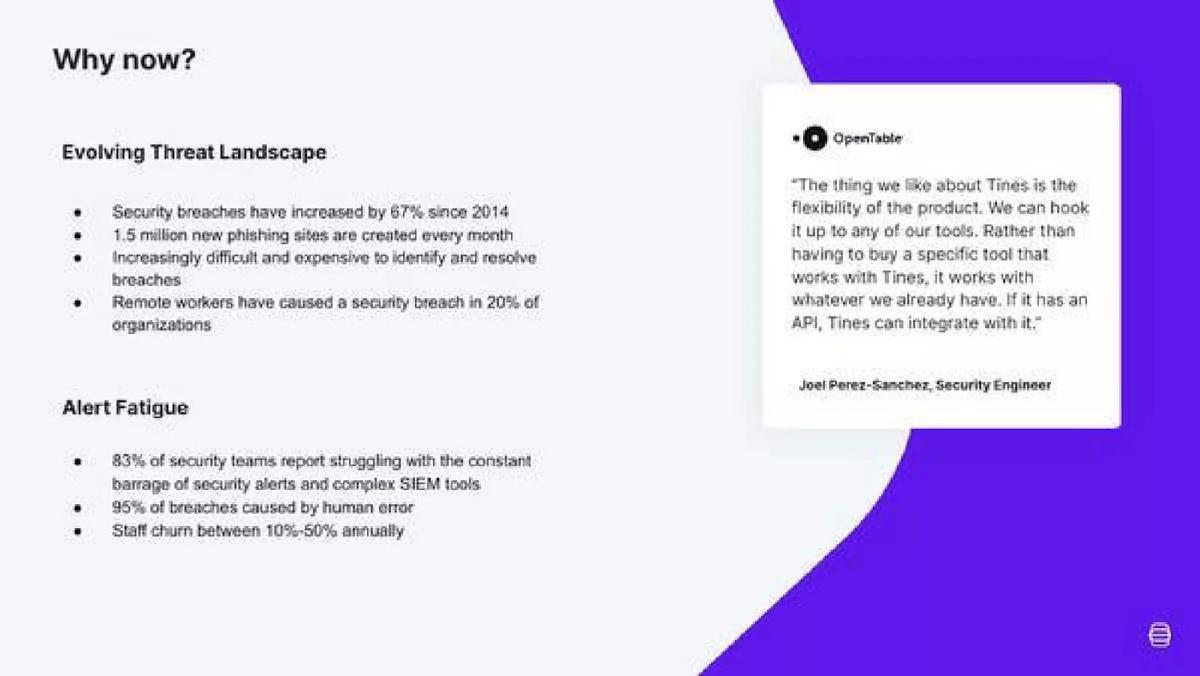
Tines spends two slides (Slide 3 and Slide 4) establishing urgency. Slide 3 cites a "Cambrian Explosion of Software," noting that the average employee uses 35 job-critical apps more than 1,100 times every day . It also highlights a "Technical Skills Gap," stating that 32% of organizations take six months to fill a cybersecurity position. Slide 4 shifts to the "Evolving Threat Landscape," noting that security breaches have increased by 67% since 2014 and 1.5 million new phishing sites are created monthly. By highlighting that 95% of breaches are caused by human error, Tines positions automation as the only viable solution to human fallibility and staff churn (which they cite as being between 10%-50% annually).
Slide 5: The Solution and Competitive Differentiation
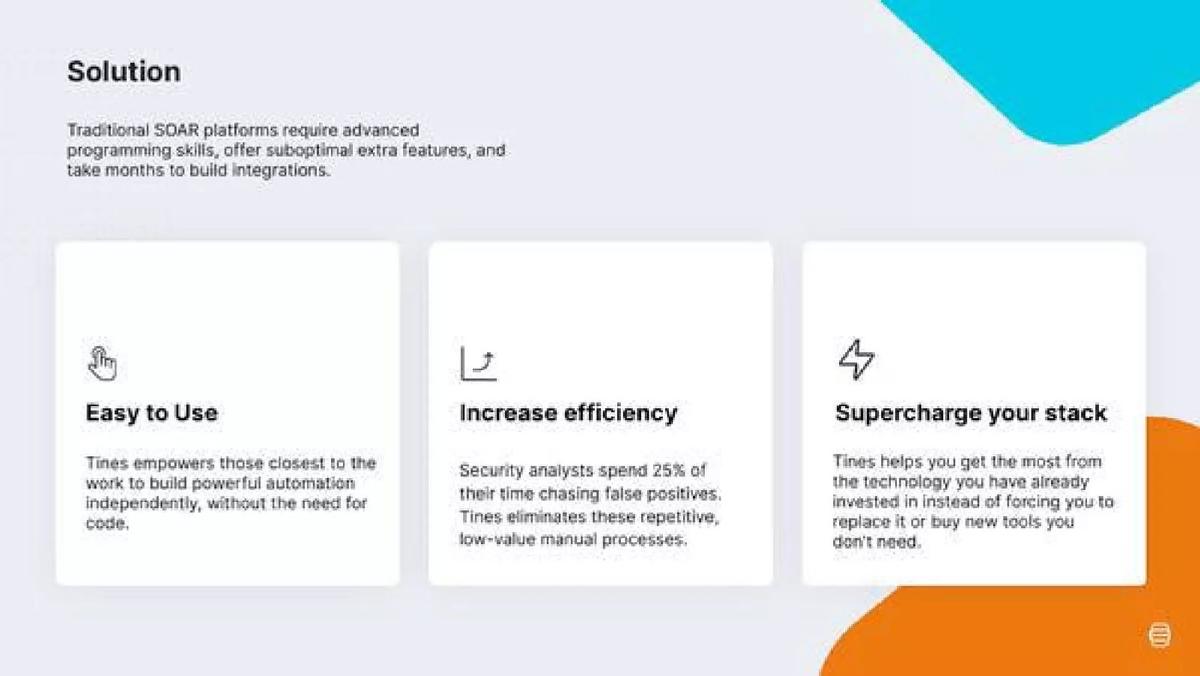
Slide 5 directly attacks "Traditional SOAR platforms," claiming they require advanced programming skills and take months to build integrations. Tines presents its solution through three pillars: Easy to Use (no-code), Increase efficiency (eliminating the 25% of time analysts spend chasing false positives), and Supercharge your stack (leveraging existing investments rather than replacing them).
Slide 6: Use Cases and Customer Validation
This slide is a heavy-hitter for social proof. It lists 11 use cases, ranging from Phishing Response to Employee Onboarding/Offboarding . The right side of the slide is a logo wall featuring Box, Auth0, Canva, Snowflake, McKesson, Chainalysis, Intercom, Coinbase, OpenTable, Sophos, and Databricks . This demonstrates that Tines has already secured a foothold in high-growth tech companies and established Fortune 500 enterprises.
Slide 7: Product Visualization
Slide 7 provides a screenshot of the Tines interface. The caption explains that "Actions perform different steps linked by Events to complete your workflow Stories." This slide is brief but essential, proving that the product is a functional, visual workflow builder rather than just a collection of scripts.
Slide 8: The Automation Advantage
Slide 8 doubles down on the value proposition with a specific testimonial from John McSweeney, Director of Active Defence at McKesson . The quote claims that just one implementation "frees up 1.5 analysts per week." This is a powerful ROI metric. The slide also reiterates that the platform is "vendor agnostic" and connects to any REST API , while signaling a future expansion from security to DevOps, IT, HR, and Marketing .
Slide 9: Market Opportunity
The final slide quantifies the total addressable market. It cites a $4.26 Billion workflow automation market in 2016, projected to grow to $18.45 Billion by 2023 . This represents a CAGR of 23.56% . By ending on this slide, Tines reminds investors that while they are starting in security, they are playing in a massive, rapidly growing horizontal market.
What Works in the Tines Deck
The deck is exceptionally strong at problem framing . By using specific percentages (e.g., the 67% increase in breaches and the 25% of time spent on false positives), Tines makes the need for their product feel inevitable. The inclusion of the McKesson testimonial on Slide 8 is a masterstroke; it moves the conversation from "this tool is cool" to "this tool saves us exactly 1.5 headcounts per week per implementation." Furthermore, the logo wall on Slide 6 is top-tier, showing that they have already won the trust of the most sophisticated security teams in the world (Coinbase, Snowflake, etc.).
What is Missing from the Tines Deck
For a Series B deck, there are several notable omissions. There is no financial data —no ARR, no growth rates, and no unit economics (CAC/LTV). While the founders' backgrounds are mentioned, there is no dedicated team slide showing the broader leadership or engineering talent. Most surprisingly, there is no 'Ask' slide . The deck does not specify how much capital is being raised in this round or how that capital will be deployed. It is likely that these details were handled in a separate data room or supplemental document, but their absence in the primary pitch narrative is unconventional for a late-stage round.
What a Founder Should Copy
Founders should emulate Tines' "Why Now" logic . Instead of just saying the market is big, they explain why the current moment is a breaking point (the explosion of apps vs. the shortage of talent). The clean, high-contrast design is also worth copying; it uses white space effectively and avoids the "wall of text" trap that many technical founders fall into. Finally, the transition from a vertical solution (Security) to a horizontal opportunity (Enterprise-wide) on Slide 8 is a perfect way to show a massive upside without losing focus on the current core business.
Conclusion
The Tines deck is a study in narrative momentum . It moves quickly from a macro problem to a specific solution, validated by the world's most recognizable tech brands. While it lacks the financial transparency typically expected in a teardown, its ability to sell a vision of "simplicity" through a simple, 9-slide presentation is a testament to the company's brand alignment. For a company that has raised nearly $100 million, this deck proves that sometimes, less is indeed more—provided you have the logos and the ROI metrics to back it up.
Frequently asked questions
- What is the primary problem Tines solves according to the deck?
- Tines addresses 'Alert Fatigue' and the 'Cambrian Explosion of Software.' Slide 3 notes that the average employee uses 35 job-critical apps over 1,100 times daily, while Slide 4 highlights that 83% of security teams struggle with a constant barrage of alerts. Tines automates these repetitive manual processes to allow teams to focus on high-impact work.
- How does Tines differentiate itself from traditional SOAR platforms?
- On Slide 5, Tines claims traditional Security Orchestration, Automation, and Response (SOAR) platforms require advanced programming skills and take months to build integrations. Tines differentiates by being 'Easy to Use,' empowering non-coders to build workflows independently, and being 'Lightweight' and 'Flexible' (Slide 2).
- What specific metrics are used to prove the 'Why Now' argument?
- The deck uses several macro-trends: a 60% increase in services connected to typical AWS applications between 2019 and 2020 (Slide 3), 1.5 million new phishing sites created monthly, and the fact that 95% of breaches are caused by human error (Slide 4).
- Who are the target users for Tines beyond security teams?
- While the deck focuses on security, Slide 8 explicitly states the platform's future involves all teams, including DevOps, IT, HR, and Marketing. This suggests a land-and-expand strategy where security is the entry point into the broader enterprise automation market.
- Does the deck provide a detailed roadmap or financial forecast?
- No. The deck is highly conceptual and focused on the current value proposition and market size. It lacks a financial slide, a detailed technical roadmap, or a specific breakdown of how the $96.2 million raised would be allocated across departments.