Time by Ping’s 2022 Series B deck is a masterclass in category creation and vertical expansion. The company identifies a massive, specific pain point—lawyers losing $140B annually due to manual timekeeping—and positions its 'Time Automation' software as the definitive solution. The deck effectively uses a 'wedge' strategy, starting with the high-stakes legal market before outlining a roadmap into accounting and consulting to reach a $10B total ARR opportunity. While the deck is light on traditional SaaS metrics like CAC or churn, it compensates with strong case study data, showing a $90K prof…
Key takeaways
- The legal industry loses $140B annually because of manual timekeeping inefficiencies (Slide 5).
- Time by Ping defines its solution as a new market category called 'Time Automation' (Slide 6).
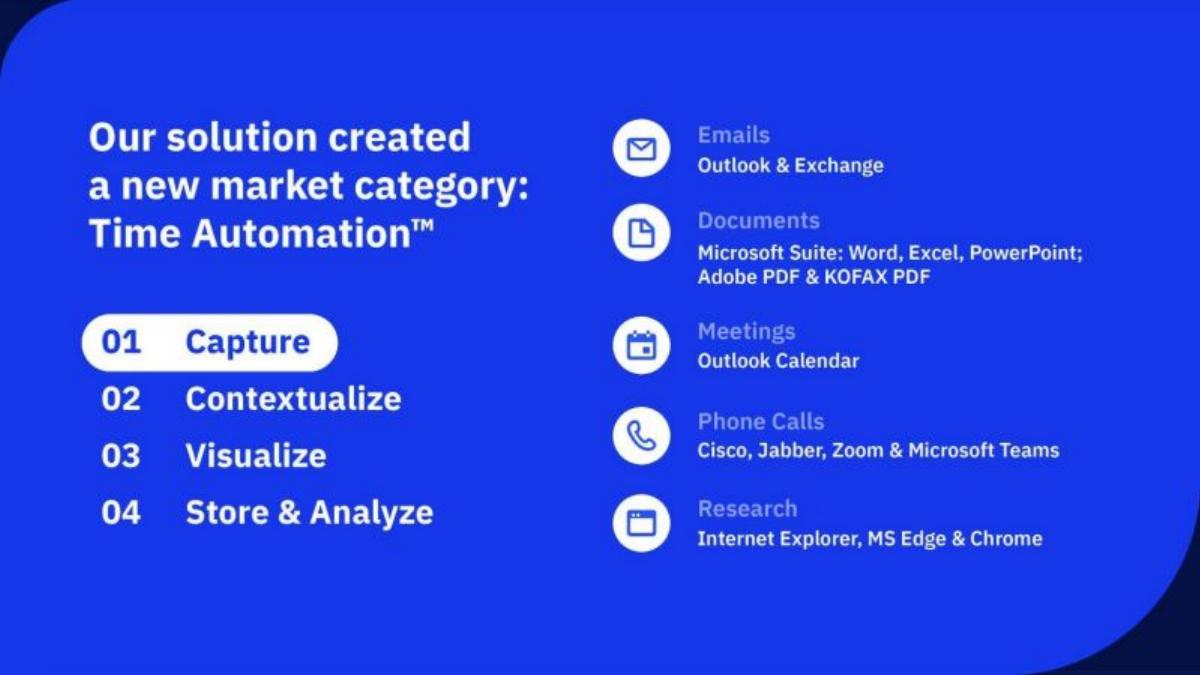
- The software automates capture across emails, documents, meetings, phone calls, and research (Slide 6).
- A case study at a premier law firm showed a $90K direct bottom-line profit increase per timekeeper (Slide 10).
- Firms using the platform see a 7.5% increase in revenue and 35% more time entries (Slide 11).
- The company identifies a $3.5B ARR opportunity in the legal market alone (Slide 14).
- Expansion into accounting and consulting brings the total ARR opportunity to $10B (Slide 15).
- The long-term vision involves moving professional services from a 'Factory Model' of pricing time to pricing outcomes (Slide 17).
Executive Summary and Vision
Slides 1-3: The Category of Time Automation
Time by Ping opens with a clean, minimalist title slide for their 2021 fundraising round. Slide 2 immediately establishes a high-level Vision Statement : "Time by Ping will capture, measure, and value the atomic unit of time to rebuild the working model." This sets the stage for a product that is more than just a utility; it is a structural change to how work is valued.
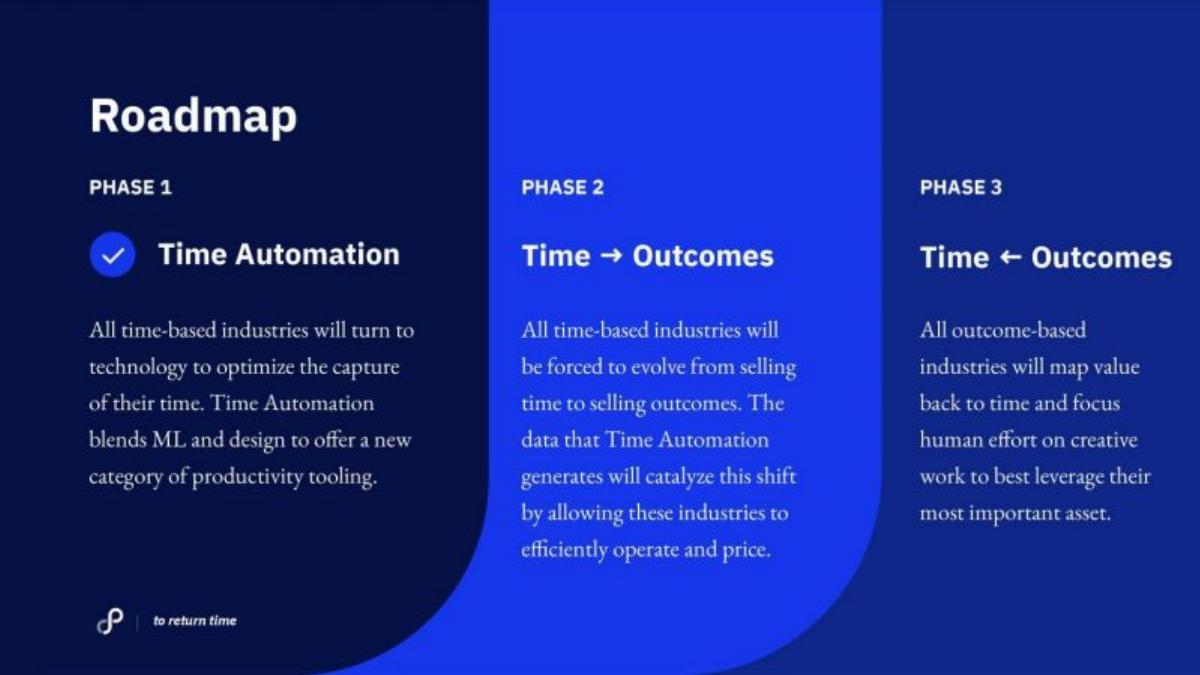
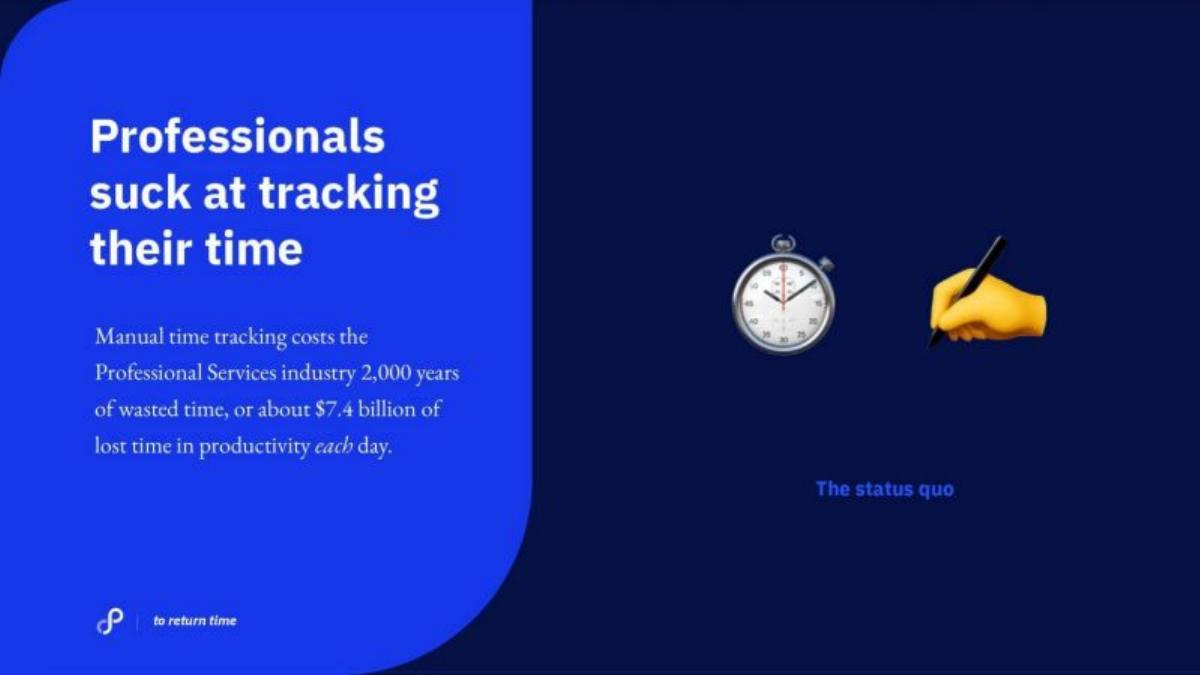
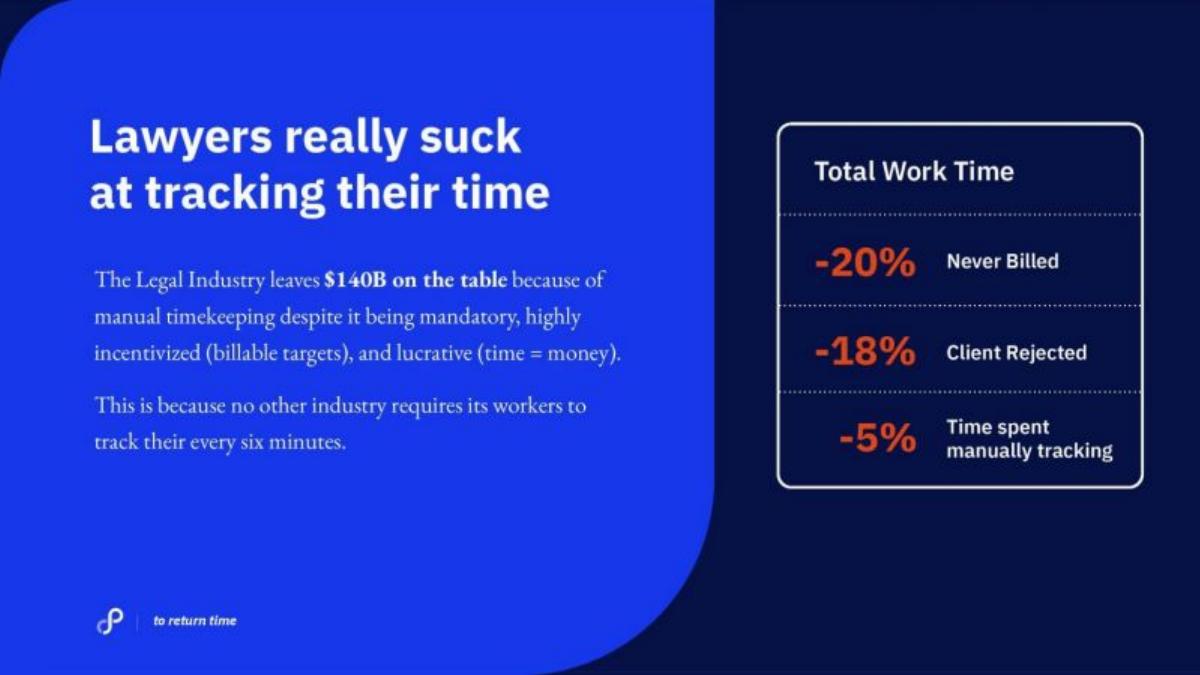
Slide 3 introduces a three-phase Roadmap . Phase 1 is "Time Automation," using ML to optimize time capture. Phase 2, "Time -> Outcomes," suggests a shift where the data generated allows industries to move from selling hours to selling results. Phase 3, "Time Slide 4 uses blunt language: "Professionals suck at tracking their time." It cites a staggering statistic that manual time tracking costs the Professional Services industry $7.4 billion in lost productivity each day . Slide 5 narrows the focus to the legal industry, which is the company's initial wedge. It claims the legal industry leaves $140B on the table due to manual timekeeping.
The deck breaks down the "Total Work Time" loss on Slide 5: 20% is never billed, 18% is rejected by clients, and 5% is wasted on the act of manual tracking itself. This slide is the "why now" and "why this matters" of the deck, providing a massive, quantifiable problem that justifies a high-valuation Series B.
The Solution: How Time Automation Works
Slides 6-9: Product and Process
Slide 6 introduces the four-step process of their solution: Capture, Contextualize, Visualize, and Store & Analyze . It lists the integrations that allow for automatic capture, including Outlook, Microsoft Suite, Zoom, and various web browsers. This demonstrates that the software lives where the work happens, requiring no manual input from the user.
Slide 7 goes deeper into the "Contextualize" phase. It shows how the system uses Named Entity Recognition to identify the client/matter, Natural Language Processing to write the narrative, and Machine Learning to assign billing codes. Slide 8 and 9 provide UI mockups of the "Visualize" and "Store & Analyze" phases, showing a clean, chronological timeline of a lawyer's day. The visual evidence of the product looks polished and enterprise-ready.
Proof of Value: Case Studies and ROI
Slides 10-12: The Economic Impact
Slide 10 presents a "Case in Point" for a premier law firm. The results are impressive: $90K direct bottom-line profit per timekeeper . It also notes that it only takes two timekeepers using the platform to recoup the entire cost of the software. This "2:1" ratio is a powerful sales and investment metric.
Slide 11 broadens the value proposition to three stakeholders: Timekeepers (saving 1-2 hours per week), Firms (7.5% more revenue), and Clients. Slide 12 specifically addresses the client benefit, showing a "Before TBP" entry ("Working on client requests - 8.5 hours") versus an "After TBP" breakdown of six specific, granular tasks. This transparency builds trust and reduces the 18% client rejection rate mentioned earlier in the deck.
Market Opportunity and Expansion
Slides 13-16: The $10B Wedge
Slide 13 asks the pivotal question: "So why are we looking for a Series B?" Slide 14 answers by defining the legal market opportunity at $3.5B ARR , split between Enterprise ($1B), Corporate ($0.5B), and SMB ($2B). Slide 15 then reveals the broader ambition: landing the next time-based verticals. By adding Accounting ($2.5B) and Consulting ($4B), the Total ARR Opportunity reaches $10B .
Slide 16 reinforces the "wedge" concept, stating that the legal market is just the starting point for replacing an antiquated value chain. This sequence is designed to show that while the company is currently a "legal tech" play, its ceiling is much higher.
The Future of Professional Services
Slides 17-19: Moving Beyond the Factory Model
Slide 17 argues that professional services will abandon the "Factory Model" (pricing on time) in favor of outcome-based pricing. Slide 18 shows a "Time Data Feedback Loop," where aggregated industry data enables firms to price more efficiently. Slide 19 uses an iceberg graphic to show the scale of the opportunity: while Law, Accounting, and Consulting represent about 3.7M workers, the total number of digital workers worldwide is 1B . This is the "moonshot" slide of the deck.
The Team and the Ask
Slides 20-21: Humanizing the Mission
Slide 20, "A Team Connected by Time," is unique. Instead of standard corporate headshots, it features personal photos of the team with their families or in personal settings. The text emphasizes that "Life has taught us the true Value of Time." While it lists impressive backgrounds (Lawyer @ Manatt, SVP @ Symantec, First Designer @ Nest), the focus is on a shared personal mission. This is a sophisticated way to signal culture and retention to Series B investors.
Slide 21 outlines the $30M Raise . The goals are clear: dominate the core legal market, replicate in adjacent industries, and maintain the mission-driven team. It also lists what they are looking for in an investor: mission-alignment, experience with product-led growth, and experience "jumping verticals."
Final Documentation
Slides 22-23: Sources and Appendix
Slide 22 provides a comprehensive list of 13 sources for the statistics used throughout the deck, ranging from Grand View Research to the Labor Department. This adds a layer of professional rigor and due diligence readiness. Slide 23 is a standard promotional slide for the platform where the deck was hosted.
What Works, What is Missing, and What to Copy
What Works
Clear Category Creation: The term "Time Automation" is used consistently to differentiate the product from "time tracking" or "billing software." · Quantifiable ROI: The $90K profit per timekeeper and the 7.5% revenue increase are "hard" numbers that make the investment case easy to understand. · The Wedge Strategy: Starting with the most difficult, high-value use case (lawyers billing in 6-minute increments) makes the expansion into accounting and consulting feel inevitable rather than aspirational.
What is Missing
Standard SaaS Metrics: For a Series B, the deck is surprisingly light on traditional metrics like Net Revenue Retention (NRR), CAC Payback, or Churn. It relies more on the market opportunity and case study data. · Competitive Landscape: There is no mention of existing incumbents in the legal billing space or other automated time-tracking competitors. · Financial Projections: While the ARR opportunity is defined, the deck does not show the company's actual current ARR or its projected growth over the next 3-5 years.
What a Founder Should Copy
The "Before and After" Slide: Slide 12 is a perfect example of showing, not just telling, the product's value. It visually demonstrates how the software improves the end-product (the bill) for the customer. · The Roadmap Slide: Slide 3 is an excellent way to show a long-term vision that feels grounded in a logical progression of technology and market shifts. · The Sources Slide: Including a dedicated slide for data citations (Slide 22) builds immediate credibility and saves time during the due diligence process.
Frequently asked questions
- What is the core problem Time by Ping is solving?
- The company addresses the massive financial leakage in professional services caused by manual time tracking. According to slide 5, the legal industry leaves $140B on the table because 20% of work time is never billed and 18% of billed time is rejected by clients. Lawyers are required to track their time in six-minute increments, a process that is both lucrative and highly prone to human error.
- How does the 'Time Automation' technology actually work?
- As detailed in slides 6 and 7, the platform automatically captures activity from work tools like Outlook, MS Office, Zoom, and web browsers. It then uses Named Entity Recognition (NER), Natural Language Processing (NLP), and Machine Learning to 'contextualize' this data—automatically assigning activities to specific clients, matters, and billing codes with narrative descriptions.
- What are the primary benefits for law firms?
- The deck highlights three major outcomes for firms on slide 11: a 7.5% average increase in revenue, faster cash flow (70% of users release time daily), and 'richer data' through a 35% increase in the number of time entries. Slide 10 quantifies this as a $90K profit increase per timekeeper.
- What is the company's expansion strategy beyond legal?
- Time by Ping views the legal market as a 'wedge.' Slide 15 outlines a plan to move into Accounting ($2.5B ARR opportunity) and Consulting ($4B ARR opportunity). By 'jumping verticals,' the company aims to capture a total addressable market of $10B ARR, eventually targeting all 1B digital workers worldwide (Slide 19).
- What was the specific fundraising goal in this deck?
- Slide 21 states a target of a $30M raise (though the catalogue facts indicate they ultimately raised $36.5M). The funds were earmarked for dominating the core legal market, replicating the model in adjacent industries, and scaling a 'mission-oriented' team.