Thunkable’s Series B pitch deck is a lean, 10-slide presentation that successfully transitioned the company from a niche developer tool to a scalable enterprise solution. By focusing on the 'native' capabilities of their no-code platform—such as Bluetooth, GPS, and push notifications—they differentiated themselves from the crowded field of web-app builders. The deck relies heavily on impressive organic growth metrics, boasting a 41% sign-up conversion rate and hundreds of weekly product-qualified leads (PQLs) without significant marketing spend. While the deck lacks a traditional financial pr…
Key takeaways
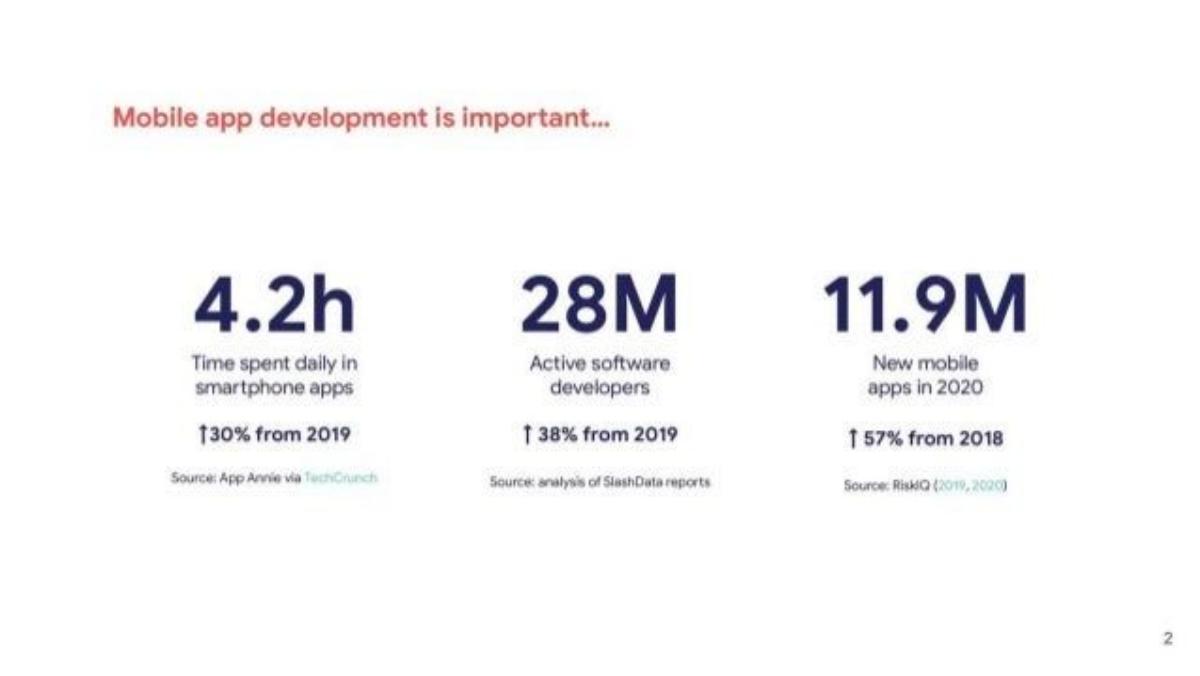
- The deck highlights a massive market opportunity with 11.9M new mobile apps launched in 2020, a 57% increase from 2018 (Slide 2).
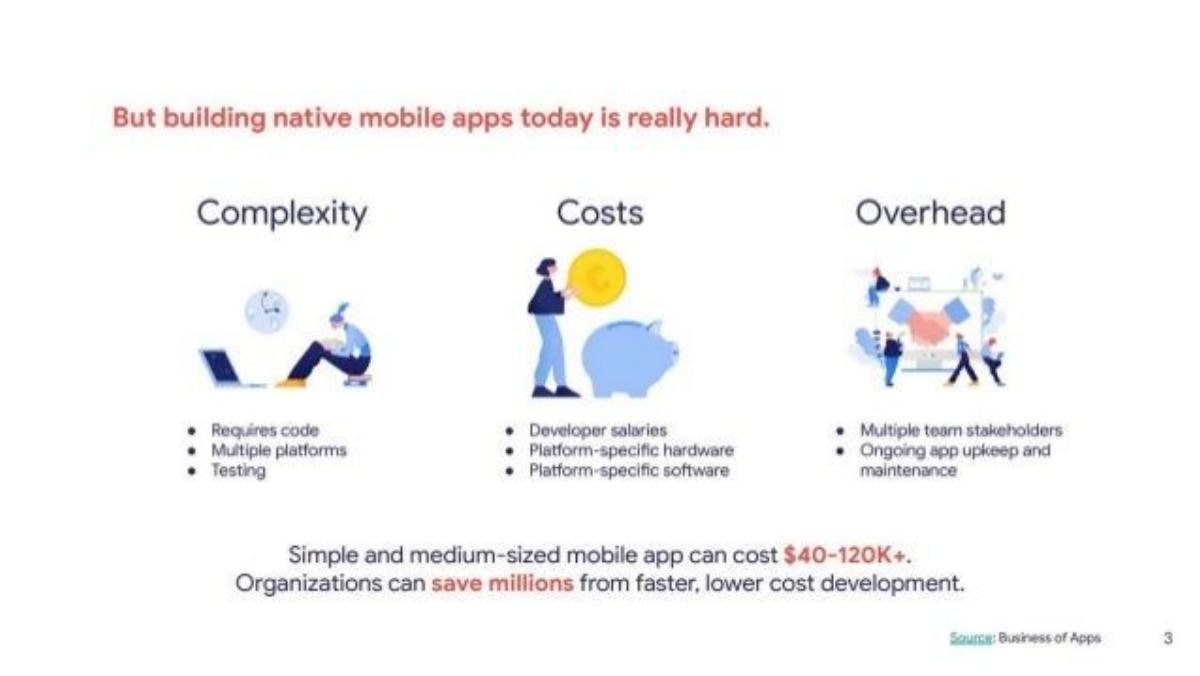
- Thunkable quantifies the pain point by stating simple mobile apps cost between $40K and $120K+ to develop traditionally (Slide 3).
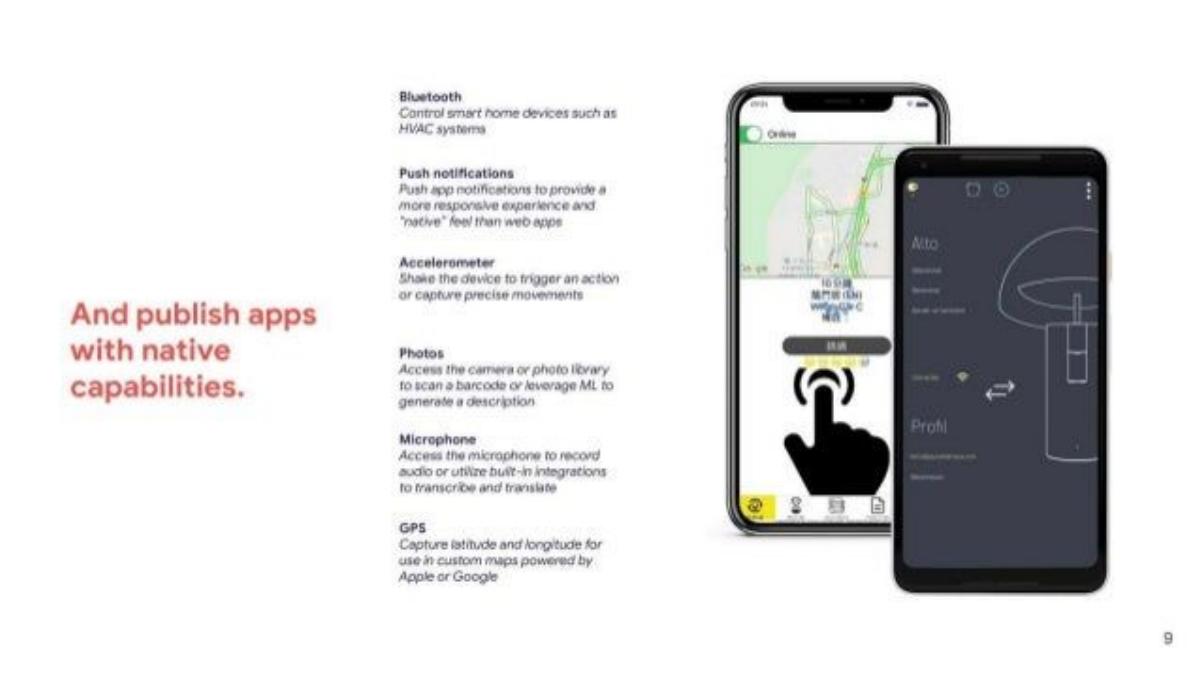
- The platform differentiates itself through 'native' features like Bluetooth, Accelerometer, and GPS, which are often missing in standard no-code web builders (Slide 9).
- Growth is almost entirely organic, with 42% of traffic coming from direct sources and 38% from organic search (Slide 12).
- The company achieves a remarkably high sign-up conversion rate of 41% (Slide 12).
- The business model is evolving toward enterprise contracts and future revenue-share integrations with partners like Stripe and AdMob (Slide 15).
- The co-founders possess deep domain expertise, having worked together on no-code building for 11 years, starting with the MIT-Google 'Blockly' project (Slide 5).
- The deck omits specific financial revenue figures, churn rates, and a detailed competitor comparison matrix.
The Series B Narrative: From Tool to Platform
Thunkable’s 2022 Series B deck is a study in efficiency. At only 10 slides, it manages to cover the essential bases of a growth-stage round: market tailwinds, product differentiation, organic traction, and team pedigree. The deck’s design is clean, utilizing a consistent red and white color palette that mirrors the brand’s logo. For a Series B, investors are typically looking for a 'money-in, growth-out' machine. Thunkable delivers this by showing a highly efficient organic funnel and a clear plan to layer on paid sales and marketing.
Slide 1: The Cover
The deck opens with a simple, bold statement: 'The no-code platform to build native mobile apps.' The inclusion of 'native' is the most important word on this slide. In the no-code world, there is a massive distinction between 'web apps' (which run in a browser) and 'native apps' (which are downloaded from an app store and have full hardware access). By leading with this, Thunkable immediately carves out its niche.
Slide 2: Market Importance
Slide 2 establishes the macro environment. It cites three key metrics: 4.2 hours spent daily in smartphone apps (up 30% from 2019), 28M active software developers (up 38% from 2019), and 11.9M new mobile apps in 2020 (up 57% from 2018). This slide serves to prove that despite the maturity of the mobile market, the demand for app creation is still accelerating, not plateauing.
Slide 3: The Problem – Complexity, Costs, and Overhead
Thunkable breaks down the barriers to entry into three buckets. They note that a 'simple and medium-sized mobile app can cost $40-120K+.' This is a critical anchor for their pricing strategy. By highlighting that organizations can 'save millions' through faster development, they shift the conversation from a 'cool tool for hobbyists' to a 'cost-saving enterprise solution.' The slide mentions platform-specific hardware and ongoing upkeep as hidden costs that their platform eliminates.
Slide 8: The Solution – Visual Building
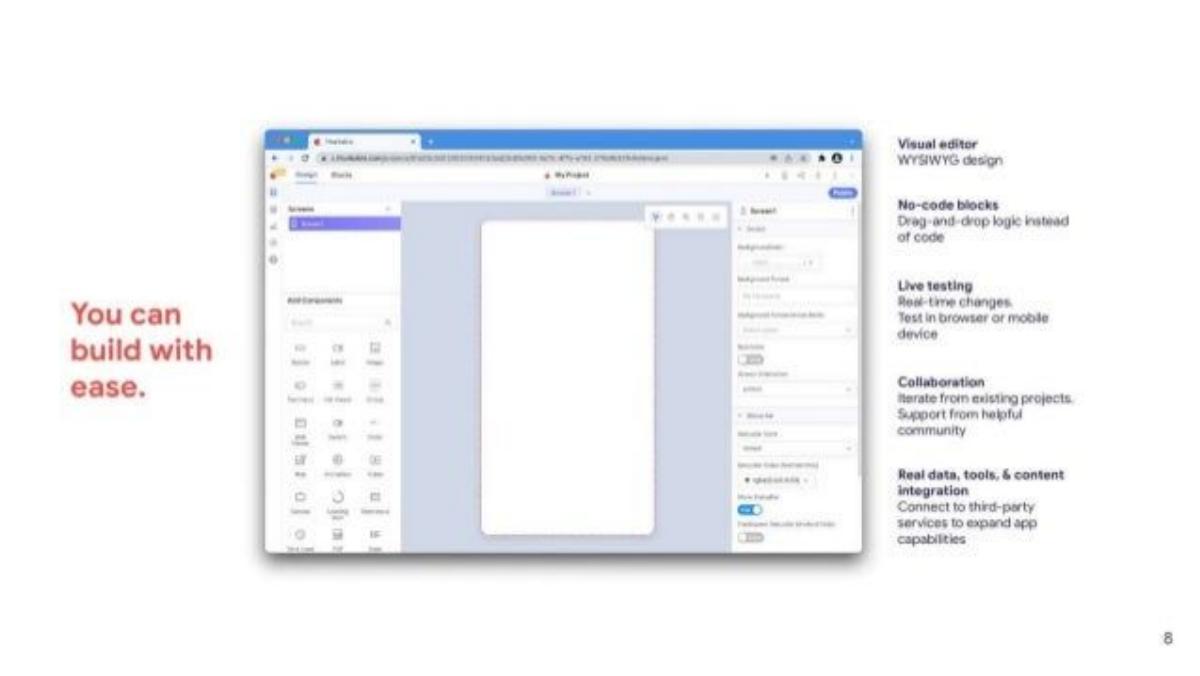
Skipping ahead to the product interface, Slide 8 showcases the 'Thunkable' workspace. It highlights a 'Visual editor,' 'No-code blocks' for logic, and 'Live testing.' The most important bullet point here is 'Real data, tools, & content integration.' This addresses a common criticism of no-code: that it creates 'dumb' apps. By showing third-party service expansion, they prove the platform’s extensibility.
Slide 9: Native Capabilities
This is arguably the most important technical slide in the deck. It lists specific hardware integrations: Bluetooth (HVAC systems), Push Notifications, Accelerometer, Photos (ML-generated descriptions), Microphone (transcription), and GPS. For an investor, this slide proves that Thunkable isn't just a UI builder; it’s a sophisticated wrapper for complex mobile hardware, making it viable for IoT and professional enterprise use cases.
Slide 10: Integrations and Ecosystem
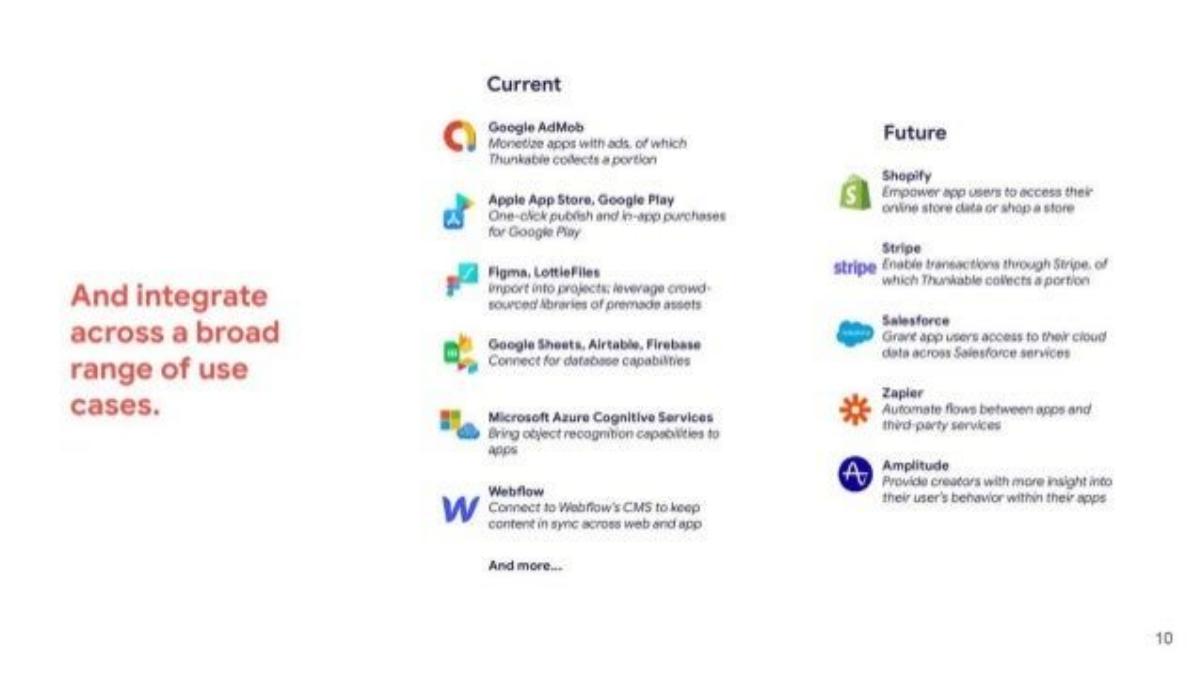
Slide 10 maps out the 'Current' and 'Future' ecosystem. Current integrations include Google AdMob, Apple/Google App Stores, Figma, and Airtable. The 'Future' column is a strategic roadmap, listing Shopify, Stripe, Salesforce, and Zapier. This signals to investors that Thunkable plans to move deeper into the e-commerce and CRM markets, where the 'B2B2C' business model truly thrives.
Slide 12: The Organic Growth Engine
This slide is the 'meat' of the Series B pitch. It reveals that growth is 'almost entirely organic,' with 42% direct and 38% organic search traffic. The standout figure is the 41% sign-up conversion rate. In the SaaS world, a 41% conversion from visitor to sign-up is exceptionally high. They also mention '100s of Product Qualified Leads per week,' defining PQLs as users with an 'intent to create a custom app to support their business.' This proves that their user base isn't just students—it's commercial buyers.
Slide 13: Retention and Switching Costs
Slide 13 addresses the 'moat.' They argue that Thunkable simplifies updates to app store requirements, meaning teams don't need to re-hire developers for every iOS or Android update. Furthermore, they explicitly mention 'Switching Costs,' stating that rebuilding a Thunkable app in code would require replicating logic and reconnecting integrations, which creates a natural lock-in effect for their customers.
Slide 15: The Ask – Scaling the Machine
The 'Ask' slide is focused on three pillars: Self-Serve (SEM and referrals), Enterprise Contracts (outbound sales team), and Revenue Share (future monetization through integrations). This is a classic Series B strategy: taking a proven organic product and applying capital to build a professional sales and monetization layer. It’s worth noting that the slide does not state the specific dollar amount being raised, though catalogue facts confirm it was $30M.
Slide 5: The Pedigree
The team slide is positioned to close the loop on credibility. It highlights that the co-founders have been working together for 11 years and were the team behind 'Blockly,' a collaboration between MIT and Google. This 'origin story' is incredibly powerful in the no-code space, as it suggests they didn't just join the trend—they helped invent the underlying technology. The slide also lists a team of 14 across the US, Canada, and the EU, with backgrounds at Lyft, IDEO, and Asana.
What Thunkable Does Well
The deck excels at differentiation through technical specificity . While many no-code decks stay at a high level of 'anyone can build an app,' Thunkable gets into the weeds of Bluetooth and Accelerometers. This appeals to investors who are wary of the limitations of 'low-code' tools. Secondly, the organic funnel metrics are the strongest part of the pitch. A 41% conversion rate suggests a product that is solving a very high-intent problem. Finally, the founder-market fit is undeniable; having the creators of Blockly pitching a no-code platform is a 'best-in-class' scenario for VCs.
What is Missing from the Deck
Despite its strengths, the deck has notable omissions. There is no financial data —no MRR (Monthly Recurring Revenue), no ARR (Annual Recurring Revenue) growth charts, and no Net Revenue Retention (NRR) figures. For a Series B, this is unusual and suggests that these details were likely reserved for a secondary 'data room' or a more confidential appendix. There is also no competitive landscape . The no-code space is crowded with giants like Bubble, Adalo, and Glide; Thunkable chooses to ignore them entirely in this presentation, relying on their 'native' focus to implicitly differentiate. Lastly, there is no mention of churn or customer acquisition cost (CAC), which are vital for evaluating the long-term health of a SaaS business.
What Founders Should Copy
Founders should emulate Thunkable’s 'Problem-to-Cost' translation on Slide 3. Instead of just saying 'app development is slow,' they put a dollar amount on it ($40K-$120K). This makes the ROI of their product immediately calculable for an investor. Additionally, the 'Current vs. Future' integration map on Slide 10 is an excellent way to show a product roadmap without needing a complex Gantt chart. It shows where the product is today and how it will become more valuable (and more monetizable) tomorrow. Finally, the use of Product Qualified Leads (PQLs) as a metric is a sophisticated way to show traction for a freemium product, as it filters out the 'noise' of free users and focuses on the high-value business intent that drives enterprise value.
Frequently asked questions
- What is the primary value proposition of Thunkable according to the deck?
- Thunkable positions itself as the premier no-code platform for building 'native' mobile apps. Unlike many competitors that focus on web apps or wrappers, Thunkable emphasizes access to device-level hardware like the microphone, GPS, and Bluetooth, while reducing the development cost from the typical $40K-$120K range to a fraction of that through a visual, drag-and-drop interface.
- How does Thunkable prove market demand in this pitch?
- The deck uses a combination of macro market data and internal funnel metrics. Slide 2 shows a 30% increase in time spent in apps since 2019, while Slide 12 reveals that the platform generates hundreds of 'Product Qualified Leads' (PQLs) per week. The 41% sign-up conversion rate serves as a powerful proof point for product-market fit.
- What is the 'Native' advantage mentioned in the slides?
- On Slide 9, Thunkable details that its apps aren't just mobile-responsive websites. They are native applications that can trigger push notifications, use the accelerometer for motion capture, and integrate with BLE (Bluetooth Low Energy) for IoT devices. This technical depth is a key differentiator for B2B2C use cases requiring high performance.
- What is the intended use of the $30M Series B funds?
- According to Slide 15, the capital is earmarked for shifting from purely organic growth to 'non-organic' channels. This includes investing in SEM (Search Engine Marketing), building an active sales team for enterprise contracts, and developing engineering integrations for future revenue-sharing models with platforms like Shopify and Salesforce.
- Who are the key people behind Thunkable?
- The team is led by CEO Arun Saigal and CTO WeiHua Li. Their pedigree is a central selling point; they were part of the original MIT-Google collaboration that built 'Blockly' in 2010. The team also includes veterans from Google, MIT, Harvard, and Red Hat, providing significant technical and institutional credibility.