Tiko’s 2021 Series A deck is a masterclass in presenting a capital-intensive business model with a focus on technological efficiency and superior unit economics. Operating in the European PropTech space, Tiko differentiates itself from US-based iBuyers like Opendoor by maintaining a significantly leaner team—35 members versus 1,600—while achieving a 6.0% net margin per transaction. The deck highlights their proprietary TikoAnalytics AVM, which processes 2.8 million data points daily to provide instant liquidity to sellers. By utilizing a dual-channel revenue model consisting of digital broker…
Key takeaways
- Tiko operates a dual-channel revenue model: Digital Brokerage for capital-light transactions and Buy-to-Sell for direct property acquisitions (Slide 8).
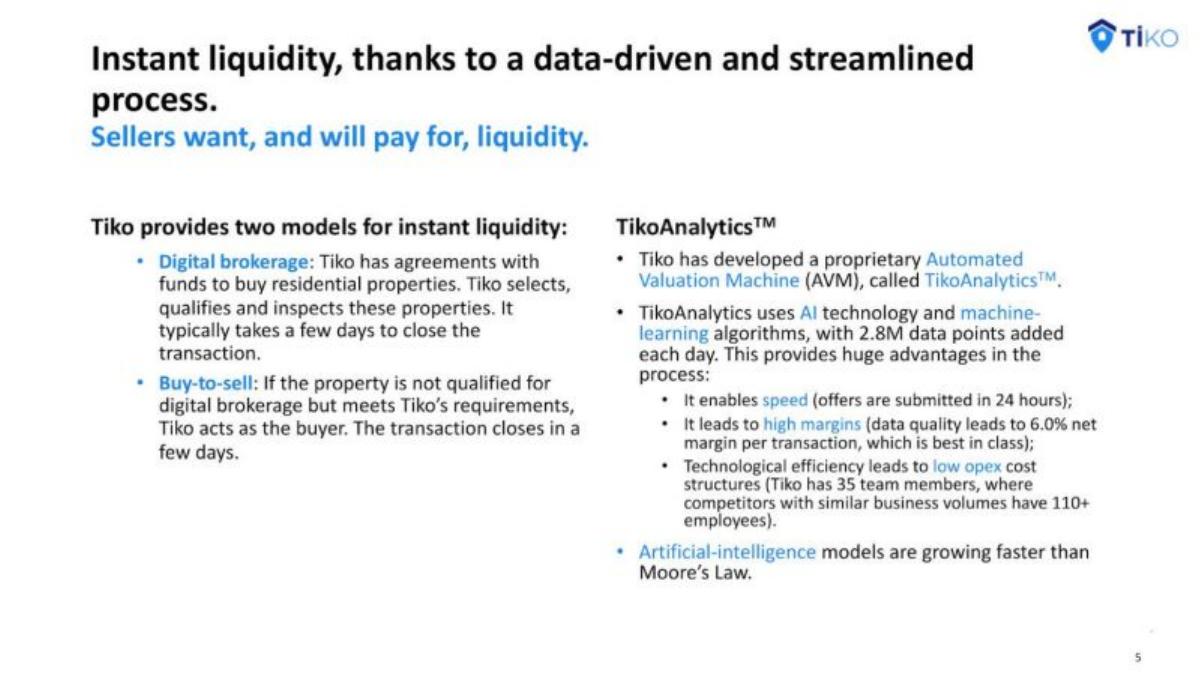
- The company achieves a 6.0% net margin per transaction, which they claim is best-in-class compared to competitors (Slide 5).
- TikoAnalytics, their proprietary AVM, processes 2.8 million data points daily to generate offers within 24 hours (Slide 5).
- The startup maintains high capital efficiency, operating with a team of 35 people compared to competitors with 110+ for similar volumes (Slide 5).
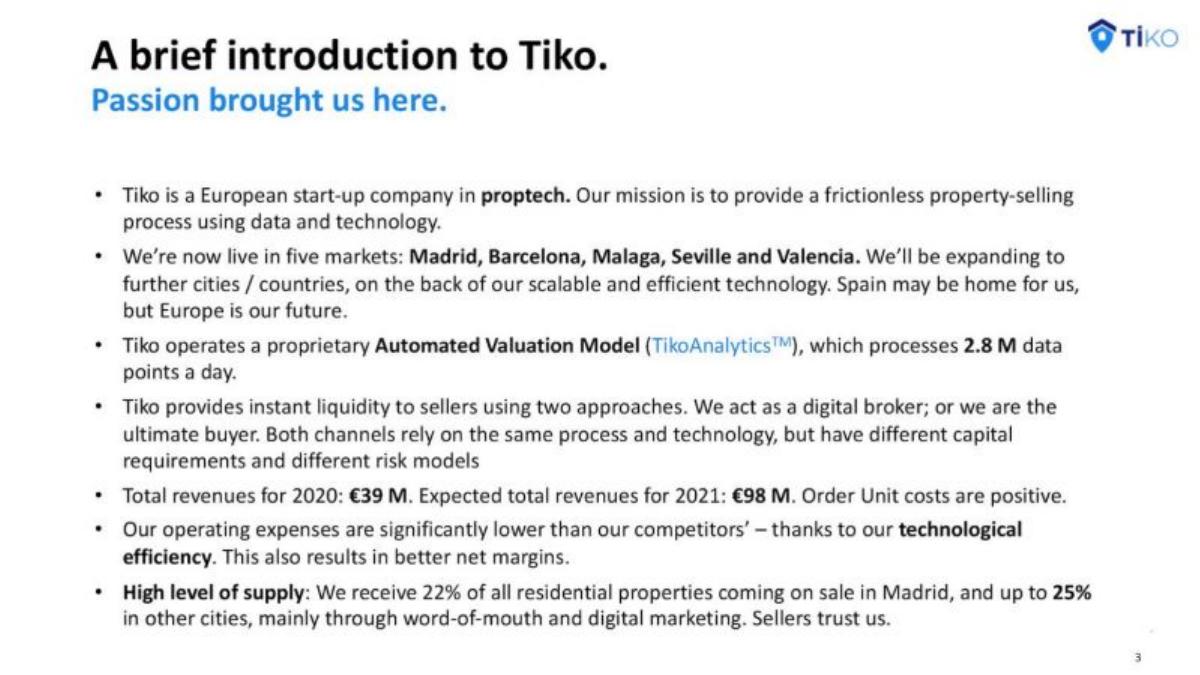
- Tiko has achieved significant market penetration in Madrid, capturing 22% of all residential properties coming on sale (Slide 10).
- Unit economics show a €5,000 net margin per property after accounting for official costs, marketing, renovation, and cost of capital (Slide 12).
- The company reported €39M in revenue for 2020 and projected €98M for 2021 (Slide 3).
- Tiko has secured a total of $90M in debt and equity to fuel its expansion into new European markets like Lisbon (Slide 17, 18).
Executive Summary and Introduction
Slides 1-3: The Hook and the Identity
Tiko opens its Series A update deck with a clean, professional aesthetic. Slide 1 sets the stage with the tagline: "Empowering home-sellers to achieve fast, friction-free transactions." This immediately identifies the target audience and the core value proposition. Slide 2 takes a creative approach by defining "Tiko" as a noun, using a dictionary-style layout. It cheekily notes that the domain was purchased for €19/year but quickly pivots to a serious comparison: "It’s like Auto1.com for properties." This anchor helps investors categorize the business model instantly.
Slide 3 provides a "brief introduction" that serves as an executive summary. It lists key achievements: presence in five Spanish markets (Madrid, Barcelona, Malaga, Seville, and Valencia), a proprietary AVM processing 2.8M data points daily, and impressive revenue growth from €39M in 2020 to an expected €98M in 2021. Crucially, it mentions that "Order Unit costs are positive," a vital metric for any iBuyer-style business.
The Problem and Solution
Slides 4-5: Liquidity as a Product
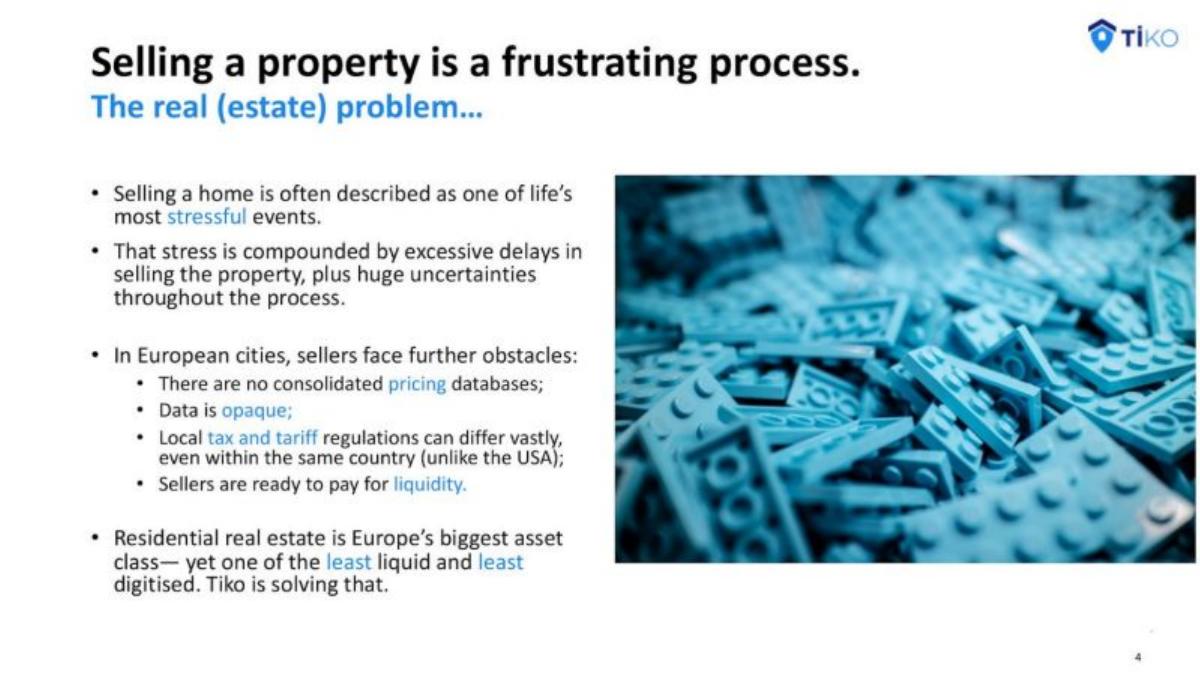
Slide 4 defines the problem: selling a property is stressful, delayed, and opaque, especially in Europe where consolidated pricing databases are rare. Tiko positions residential real estate as Europe’s biggest but least liquid asset class. Slide 5 introduces the solution: "Instant liquidity." Tiko offers two models: Digital Brokerage (acting as a middleman for funds) and Buy-to-Sell (acting as the ultimate buyer). The slide emphasizes their 6.0% net margin per transaction and their lean team of 35 members, contrasting it with competitors who require 110+ employees for similar volumes.
Slides 6-7: The User Experience
To humanize the technology, Slide 6 introduces "Rosa Sanchez," a bank worker in Madrid. This narrative walkthrough explains how Rosa received a valuation in 24 hours and sold her property in nine days. It’s a classic "hero’s journey" for a pitch deck. Slide 7 supports this with mobile app mockups, showing a fully integrated digital process that includes digital signing, which Tiko claims increases both conversion and customer satisfaction.
Business Model and Technology
Slides 8-9: Revenue Channels and TikoAnalytics
Slide 8 visualizes the two paths to revenue. Channel 1 (Digital Brokerage) involves selling directly to corporate investors for a commission, with a commitment to deliver 5,000 properties in 3-5 years. Channel 2 (Buy-to-Sell) involves direct purchases with an average resale time of 86 days. Slide 9 dives into the "black box" of TikoAnalytics. It maps out data sources (notary data, portals, etc.) and the resulting outcomes like the Pricing Index and Geolocation Analysis. This slide is essential for proving that their "AI" is more than just a buzzword.
Traction and Financial Performance
Slides 10-11: Lead Volume and Transaction Growth
Slide 10 shows lead growth from Q4 2019 to Q4 2020. Despite a dip during the COVID-19 lockdowns in Q2 2020, lead volumes recovered quickly, reaching 7,706 in Q4 2020. A standout metric here is that 22% of all residential properties for sale in Madrid come to Tiko first. Slide 11 displays the "Annual Total Transaction Volume" in a bar chart, showing a steep trajectory from €6.9M in 2018 to a projected €250M in 2022. It also hints at future upside from financial products and insurance sales.
Slides 12-13: Unit Economics and KPIs
Slide 12 is perhaps the most important slide for a Series A investor. It provides a waterfall chart of unit economics for 2021 YTD. Starting with a gross margin of €18,600, it deducts specific costs to arrive at a net margin of €5,000 per property. Slide 13 reinforces this by showing that gross margins, holding days, and IRR have remained constant from 2018 to 2020, suggesting a stable and predictable business model even as they scale.
Competitive Landscape and Team
Slides 14-16: Differentiation and Backing
Slide 14 directly addresses the "European Opendoor" comparison. Tiko claims to be better placed due to its digital brokerage arm (less capital intensive), fully automated AVM, and superior cost structure. Slide 15 introduces the team, led by Sina Afra (Founder & CEO), who has a background with several exits and eBay. The team photo features them in Stormtrooper costumes, which is a bold cultural choice but reflects the "Passion brought us here" theme. Slide 16 lists their backers, including Rocket Internet, Global Founders Capital, and btoV, signaling strong institutional support.
The Ask and Use of Funds
Slides 17-18: The Fundraising Process
Slide 17 officially launches the fundraising process. It notes that they have already secured $90M in total debt and equity. Slide 18 details the deployment of new funds into four areas: TikoAnalytics development, capital structure optimization, new marketing levers, and geographic expansion into Lisbon and other Spanish cities. The deck concludes with a simple "Thank you" and contact information on Slide 19 .
What Works and What is Missing
What Works
Granular Unit Economics: Slide 12 is a standout. Many PropTech decks hide behind gross numbers; Tiko’s willingness to show the €5,000 net margin after cost of capital is highly persuasive. · Dual-Channel Strategy: By explaining the Digital Brokerage vs. Buy-to-Sell models, Tiko addresses the primary investor fear regarding iBuying: capital intensity and balance sheet risk. · Market Dominance Proof: Claiming 22% of the Madrid market (Slide 10) provides a concrete sense of their current scale and brand authority.
What is Missing
Detailed Debt Terms: While they mention $90M in debt and equity, the specific split and the cost of that debt are not detailed, which is crucial for a business where "Cost of Capital" is a major line item. · Regulatory Risks: European real estate is heavily regulated. The deck mentions "different local regulations" on Slide 12 but doesn't elaborate on how they navigate these as they expand. · Exit Strategy: While the growth is clear, there is no mention of potential exit paths or comparable M&A activity in the European PropTech space.
What a Founder Should Copy
The Dictionary Definition Slide: It’s a great way to clear up any confusion about a company name or mission in the first 30 seconds. · The Competitor Comparison Table: Slide 14 is excellent because it doesn't just use checkmarks; it uses specific data points (e.g., "team of 40" vs "1,600") to prove efficiency. · The Waterfall Chart: If you have positive unit economics, show the math. It builds immediate trust with analysts.
Frequently asked questions
- What is Tiko's primary value proposition for home sellers?
- Tiko focuses on providing 'instant liquidity' in a market where selling a home is traditionally slow and stressful. According to the deck, they can provide a fair market valuation and an offer to buy a property outright within 24 hours. Their 'Rosa Sanchez' case study illustrates a property being sold in just nine days, which is significantly faster than the months-long process typical in European real estate markets.
- How does Tiko's business model differ from traditional iBuyers?
- Unlike many iBuyers that rely solely on purchasing homes, Tiko uses a dual-channel approach. Channel 1 is Digital Brokerage, where they act as a middleman for corporate investors, taking a commission without the capital risk. Channel 2 is Buy-to-Sell, where Tiko buys the property directly. This hybrid model allows them to be more capital-efficient, with 40% of their 2021 business coming from the brokerage side.
- What are the key components of Tiko's technology stack?
- The core of their technology is TikoAnalytics, an Automated Valuation Model (AVM). It integrates data from classifieds, proprietary Tiko data, location-based data, real-estate agent portals, and notary data. The system uses AI and machine learning to produce not just valuations, but also pricing indices, geolocation analysis, and opportunity tracking, processing 2.8 million data points every day.
- What do Tiko's unit economics look like per property?
- Slide 12 provides a detailed breakdown. From a gross margin of €18,600 (8.4%), they subtract official costs (2.3%), marketing (1.5%), renovation (0.3%), and cost of capital (2.1%). This leaves a net margin of €5,000 (2.3%) per property. They also boast an Internal Rate of Return (IRR) of 35% and an average of 58 days on the market for their inventory.
- What are Tiko's plans for the Series A funding?
- Tiko outlines four key deployment areas: further developing TikoAnalytics to lower error rates and integrate public data; leveraging their capital structure to secure more debt for the buy-to-sell channel; launching new marketing automation and PR levers; and geographic expansion, specifically targeting Lisbon as their first international city outside of Spain.