TimeFlip addresses the inherent friction of digital time-tracking apps—which often require distracting screen interactions—by introducing a physical, multi-sided gadget that records tasks via simple orientation changes. The deck highlights a fragmented market of over 100 digital apps (Slide 2) and positions TimeFlip as a friction-less alternative that has already sold 4,000+ units (Slide 7). While the initial revenue comes from hardware sales, the long-term strategy shifts toward a subscription model and big data analytics, drawing parallels to high-value acquisitions like Nest and Ring (Slid…
Key takeaways
- The market is described as a fragmented landscape with over 100 digital apps and no dominant solution (Slide 2).
- TimeFlip identifies three core pains of software tracking: screen clicks/taps, lost focus, and time consumed to learn (Slide 3).
- The product is a physical dodecahedron that syncs with a mobile app to record time based on which face is turned up (Slide 4).
- The business model transitions from hardware sales (Phase A) to big data analytics and behavioral analysis (Phase B) (Slide 6).
- Traction is evidenced by 4,000+ items sold and a presence on major marketplaces like Amazon and Indiegogo (Slide 7).
- The company has secured pre-seed funding from HaxVentures and holds trademarks in the USA and Russia (Slide 7).
- Growth plans include B2B integrations with tools like Slack, Toggl, Jira, and Wrike (Slide 9).
- The exit strategy explicitly targets M&A with time management leaders or acquisition by data-seeking giants like Amazon or Google (Slide 9).
TimeFlip Pitch Deck Analysis
TimeFlip enters the productivity space not as another app, but as a physical peripheral designed to bridge the gap between physical action and digital logging. This teardown examines their February 2019 deck, which focuses heavily on the friction of existing solutions and the transition from a hardware vendor to a data company.
Slide 1: Title and Vision
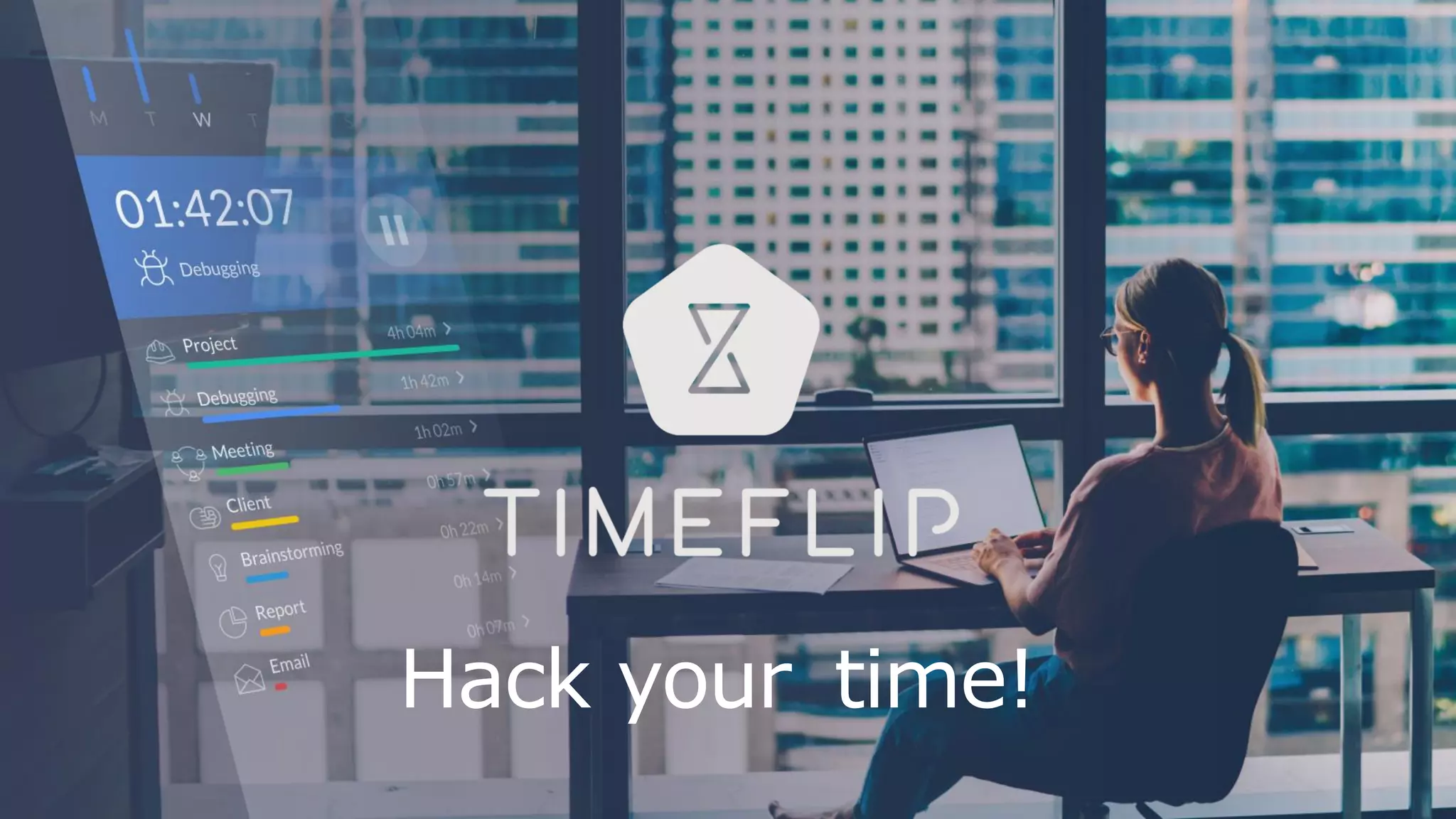
The cover slide features the TimeFlip logo—a stylized hourglass inside a pentagon—and the tagline "Hack your time!" The background image shows a professional in a modern office setting with a digital overlay of the TimeFlip interface, showing tasks like "Debugging," "Brainstorming," and "Email." This immediately establishes the product's context: a tool for knowledge workers who juggle multiple distinct tasks throughout the day.
Slide 2: The Competitive Landscape
Slide 2 addresses the "Global trend of time tracking/management." It displays logos for nine competitors, including Harvest, Toggl, and Jira. The key takeaway here is the text at the bottom: "Fragmented market with >100 digital apps. No universal or dominant solution." By framing the market as fragmented rather than competitive, TimeFlip suggests there is room for a new category of solution that doesn't rely solely on a screen.
Slide 3: Defining the Pain Points
The "Pain of time tracking software" is broken down into three categories: Screen clicks and taps (requiring PC/smartphone interaction), Lost focus (distraction from actual work), and Time consumed (the learning curve). This slide is crucial because it justifies the existence of a hardware product. If the problem is "too much screen time," then a software-only solution cannot be the cure.
Slide 4: The Mechanism of Action
Under the heading "How it works?" , TimeFlip uses a three-step illustration. First, users mark tasks on the sides of the device. Second, they connect it to a smartphone app to assign those tasks. Third, they simply place the device with the current task facing up to record time. This visualizes the simplicity of the user experience, emphasizing the low-friction nature of the physical "flip" compared to navigating a software menu.
Slide 5: The Ecosystem
This slide showcases the "TimeFlip App" alongside the physical dodecahedron. It highlights availability on Google Play and the App Store. The inclusion of an "App screencast" button (though non-functional in a static deck) indicates a readiness to demonstrate the software's UI. The imagery reinforces the product's aesthetic—a clean, white, geometric object that fits into a modern workspace alongside cameras and keyboards.
Slide 6: The Two-Phase Business Model
This is the most strategically significant slide. Phase A (2017-2019) is defined by the production and sales of the gadget and the growth of the user count. Phase B (2019 -) introduces "Data as a revenue source." TimeFlip explicitly compares itself to Nest ($3.2B acquisition) and Ring ($1B acquisition), suggesting that their hardware is a vehicle for capturing high-value behavioral data that "data-seeking businesses" would find attractive. This pivots the company from a low-margin hardware play to a high-value data play.
Slide 7: Current Traction and Infrastructure
The "Where we are now" slide provides hard evidence of progress. Key metrics include:
Items sold: 4000+ · HQ: Singapore; Manufacturing: Shenzhen, China. · Investments: Pre-seed by HaxVentures. · Marketplace presence: Amazon, Indiegogo, Mashable, Sharaf DG, Noova. · Certificates: CE, FCC, TRA.
This slide effectively de-risks the investment by showing that the product is already through the difficult manufacturing and certification phases and has found early product-market fit.
Slide 8: Social Proof and Press
The "Press" slide features quotes from Mashable, TechCrunch, Digital Trends, Global News, Popular Science, and Gadget Flow. The TechCrunch quote— "A time-tracking gadget simple enough that I might actually use" —directly validates the problem statement from Slide 3. This external validation is essential for hardware startups, which often face skepticism regarding user adoption.
Slide 9: Future Growth and Exit Strategy
The "Growth plans" include B2B market access through integrations with Slack, Toggle, Jira, and Wrike , and a shift to a subscription-based model . The "Exit strategy options" are unusually blunt, listing M&A with market leaders or acquisition by Amazon, Google, or Facebook . While some investors prefer founders who want to build "forever companies," in the hardware space, a clear path to acquisition by a tech giant is often a realistic and welcomed roadmap.
Slide 10: Contact Information
The final slide provides a contact email and website, set against a photo of the TimeFlip device in a real-world setting (next to a coffee cup and a pencil holder). This reinforces the "tangible" nature of the product one last time.
What TimeFlip Does Well
The deck is exceptionally clear about the problem-solution fit . By identifying "screen fatigue" as the primary barrier to time tracking, they create a logical necessity for their hardware. The transition from hardware sales to a data-driven business model (Slide 6) is a classic venture capital narrative, moving the needle from a linear growth business to an exponential one. Furthermore, the traction slide (Slide 7) is dense with facts that prove the team can actually ship a physical product—a major hurdle for early-stage hardware startups.
What is Missing from the Deck
The most glaring omission in this 10-slide set is a Team Slide . Investors invest in people, especially in hardware where supply chain expertise is vital. There is also no mention of Unit Economics (COGS, MSRP, and margins), which are critical for evaluating a hardware business. Finally, the deck lacks a specific "Ask" —it does not state how much money they are raising or what the specific milestones for that capital will be, other than a general mention of a May 2019 Indiegogo campaign.
Founder Takeaways
Founders should emulate TimeFlip's use of social proof . Instead of just listing press logos, they included specific quotes that addressed their core value proposition. Additionally, the way they categorized their business model into "Phase A" and "Phase B" is a smart way to show long-term vision without ignoring the immediate reality of needing to sell products to survive. However, always ensure that your deck includes the backgrounds of your founding team to build trust in your ability to execute the stated plan.
Frequently asked questions
- What is the primary problem TimeFlip aims to solve?
- TimeFlip targets the 'friction' of traditional time tracking. According to Slide 3, digital software requires too many screen clicks and taps, which leads to lost focus and consumes the very time it is meant to track. By using a physical object, the user can switch tasks without opening an app or interacting with a computer, theoretically maintaining a higher state of 'flow' during work.
- How does the company plan to make money beyond selling gadgets?
- Slide 6 outlines a two-phase business model. Phase A focuses on hardware sales and the introduction of a subscription model. Phase B shifts to 'Data as a revenue source,' where the company intends to build big data analytics based on accumulated user behavior. They compare this trajectory to Nest and Ring, suggesting that the hardware is a gateway to valuable behavioral data.
- What is TimeFlip's current manufacturing and distribution status?
- As of Slide 7, the company is headquartered in Singapore with manufacturing operations in Shenzhen, China. They have already sold over 4,000 units and established distribution agreements in the USA, UAE, and Russia, with France and Germany in development. They also hold necessary certifications including CE, FCC, and TRA.
- Who are the competitors mentioned in the deck?
- Slide 2 lists several digital competitors to illustrate market fragmentation, including Timecamp, Harvest, Hours, Time Doctor, Everhour, Avaza, Toggl, Timely, and Jira. TimeFlip uses this list to argue that the market is oversaturated with software-only solutions, creating an opening for a unique hardware-integrated approach.
- What are the planned next steps for the product?
- According to Slide 9, the company planned to launch an updated 'TimeFlip2' version via Indiegogo in May 2019. They also aim to transition to a subscription-based model with freemium software and develop deeper B2B integrations with workflow tools like Slack and Wrike to expand their market reach beyond individual consumers.