Ben’s Series A pitch deck is a concise 13-slide narrative that successfully raised $16M by framing employee benefits as a fintech and infrastructure problem rather than just an HR headache. The deck leans heavily on the founders' backgrounds—Sebastian Fallet (ex-Secret Escapes) and David Duckworth (ex-HSBC)—to establish credibility in a complex, regulated market. By mapping out the 'low-tech, fragmented' ecosystem on Slide 7 and presenting a unified 'all-in-one' solution on Slide 9, Ben demonstrates a clear path from administrative chaos to a streamlined payments-led platform. While the deck…
Key takeaways
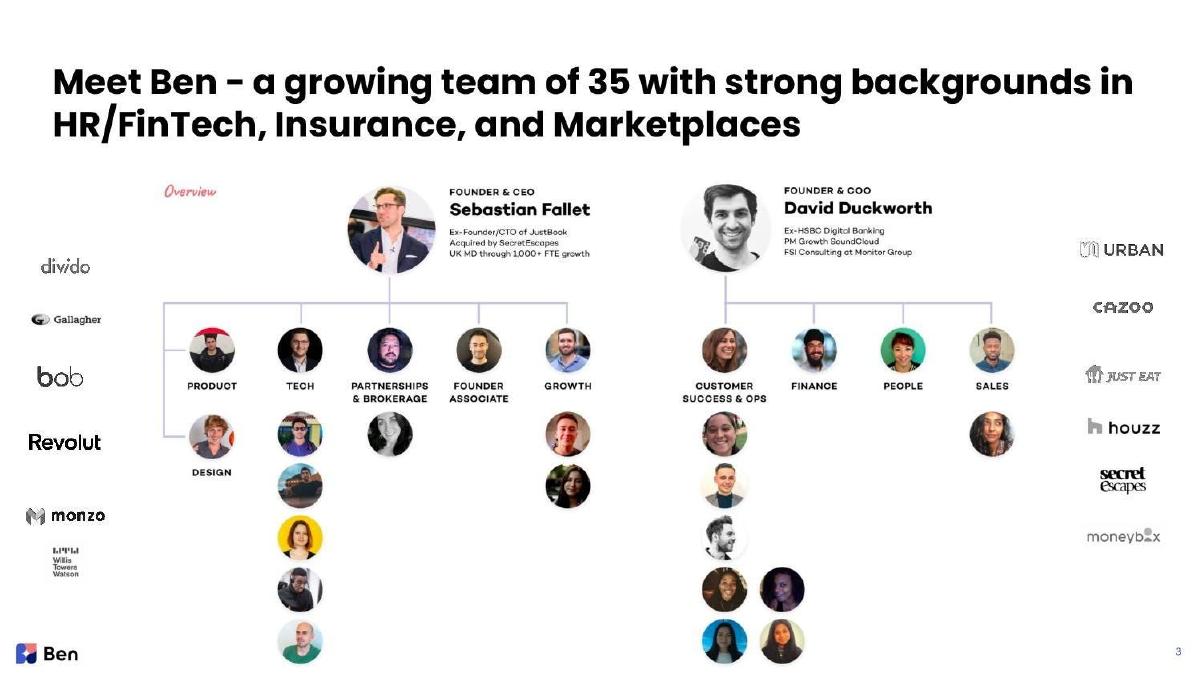
- The deck emphasizes a team of 35 with deep experience in HR, FinTech, and marketplaces to justify their ability to handle complex integrations (Slide 3).
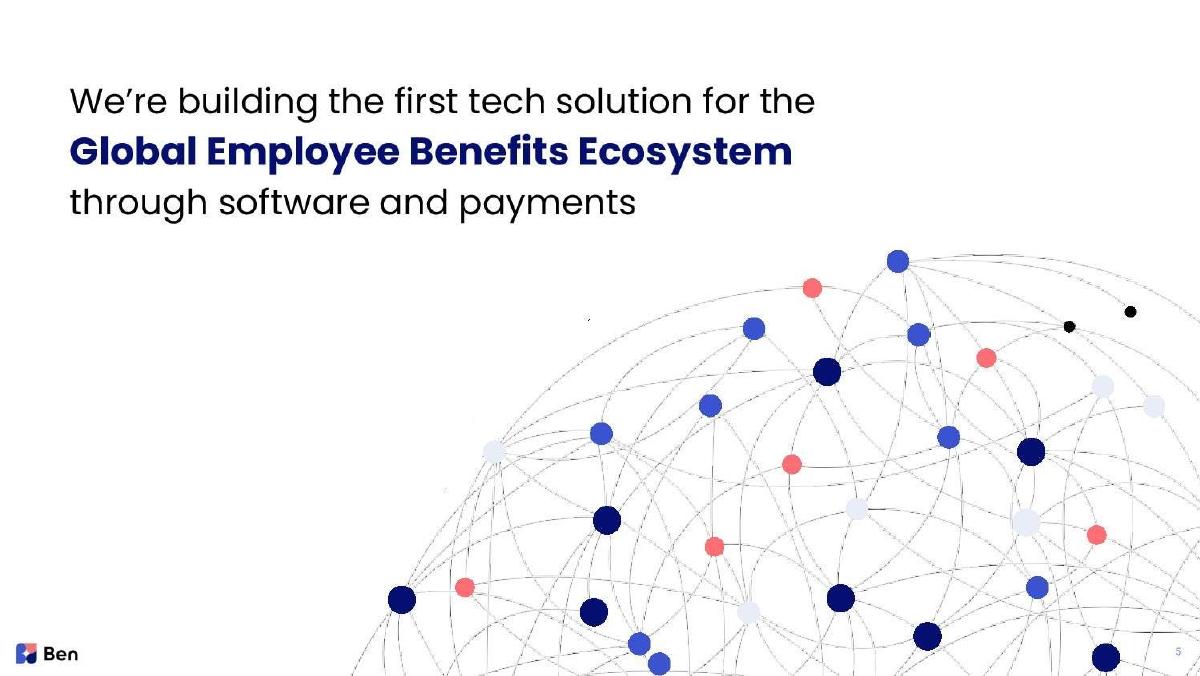
- Ben positions itself as a 'tech solution' powered by 'software and payments,' moving beyond simple SaaS into infrastructure (Slide 5).
- The problem slide identifies specific pain points for both brokers (high cost of sale) and employers (high admin overhead) (Slide 7).
- The solution is presented as a dual-sided platform where companies set rules and employees choose benefits via a branded Mastercard (Slide 9).
- The deck highlights integrations with HRIS, Payroll, and Brokers as the core engine of their 'all-in-one' claim (Slide 9).
- The product vision centers on 'Harmonised Rails,' suggesting a long-term play to become the transactional standard for benefits (Slide 11).
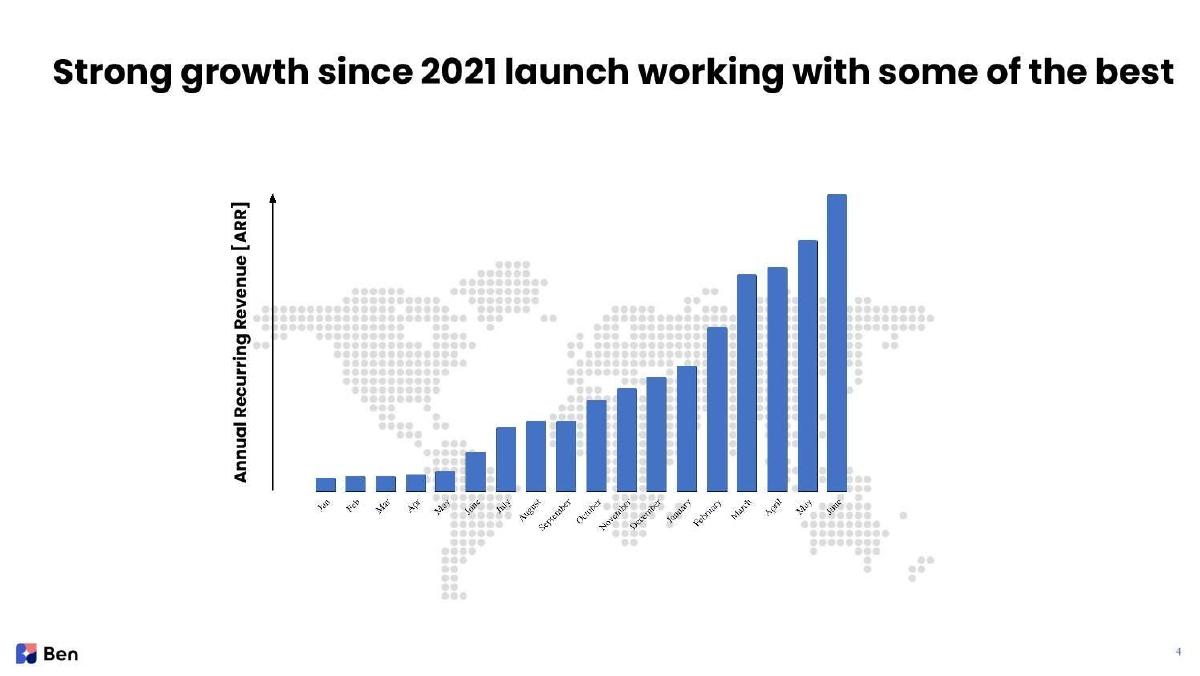
- The deck omits traditional Series A metrics like ARR, churn, or CAC, focusing instead on the structural opportunity of the market.
- There is no explicit 'Ask' slide detailing how the $16M will be spent, which is unusual for a successful Series A deck.
The Infrastructure Play for Global Benefits
Ben’s Series A deck is a study in narrative simplicity applied to a notoriously complex industry. While many HR tech companies focus on the 'happiness' of employees, Ben focuses on the 'rails' of the industry. As reported by Business Insider, this deck helped secure $16M in 2024 for the London-based startup. The 13-slide presentation moves quickly from team pedigree to ecosystem mapping, positioning Ben as the inevitable solution to a fragmented global market.
Slide 1-2: The Hook and Branding
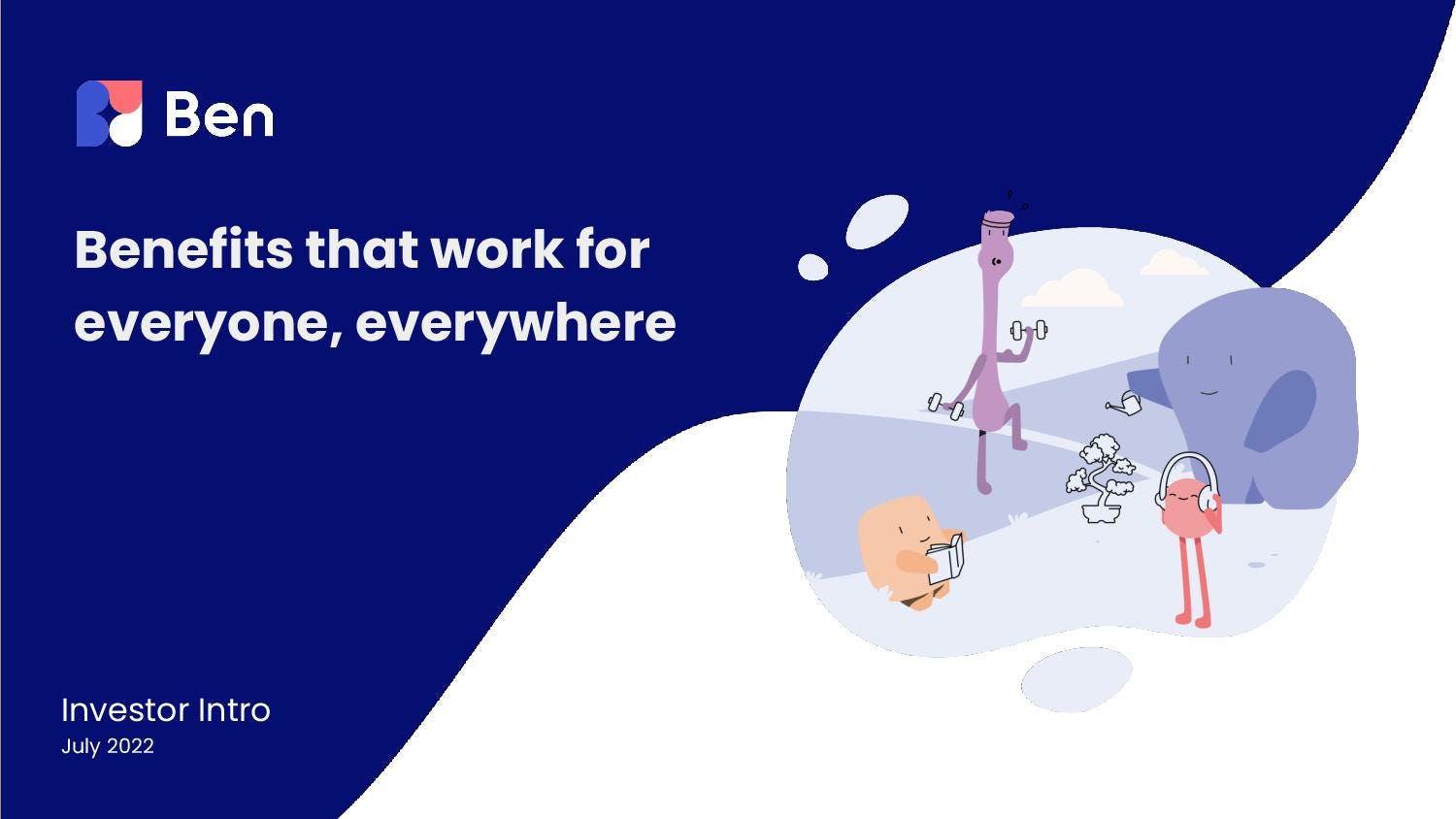
The deck opens with a clean, minimalist title slide featuring the tagline: "Benefits that work for everyone, everywhere." The use of soft, rounded illustrations and a deep blue palette immediately establishes a professional yet approachable brand identity. Slides 1 and 2 are identical in the provided sequence, serving as the entry point for the 'Investor Intro' dated July 2022.
Slide 3: The Team Pedigree
Slide 3 is perhaps the most important slide for a Series A company operating in a regulated space like insurance and fintech. Titled "Meet Ben - a growing team of 35 with strong backgrounds in HR/FinTech, Insurance, and Marketplaces," it visually maps out the organization. The founders, Sebastian Fallet and David Duckworth, highlight their exits and leadership roles at companies like SecretEscapes and HSBC. The slide also lists logos of former employers for the wider team, including Revolut, Monzo, and Deliveroo. This 'logo soup' is a strategic move to signal to investors that the team has the technical and operational muscle to build a global platform.
Slide 5: Defining the Category
On Slide 5, Ben makes a bold claim: "We’re building the first tech solution for the Global Employee Benefits Ecosystem through software and payments." The inclusion of the word 'payments' is critical. It signals to investors that this isn't just a SaaS dashboard; it is a transactional platform with the potential for fintech-style margins and stickiness. The background graphic of a connected node network reinforces the idea of Ben as the central nervous system of a complex web.
Slide 7: The Problem Map
Slide 7 provides a detailed breakdown of the current market dysfunction. It labels the ecosystem as "low-tech, fragmented, service-heavy, and highly inefficient." Ben identifies two distinct sets of pain points:
Broker/Provider Issues: High cost of sale, manual operating costs, and a reliance on relationships over technology. · Employer Issues: Lack of benchmarks, supplier complexity, compliance risk, and high administrative overhead.
By showing the 'Employer' stuck in the middle of a mess of CSV files and manual emails (illustrated by a stressed character at a desk), Ben makes the case that the current way of working is unsustainable for modern, global companies.
Slide 9: The All-in-One Solution
Slide 9 introduces the product as the "first 'all-in-one' software solution for global, flexible employee benefits." The slide uses a clear 'Company vs. Employee' split to explain the value proposition:
Companies: Assign budget, curate options, and set rules. · Employees: Choose what works for them, ranging from core benefits (pension, health) to 'Flex Allowances' spent via the Ben Mastercard .
The bottom of the slide shows integrations with HRIS, Payroll, and Brokers, emphasizing that Ben sits on top of existing systems rather than requiring a total rip-and-replace of an employer's tech stack.
Slide 11: The Product Vision
Slide 11 looks toward the future, describing the "global tech platform for the benefits ecosystem." It outlines three pillars of their vision: Open Ecosystem (aligned incentives), Harmonised Rails (access and efficiency), and Flexibility (value and control). This slide is designed to show that Ben isn't just building a tool for today, but an infrastructure that will scale as the nature of work becomes more global and flexible.
Slide 13: The Closing
The deck concludes on Slide 13 with a call to action: "Let’s make benefits work for everyone, everywhere." The illustration shows a character with a backpack placing flags across a world map, reinforcing the 'global' theme that was introduced on the first slide.
What Works in the Ben Deck
1. Clear Categorization: Ben avoids the trap of being 'just another HR tool.' By explicitly mentioning 'payments' and 'infrastructure' (Slide 5 and 11), they move the conversation into a higher-valuation category. Investors love 'rails' because they are harder to displace than simple applications.
2. Founder-Market Fit: The team slide (Slide 3) is exceptionally strong. In a field like employee benefits, which involves insurance brokerage and financial regulation, having founders from HSBC and successful tech exits is a massive de-risking factor. They aren't just enthusiasts; they are operators who have seen scale.
3. Ecosystem Thinking: Slide 7 is a masterclass in problem definition. Instead of just listing 'HR is hard,' they map out the incentives of every player in the market (brokers, providers, and employers). This shows a deep understanding of why the problem hasn't been solved yet.
What is Missing from the Ben Deck
1. The Numbers: For a Series A deck, the total absence of metrics is startling. There is no mention of Annual Recurring Revenue (ARR), number of customers, number of employees on the platform, or growth rates. While this information was likely shared in a data room, its absence in the 'Investor Intro' deck makes it feel more like a Seed deck than a Series A.
2. The Competitive Landscape: The deck assumes Ben is the 'first' (Slide 5 and 9), but the HR tech and flexible benefits space is crowded with players like Remote, Deel, and various local incumbents. A slide addressing how Ben wins against these giants would have added weight to their 'all-in-one' claim.
3. The Financial Ask: There is no slide detailing how much capital is being raised or how it will be deployed. Usually, a Series A deck will specify that funds will go toward 'International Expansion,' 'Product R&D,' or 'Sales & Marketing.' Ben leaves this entirely to the verbal pitch.
Lessons for Founders
Focus on the 'Why Now': Ben leans into the global nature of modern work. As companies hire across borders, the old model of localized benefits breaks. If you are building in a legacy industry, your deck must explain why the current infrastructure is failing the modern economy.
Use a 'Trojan Horse' Strategy: Ben’s use of a Mastercard (Slide 9) is a brilliant 'Trojan Horse.' It gives them a footprint in the employee's daily life and a share of the transaction volume, while the 'software' side of the business handles the boring administrative rules for the employer. When pitching, look for the one feature that turns your software into a platform.
Design for Clarity: The visual consistency of this deck is high. By using custom illustrations to represent complex concepts (like the 'stressed employer' on Slide 7), Ben makes a dry subject like insurance brokerage feel modern and solvable. Don't underestimate the power of a cohesive visual narrative to keep an investor engaged through technical slides.
Frequently asked questions
- What is the core value proposition of Ben according to the deck?
- Ben positions itself as the first 'all-in-one' software solution for global, flexible employee benefits. As shown on Slide 9, the platform allows companies to assign budgets and set rules while giving employees the freedom to choose their own benefits, including spending via a dedicated Ben Mastercard.
- How does Ben address the complexity of the benefits market?
- On Slide 7, Ben maps out the current ecosystem as 'low-tech' and 'fragmented.' They identify that brokers suffer from high operating costs and manual processes, while employers face compliance risks and low transparency. Ben’s solution acts as the central hub connecting these disparate players through software.
- Who are the founders and what is their background?
- The team is led by CEO Sebastian Fallet, an ex-founder/CTO of JustBook (acquired by SecretEscapes), and COO David Duckworth, who has a background in digital banking at HSBC and growth at SoundCloud. Their combined experience in marketplaces and fintech is central to the deck's credibility (Slide 3).
- What is missing from this pitch deck?
- The deck is notably missing quantitative data. There are no slides covering revenue growth, user acquisition costs, retention rates, or market size (TAM/SAM). Additionally, there is no 'Ask' slide or financial roadmap, which are standard components for a Series A fundraise.
- Why did Ben focus on payments and a Mastercard?
- By incorporating a 'Ben Mastercard' (Slide 9), the company moves from being a mere record-keeping tool to a transactional platform. This allows for 'Flex Allowances' that employees can spend anywhere, reducing the need for the company to manage hundreds of individual vendor relationships.