Beelinguapp's 13-slide pre-seed deck focuses on the transition from traditional, 'boring' classroom-style apps to a content-first model. By positioning themselves as the 'Blinkist or Netflix' of language learning, the team highlighted a shift toward natural acquisition through stories and music. The deck is notable for its strong social proof, citing an 85% product-market fit score, and a team with significant pedigree from Google and Meetup. However, the deck is entirely missing a specific financial 'Ask' slide and detailed unit economics, relying instead on high-level market growth projecti…
Key takeaways
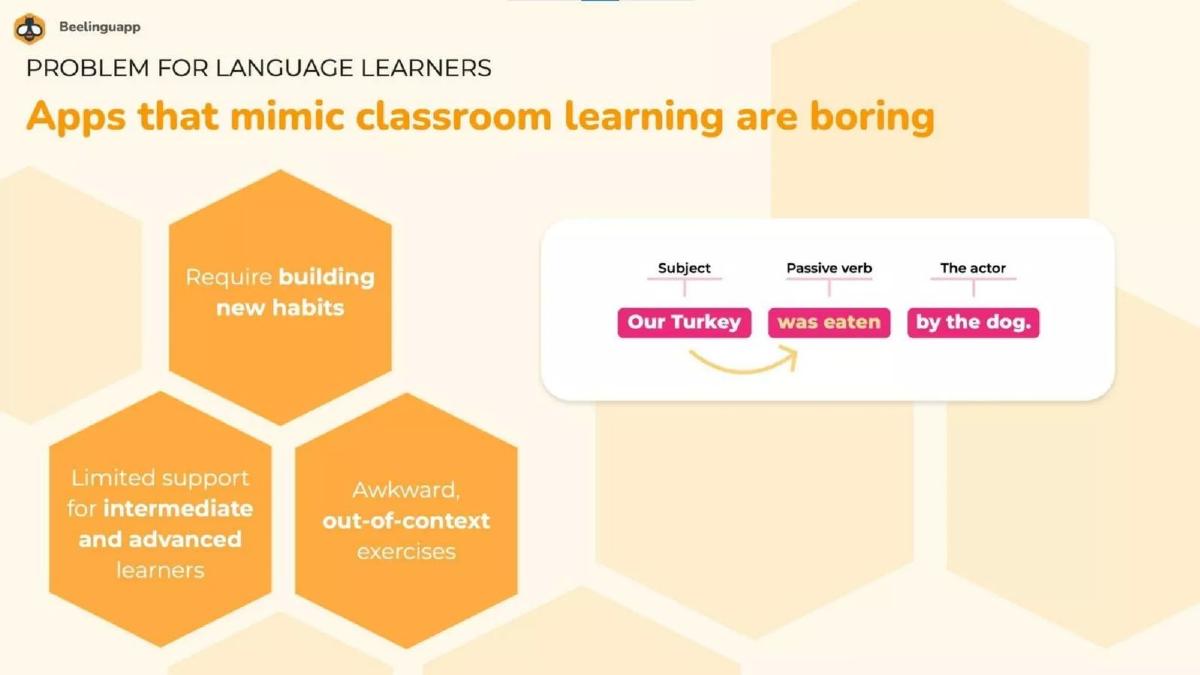
- The problem slide identifies that existing apps require building new habits and offer limited support for advanced learners (Slide 2).
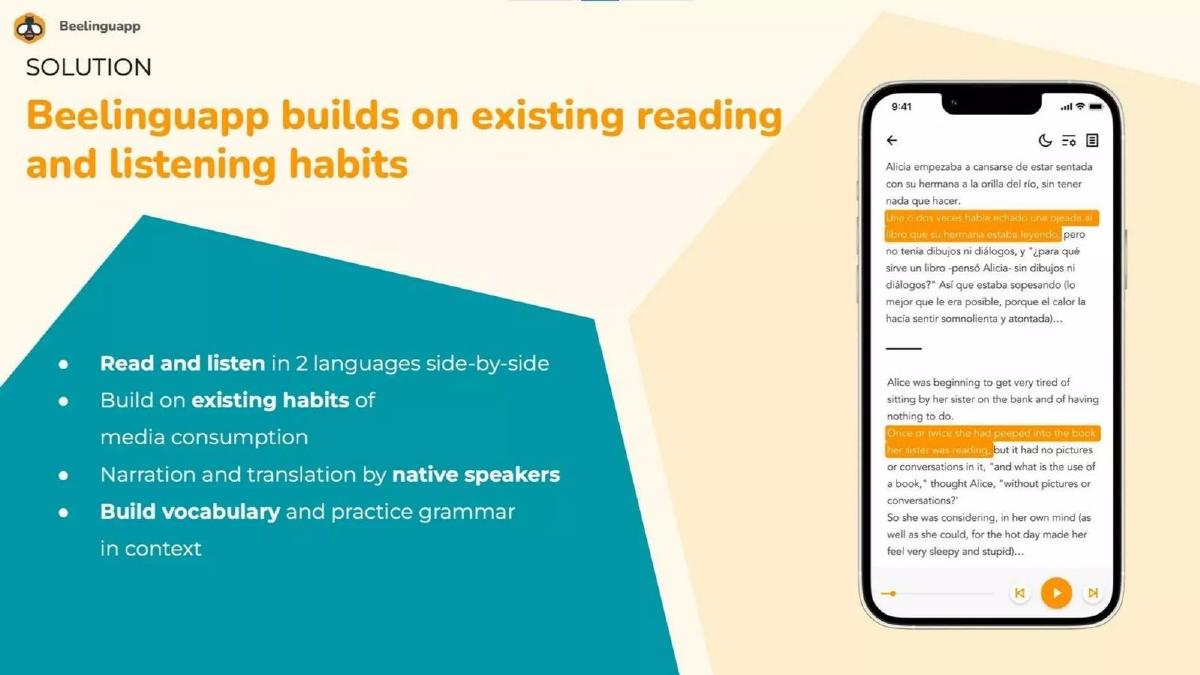
- The solution utilizes a side-by-side reading and listening interface with narration by native speakers (Slide 3).
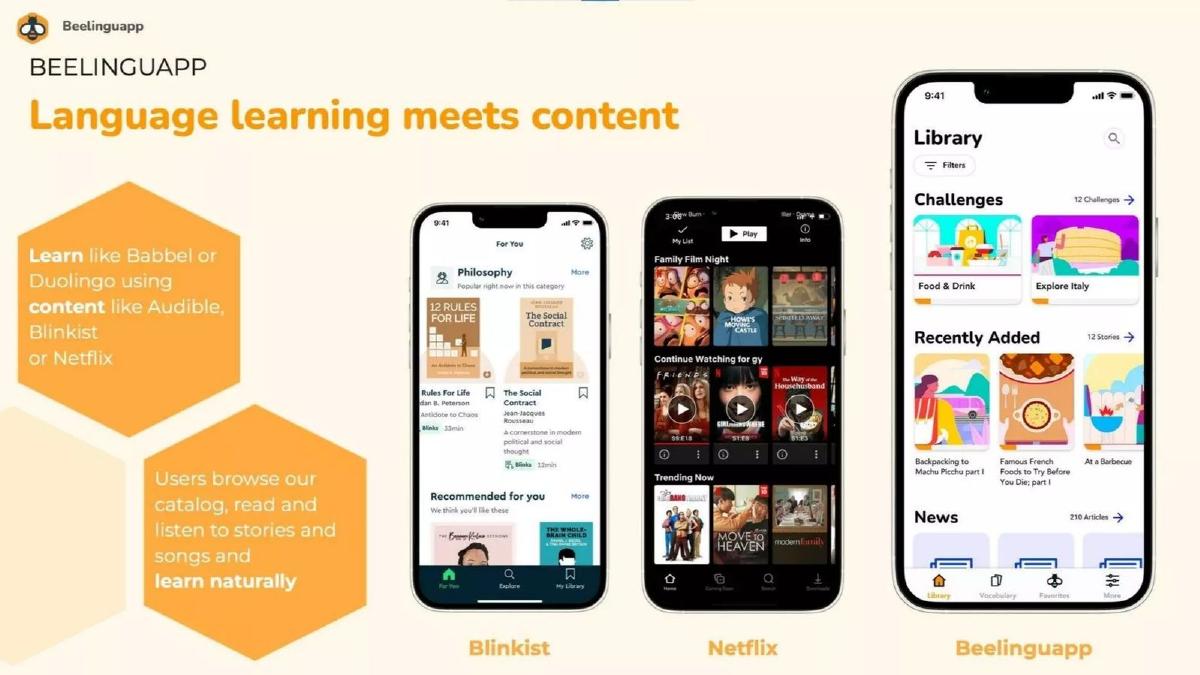
- Beelinguapp positions itself as a hybrid of learning platforms like Duolingo and content platforms like Audible or Netflix (Slide 4).
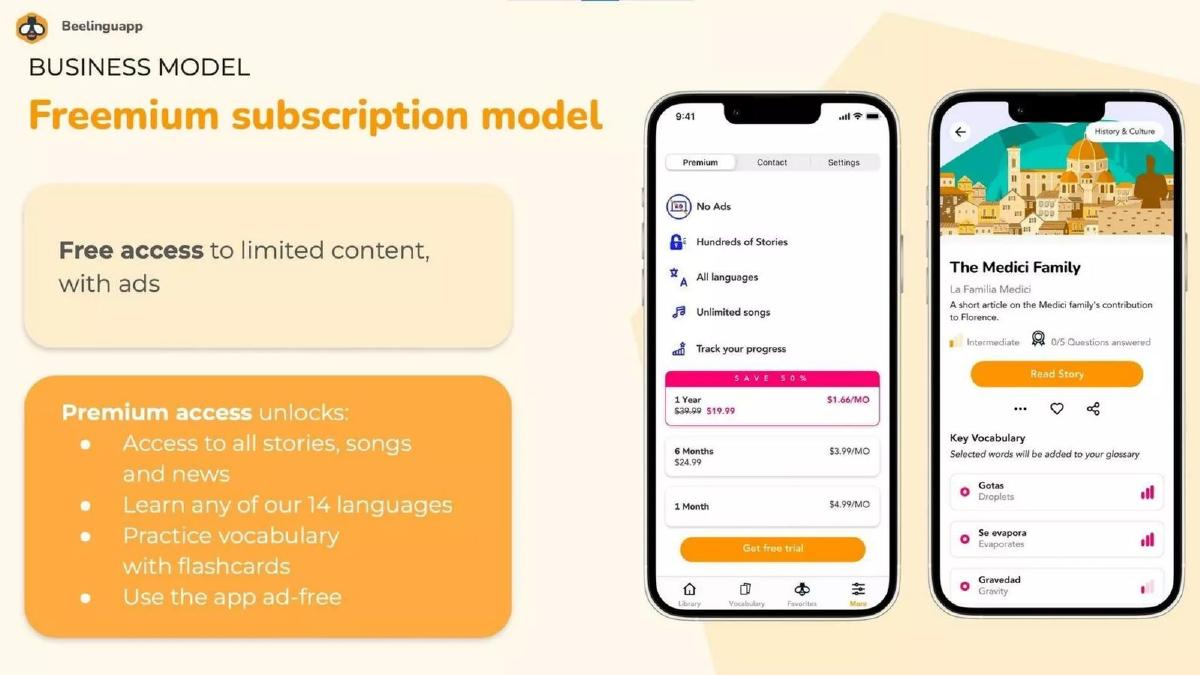
- The business model is a standard freemium subscription, with premium tiers ranging from $1.66/mo to $4.99/mo (Slide 5).
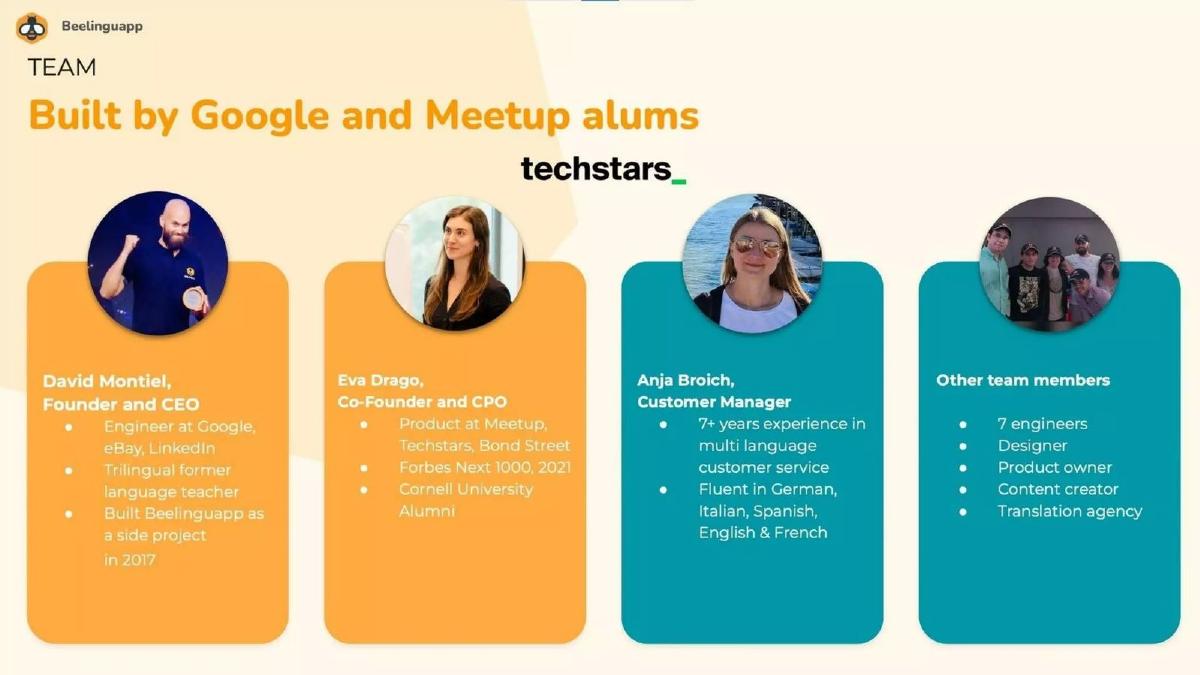
- The founding team includes alumni from Google, eBay, LinkedIn, and Meetup (Slide 6).
- Social proof is emphasized through a study claiming 85% of users would be disappointed if the app didn't exist (Slide 8).
- The product evolved from under 150 pieces of content in 2020 to over 800 pieces by 2022 (Slide 9).
- Market data projects the digital language learning sector to grow from $12 billion in 2019 to $47 billion by 2025 (Slide 11).
Executive Summary: The Content-First Language Play
Beelinguapp entered the EdTech space with a specific thesis: language learning is more effective when it feels like entertainment. Their 13-slide pre-seed deck, used to raise $1.1 million, leans heavily on the 'Karaoke' method of dual-language consumption. While the deck excels at communicating product vision and team pedigree, it is remarkably light on the financial mechanics typically expected by institutional investors.
Slide 1: Title and Visual Identity
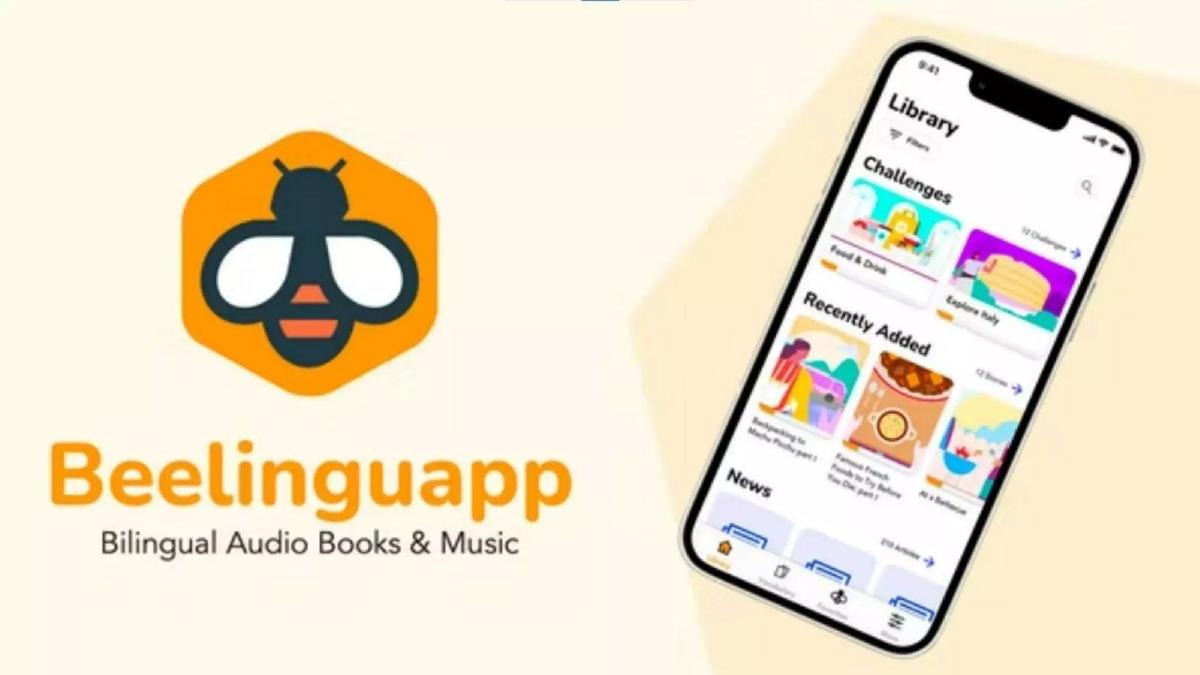
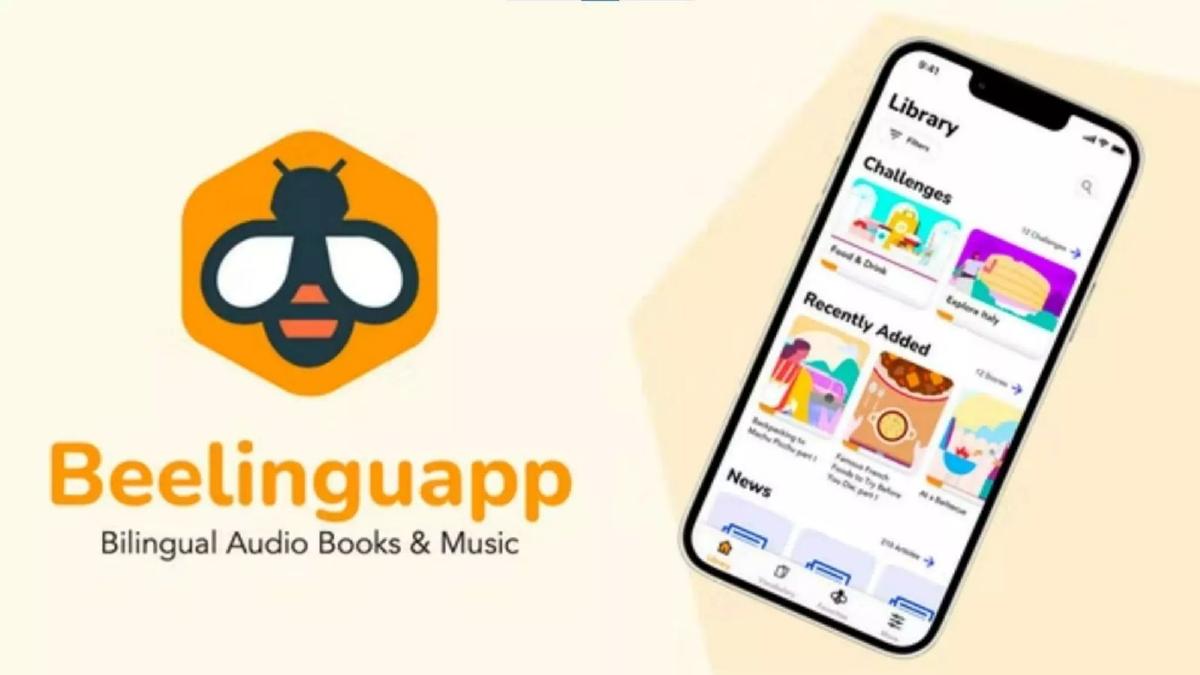
The cover slide introduces the Beelinguapp logo—a bee inside a hexagonal honeycomb—and the tagline 'Bilingual Audio Books & Music.' A high-fidelity mockup of the app on a smartphone is displayed, showing a clean, modern UI with categories like 'Challenges,' 'Recently Added,' and 'News.' This immediately establishes the app as a content aggregator rather than a simple flashcard tool.
Slides 2-4: The Problem, Solution, and Market Positioning
Slide 2 identifies the 'Problem for Language Learners.' It argues that apps mimicking classroom learning are boring, require building entirely new habits, and offer limited support for intermediate or advanced learners. It uses a graphic of a sentence diagram ('Our Turkey was eaten by the dog') to represent the 'awkward, out-of-context exercises' of competitors.
Slide 3 presents the 'Solution.' The core value proposition is building on 'existing reading and listening habits.' The slide features a side-by-side view of 'Alice in Wonderland' in Spanish and English, highlighting the synchronized text. Key features listed include narration by native speakers and learning vocabulary in context.
Slide 4 defines the brand's niche. It uses a hexagonal Venn-style diagram to explain that Beelinguapp is where 'Language learning meets content.' It positions the startup as a hybrid: 'Learn like Babbel or Duolingo using content like Audible, Blinkist or Netflix.' This is a classic 'X for Y' positioning strategy designed to help investors quickly categorize the business model.
Slide 5: Business Model
The company utilizes a 'Freemium subscription model.' Slide 5 breaks this down into two tiers. The free tier offers limited content with ads. The premium tier unlocks all 14 languages, all stories/songs/news, flashcards, and an ad-free experience. The slide includes a screenshot of the pricing page, showing three options: 1 Year for $1.66/mo (marked as 50% savings), 6 Months for $3.99/mo, and 1 Month for $4.99/mo. This transparency regarding price points is helpful, though the deck does not disclose conversion rates or churn.
Slides 6-7: Team, Advisors, and Investors
Slide 6 highlights the team's pedigree, led by the headline 'Built by Google and Meetup alums.' David Montiel (Founder/CEO) is noted as an ex-Google, eBay, and LinkedIn engineer who built the app as a side project in 2017. Eva Drago (Co-founder/CPO) brings experience from Meetup and Techstars. The slide also mentions a supporting cast of 7 engineers, a designer, and a translation agency.
Slide 7 showcases significant institutional support. The 'Investors' column features logos for SoftBank Group/WeWork, Techstars, Equity Pitcher Ventures, and Joyance Partners. The 'Advisors' section includes the Co-founder of Busuu (a direct competitor) and the CEO of eBay Kleinanzeigen. Having a competitor's founder as an advisor is a strong signal of product validity.
Slides 8-9: Social Proof and Product Evolution
Slide 8 focuses on 'Product Market Fit.' It cites a study claiming '85% of users would be disappointed if Beelinguapp didn't exist.' This metric is a popular benchmark for PMF in early-stage startups. The slide also displays four 5-star reviews and an 'App of the Day' badge, reinforcing user satisfaction.
Slide 9 , titled 'How we did it,' shows the platform's growth trajectory. It notes '150+ experiments' conducted between 2020 and 2022. The content library grew from under 150 pieces (mostly fairytales) to over 800 pieces, including daily news articles and flexible learning paths. This slide demonstrates execution capability and a commitment to content depth.
Slides 10-11: Market Opportunity
The deck uses two slides to discuss the 'growing market.' Slide 10 uses HolonIQ data to show a $60B D2C language learning market set to double by 2025. It also highlights a massive surge in EdTech venture funding, reaching $20.8B in 2021. Slide 11 narrows the focus to 'Digital Language Learning,' projecting growth from $12 billion in 2019 to $47 billion in 2025. It also claims that '1 in 4 people on earth are active language learners,' suggesting a total population of 1.8 billion potential users.
Slides 12-13: Vision and Contact
Slide 12 outlines the future 'Vision.' The company aims to secure 'content distribution deals' for copyrighted material like Harry Potter or The Lord of the Rings (mockups of which are shown on the slide). They also plan to integrate news from major outlets like CNN and Al Jazeera, as well as video and podcasts. Slide 13 is a simple contact slide with email addresses for the two founders and 'Thanks' written in multiple languages.
What Works in This Deck
The deck excels at visual storytelling . By using consistent brand colors (orange and teal) and high-quality app mockups, the founders make the product feel 'real' and ready for scale. The competitive positioning on Slide 4 is particularly effective; by comparing themselves to Netflix and Blinkist rather than just other language apps, they expand the perceived value of their platform from 'education' to 'entertainment/lifestyle.'
Furthermore, the social proof is concentrated and powerful. Listing SoftBank and Techstars alongside a specific PMF percentage (85%) creates a sense of momentum that offsets the lack of detailed financial data. The team slide also does a great job of highlighting 'Big Tech' experience, which is often a primary filter for pre-seed investors.
What is Missing
The most glaring omission is the Ask Slide . A pitch deck is a fundraising tool, yet this deck never specifies how much money is being raised, the valuation target, or the specific milestones the team intends to hit with the new capital. Without a 'Use of Funds' breakdown, investors are left guessing about the company's operational priorities.
Additionally, there is a total lack of Unit Economics . While the business model is stated as freemium, there is no mention of Customer Acquisition Cost (CAC), Lifetime Value (LTV), or even basic user growth numbers (DAU/MAU). The 'How we did it' slide mentions content growth, but not user growth. Finally, a Competitive Landscape slide is missing. While they mention Duolingo and Babbel as 'boring,' a formal matrix showing where Beelinguapp sits relative to other 'reading-based' tools (like LingQ or Readlang) would have strengthened the case for their unique defensibility.
What a Founder Should Copy
Founders should emulate the Product-Market Fit slide (Slide 8) . Instead of just showing raw download numbers, which can be vanity metrics, Beelinguapp uses the 'disappointment' metric. This tells a much deeper story about user retention and the 'must-have' nature of the product.
The Evolution Slide (Slide 9) is also a great template for showing progress. By contrasting the 'before' (mostly fairytales) with the 'after' (news, science, tech), they show that they are listening to user needs and expanding their moat through content variety. Lastly, the Advisor/Investor slide is a masterclass in 'borrowed credibility.' Grouping high-profile logos and specific titles for advisors helps build trust quickly, which is the primary goal of a pre-seed deck.
Frequently asked questions
- What is the core product hook of Beelinguapp?
- The core hook is the 'Karaoke Audiobook' style of learning. As shown on Slide 3, the app displays text in two languages side-by-side. As a native speaker reads the audio, the text is highlighted in both languages simultaneously, allowing users to learn through context and natural media consumption rather than rote memorization or isolated grammar exercises.
- How does the company differentiate itself from giants like Duolingo?
- Slide 4 explicitly addresses this by stating they combine the learning mechanics of Duolingo/Babbel with the content-rich experience of Audible, Blinkist, or Netflix. They argue that traditional apps are 'boring' and mimic classroom learning too closely, whereas Beelinguapp focuses on 'natural' learning through a catalog of stories and songs.
- What evidence of traction does the deck provide?
- Traction is presented through product growth and user sentiment rather than hard revenue figures. Slide 9 shows a timeline of '150+ experiments' and a content library expansion from under 150 pieces (mostly fairytales) in 2020 to over 800 pieces (including news and science) by 2022. They also cite an 'App of the Day' feature on Slide 8.
- Who are the key investors and advisors supporting the startup?
- Slide 7 lists a heavy-hitting roster including Techstars, SoftBank Group/WeWork, Equity Pitcher Ventures, and Joyance Partners. Advisors include Adrian Hilti (Co-founder of Busuu), Jag Singh (Techstars MD), and Paul Heimann (CEO of eBay Kleinanzeigen), providing significant industry credibility.
- What is missing from this pitch deck?
- The deck is missing several critical components for a standard investment pitch. There is no 'Ask' slide specifying the round size or use of funds. It also lacks a detailed breakdown of unit economics (CAC, LTV), a competitive landscape matrix, and specific financial projections or current MRR/ARR figures.