BeautyNow presents a classic marketplace aggregator pitch, targeting the highly fragmented US salon and spa industry. The deck centers on a 'Behind the Scenes' integration strategy, claiming to unite disparate scheduling platforms like Mindbody and Booker into a single consumer interface. By moving away from the 'city-by-city' rollout typical of competitors and adopting a flat $40 monthly subscription fee, BeautyNow attempts to build a national footprint quickly. While the deck excels at defining the technical problem of software fragmentation and leverages the founder's existing audience of…
Key takeaways
- The company uses a high-level analogy, calling itself the 'OpenTable for beauty appointments' to quickly communicate its value proposition (Slide 2).
- BeautyNow identifies 4,500 businesses already included in its network across the U.S. at the time of the pitch (Slide 2).
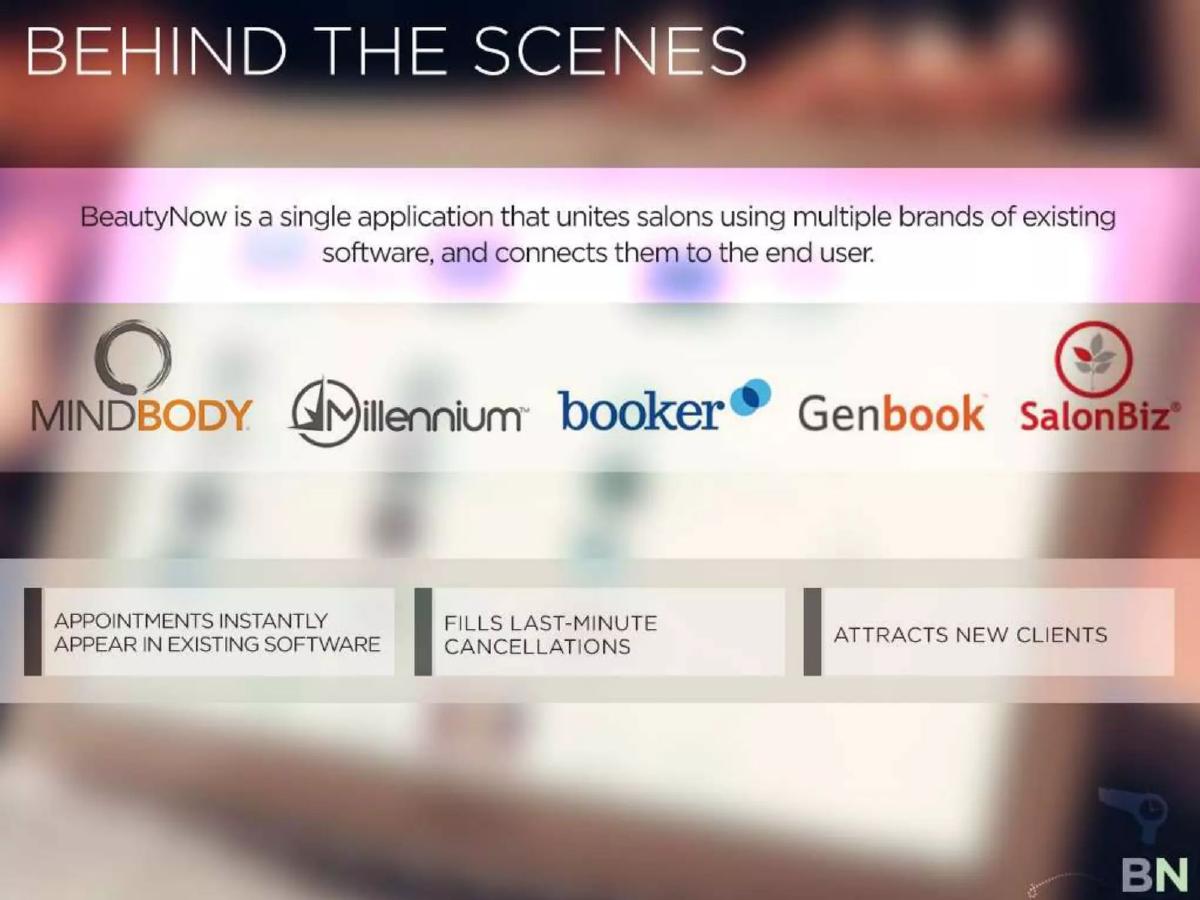
- The core technical moat is aggregation, integrating with five major software brands: Mindbody, Millennium, Booker, Genbook, and SalonBiz (Slide 5).
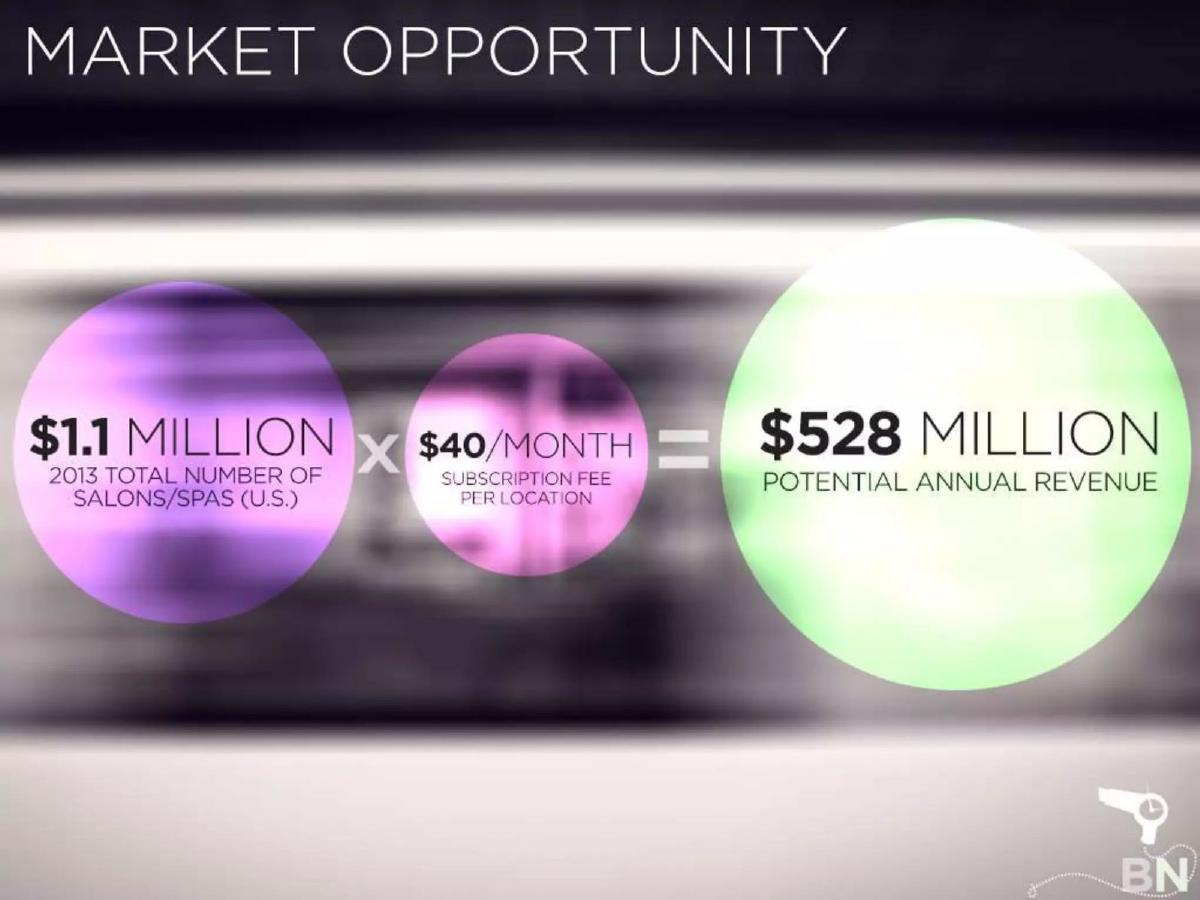
- Market opportunity is calculated at $528 million based on 1.1 million U.S. salons and a $40/month subscription fee (Slide 6).
- The competitive landscape is mapped on two axes: 'Integrated Solution' vs. 'Non-Integrated' and 'Open Appointments' vs. 'Locates Stylist' (Slide 8).
- Strategic differentiation includes a national rather than city-by-city rollout and exclusive contracts with major chains (Slide 9).
- The founder, Kathleen Jennings, leverages a beauty blog started in August 2013 that generates 20,000 hits per month as a customer acquisition channel (Slide 10).
- The deck omits a specific investment ask, use of funds, or detailed financial projections beyond the top-down market size.
Executive Summary: The Aggregator for a Fragmented Industry
BeautyNow presents an 11-slide pitch deck that focuses on solving the 'phone tag' and fragmentation issues inherent in the beauty services industry. The deck is structured to highlight a technical solution to a logistical problem: the fact that salons use many different, incompatible scheduling softwares. By positioning themselves as an aggregator rather than a new scheduling tool, BeautyNow attempts to bypass the friction of convincing salons to switch their internal systems.
Slide 1: Title Slide
The cover slide features the BeautyNow logo—a hairdryer combined with a clock icon—and the tagline 'Instantly Book Beauty Appointments.' It displays a mobile device showing a clean, icon-based interface for services like Hair Care, Salon, Manicures, and Facials. The visual emphasis is clearly on mobile-first consumer convenience.
Slide 2: Vision and Current Reach
Slide 2 establishes the 'OpenTable for beauty' analogy. This is a common but effective pitch tactic to help investors immediately grasp the marketplace dynamics. The slide claims the platform already includes 4,500 businesses across the U.S. It also introduces the founder's background as a beauty blogger, suggesting an organic path to user acquisition. The text emphasizes that this is not just for last-minute bookings, but a comprehensive solution for all beauty needs.
Slide 3: The Problem
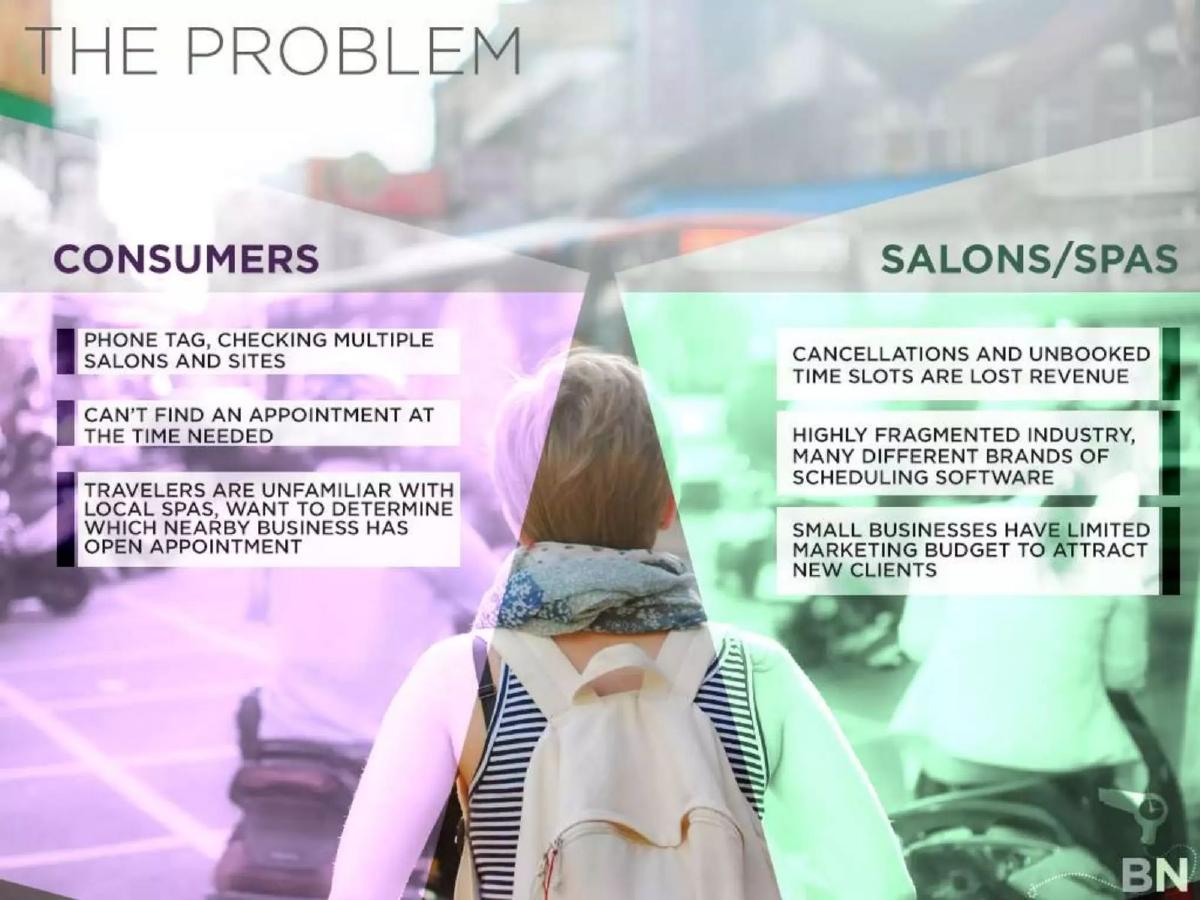
The problem is bifurcated into consumer and provider pain points. For consumers, the deck lists 'phone tag,' the inability to find specific time slots, and the difficulty travelers face in finding nearby services. For salons and spas, the focus is on lost revenue from cancellations, industry fragmentation (multiple software brands), and limited marketing budgets. This slide sets up the 'integrated solution' as the necessary bridge between these two groups.
Slide 4: How It Works
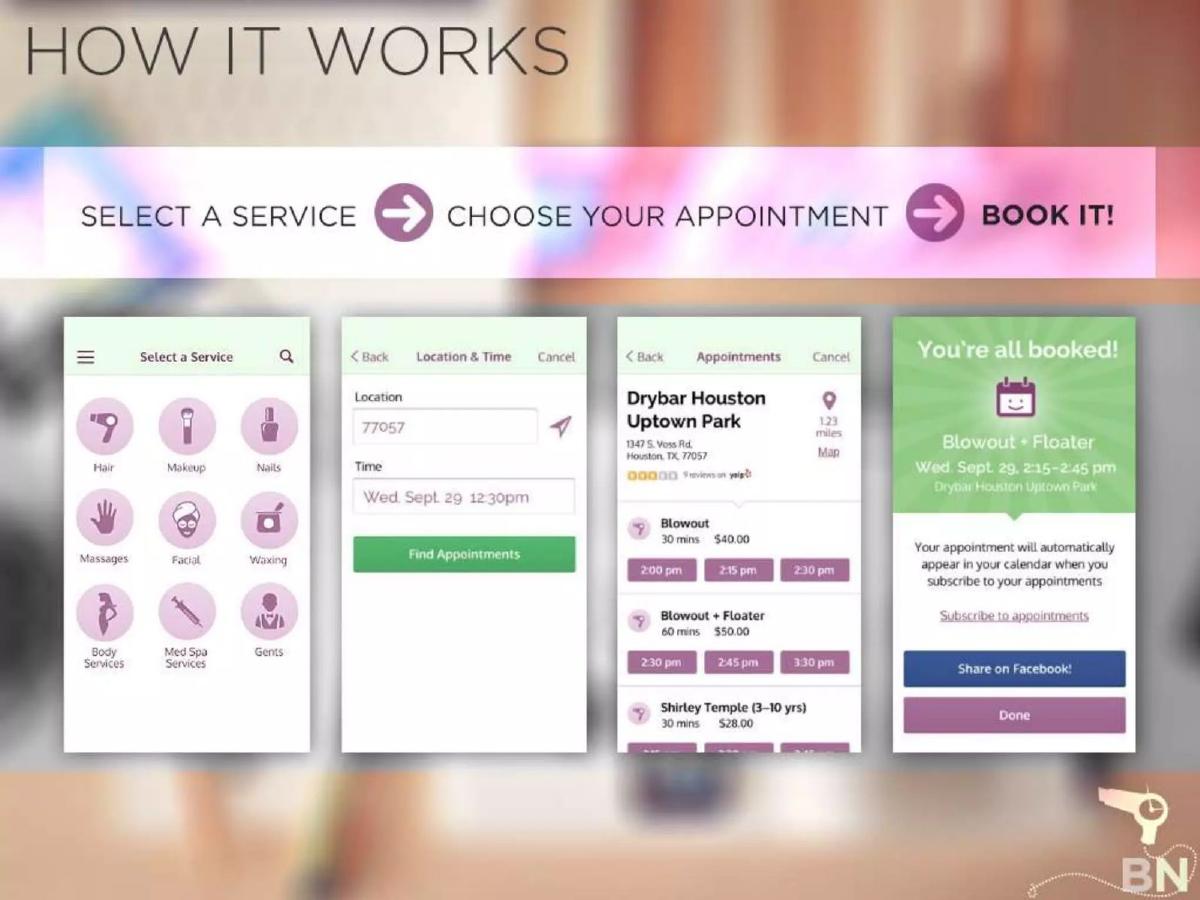
This slide provides a four-step visual walkthrough of the user experience: Select a Service, Choose Your Appointment, and Book It. The screenshots show a location and time search (using zip code 77057), a results page featuring a 'Drybar' location with specific time slots and prices (e.g., Blowout for $40.00), and a confirmation screen with social sharing options. It demonstrates a functional, high-fidelity product.
Slide 5: Behind The Scenes (Integration)
This is arguably the most important slide in the deck. It lists the logos of five major industry software providers: MINDBODY, Millennium, booker, Genbook, and SalonBiz. BeautyNow claims to unite these brands into a single application. The value proposition for the salon is that appointments appear 'instantly' in their existing software, which is a critical point for operational adoption.
Slide 6: Market Opportunity
The deck uses a top-down market sizing approach. It cites 1.1 million salons/spas in the U.S. (based on 2013 data) and multiplies this by a $40/month subscription fee. The resulting figure is $528 million in potential annual revenue. While top-down math is often scrutinized by investors, it provides a sense of the ceiling for a B2B subscription model in this specific niche.
Slide 7: A Different Product
This slide reiterates the core product advantages: integration with multiple brands, national availability, instant confirmation without phone calls, and an intuitive search process. It serves as a summary of the 'Solution' before moving into the competitive analysis.
Slide 8: Competitive Landscape
The competitive matrix uses two axes: 'Integrated Solution' vs. 'Non-Integrated' and 'Displays Open Appointments' vs. 'Locates Stylist/Salon.' BeautyNow places itself in the top-right quadrant (Integrated + Open Appointments). Competitors like StyleSeat are positioned as locating stylists rather than specific times, while others like Beautified are noted for requiring phone confirmation or lacking deep integration.
Slide 9: A Different Strategy
Slide 9 outlines the go-to-market and operational strategy. Key points include a national rollout (avoiding the high cost of city-by-city launches), a flat $40/month fee (avoiding commission friction), and exclusive contracts with major chains. It also mentions 'Search by Salon' to encourage cross-promotion, suggesting they are trying to be a partner to salons rather than just a lead-gen tool.
Slide 10: The Founder
The team slide is limited to a single person: Kathleen Jennings, Founder & CEO. Her credentials include a merit scholarship, a B.A. Magna Cum Laude, a J.D. with honors, and five years in corporate litigation. The most relevant metric provided is for her beauty blog, which started in August 2013 and receives 20,000 hits per month. This is presented as the primary engine for building trust and acquiring users.
Slide 11: Contact Information
The final slide repeats the branding from the cover and provides the founder's phone number and email address. There is no 'Ask' slide in this deck—no mention of the amount being raised, the valuation, or the specific milestones the funding would achieve.
What BeautyNow Does Well
The deck is visually consistent and uses a clear, feminine aesthetic that aligns with its target market. The 'Behind the Scenes' slide (Slide 5) is a strong inclusion because it addresses the primary technical hurdle in this industry: how to sync with the fragmented software already in use by salons. By showing the logos of established players like Mindbody and Booker, the founders signal that they have solved (or are solving) the integration piece, which is a common point of failure for beauty marketplaces.
The use of the 'OpenTable' analogy is also a strength. It immediately sets expectations for the business model and user behavior, allowing the rest of the deck to focus on the specific nuances of the beauty industry rather than explaining what a marketplace is.
What is Missing from the Deck
The most glaring omission is a clear 'Ask' slide. A professional pitch deck should specify how much capital is being sought and what that capital will be used for (e.g., hiring, marketing, geographic expansion). Without this, the deck feels more like a company overview than a fundraising tool.
Furthermore, the deck lacks a 'Traction' slide with hard numbers. While it mentions 4,500 businesses and 20,000 blog hits, it does not disclose the number of active app users, the number of bookings processed, or current monthly recurring revenue (MRR). Investors typically want to see the growth rate of these core metrics to validate that the 'OpenTable' model is actually working in practice.
Finally, there is no mention of a broader team. While the founder has strong academic and legal credentials, a marketplace business usually requires technical leadership and operations experts. The absence of a CTO or Head of Engineering is a potential red flag for a company whose value proposition relies heavily on software integrations.
Lessons for Founders
Leverage existing audiences: Kathleen Jennings uses her blog's 20,000 monthly hits as a proof of concept for user acquisition. Founders who have a 'pre-built' audience or a relevant personal brand should always highlight this as a low-cost acquisition channel.
Address the integration hurdle early: If your industry is fragmented by legacy software, don't ignore it. BeautyNow’s Slide 5 is a great example of how to show you are working within the existing ecosystem rather than trying to replace it entirely, which is often a much harder sell to small business owners.
Use clear competitive axes: The competitive matrix on Slide 8 is well-constructed. Instead of just saying 'we are better,' it defines the specific technical and functional dimensions (Integration and Appointment Display) where the company believes it has an edge. This helps investors understand the 'why' behind the product's design.
Don't forget the 'Ask': Even if you are just 'starting conversations,' your deck should have a slide that outlines your funding goals. It shows you have a plan for the capital and a clear vision for the next stage of the company's growth.
Frequently asked questions
- What is BeautyNow's primary business model?
- According to slide 6 and slide 9, BeautyNow operates on a B2B subscription model. They charge salons and spas a flat fee of $40 per month per location. This differs from commission-based models often seen in marketplaces, which the deck highlights as a 'Different Strategy' to encourage salon participation and cross-promotion.
- How does BeautyNow handle the technical challenge of different salon softwares?
- BeautyNow positions itself as a 'single application' that acts as a middle layer. As shown on slide 5, they integrate directly with existing industry software like Mindbody and Booker. This allows appointments booked through the BeautyNow app to appear instantly in the salon's own management software without requiring manual entry or phone confirmations.
- What is the scale of the beauty market according to this deck?
- Slide 6 cites 2013 data stating there are 1.1 million total salons and spas in the United States. By applying their $40 monthly subscription fee to this total number of locations, they estimate a potential annual revenue opportunity of $528 million.
- Who are BeautyNow's main competitors and how do they differ?
- Slide 8 identifies five competitors: Beautified, PrettyQuick, BeautyBooked, StyleSeat, and SpaFinder. BeautyNow differentiates itself by being both a fully integrated solution (unlike StyleSeat or Beautified) and focusing on displaying open appointment times rather than just locating a stylist or salon.
- What is the founder's background and how does it relate to the business?
- Founder Kathleen Jennings has a background in corporate litigation with a J.D. from the University of Texas. However, her relevant 'unfair advantage' is her role as a beauty blogger. Slide 10 notes her blog receives 20,000 hits per month, which serves as a pre-built marketing engine and establishes her as a 'trusted beauty source' for the app.