Beckley Psytech’s 22-slide presentation is a sophisticated example of a biotech platform play. Rather than pitching a single 'miracle drug,' the company presents a multi-generational pipeline strategy that balances immediate clinical validation with long-term intellectual property (IP) creation. The deck leans heavily on the 'Beckley Advantage'—a 20-year legacy of research via the Beckley Foundation—to de-risk the investment. By citing specific FDA-approved precedents like Epidiolex and Spravato, the company anchors its high-science approach in proven commercial outcomes. The ask of $18 milli…
Key takeaways
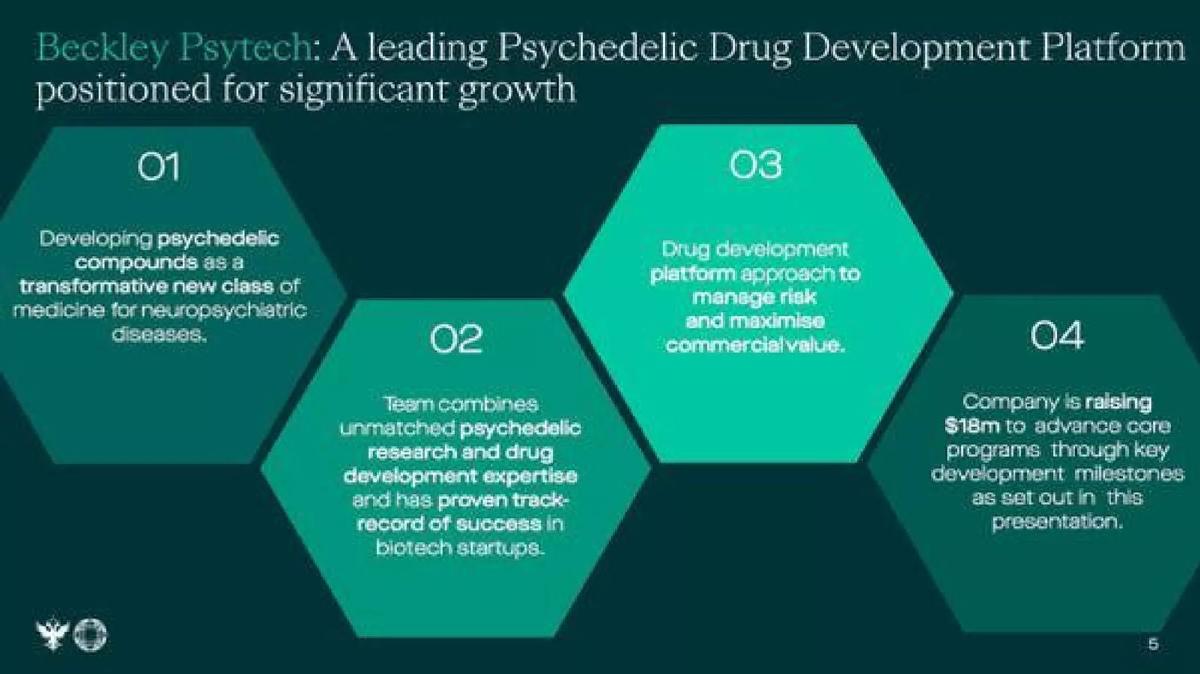
- The deck explicitly states a fundraising goal of $18 million to advance core programs through key milestones (Slide 5).
- The company utilizes a 'three-generation' pipeline strategy to manage risk, moving from known formulations to New Chemical Entities (Slide 13).
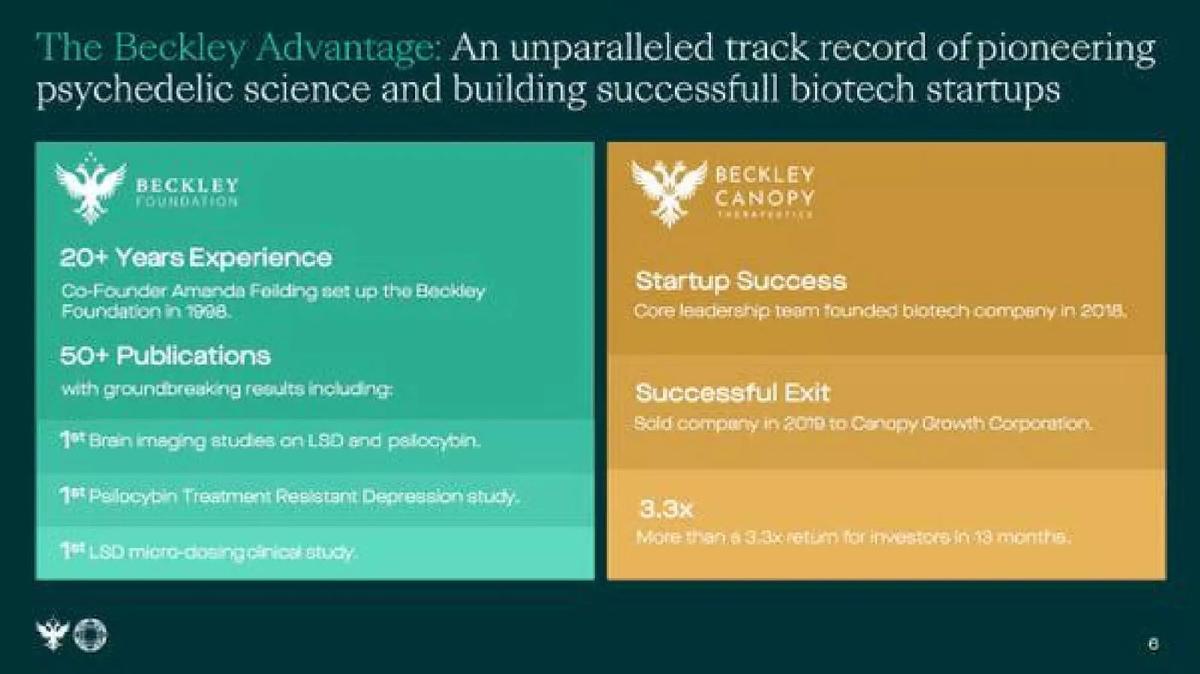
- Beckley Psytech leverages a 20+ year track record and 50+ publications from the Beckley Foundation to establish scientific authority (Slide 6).
- The deck identifies a $6 trillion anticipated cost for treating global mental illness by 2030 as the primary market driver (Slide 8).
- A specific focus is placed on 5-MeO-DMT as a '2nd Generation' medicine with short-acting clinical advantages (Slide 19).
- The leadership team includes former executives from major pharma players like Johnson & Johnson, Allergan, and Biogen (Slide 14).
- The 'Beckley Deep Labs' division is introduced to apply AI and Machine Learning to clinical development (Slide 20).
- The deck cites a previous successful exit where a core leadership team sold a biotech company in 2019 for a 3.3x return in 13 months (Slide 6).
Introduction: The Pedigree of Psychedelic Medicine
Beckley Psytech’s pitch deck is a masterclass in using institutional history to validate a nascent and often misunderstood industry. Operating in the psychedelic medicine space, the company doesn't just pitch a product; it pitches a legacy. By the time an investor reaches the end of the 22-slide deck, the narrative has shifted from 'experimental drugs' to 'licensed pharmaceutical medicines' backed by decades of research. This teardown examines how they structured their Series B narrative to raise $18 million (as stated in the deck) and eventually over $114 million in total.
Slides 1-6: The Hook and the 'Beckley Advantage'
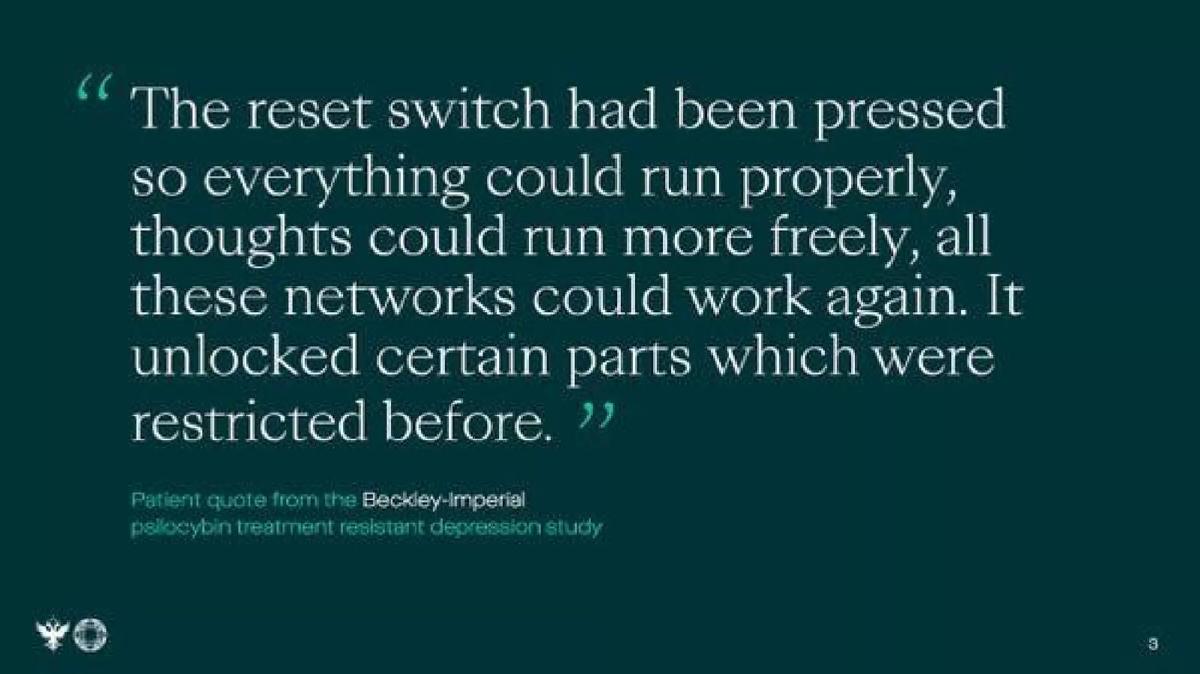
The presentation opens with a standard title and a heavy-duty legal disclaimer (Slide 2). However, Slide 3 immediately pivots to the human element with a patient quote from a psilocybin study, describing a 'reset switch' in the brain. This sets the emotional and clinical stakes early.
Slide 4 defines the mission: developing a pipeline of psychedelic compounds into licensed pharmaceutical medicines. This is a crucial distinction—they are not a wellness company; they are a pharma company. Slide 5 provides the 'Executive Summary' in four hexagons, explicitly stating on point 04 that the company is raising $18m to advance core programs.
Slide 6 is perhaps the most important in the deck for building trust. It details 'The Beckley Advantage,' citing 20+ years of experience, 50+ publications, and a previous 'Successful Exit' where the team sold a company to Canopy Growth Corporation in 2019, yielding a 3.3x return for investors in just 13 months. This slide effectively says: 'We have done this before, and we have made people money.'
Slides 7-11: Market Opportunity and Macro Drivers
Part One of the deck focuses on the 'Opportunity.' Slide 8 quantifies the problem: 1 in 4 people suffer from neurological disorders, and the global cost of mental illness is projected to hit $6 trillion by 2030. More importantly, it notes that 33% of patients are resistant to current treatments, creating a massive 'unmet need.'
Slide 9 provides the 'Proof of Concept' for the entire sector. It highlights Epidiolex (cannabis-based) and Spravato (ketamine-derivative) as FDA-approved precedents with peak sales forecasts of $2bn and $1.35bn, respectively. This anchors the investor’s expectations in real-world pharmaceutical success stories.
Slide 10 shows a timeline of psychedelic research from 2005 to the present, highlighting high remission rates in studies for alcohol addiction and depression. Slide 11 concludes this section with a 'Why Now?' montage of media headlines from 2019 and 2020, signaling that the market is 'maturing' and 'heading for the mainstream.'
Slides 12-16: Strategy, Team, and Network
Part Two moves into the 'how.' Slide 13 introduces the 'Three Generation' pipeline strategy. This is a sophisticated way to show risk diversification: 1st Gen is about new applications of known agents, 2nd Gen is about under-researched agents with stronger IP (like 5-MeO-DMT), and 3rd Gen is about New Chemical Entities (NCEs). This tells the investor that the company isn't betting everything on one molecule.
Slide 14 presents the Leadership Team. The pedigree here is undeniable, with logos from Johnson & Johnson, Allergan, Biogen, and Pfizer appearing under the bios of the directors and officers. This isn't a team of enthusiasts; it's a team of pharma executives. Slide 15 reinforces this with a Scientific Advisory Board featuring professors from Oxford, King’s College London, and Johns Hopkins.
Slide 16 explains the strategic moat: the partnership with the Beckley Foundation. This gives the company access to 'Big Data' and a 'Pipeline of IP' that competitors would have to spend decades to replicate. It also mentions a revenue-share agreement with the non-profit, adding an ESG (Environmental, Social, and Governance) layer to the investment.
Slides 17-20: Research and Competitive Positioning
Part Three dives into the technical specifics. Slide 18 breaks down the competitive advantages of each generation, specifically mentioning 'Composition of matter IP' for the 3rd Generation NCEs. This is a key term for biotech investors, as it represents the strongest form of patent protection.
Slide 19 provides an 'In Depth' look at 5-MeO-DMT. It highlights that the drug is 'short-acting and potent,' which is a significant commercial advantage over long-acting psychedelics like LSD or psilocybin, which require 6-8 hours of clinical supervision. A 20-minute experience (as hinted on Slide 11) is much easier to scale in a healthcare system.
Slide 20 introduces 'Beckley Deep Labs,' an advanced research division using AI and Machine Learning to accelerate clinical development. This adds a 'tech' layer to the biotech story, appealing to investors looking for modern, data-driven approaches to drug discovery.
Slides 21-22: The Ask and Conclusion
Slide 21 brings it all together with the final pitch: 'Right Projects, Right Team, Right Time.' It reiterates the $18m fundraising goal for Autumn 2020 and lists four specific milestones that the money will fund: a Proof-of-Concept trial, a Phase 1 trial for 5-MeO-DMT, NCE development, and the launch of Deep Labs. This level of specificity in the 'Use of Funds' is exactly what Series B investors look for.
What Works in This Deck
Institutional Credibility: By tying the startup to the Beckley Foundation, the founders bypass the 'newcomer' stigma. They present themselves as the commercial arm of a 20-year scientific institution.
Risk Stratification: The 'Three Generation' pipeline is a brilliant way to explain a complex R&D strategy. it shows that the company has a path to near-term clinical data (1st Gen) and long-term defensible IP (3rd Gen).
Commercial Realism: Citing the 20-minute duration of 5-MeO-DMT shows that the company understands the operational constraints of the healthcare system. They aren't just thinking about the 'trip'; they are thinking about the 'clinic hour.'
What Is Missing
Financial Projections: While the deck is heavy on science and strategy, it lacks a slide on projected revenue or market share capture. While common in early biotech, Series B investors often want to see more detailed 'bottom-up' market sizing.
Competitive Landscape: Slide 18 mentions competitive positioning, but it doesn't name other players in the space (like COMPASS Pathways or Atai Life Sciences). A direct comparison table would have helped clarify their unique moat.
Regulatory Roadmap: While they mention 'FDA Breakthrough Status' for the sector, a more detailed timeline of their specific interactions with the FDA or EMA (European Medicines Agency) for their lead compounds would have added another layer of de-risking.
What a Founder Should Copy
The 'Precedent' Slide: Slide 9 is a perfect example of how to use existing market successes to validate your own category. If you are in a 'weird' or 'new' industry, find the closest FDA-approved or regulated equivalent and show their numbers.
The Milestone-Based Ask: Don't just ask for money. Link the dollar amount to specific, value-inflection milestones as Beckley did on Slide 21. This makes the investment feel like a purchase of progress rather than a donation to a dream.
The 'Deep Labs' Pivot: Even if your core business is traditional (like drug development), showing how you are using modern tools like AI/ML (Slide 20) can help you capture a broader range of venture capital interest and signal forward-thinking leadership.
Frequently asked questions
- How much was Beckley Psytech raising in this specific deck?
- According to Slide 5 and Slide 21, the company was seeking $18 million in the Autumn of 2020. This capital was earmarked for conducting a Proof-of-Concept trial for their 1st Generation program, completing a Phase 1 trial for 5-MeO-DMT, and advancing internal New Chemical Entity (NCE) development.
- What is the 'Three Generation' strategy mentioned in the deck?
- On Slide 13, the company outlines its risk management approach. 1st Generation focuses on innovative formulations of well-characterized agents. 2nd Generation develops under-researched agents (like 5-MeO-DMT) for stronger IP. 3rd Generation involves designing entirely New Chemical Entities (NCEs) to improve upon existing psychedelics for better health economic outcomes.
- Who are the key people leading Beckley Psytech?
- The leadership team, shown on Slide 14, is led by CEO Cosmo Feilding Mellen and Chair of the Scientific Advisory Board Lady Amanda Feilding. The team includes veterans from the pharmaceutical industry, such as Dr. Steve Wooding (formerly of Johnson & Johnson) and Tim Mason (formerly of Allergan).
- How does the company address the 'Why Now?' question for investors?
- Slide 11 uses a 'social proof' approach, featuring headlines from Bloomberg, Forbes, and the Financial Times about the maturation of the psychedelic drug market. It also points to recent FDA breakthroughs and the successful commercialization of related drugs like Spravato and Epidiolex on Slide 9.
- What is the relationship between the company and the Beckley Foundation?
- Slide 16 explains that Beckley Psytech has a close strategic partnership with the non-profit Beckley Foundation. This provides the company with 'Big Data,' 'Deal Flow,' and a 'Pipeline of IP.' In exchange, the company commits to donating a share of future revenues to fund the Foundation's non-profit work.