Everside Health’s 2022 pitch deck is a masterclass in positioning a service-heavy business as a scalable technology-enabled platform. By framing the U.S. healthcare crisis around wait times and provider burnout, Everside presents its direct primary care model as the antidote for both patients and employers. The deck effectively uses comparative tables to contrast traditional fee-for-service models with its own 'Total Cost of Care' approach. With a footprint spanning 34 states and 375+ health centers, the company leans heavily on its operational scale and a management team with deep institutio…
Key takeaways
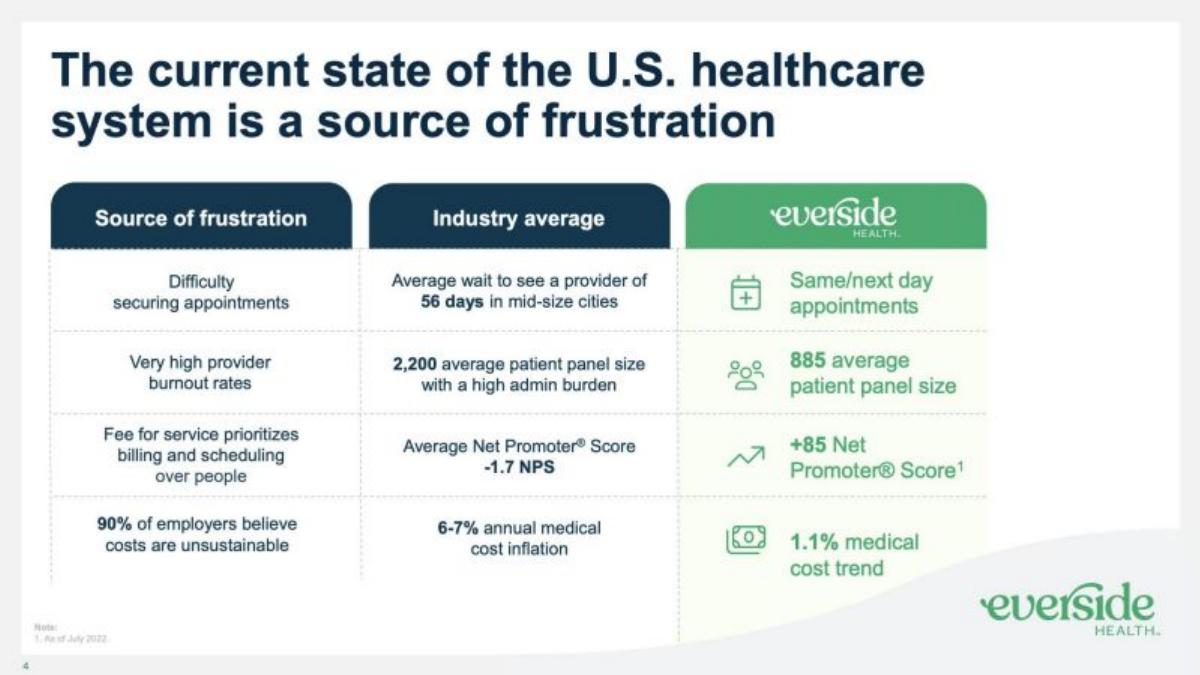
- The industry average wait time to see a provider is 56 days in mid-size cities, which Everside counters with same or next-day appointments (Slide 4).
- Everside maintains an average patient panel size of 885, significantly lower than the industry average of 2,200 (Slide 4).
- The company claims a +85 Net Promoter Score, contrasting with an industry average of -1.7 NPS (Slide 4).
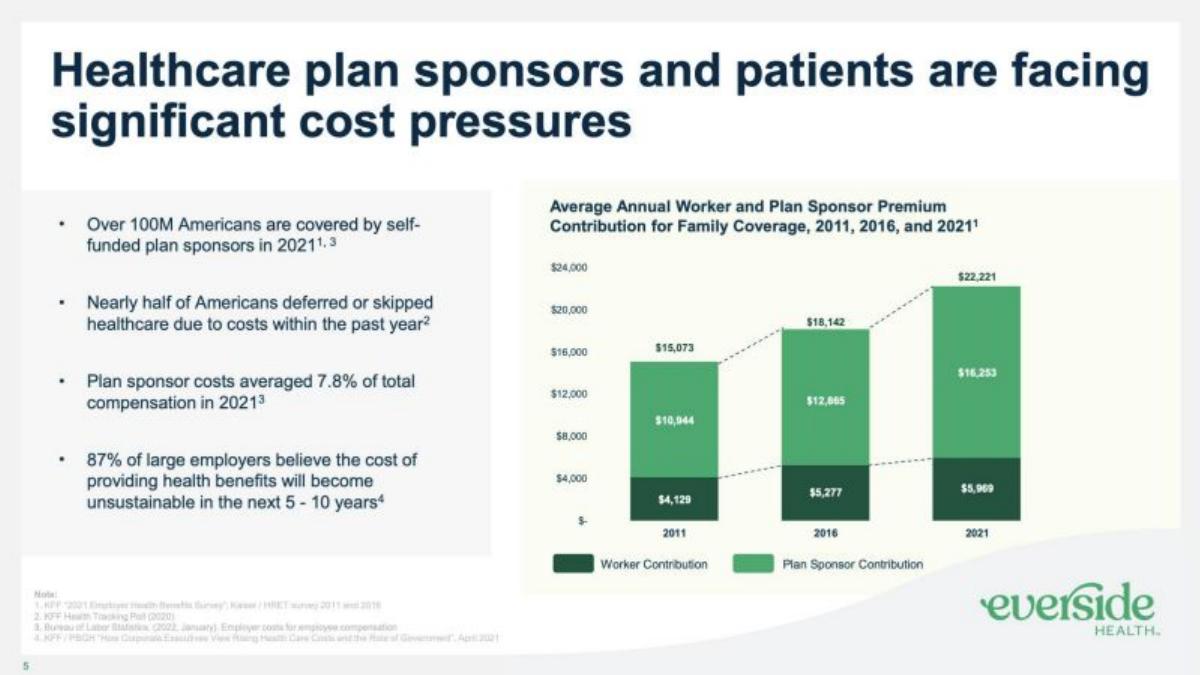
- Plan sponsor contributions for family coverage reached $16,253 in 2021, up from $10,944 in 2011 (Slide 5).
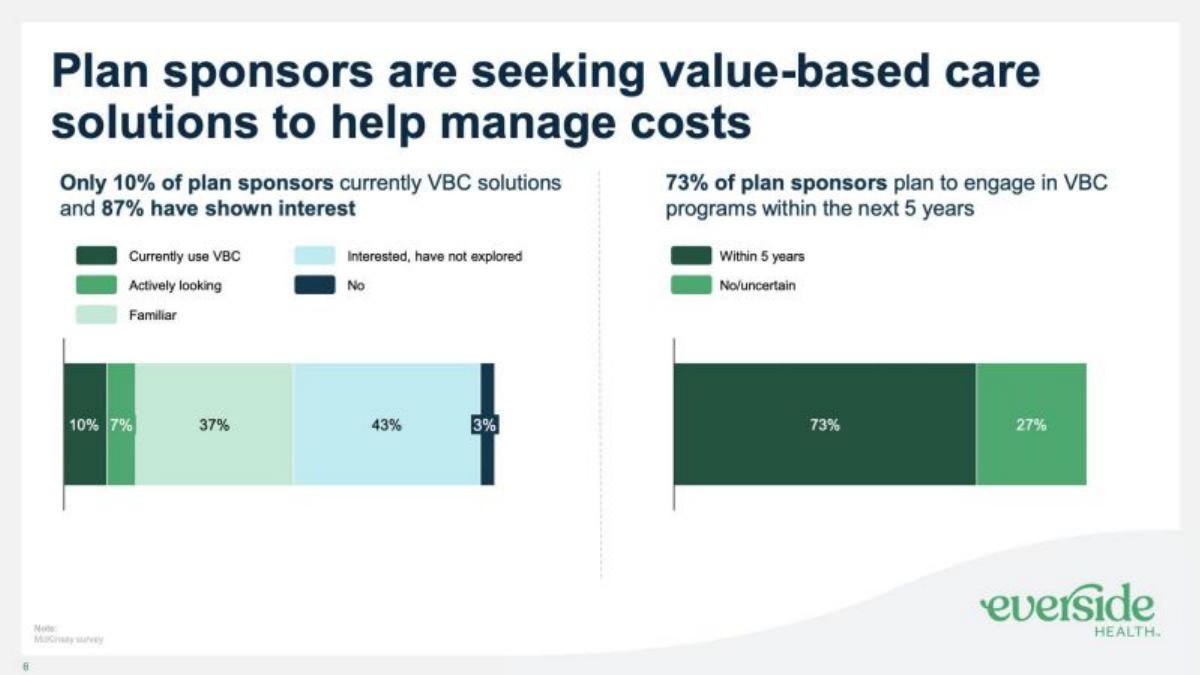
- 73% of plan sponsors intend to engage in Value-Based Care (VBC) programs within the next five years (Slide 6).
- The business model relies on fixed, recurring multi-year contracts with employers to reduce total healthcare expenses (Slide 7).
- Everside claims to deliver 30%+ cost savings for employers through its integrated clinical model (Slide 9).
- Operational scale includes 375+ health centers, 400+ employed providers, and 575,000+ patients across 34 states (Slide 11).
Executive Summary: The Shift to Value-Based Primary Care
Everside Health’s 13-slide pitch deck is a targeted document designed for growth-stage investors. It moves quickly past the 'what' of the business to focus on the 'why now' and the 'how it scales.' The deck is built around the central thesis that the current U.S. healthcare system is failing both the payor (employers) and the user (patients). By positioning itself as a technology-enabled solution to these systemic failures, Everside justifies its high-touch, brick-and-mortar heavy model as a scalable platform. The following teardown examines how the company uses data and comparative analysis to build a case for its $164M growth round.
Slide 1: Title and Branding
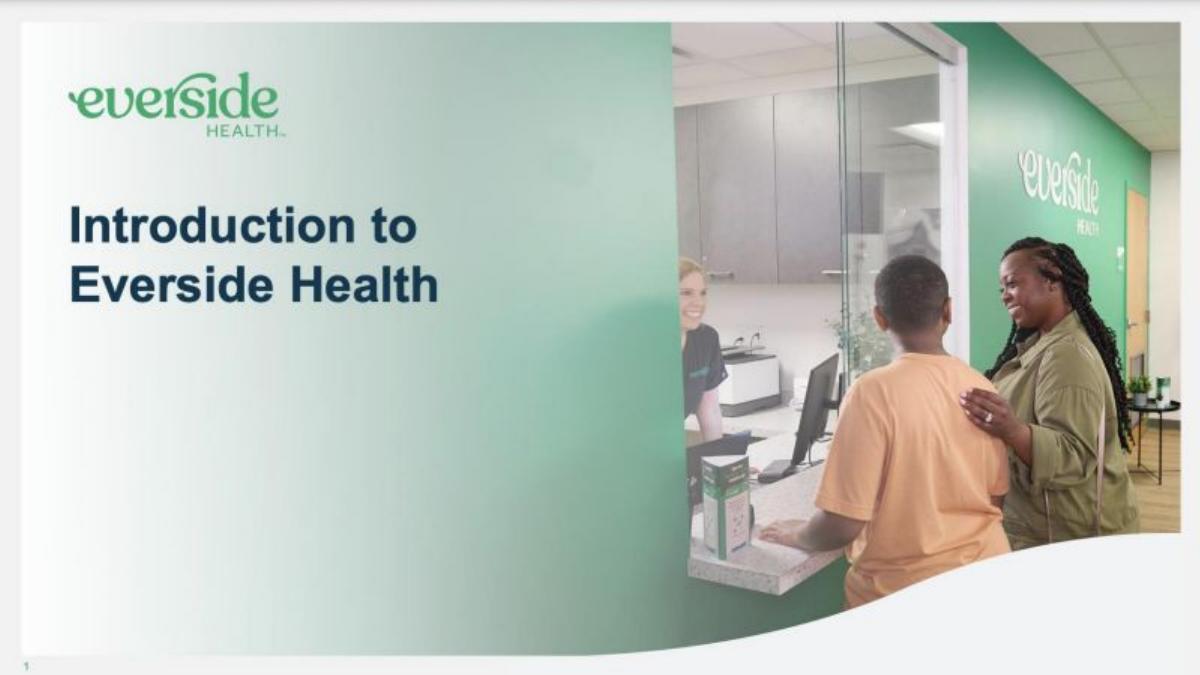
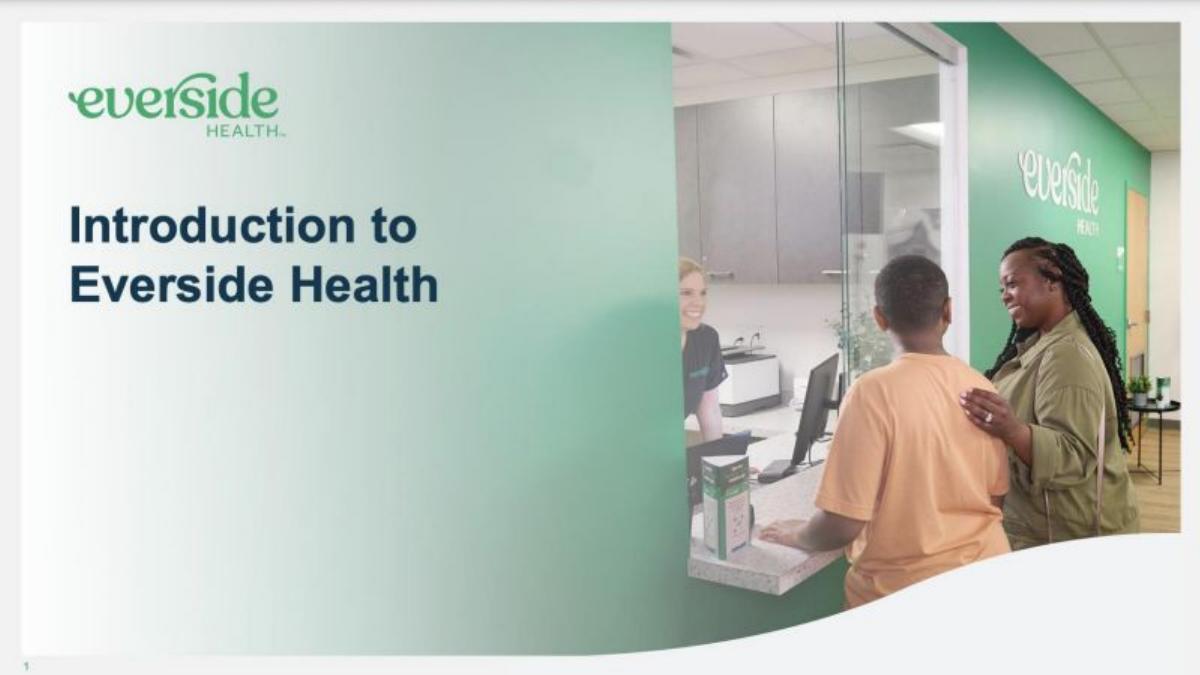
The cover slide is clean, featuring the Everside Health logo and a high-quality photograph of a patient interaction in a modern clinic. The imagery reinforces the 'Health Center' aspect of the business, grounding the tech-enabled claims in physical reality. There are no taglines or sub-headers here, just a simple Introduction to Everside Health .
Slide 2: The Value Proposition
Slide 2 serves as the mission statement. It defines the company as a scaled technology-enabled primary care platform . The slide highlights three core pillars: superior patient experiences, improved health outcomes, and partnership with employers to reduce the total cost of care. This is a classic 'triple aim' healthcare strategy, clearly identifying the employer as the primary customer.
Slide 3: Mission, Vision, and Values
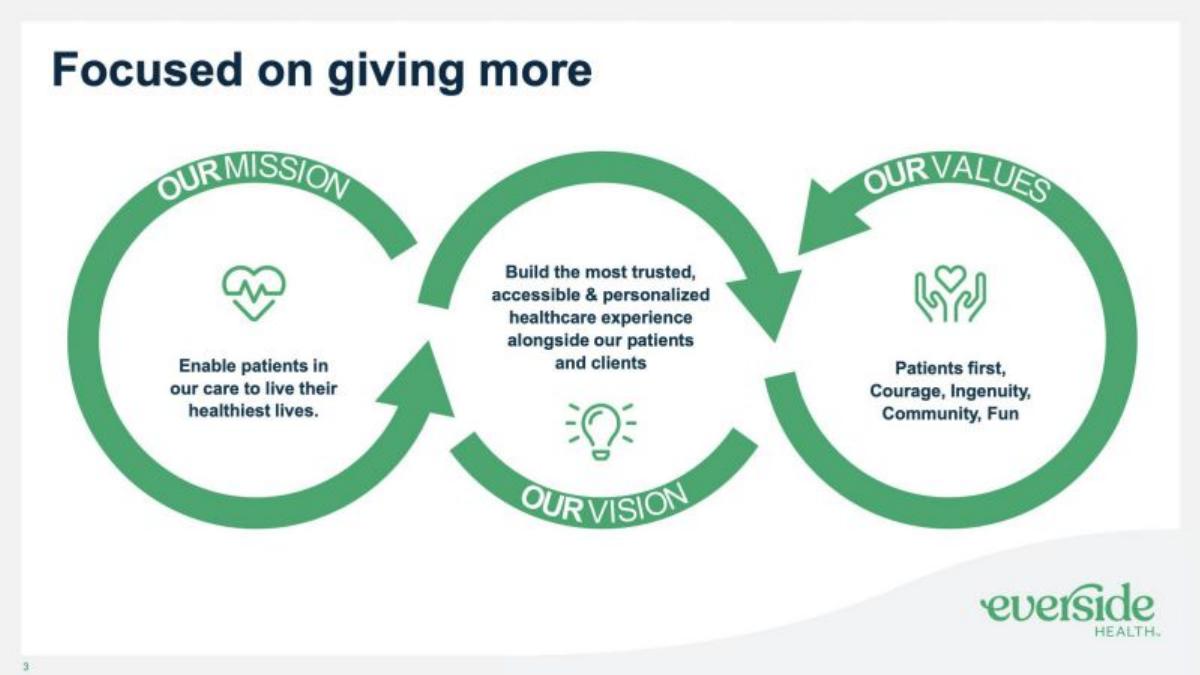
This slide uses a cyclical graphic to link the mission (enable patients to live healthiest lives), vision (build the most trusted, accessible & personalized experience), and values (Patients first, Courage, Ingenuity, Community, Fun). While standard for corporate decks, it emphasizes the patient-centric nature of their clinical operations.
Slide 4: The Problem—Source of Frustration
This is one of the most effective slides in the deck. It uses a three-column table to compare 'Source of frustration,' 'Industry average,' and 'Everside Health.' Slide 4 notes that the average wait to see a provider is 56 days in mid-size cities, while Everside offers same/next day appointments . It also highlights a massive disparity in Net Promoter Scores: -1.7 NPS for the industry versus +85 NPS for Everside. By quantifying the frustration, they make the solution feel mandatory rather than optional.
Slide 5: The Economic Burden
Slide 5 shifts the focus to the 'Plan Sponsor' (the employer). It cites that over 100M Americans are covered by self-funded plan sponsors. A bar chart shows the average annual premium for family coverage rising from $15,073 in 2011 to $22,221 in 2021 . The most striking stat is that 87% of large employers believe healthcare costs will become unsustainable in the next 5-10 years. This creates the 'burning platform' necessary for a growth-stage investment.
Slide 6: Market Readiness for Value-Based Care
This slide addresses market timing. It shows that while only 10% of plan sponsors currently use Value-Based Care (VBC) solutions, 87% have shown interest . Furthermore, 73% plan to engage in VBC programs within the next 5 years. This suggests a massive tailwind for Everside’s specific business model, moving from early adoption to mainstream corporate strategy.
Slide 7: The Business Model Pivot
Slide 7 contrasts the 'Traditional fee-for-service' (Reactive sick care) with Everside’s 'Total Cost of Care Approach' (Proactive preventive care). The key takeaway for investors is the fixed, recurring multi-year contracts . This moves the business away from the volatility of clinical visits toward a predictable, SaaS-like revenue durability, which is highly attractive for valuation multiples.
Slide 8: The Solution Ecosystem
This slide visualizes the 'one convenient solution.' It surrounds a patient image with icons for Primary Care, Mental Health Services, Chronic Condition Management, Wellness Coaching, Pharmacy, Referral Management, Occupational Health, and Onsite Testing . The note 'In-person or Virtual' ensures the company isn't pigeonholed as just a physical clinic operator.
Slide 9: Managing Total Cost of Care
Slide 9 explains the 'how.' It introduces the Everside Health Rules Engine , which ingests medical/Rx claims, clinical labs, and social determinants to create a '360-degree view of the patient.' The outcomes listed on the right are impressive: 30%+ cost savings for employers and clinical quality metrics at the 90th percentile or higher . This slide bridges the gap between 'we have clinics' and 'we are a data-driven health platform.'
Slide 10: Social Proof and Case Study
A full-slide testimonial from Don Bough, Business Manager of Local 440, states that their plan has saved over $11M in the last 5 years . Using a specific dollar amount from a named client adds significant credibility to the 30% savings claim made on the previous slide.
Slide 11: Operational Scale
This slide demonstrates the 'moat' of physical infrastructure. A map shows a scaled national footprint across 34 states. The key metrics as of 2022 are: 575K+ Patients, 350+ Clients, 375+ Health Centers, 400+ Employed Providers, and 1,400+ Employees . It also features a 'Best in KLAS 2022' award, signaling industry-leading performance in employer-sponsored healthcare services.
Slide 12: The Management Team
The team slide is heavy on institutional experience. It features 9 executives with logos from Aetna, Walgreens, CVS Health, DaVita, Optum, and Cognizant . This is not a 'founder-led' startup deck in the traditional sense; it is a 'professional management' deck designed to signal that the company is ready for an IPO or a major private equity exit.
Slide 13: Key Advantages
The final slide summarizes the 'unique' advantages: Revenue model durability, Unit economics, Tech-driven solution, Cost reduction, and Client/patient base . Curiously, this slide acts as a summary but does not include a 'Call to Action' or the details of the $164M raise. It functions more as a closing argument for the company's stability and market position.
What Everside Health Does Well
The deck is exceptionally strong at benchmarking . By placing their internal metrics (NPS, panel size, wait times) directly next to industry averages, they make the superiority of their model self-evident. They also do a great job of speaking to the 'economic buyer'—the employer—by focusing on cost sustainability and recurring contract structures rather than just clinical outcomes.
The visual hierarchy is also noteworthy. The deck uses a consistent color palette and clean layouts that make dense healthcare data easy to digest. The use of a map to show geographic density (Slide 11) effectively communicates that this is no longer a regional pilot but a national infrastructure play.
What is Missing from the Deck
Despite the successful $164M raise, several standard elements are missing from this specific version of the deck:
The Ask: There is no slide detailing how much capital is being raised or how it will be allocated (e.g., R&D, geographic expansion, M&A). · Financial Projections: While they mention 'recurring contracts,' there are no charts showing revenue growth, EBITDA margins, or path to profitability. · Unit Economics Detail: Slide 13 mentions unit economics as a key advantage, but the deck never actually defines what those economics are (e.g., CAC, LTV, or payback period per health center). · Competitive Landscape: The deck ignores competitors like One Medical, Crossover Health, or Premise Health. It positions Everside against the 'status quo' rather than other modern primary care innovators.
Founder Takeaways: Lessons from Everside
1. Frame your service as a platform: If you are building a business with high overhead (like clinics), you must convince investors that your technology 'Rules Engine' (Slide 9) is what drives the value, not just the labor of the providers. This justifies a higher valuation multiple.
2. Use the 'Frustration' Table: Every founder should have a version of Slide 4. Identifying the specific, quantifiable pain points of the current industry and showing your exact delta against those averages is the fastest way to build investor conviction.
3. Focus on the Payor's ROI: In B2B healthcare, the patient's health is a feature, but the employer's cost saving is the product. Everside’s constant refrain of '30%+ cost savings' and 'unsustainable costs' (Slide 5) keeps the focus on the financial incentive for their customers to switch.
4. Professionalize the Team Slide: For growth-stage rounds, investors want to see 'been there, done that' experience. Highlighting logos of massive incumbents (Aetna, CVS) shows that the leadership understands the complexities of the system they are trying to disrupt.
5. Quantify the 'Burning Platform': Slide 5 doesn't just say healthcare is expensive; it shows a 10-year trend line and a survey result (87% of employers) that proves the market is desperate for a solution. This creates a sense of urgency for the investment.
Frequently asked questions
- What is Everside Health's core business model?
- Everside Health operates on a 'Total Cost of Care' approach, utilizing fixed, recurring multi-year contracts with employers. Unlike traditional fee-for-service models that are utilization-driven, Everside focuses on proactive preventive care. This model aims to reduce the total healthcare expense for the employer while providing patients with free or low-cost access to primary care, mental health, and chronic condition management.
- How does Everside Health differentiate itself from traditional primary care?
- The deck highlights four key differentiators on Slide 4: accessibility (same/next-day appointments vs. 56-day wait), provider focus (885 patient panel vs. 2,200), patient satisfaction (+85 NPS vs. -1.7 NPS), and cost control (1.1% medical cost trend vs. 6-7% inflation). They position themselves as a 'technology-enabled' platform rather than just a clinic operator.
- What evidence of cost savings does the deck provide?
- Slide 9 claims that Everside delivers 30%+ cost savings for employers and 'millions of $$ savings for patients.' Slide 10 provides a specific case study for 'Local 440,' stating the plan saved over $11M in the last 5 years. These savings are attributed to their 'Rules Engine' which uses medical claims, clinical labs, and social determinants to manage patient health proactively.
- What is the scale of Everside Health's operations as of this deck?
- According to Slide 11, Everside has a national footprint covering 34 states and over 140 markets. Their operations include 375+ health centers, 400+ employed providers, and a total staff of 1,400+ employees. They serve over 350 clients and 575,000+ patients, positioning them as a major player in the direct primary care space.
- Who are the key investors and how much was raised?
- Based on the catalogue facts, Everside Health raised $164M in a Growth round in 2022. The round was led by NEA (New Enterprise Associates), with participation from Oak HC/FT and Alta Partners. The deck itself focuses on the operational and strategic value proposition rather than the specific terms of the investment round.