Everside Health’s $164M pitch deck is a high-level strategic overview of the Direct Primary Care (DPC) market, specifically targeting the self-funded employer segment. The deck successfully contrasts the traditional fee-for-service model with Everside’s 'Total Cost of Care' approach, which claims to deliver 30%+ cost savings for employers. By showcasing a national footprint of 375+ health centers and 400+ employed providers, the company demonstrates significant operational maturity. While the provided slides lack a specific financial 'ask' or detailed team bios, the emphasis on clinical outco…
Key takeaways
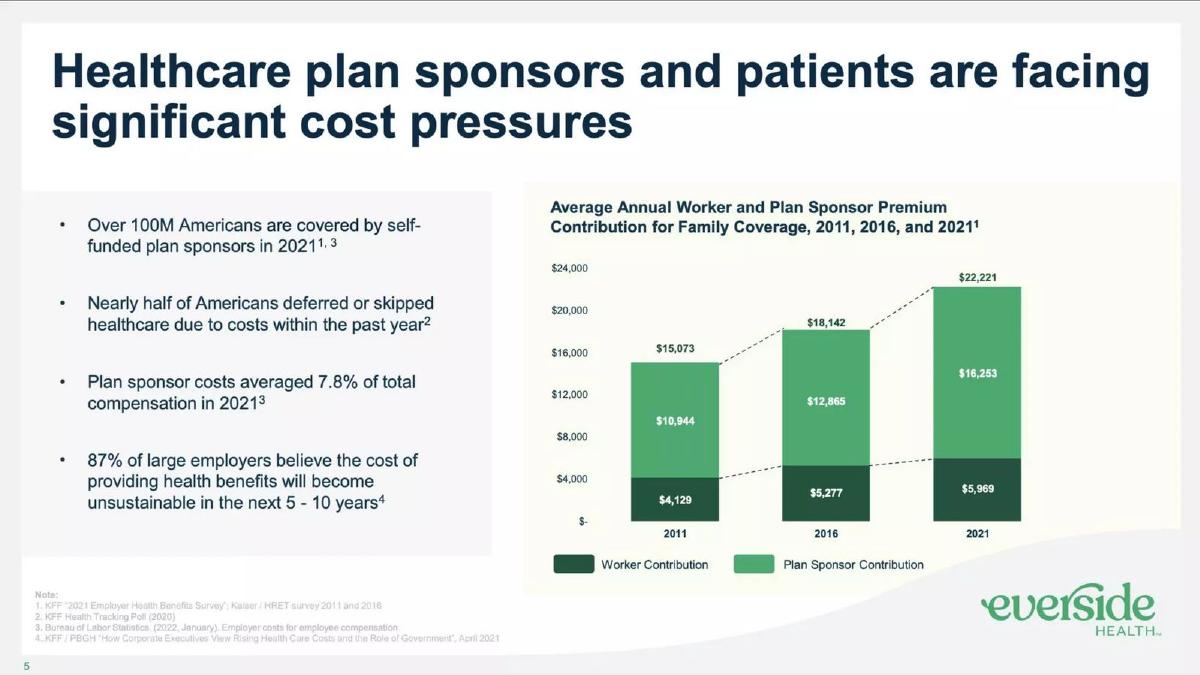
- The deck identifies a massive market of over 100M Americans covered by self-funded plan sponsors as of 2021 (Slide 5).
- Everside positions its business model as a shift from 'utilization-driven' reactive care to 'fixed, recurring multi-year contracts' (Slide 7).
- The company claims a significant 30%+ cost savings for employers through its proactive preventive care model (Slide 9).
- Clinical quality is a core selling point, with the company stating its outcomes metrics are at the 90th percentile or higher (Slide 9).
- Operational scale is demonstrated by a presence in 34 states and 140 markets across the U.S. (Slide 11).
- The workforce is substantial, consisting of over 1,400 employees and 400+ employed providers (Slide 11).
- Technology is framed as a 'Rules Engine' that integrates medical claims, labs, and social determinants to create a 360-degree patient view (Slide 9).
- The deck highlights a 2022 'Best in KLAS' award for employer-sponsored healthcare services to validate its market position (Slide 11).
Executive Summary: The Shift to Value-Based Primary Care
Everside Health’s presentation is a textbook example of how to pitch a mature, late-stage healthcare services company. Rather than focusing on the mechanics of a single clinic, the deck focuses on the systemic failures of the U.S. healthcare system and how Everside’s scale solves them for large employers. The narrative arc moves from the macro-economic problem of rising premiums to the micro-level solution of integrated, tech-enabled primary care.
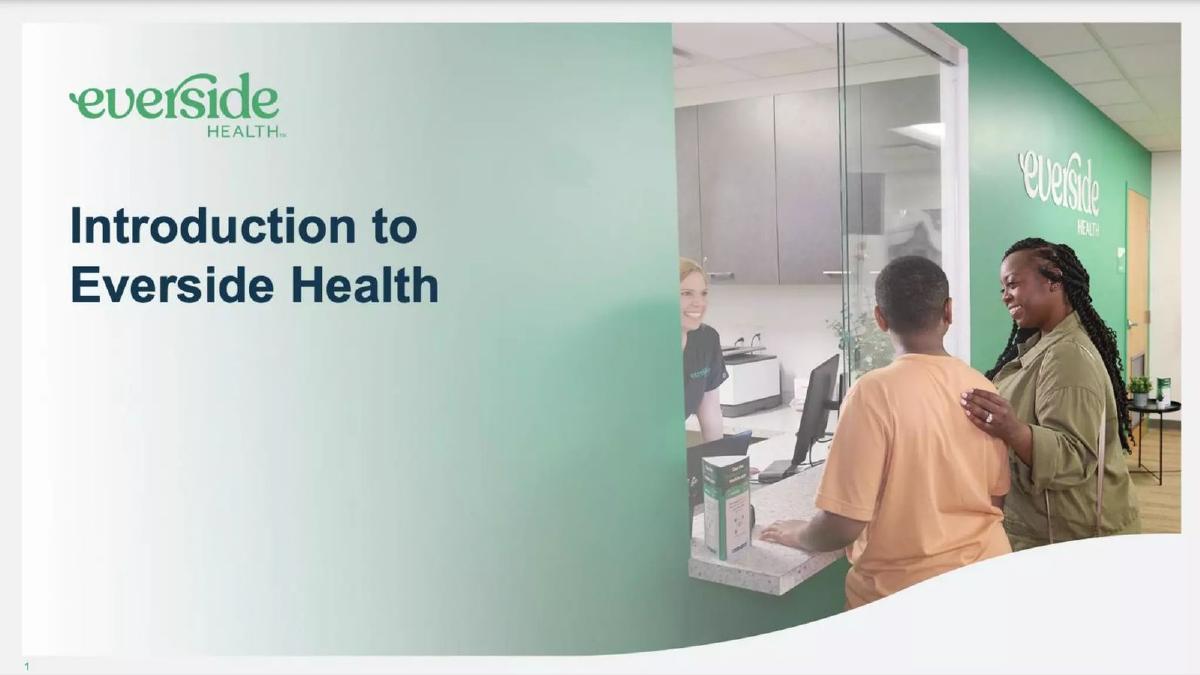
Slide 1: Title and Brand Identity
The cover slide is minimalist, featuring the Everside Health logo and the title "Introduction to Everside Health." The imagery depicts a warm, professional interaction between a healthcare provider and a patient family in a modern clinic setting. This immediately establishes the brand as a physical, human-centric service rather than a pure software play. The use of the number '1' in the bottom left corner indicates this is the start of a structured 13-slide narrative.
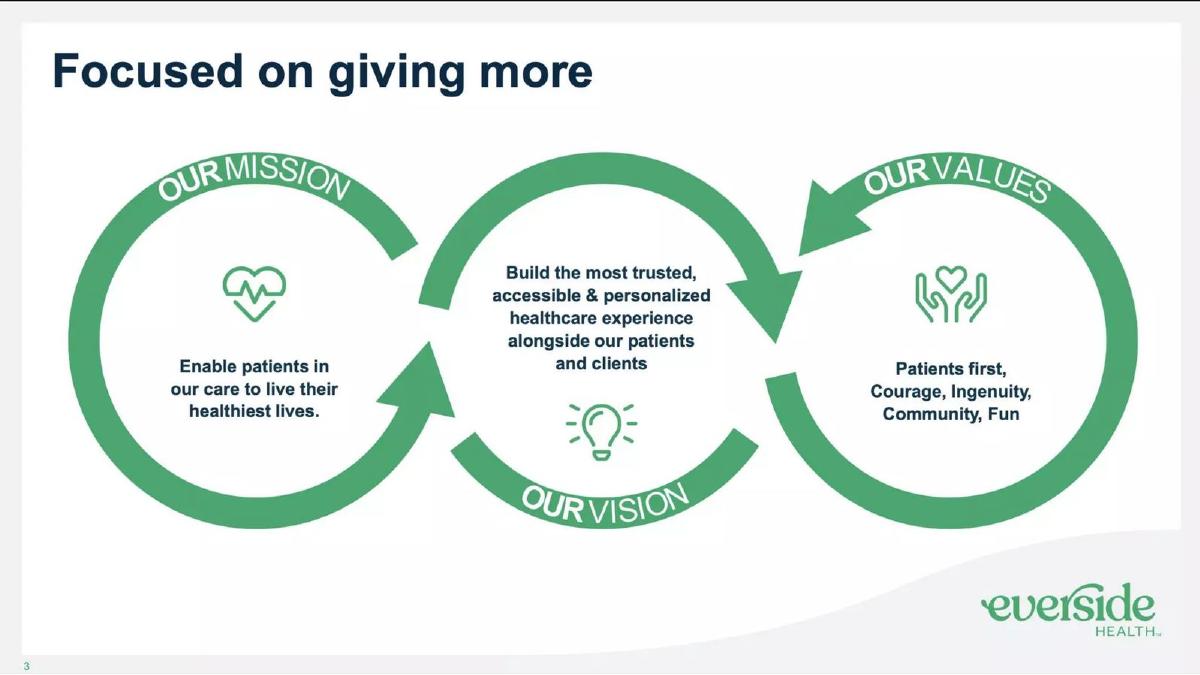
Slide 3: Mission, Vision, and Values
Slide 3 uses a three-ring interlocking graphic to define the company’s internal compass. The mission is stated as "Enable patients in our care to live their healthiest lives." The vision is to "Build the most trusted, accessible & personalized healthcare experience alongside our patients and clients." Finally, the values listed are "Patients first, Courage, Ingenuity, Community, Fun." While mission slides are often viewed as filler, in healthcare, they serve to signal a commitment to patient outcomes over pure volume—a necessary precursor to the business model discussion that follows.
Slide 5: The Macro Problem - Unsustainable Costs
This is the 'Why Now' slide. It leverages data from KFF and the Bureau of Labor Statistics to paint a grim picture of the current landscape. Key figures include:
Over 100M Americans covered by self-funded plan sponsors in 2021. · Plan sponsor costs averaged 7.8% of total compensation in 2021. · 87% of large employers believe health benefit costs will become unsustainable within 5-10 years.
The chart on the right shows the Average Annual Worker and Plan Sponsor Premium Contribution for Family Coverage rising from $15,073 in 2011 to $22,221 in 2021. This slide establishes the urgency for a new model by showing that the current trajectory is financially impossible for employers to maintain.
Slide 7: The Business Model Pivot
Slide 7 is the core of the pitch. It uses a side-by-side comparison table to contrast "Traditional fee-for-service" (Reactive sick care) with "Everside Health Total Cost of Care Approach" (Proactive preventive care). The comparison is broken down by four stakeholders: Cost drivers to employer: Traditional is utilization-driven; Everside uses fixed, recurring multi-year contracts. Affordability for patients: Traditional has significant copays; Everside is typically free. Patient clinical experience: Traditional is fragmented; Everside is integrated and guided. Provider experience: Traditional is transactional with high admin burden; Everside focuses on trusted relationships and low admin burden.This slide effectively positions Everside not just as a provider, but as a financial and operational hedge against the inefficiencies of the standard insurance-led model.
Slide 9: Managing the Total Cost of Care
This slide explains the 'How.' It breaks the strategy into three pillars: building deep relationships, a multi-channel clinical model (including Mental Health, Rx, Labs, and MSK), and a technology-enabled 'Rules Engine.' The right side of the slide provides the proof points:
81% of patients say their health improved. · Clinical quality metrics at the 90th percentile or higher. · 75% of patients view their employer more favorably. · 30%+ cost savings for employers.
The mention of "Millions of $$ savings for patients" and "30%+ cost savings for employers" provides the economic justification for the $164M investment.
Slide 11: National Footprint and Scale
To prove they are a viable partner for national corporations, slide 11 displays a U.S. map with significant coverage across the Midwest, South, and West Coast. The headquarters is noted in Denver, CO. The operational stats are impressive:
575K+ Patients. · 350+ Clients. · 375+ Health Centers. · 400+ Employed Providers. · 34/140+ U.S. States / Markets. · 1,400+ Employees.
The inclusion of the "Best in KLAS 2022" award for Employer Sponsored Healthcare Services adds third-party validation to these internal metrics.
Slide 13: Key Advantages Summary
The final slide in the provided set summarizes the five pillars of their competitive moat: 1. Revenue model & durability, 2. Unit economics, 3. Tech-driven solution, 4. Cost reduction & positioned for risk, and 5. Client and patient base. This serves as a closing summary of why the business is a 'unique' investment opportunity.
What Everside Health Does Well
The deck is exceptionally strong at contrasting two different worlds: the broken status quo and the Everside solution. By using a table (Slide 7) to compare the models, they make the transition to Direct Primary Care (DPC) seem like a logical financial evolution rather than a risky experiment. The use of hard data from reputable sources (KFF, BLS) on Slide 5 builds immediate credibility. Furthermore, the scale metrics on Slide 11 are presented clearly, proving that the company has moved past the 'proof of concept' stage and is now in a 'land and expand' phase.
What is Missing from the Deck
As this is a partial set of 7 slides from a 13-slide deck, several critical components are absent: 1. The Team: There are no slides detailing the leadership team's experience in healthcare or scaling large organizations. 2. Financials: While they mention "Unit economics" as a key advantage on Slide 13, no actual numbers (CAC, LTV, Payback period, or Revenue growth) are shown in these slides. 3. The Ask: There is no slide detailing the $164M round, the valuation, or the specific use of proceeds. 4. Competition: The deck does not explicitly name competitors like One Medical or Crossover Health, which would be expected in a full investor presentation. 5. Case Studies: While they claim 30% savings, a specific case study of a named client would have strengthened the 'Total Cost of Care' argument.
Founder Takeaways: Scaling the Service Model
Founders in the healthcare space should study Slide 7 and Slide 9. Slide 7 is a masterclass in 'Status Quo vs. Our Way' positioning. It doesn't just say they are better; it explains why the underlying incentives of their model (fixed contracts vs. utilization) lead to better outcomes. Slide 9 is equally important because it shows how to present a complex service as a 'product.' By framing their clinical process as a 'Rules Engine' that ingests data and outputs 'Actions,' they appeal to investors who are looking for scalable technology, even in a business that relies heavily on physical clinics and human providers.
Frequently asked questions
- What is Everside Health's primary value proposition for employers?
- Everside Health focuses on reducing the 'Total Cost of Care' for self-funded employers. According to slide 9, they achieve this by providing proactive preventive care that leads to 30%+ cost savings. By using fixed, recurring multi-year contracts instead of traditional fee-for-service models, they aim to make healthcare costs more predictable and sustainable for plan sponsors who currently see costs averaging 7.8% of total compensation.
- How does Everside Health differentiate its clinical model from traditional healthcare?
- On slide 7, the company contrasts its model against 'Traditional fee-for-service' or 'Reactive sick care.' While traditional models are utilization-driven with short, transactional visits and high admin burdens, Everside offers comprehensive appointments, trusted patient relationships, and a clinical focus with low administrative burden. Their model is integrated and guided rather than fragmented and difficult to navigate.
- What evidence of scale does the deck provide?
- Slide 11 provides comprehensive scale metrics: 575,000+ patients, 350+ clients, and 375+ health centers. They operate in 34 states and 140 markets with a workforce of over 1,400 employees. This national footprint is intended to show that they can serve large, multi-state employers effectively, moving beyond a localized or regional clinic model.
- What role does technology play in their healthcare delivery?
- Technology is described on slide 9 as a 'Rules Engine' that aggregates data from medical and Rx claims, clinical labs, wellness risks, and social determinants. This data creates a '360-degree view of the patient,' which then triggers specific actions for patients and providers via a mobile app. This tech-driven approach is listed as one of their five 'key advantages' on slide 13.
- Does the deck include specific financial projections or a funding ask?
- No. The 7 slides provided from the 13-slide deck do not include a specific funding ask, detailed revenue projections, or a breakdown of how the $164M would be spent. It also lacks a team slide. The deck functions more as a strategic capabilities presentation than a granular financial pitch, focusing on market fit, business model, and operational reach.